
How Many Quarts of Oil Does a Ford F-150 Need?

The amount of oil a Ford F-150 needs isn’t a one-size-fits-all answer—it depends entirely on the specific engine under the hood. From the 2.7L EcoBoost V6 to the powerful 5.0L V8, capacities range from about 6 to 8 quarts. Always confirm your exact requirement using your owner’s manual or the dipstick, and never deviate from Ford’s specified oil viscosity for optimal performance and longevity.
So, you’re gearing up for an oil change on your trusty Ford F-150. You’ve got the drain pan, the new filter, and maybe even a fresh set of gloves. Then it hits you: “How many quarts of oil does this thing actually need?” It’s a deceptively simple question with a critically important answer. Getting it wrong—either by underfilling or overfilling—can lead to anything from a frustrating check engine light to catastrophic engine failure. Let’s pop the hood and break down everything you need to know about your F-150’s oil capacity, why it varies, and how to get it absolutely right every single time.
Key Takeaways
- Capacity varies by engine: Your F-150’s oil capacity is determined by its specific engine (e.g., 3.5L EcoBoost vs. 5.0L V8), not just the model year.
- The owner’s manual is law: Your definitive source for the exact quart capacity, recommended oil type (like WSS-M2C947-A/B), and change interval.
- Viscosity matters: Most modern F-150s require 5W-20 oil, but some earlier models or specific trims may call for 5W-30. Using the wrong weight can harm your engine.
- The dipstick is your friend: After an oil change, always use the dipstick to verify the level is between the MIN and MAX marks. “Full” on a dipstick means exactly that—not “add more.”
- Don’t forget the filter: A standard oil change includes the filter. A larger capacity oil filter (like a high-performance or racing filter) will require you to subtract about 0.5 to 1 quart from the total capacity.
- Synthetic is standard: For all modern F-150s, Ford fully recommends and most require full synthetic oil to meet their stringent specifications.
📑 Table of Contents
- Why Knowing Your Exact Oil Capacity is Non-Negotiable
- Decoding the F-150: Engine Options and Their Specific Capacities
- Oil Type and Viscosity: It’s Not Just About the Quantity
- The Step-by-Step Guide: Checking and Adding Oil Like a Pro
- Common Pitfalls and How to Avoid Them
- Conclusion: Your F-150’s Longevity Starts with the Right Oil
Why Knowing Your Exact Oil Capacity is Non-Negotiable
Think of engine oil as the lifeblood of your F-150’s powerplant. It lubricates thousands of moving parts, reduces friction, cools the engine, seals gaps, and even cleans away harmful sludge and debris. The correct oil level is paramount to these functions. Too little oil means metal-on-metal contact, rapid wear, and eventual seizing. Too much oil creates aeration (the oil turns into a frothy, bubbly mess), which destroys its lubricating properties, leads to foaming, increases pressure, and can cause seal leaks or even engine damage from excessive drag.
Your Ford F-150 is a workhorse, designed for towing, hauling, and enduring tough conditions. Its engine—whether a proven V8 or a sophisticated turbocharged V6—is engineered with precise tolerances. The specified oil capacity ensures the perfect balance: enough to fully lubricate every critical component under all operating conditions, but not so much that it creates harmful aeration when churned by the crankshaft. This precision is why the capacity changes with engine design. For a clear comparison on how capacities differ across vehicle types, you can look at general guidelines for various cars, but for your truck, factory specs are the only rule.
The Real-World Cost of a Guess
Let’s be practical. A quart of good synthetic oil isn’t cheap, and neither is your time. Guessing and adding an extra quart “just to be safe” is a costly gamble. Overfilling by even a quart can cause the crankshaft to whip through the oil sump, creating foam. This foam can’t be pumped effectively, leading to sudden oil pressure loss and engine starvation—often at the worst possible moment, like when you’re merging onto the highway with a trailer. Conversely, being a quart low might not trigger an immediate warning but will cause accelerated wear on piston rings, bearings, and camshafts, silently shortening your engine’s lifespan and costing thousands in repairs down the road. Precision isn’t just a suggestion; it’s essential maintenance.
Decoding the F-150: Engine Options and Their Specific Capacities
This is the core of your question. The Ford F-150 has been offered with a wide array of engines over the years, especially in the last decade with the introduction of the EcoBoost lineup. The capacity is tied directly to the engine’s displacement, design, and oil pan size. Here is a detailed breakdown for the most common engines in model years from approximately 2015 to the present. Always double-check your engine code in the owner’s manual, as there can be minor variations.
Visual guide about How Many Quarts of Oil Does a Ford F-150 Need?
Image source: vehiclefreak.com
The V8 Workhorses: 5.0L “Coyote” and 6.2L “Boss”
The iconic 5.0L V8 (code often “Coyote” or “5.0”) is a favorite for its power and reliability. For most model years (2015-2023), its total oil capacity with a filter change is 7.0 quarts (6.6 liters). Some earlier 2015-2017 models might list 6.9 quarts, but 7.0 is the standard. The mighty 6.2L V8 (code “Boss”), found in higher-trim models like the Raptor and Platinum, holds slightly more: 7.7 quarts (7.3 liters). The difference comes from a larger oil pan to handle the increased stress and heat from the extra cylinders and displacement.
The EcoBoost V6 Family: 2.7L and 3.5L
Ford’s turbocharged EcoBoost engines are all about efficiency and power density. Their oil capacities are generally lower than the V8s due to smaller displacement, but they have specific needs.
- 2.7L EcoBoost V6: The standard capacity is 6.1 quarts (5.8 liters). This engine is common in XL, XLT, and mid-range trims.
- 3.5L EcoBoost V6 (TT): The twin-turbo 3.5L, a powerhouse in the Limited, King Ranch, Platinum, and Raptor (pre-2021), requires 7.0 quarts (6.6 liters). Interestingly, this matches the 5.0L V8 capacity, despite having two fewer cylinders, due to the added complexity and heat of the turbochargers which require a robust oiling system.
The Diesel Option: 3.0L Power Stroke V6
For the model years it was available (2018-2020), the 3.0L turbo-diesel V6 had a unique requirement. Its total capacity with filter was 9.0 quarts (8.5 liters). Diesel engines generally require more oil due to higher compression ratios and different lubrication demands. If you own one of these, adhering to the capacity is especially crucial.
How to Find Your Engine Code and Exact Spec
Your best friend is the owner’s manual. It has a dedicated section for “Capacities and Specifications” that lists engine oil capacity for your exact configuration. If you don’t have the manual, look for the underhood label or decal, often on the radiator support or engine itself. It will list the recommended oil viscosity and sometimes capacity. You can also find the engine code (like “2.7L EcoBoost” or “5.0L V8”) on a sticker in the driver’s door jamb. Once you have that, a quick search for “[Your Year] F-150 [Engine Code] oil capacity” from a reputable source like Ford or a trusted mechanic forum will confirm it. For a broader view of how manufacturers specify capacities, see how it’s done for other popular trucks like the Nissan Titan.
Oil Type and Viscosity: It’s Not Just About the Quantity
Knowing the quart count is only half the battle. Putting the wrong type of oil in your F-150 can be just as damaging as having the wrong level. Ford has very specific oil specifications that go beyond the simple “5W-20” or “5W-30” label on the bottle.
Visual guide about How Many Quarts of Oil Does a Ford F-150 Need?
Image source: vehiclefreak.com
Decoding the Sticker: Ford’s WSS Specifications
Your owner’s manual will call for oil that meets Ford’s WSS-M2C947-A or the newer WSS-M2C947-B specification (for 2020+ models). This is Ford’s in-house standard for engine oil performance. It ensures the oil has the correct additive package for wear protection, fuel economy, and turbocharger lubrication (in EcoBoost engines). When buying oil, look for this specification clearly printed on the bottle’s API donut or in the product description. Brands like Motorcraft (Ford’s OEM brand), Mobil 1, Pennzoil, and others make oils that meet this spec.
Viscosity: The 5W-20 vs. 5W-30 Question
For the vast majority of 2015+ F-150s, Ford specifies 5W-20 full synthetic oil. The “5W” means it flows like a thin winter-weight oil (5) in cold starts, ensuring quick lubrication. The “20” means it maintains the viscosity of a thicker 20-weight oil at high operating temperatures, providing a protective film. Some older models (pre-2011) or specific high-performance applications might use 5W-30. Never assume. Using a thicker oil like 5W-30 in an engine designed for 5W-20 can increase drag, reduce fuel economy, and potentially cause issues with variable valve timing systems. Conversely, using a thinner oil than specified can lead to insufficient film strength and wear. If you’re ever in doubt, the manual or a dealership parts department is your final authority.
Synthetic is the Only Game in Town
Forget the old debates. For your modern F-150, full synthetic oil is not optional; it’s required. The WSS-M2C947 spec is a synthetic oil specification. Conventional or synthetic blend oils cannot meet its performance criteria, especially for turbocharged EcoBoost engines that run hotter and under more stress. Synthetic oil resists breakdown better, flows better in cold weather, and provides superior protection against deposits and wear. Investing in a quality full synthetic is one of the best things you can do for your engine’s health and longevity.
The Step-by-Step Guide: Checking and Adding Oil Like a Pro
Now that you know what you need, let’s talk about the how. Proper checking is as important as using the right oil.

Visual guide about How Many Quarts of Oil Does a Ford F-150 Need?
Image source: vehiclefreak.com
Essential Tools
- Your specified full synthetic oil (e.g., 5W-20 meeting WSS-M2C947-B)
- A new, correct oil filter (if doing a change)
- A clean funnel
- A clean rag or paper towel
- Your owner’s manual (for capacity reference)
The Golden Rule: Check on Level Ground, Cold Engine
Park your truck on a perfectly level surface. An incline will give a false reading on the dipstick. For the most accurate check, the engine should be cold (not run for at least 2-3 hours) or have been shut off for at least 15-20 minutes. This allows oil to fully drain back into the oil pan. If you check it right after a drive, the dipstick will read low because oil is still circulating in the engine.
The Dipstick Dance: A Detailed Walkthrough
- Locate the dipstick: It’s usually a bright yellow or orange looped handle near the front of the engine bay, often marked with an oil can icon.
- Pull and wipe: Pull the dipstick all the way out. Wipe it clean with your rag.
- Reinsert fully: Push the dipstick all the way back into its tube until it seats properly. Don’t just let it drop.
- Read the level: Pull it out again and look at the tip. There will be two notches, holes, or lines marked “MIN” (or L) and “MAX” (or F/H). The oil film should be between these two marks. Ideally, it should be right at or just below the MAX mark. If it’s at or below MIN, you need to add oil. If it’s above MAX, you have overfilled and need to drain some out.
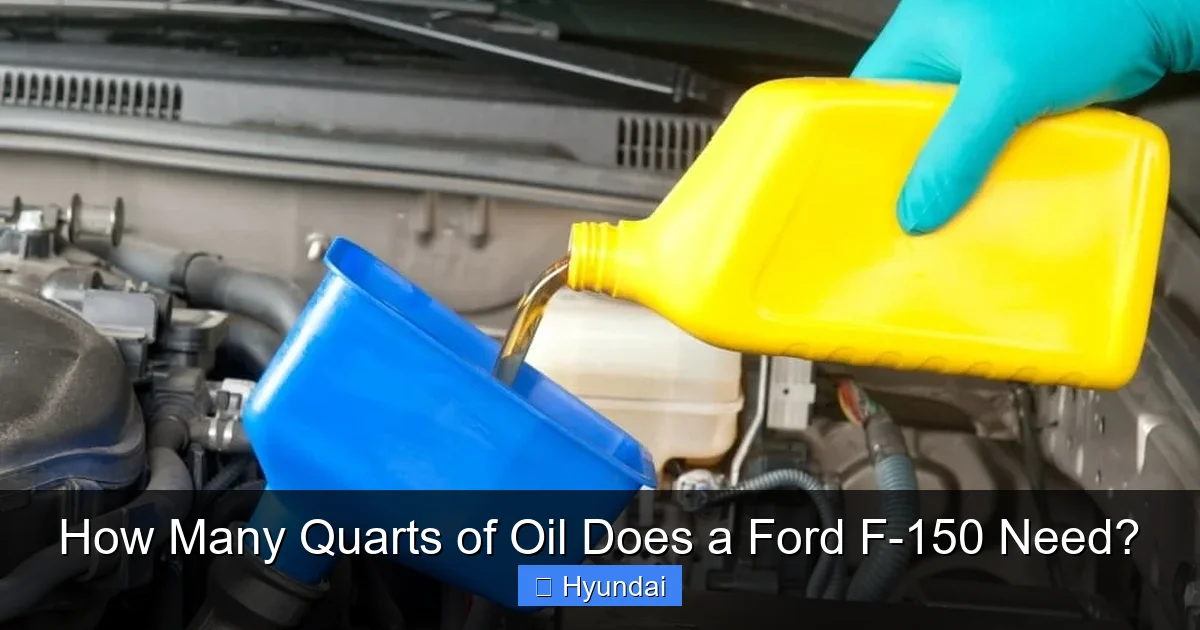
- Add slowly: If adding oil, remove the oil filler cap (a large cap on the top of the valve cover, often black). Using a funnel, add half a quart at a time. After each half-quart, repeat the dipstick check (remember, wait a minute for oil to settle). It’s easy to overfill by going too quickly.
Pro Tip: The capacity listed in the manual is for a completely dry engine during a rebuild. During a standard drain-and-fill change (where some oil remains in the engine), you will typically need about 0.5 to 1 quart less than the total capacity listed. This is why the dipstick check is irreplaceable. If you’re changing the filter, use the new filter’s capacity (often printed on it) to adjust your total. A standard filter might hold 0.2-0.3 quarts; a larger “high-mileage” or performance filter could hold 0.5-0.8 quarts. For example, if your manual says 7.0 quarts total capacity and your new filter holds 0.3 quarts, you would pour in about 6.7 quarts, then use the dipstick to fine-tune to the exact correct level.
Common Pitfalls and How to Avoid Them
Even with the best intentions, mistakes happen. Here are the most common oil-related errors with the F-150 and how to sidestep them.
Overfilling: The “More is Better” Myth
This is the most frequent and dangerous error. The crankcase is not a storage tank; it’s a sump. The crankshaft rotates at thousands of RPMs inside it. If the oil level is too high, the spinning crankshaft will aerate the oil, creating foam. This foam cannot be pumped by the oil pump, leading to a sudden loss of oil pressure and potential engine destruction. The fix is simple: always, always verify with the dipstick after adding oil. Never just pour in the full manual capacity without checking. If you do overfill, the only proper remedy is to drain some out. You can carefully loosen the drain plug for a few seconds to let a little out, then retighten and re-check.
Using the Wrong Oil Specification
Using a generic “5W-20” oil that does not meet Ford’s WSS-M2C947 spec is a silent killer. It may have the right viscosity but lacks the specific additives for turbocharger cooling (critical for EcoBoost engines) or for maintaining fuel economy. Always read the bottle. If it doesn’t say “WSS-M2C947-A” or “-B,” don’t use it. This is a non-negotiable specification for warranty compliance and engine health. For comparison, other manufacturers have similar strict specs; for instance, certain Toyota engines require specific Toyota oil formulations.
Ignoring the Oil Life Monitor (OLM)
Modern F-150s have a sophisticated Oil Life Monitor that calculates when an oil change is needed based on engine revolutions, temperature, and driving conditions—not just a simple mileage or time interval. When the OLM says “Change Oil Soon” or “Oil Change Required,” that’s your cue. Resetting it after an oil change is a critical step (the procedure is in your manual). Ignoring the OLM and changing based on an old 3,000-mile rule is wasteful with synthetic oil. Conversely, ignoring it after severe duty (towing, dusty conditions, extreme temps) can lead to overdue changes. Use the OLM as your primary guide, but use your judgment for severe service.
Skipping the Filter or Using a Cheap One
The oil filter is the engine’s kidney. A cheap, poor-quality filter can have inefficient media (allowing abrasive particles through), poor anti-drainback valves (causing dry starts), or incorrect flow restrictions. Always use a filter that meets Ford’s specifications. OEM Motorcraft filters are a safe bet, as are reputable brands like Wix, Fram, and Mobil 1. When replacing the filter, lubricate the new filter’s rubber seal with a dab of fresh oil before installing it. This ensures a good seal and prevents the seal from sticking to the engine block.
Conclusion: Your F-150’s Longevity Starts with the Right Oil
Figuring out how many quarts of oil a Ford F-150 needs is the first, fundamental step in a chain of maintenance decisions that directly impact your truck’s reliability, performance, and resale value. The answer is etched in your engine’s design—the 2.7L EcoBoost takes 6.1 quarts, the 5.0L V8 takes 7.0 quarts, and so on. But the real wisdom lies in understanding why that number exists and respecting the process of getting it exactly right.
Commit to the ritual: consult your manual, use the exact specified full synthetic oil meeting Ford’s WSS standard, and never skip the post-fill dipstick check. This isn’t just about avoiding disaster; it’s about proactive care. A properly maintained F-150 with the correct oil level and type will reward you with smoother operation, better fuel economy, cooler engine temps, and a million miles of faithful service. It transforms a routine chore into a powerful act of stewardship for one of the most capable and beloved trucks on the road. So next time you’re under the hood with that oil drain pan, know your quarts, trust your dipstick, and drive with confidence.
Frequently Asked Questions
What happens if I accidentally overfill my F-150’s engine with oil?
Overfilling is very serious. Excess oil gets aerated (churned into foam) by the spinning crankshaft. This foam cannot be pumped properly, leading to a sudden loss of oil pressure, which can cause catastrophic engine failure due to oil starvation. If you overfill, you must immediately drain the excess oil until the dipstick shows the correct level between MIN and MAX.
Can I use 5W-30 oil instead of the recommended 5W-20 in my F-150?
It is not recommended. Ford designs its engines, especially the EcoBoost turbochargers and variable valve timing systems, for the specific flow and protection characteristics of 5W-20. Using a thicker 5W-30 can increase internal drag, reduce fuel economy, and potentially harm sensitive components over time. Always use the viscosity specified in your owner’s manual.
How often should I change the oil in my Ford F-150?
Follow your vehicle’s Oil Life Monitor (OLM). For normal driving, this typically extends to 7,500-10,000 miles with full synthetic oil. For severe conditions (frequent short trips, extreme temperatures, dusty environments, or heavy towing), the OLM will calculate shorter intervals, often around 5,000 miles. Never exceed the OLM’s recommendation.
Does towing a heavy trailer affect how much oil my F-150 needs or how often I should change it?
Towing significantly increases engine load, heat, and stress, which falls under “severe service” conditions. It does not change the capacity (you still fill to the same dipstick marks), but it will cause the Oil Life Monitor to calculate much shorter change intervals—potentially half the normal mileage. Always change the oil when the OLM indicates after heavy towing use.
My 2021 F-150 has a 3.5L EcoBoost. The manual says 7.0 quarts. My new oil filter is a high-capacity one that holds 0.8 quarts. How much oil should I pour in?
You subtract the filter’s capacity from the total. Start by pouring in approximately 6.2 quarts (7.0 – 0.8). Then, always use the dipstick to verify the exact level. Add oil in half-quart increments until the dipstick reads perfectly at the MAX mark. The dipstick check is the final and most important step, regardless of calculations.
Is it okay to mix a little bit of conventional oil with my full synthetic if I’m low?
In a pinch, adding a small amount of conventional oil to top off a synthetic system is better than running low. However, it dilutes the synthetic’s superior properties. The best practice is to always top off with the exact same full synthetic oil that meets Ford’s specification. Mixing different brands or types can also affect additive packages. For optimal protection, use only the recommended full synthetic oil.
