
How to Check Transmission Fluid on Mazda 3

Regularly checking your Mazda 3’s transmission fluid is a non-negotiable maintenance task that prevents costly repairs. The process differs significantly between traditional automatic, manual, and modern CVT transmissions, with many 2026 models featuring sealed systems without dipsticks. By following the correct procedure for your specific model, you can identify low fluid levels, contamination, or leaks early, ensuring smooth shifts and a long transmission life.
Your Mazda 3 is a masterpiece of engineering, celebrated for its agile handling and efficient powertrain. But beneath that sporty exterior and refined interior lies a complex transmission that silently bears the brunt of every drive. Whether you’re navigating city streets or cruising on the highway, this critical component relies on one thing to function smoothly: pristine transmission fluid. For the 2026 model year, Mazda continues to refine its lineup, and understanding how to properly check this vital fluid is more important than ever. It’s not just a routine task; it’s your first line of defense against a multi-thousand-dollar repair. This guide will walk you through everything you need to know, from identifying your transmission type to performing a flawless check, ensuring your Mazda 3 continues to deliver that signature driving experience for years to come.
We’ll break it down simply. No confusing jargon, just clear steps. Think of this as a friendly chat over the hood of your car. We’ll cover the classic dipstick method for older automatics, the plug-and-check technique for manuals, and what to do if your shiny new 2026 Mazda 3 has a sealed transmission with no visible dipstick—a situation that’s becoming increasingly common. By the end, you’ll have the confidence to peek under the hood, assess your fluid’s health, and know exactly when to top it off or call in the pros.
Key Takeaways
- Transmission fluid is vital for lubrication, cooling, and hydraulic pressure. Low or degraded fluid causes slipping, harsh shifts, and eventual failure.
- Your 2026 Mazda 3’s transmission type dictates the check method. Older automatics use a dipstick, manuals use a fill plug, and newer CVTs may require a scan tool or dealer.
- Always check fluid on level ground with the engine warmed up. The engine should be running for most automatics, and the transmission at operating temperature.
- Healthy fluid is typically red or amber, clear, and has a slightly sweet smell. Dark, gritty, or burnt-smelling fluid indicates it’s time for a service.
- Never overfill. Adding fluid past the “full” mark can cause aeration, foaming, and serious damage.
- If your Mazda 3 has no dipstick, don’t force one. Sealed systems are designed to be checked differently, often requiring professional equipment.
- Consult your owner’s manual first. It contains the definitive, model-specific procedure and fluid specification for your vehicle.
📑 Table of Contents
- Understanding Your 2026 Mazda 3’s Transmission
- When and Why to Check Your Transmission Fluid
- Tools and Safety Precautions: Getting Ready
- Step-by-Step: Checking Automatic Transmission Fluid (With Dipstick)
- Step-by-Step: Checking Manual Transmission Fluid
- What To Do If Your Mazda 3 Has No Dipstick (Sealed Systems)
- Interpreting Your Findings and Next Steps
- Conclusion: Proactive Care for Your Mazda 3
Understanding Your 2026 Mazda 3’s Transmission
Before you can check the fluid, you must know what you’re looking at. The 2026 Mazda 3 lineup offers a few different transmission configurations, and the check process varies dramatically between them. Using the wrong method can lead to inaccurate readings or, worse, damage. Let’s identify your setup.
The Traditional Automatic (Aisin or Mazda-Sourced)
Many base and mid-trim Mazda 3 models, especially those with the 2.5L Skyactiv-G engine, are equipped with a conventional 6-speed automatic transmission. This is the good old-fashioned type with a torque converter and a physical dipstick tube under the hood. The fluid level is checked with the engine running, in park or neutral, on a warmed-up transmission. If your 2026 Mazda 3 has a dipstick with a red or yellow handle labeled “ATF” or “Transmission,” this is your transmission type. The process is straightforward and a perfect DIY task.
The Manual Transmission
The enthusiast-focused Mazda 3 with a manual gearbox is a true driver’s car. Checking fluid here is a different beast. There is no dipstick. Instead, you locate a fill plug on the side of the transmission case. You remove this plug and check if fluid is at the very bottom of the hole. If it’s not, you add the specified manual transmission fluid until it just begins to seep out. This requires the car to be level, and the fluid should be checked when the transmission is cool or at a specific temperature, as per your manual. It’s a simpler process in terms of tools but requires precise location of the plug.
The Modern CVT (Continuously Variable Transmission)
This is where things get tricky for 2026. Mazda has been phasing in its own Skyactiv-Drive CVT for better fuel economy. Many modern CVTs, including some Mazda designs, are “sealed for life” or have no traditional dipstick for consumer access. Checking the fluid level and condition on these models is not a simple under-hood procedure. It often requires:
- Accessing a special service plug underneath the car.
- Using a scan tool to read transmission temperature and put the transmission into a “check mode.”
- Having the vehicle on a lift with the transmission at a precise temperature.
For these models, your owner’s manual will state that fluid checks and changes are only required at extreme intervals (e.g., 100,000+ miles) and should be performed by a certified technician with the proper equipment. Attempting a DIY check on a sealed CVT without the correct procedure can lead to overfilling or contamination. If you can’t find a dipstick, this is likely your scenario. You can learn about a similar sealed system by researching how to check Nissan CVT transmission fluid level without a dipstick, as many manufacturers use this design philosophy.
When and Why to Check Your Transmission Fluid
Knowing the “how” is useless without understanding the “when” and “why.” Transmission fluid degrades over time. It’s subjected to extreme heat and shear forces inside the transmission. Checking it regularly is like getting a regular blood test—it gives you a snapshot of your engine’s (or transmission’s) health.

Visual guide about How to Check Transmission Fluid on Mazda 3
Image source: mazdashopusa.com
The Ideal Schedule
For a 2026 Mazda 3 with a conventional automatic or manual transmission, a good rule of thumb is to check the fluid level at least once every 3 months or every 3,000-5,000 miles. For severe driving conditions—frequent stop-and-go traffic, towing, mountain driving, or extremely hot climates—check it monthly. If your car has a sealed CVT, follow the manufacturer’s interval in your owner’s manual, which may be as long as 100,000 miles for a change, but level checks are still not typically user-serviceable.
Warning Signs That Demand an Immediate Check
Don’t wait for your scheduled check if you notice any of these symptoms. They are your transmission’s cry for help:
- Delayed or Hesitant Shifts: The transmission takes a moment to engage when you move the gear selector from Park to Drive or Reverse.
- Hard or Jarring Shifts: Shifts are noticeably rough or clunky, especially between 1st and 2nd gear.
- Slipping: The engine RPMs surge, but the car doesn’t accelerate accordingly. It feels like it’s in neutral for a second.
- Unusual Noises: Whining, humming, or clattering sounds that change with transmission speed.
- Fluid Leaks: Look for fresh red or brown fluid spots under the front center of your car.
If you experience any of these, check the fluid level and condition immediately. Low fluid is the most common and easily fixable cause of these issues.
Tools and Safety Precautions: Getting Ready
A successful check starts with the right preparation. Rushing this step is the number one cause of misreads and mistakes. Here’s your checklist.
Visual guide about How to Check Transmission Fluid on Mazda 3
Image source: cdn.shopify.com
Essential Tools
- Clean Lint-Free Cloths or Rags: For wiping the dipstick clean. Paper towels can leave fibers.
- Funnel: A long, slender funnel with a wide mouth for clean fluid addition.
- Flashlight or Work Light: The engine bay is often dark.
- Gloves: Nitrile or mechanic gloves to keep your hands clean and protected.
- Jack and Jack Stands (if needed): Only for manual transmission fill plug access on some models, and only if you cannot reach it from above. Never rely on the factory jack alone.
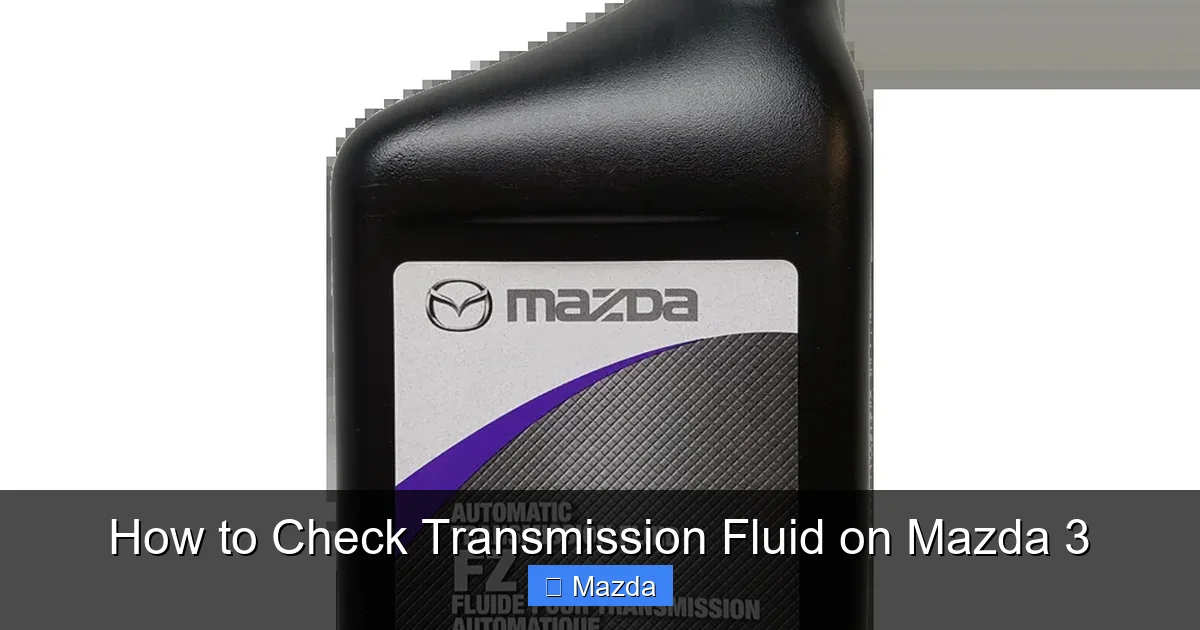
- The Correct Transmission Fluid: This is critical. For a 2026 Mazda 3, this is likely Mazda ATF M5 (for automatics) or Mazda MTF (for manuals). Using the wrong fluid can destroy the transmission. Confirm the specification in your owner’s manual.
Critical Safety Steps
Park on a Level Surface: This is absolute. An incline will give you a false reading. Engage the parking brake firmly.
Warm Up the Engine (For Most Automatics): The fluid must be at its normal operating temperature (typically 170-200°F / 77-93°C) for an accurate check. Drive the car for at least 15-20 minutes on surface streets or highways. Then, immediately proceed to check it without letting it cool down.
Engine Running, Parking Brake Engaged: For automatic transmissions with a dipstick, the engine must be running, the transmission in Park (or Neutral for some older models), and the parking brake must be set. For manuals, the engine is usually off, and the car is level.
Do Not Overfill: Adding fluid is a “little at a time” game. It is far easier to add more than to remove excess. Overfilling causes aeration, leading to erratic shifting, slipping, and pump damage.
Step-by-Step: Checking Automatic Transmission Fluid (With Dipstick)
This is the classic, most straightforward procedure. Let’s assume your 2026 Mazda 3 base model has the traditional dipstick.
Visual guide about How to Check Transmission Fluid on Mazda 3
Image source: d2n97g4vasjwsk.cloudfront.net
Locate the Dipstick
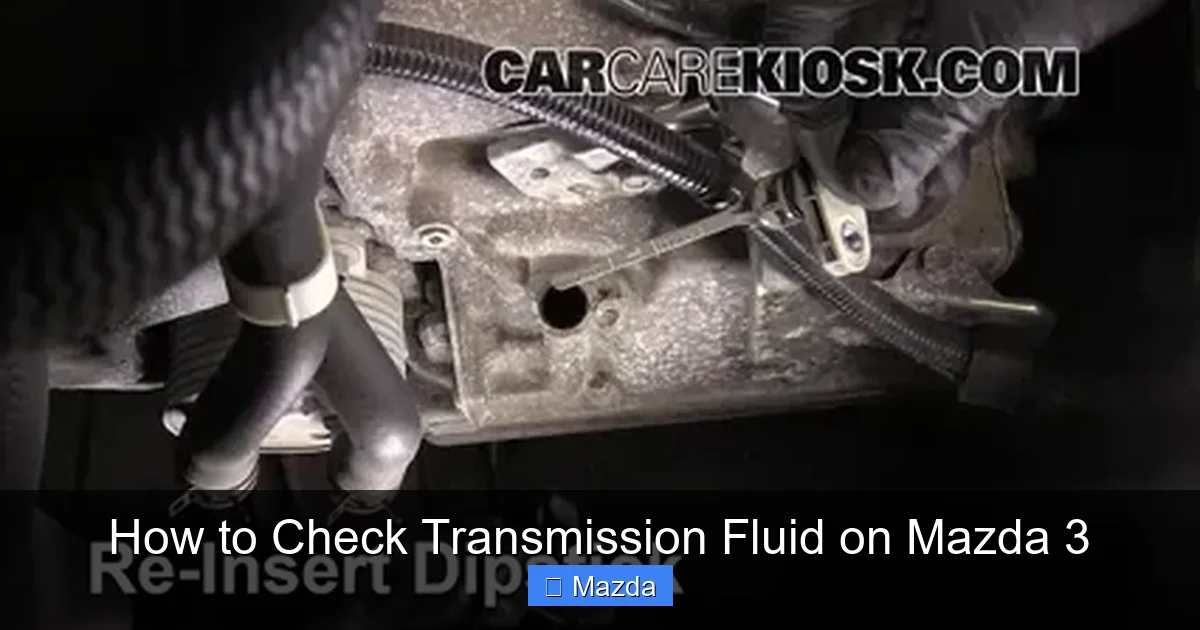
Open the hood. The transmission dipstick is usually located near the back of the engine bay, on the passenger side, and is often color-coded red or yellow. It will have a distinctive loop or T-handle. It is NOT the engine oil dipstick (which is usually yellow or black). If you’re unsure, consult your owner’s manual’s diagram. If you cannot find a second dipstick, you likely have a sealed system, and you should skip to the next section’s advice.
The Warm-Up and Check Procedure
- Warm Up: Drive the car for 15-20 minutes as described above.
- Park and Idle: Park on level ground, leave the engine running, set the parking brake, and shift the transmission into Park (or Neutral, if specified in your manual).
- Extract and Wipe: Pull the dipstick all the way out. Wipe it completely clean with your lint-free cloth.
- Reinsert Fully: Push the dipstick all the way back into its tube until it seats fully. This is crucial for an accurate reading.
- Read the Level: Pull the dipstick out again and observe the fluid on the end. There will be two marks: “HOT” or “FULL,” and “COLD” or “ADD.” Since your transmission is hot, you read the “HOT” marks. The fluid level should be between the two lines or at the “FULL” mark. Never check against the “COLD” marks on a warm transmission.
- Assess the Fluid: While the dipstick is out, look at the fluid’s color and smell. It should be translucent red or amber. It should not smell burnt. If it’s dark brown/black, milky, or has a burnt odor, it’s severely degraded and needs immediate service, regardless of the level.
How to Add Fluid (If Low)
If the level is below the “HOT ADD” mark, you need to add fluid. This is a delicate operation.
- Remove the dipstick.
- Place your funnel into the dipstick tube.
- Pour the correct Mazda ATF M5 fluid in small increments (about 1/4 to 1/2 quart at a time).
- After each small addition, repeat steps 3-5 from the procedure above to re-check the level. Do not dump in a full quart and then check.
- Stop adding as soon as the fluid reaches the “HOT FULL” mark.
- Reinsert the dipstick securely and close the hood.
If you are consistently low on fluid, you have a leak. The fluid doesn’t evaporate. Common leak points are the pan gasket, input/output shaft seals, or the cooler lines. A leak must be repaired.
Step-by-Step: Checking Manual Transmission Fluid
Manual transmissions are simpler in concept but require a different approach. There is no dipstick.
Locate the Fill Plug
The fill plug is typically a square or hex-headed bolt on the side of the transmission case, roughly halfway up. Your owner’s manual will have a diagram. It is often labeled or is the only plug on the side. The drain plug is on the very bottom. Do not confuse the two.
The Check Procedure
- Level Ground: Park on a perfectly level surface. Use a spirit level if you’re unsure.
- Cool Transmission: For most manuals, the fluid should be checked when the transmission is at ambient temperature (cold). Driving will heat it and expand, giving a false “full” reading. Check it first thing in the morning or after the car has been sitting for hours.
- Clean the Area: Clean any dirt and debris from around the fill plug to prevent contamination.
- Remove the Fill Plug: Using the correct socket or wrench, carefully remove the plug. Have a drain pan ready, as a small amount of fluid may seep out.
- Check the Level: The fluid level is correct when it is just barely at the bottom edge of the threaded hole. You should see fluid at the very bottom of the hole, or a small drip should occur. If you can see straight into the hole and see the bottom of the transmission case, it’s low. If fluid immediately flows out, it’s full.
- Assess the Fluid: Use a clean finger or a dipstick to sample the fluid. It should be clear amber or light brown (specific color depends on the MTF type). It should feel slick and smell slightly of oil. Grittiness or a burnt smell is bad news.
How to Add Fluid
If low, add the specified Mazda MTF fluid.
- With the fill plug still removed, use your funnel to slowly add fluid.
- Add until you see fluid just begin to appear at the bottom of the fill hole.
- Immediately stop adding. The correct level is when fluid is just barely visible or seeping from the hole. It is not “full to the brim.”
- Wipe away any excess fluid and reinstall the fill plug. Torque it to the specification in your manual (usually hand-tight plus a quarter to half turn).
What To Do If Your Mazda 3 Has No Dipstick (Sealed Systems)
If you opened the hood and cannot find a second dipstick, your 2026 Mazda 3 almost certainly has a sealed transmission. This is common on newer models with the Skyactiv-Drive CVT or some advanced automatics. Do not drill holes, try to force a dipstick in, or guess. The system is designed to be checked in a controlled manner.
The Official Procedure
For these models, checking the fluid level is a diagnostic procedure. It requires:
- A specific scan tool that can communicate with the Transmission Control Module (TCM).
- The ability to put the transmission into a “Maintenance Mode” or “Fluid Check Mode.”
- Access to a service port, which may be under the car or behind an access panel.
- The transmission must be at a precise temperature, often between 104-122°F (40-50°C).
- Consult your owner’s manual. It will state the official service interval and likely recommend dealer service.
- Visit a Mazda dealer or a reputable independent shop equipped with the proper Mazda diagnostic software (like Mazda IDS).
- For a simple level check during routine service, a technician can perform it quickly with the right tools.
- Bright Red, Clear, Sweet-Smelling: Perfect. Your fluid is healthy. Just monitor the level.
- Dark Red or Brown, Slightly Opaque: Normal aging. It’s still functional but is starting to break down. Note the mileage and plan for a fluid and filter change soon if you have a serviceable transmission.
- Dark Brown or Black, Gritty, Burnt Smell (Like Toasted Nuts):strong> CRITICAL. The fluid has thermally decomposed. It has lost its lubricating and cooling properties. Do not delay. A fluid and filter change is urgently needed. Continuing to drive will cause rapid wear and eventual failure.
- Milky or Foamy Appearance: This indicates coolant contamination, likely from a failed transmission cooler inside the radiator. This is a major failure. Do not drive the car. Have it towed to a shop.
- At or Slightly Below “FULL” (Hot): Ideal.
- Significantly Below “ADD” (Hot): Dangerously low. Add fluid immediately to the correct level and investigate for leaks.
- Way Above “FULL”: Overfilled. This is also bad. Fluid must be drained to the correct level. Overfilling causes aeration and can damage bearings and seals.
- Level Good, Fluid Good: Great job! Replace the dipstick or plug securely, close the hood, and note the date/mileage in your maintenance log.
- Level Low, Fluid Good: Top off carefully with the correct fluid. Monitor the level weekly. If it drops again, you have a leak. Get it diagnosed.
- Level Good, Fluid Bad (Dark/Gritty): Schedule a transmission fluid and filter change (if applicable to your model). For a sealed CVT, discuss inspection and potential service with a dealer.
- Any Combination of Low Level AND Bad Fluid: This is a red flag. A fluid change is needed, but the low level suggests a leak that must be found and fixed first, or the new fluid will just leak out.
- Fluid Contaminated (Milky): Stop driving. Tow to a professional. This is a major internal failure.
This is not a driveway job. The correct and safe approach is to:
Attempting a DIY on a sealed system risks introducing contaminants, using the wrong fluid, or overfilling due to a lack of temperature control. If you’re curious about the process for other sealed systems, you can research how to check Nissan Altima without a dipstick, as the methodology for accessing the service port and using a scan tool is analogous.
Interpreting Your Findings and Next Steps
You’ve checked the level and condition. Now, what does it all mean? Here’s your translation guide.
Fluid Condition Decoder
Level Decoder
Your Action Plan
Based on your findings:
Conclusion: Proactive Care for Your Mazda 3
Checking the transmission fluid on your 2026 Mazda 3 isn’t glamorous, but it’s one of the most impactful maintenance tasks you can perform. It transforms you from a passive driver into an active caretaker of your vehicle. For models with a traditional dipstick or fill plug, it’s a 10-minute DIY job that saves you from discovering a problem the hard way—stranded on the side of the road. For the newer sealed CVT models, understanding that this is a professional service item is equally important knowledge.
Remember the golden rules: use the correct fluid, check on level ground with a warm transmission (for dipstick models), and never overfill. Integrate this check into your quarterly routine. Pair it with other simple checks, like how to check tire pressure on a Honda Civic (a process similar in its simplicity), to build a comprehensive maintenance habit. Your transmission is a complex, expensive piece of machinery. A few minutes of your time spent checking its lifeblood will pay dividends in reliability, smooth performance, and avoiding a financial nightmare. When in doubt, your owner’s manual is your ultimate guide. And when the manual points to a professional, trust the process. Keep your Mazda 3 shifting beautifully for the long haul.
Frequently Asked Questions
Can I check the transmission fluid on my Mazda 3 when the engine is cold?
For models with a traditional dipstick, no. The fluid must be at operating temperature for an accurate “HOT” reading. Checking it cold will show a low level and lead to dangerous overfilling. For sealed CVT systems, a specific cool temperature is often required by the manufacturer’s diagnostic procedure.
What type of transmission fluid does a 2026 Mazda 3 use?
It depends entirely on the transmission type. Most automatic Mazda 3 models use Mazda ATF M5. Manual transmissions use Mazda MTF. Sealed CVTs use a specific Mazda CVT fluid. The only way to be 100% certain is to check your owner’s manual or the fluid cap/dipstick label. Using the wrong fluid can cause severe damage.
How often should I check my transmission fluid?
For conventional automatic and manual transmissions, check the level and condition at least every 3 months or 3,000-5,000 miles. For severe driving (towing, hot climates, stop-and-go), check monthly. For sealed CVT transmissions, follow the manufacturer’s service interval in your manual, which may be 60,000-100,000 miles for a change, but level checks are typically dealer-only.
What does burnt transmission fluid smell like?
It has a sharp, acrid odor, often compared to burnt toast or burnt nuts. It’s a distinct, unpleasant smell that is completely different from the slightly sweet or oily smell of fresh fluid. A burnt smell means the fluid has overheated and broken down, requiring immediate service.
My 2026 Mazda 3 has no dipstick. What do I do?
Do not attempt to create one or guess the level. Your vehicle has a sealed transmission system. The fluid level must be checked by a qualified technician using a Mazda-specific scan tool and following a precise temperature-controlled procedure. Consult your owner’s manual for the official service interval and have it checked at a Mazda dealer or specialized shop.
Can I add transmission fluid myself if it’s low?
Yes, but only if your Mazda 3 has a dipstick or fill plug. Add the exact fluid type specified in your manual, in small increments, re-checking the level frequently to avoid overfilling. If your car has a sealed system, do not try to add fluid yourself. The service port is not designed for consumer access, and improper addition can cause catastrophic damage.
