
What Should the Tire Pressure Be on a Hyundai Sonata?

Maintaining the correct tire pressure in your Hyundai Sonata is crucial for safety, handling, and fuel economy. The standard recommended pressure is typically 32-35 PSI for all four tires, but always verify your specific model’s placard. Check pressures monthly when tires are cold, and adjust for seasonal temperature changes to ensure optimal performance and tire longevity.
Let’s talk about something that sits between your Hyundai Sonata and the road, yet is one of the most overlooked aspects of car maintenance: tire pressure. It’s easy to forget, but getting it right is a non-negotiable part of keeping your Sonata safe, efficient, and a joy to drive. You might think, “As long as they’re not flat, I’m good.” But that’s a risky assumption. Underinflated or overinflated tires are like wearing shoes that are the wrong size—they’ll get you there, but you’ll be uncomfortable, inefficient, and more prone to an accident. In this complete guide, we’ll demystify everything about Hyundai Sonata tire pressure, from finding the exact PSI for your specific model year to understanding your car’s TPMS light and mastering the art of a perfect check. Consider this your friendly, expert-led masterclass on keeping your Sonata’s tires happy and healthy.
Why is this such a big deal? Because tire pressure directly impacts five critical areas: your safety, your wallet (fuel costs), your comfort, your tire’s lifespan, and your car’s overall performance. Incorrect pressure leads to poor handling, longer stopping distances, uneven and premature tire wear, and increased rolling resistance that sips more fuel. For a midsize sedan like the Sonata, which is often used for family commuting and road trips, nailing this simple task is one of the highest-return maintenance items you can do. So, let’s dive in and make sure you know exactly what those numbers on your door jamb mean and how to act on them.
Key Takeaways
- Find Your Specific PSI: Your Sonata’s exact recommended tire pressure is on a yellow and white sticker inside the driver’s door jamb or in the owner’s manual; it’s not always the max on the tire sidewall.
- Standard Range: For most recent Hyundai Sonata models (2015-2023), the standard cold inflation pressure is 32 PSI for normal load, but some trims or model years may specify 33 or 35 PSI.
- Check When Cold: Tire pressure should always be checked and adjusted when tires are cold (driven less than 1-2 miles), as driving heats tires and air, giving falsely high readings.
- Seasonal Changes Matter: Tire pressure drops about 1 PSI for every 10°F drop in temperature; check and adjust more frequently in fall and winter.
- TPMS is a Warning, Not a Replacement: Your Sonata’s Tire Pressure Monitoring System (TPMS) light alerts you to severe underinflation (usually 25% below spec), but it doesn’t replace monthly manual checks.
- Don’t Forget the Spare: If your Sonata has a temporary spare tire, it often requires a higher pressure (usually 60 PSI); check your door jamb sticker for the spare’s specification.
- Correct Pressure Saves Money: Proper inflation improves fuel economy by up to 3%, promotes even tire wear for longer tire life, and ensures maximum safety and handling.
📑 Table of Contents
- Official Hyundai Sonata Tire Pressure Recommendations
- Understanding Tire Pressure: PSI, BAR, and kPa Explained
- Seasonal Adjustments: Summer, Winter, and Altitude Changes
- Your Sonata’s Tire Pressure Monitoring System (TPMS)
- Practical Guide: How to Check and Adjust Your Sonata’s Tire Pressure
- The Real Cost of Incorrect Tire Pressure
- Conclusion: Your Simple Path to Safety and Savings
Official Hyundai Sonata Tire Pressure Recommendations
This is the golden rule: your Hyundai Sonata’s manufacturer-recommended tire pressure is not a guess. It’s a precise engineering specification calculated for your specific vehicle’s weight, suspension design, and intended performance. The source of truth is always the tire placard located on the driver’s side door jamb or the owner’s manual. This placard is a small, usually yellow and white sticker that lists pressures for the front tires, rear tires, and often the spare tire, for different load conditions.
Where to Find Your Sonata’s Specific PSI
Open the driver’s door and look at the door pillar (the B-pillar) where the door latch is. You should see a sticker firmly attached there. If it’s missing or you can’t find it, your owner’s manual is the backup. This sticker will list something like “FRONT: 33 PSI (230 kPa)” and “REAR: 33 PSI (230 kPa)” for normal load. It might also have a separate line for “MAX LOAD” conditions, which is higher. Always use the “normal load” or “up to 3 occupants” pressure for everyday driving. The number molded into your tire’s sidewall (e.g., “MAX 44 PSI”) is the tire’s maximum structural pressure, not the recommended operating pressure for your Sonata. Using that max number is dangerous and will lead to a harsh ride, poor contact patch, and center-wear on your tires.
Typical PSI Ranges by Model Year and Trim
While the door jamb is the final authority, we can give you a solid baseline. For Hyundai Sonata models from the seventh generation (2015-2019) and eighth generation (2020-2023), the standard recommended cold inflation pressure for normal load is most commonly 32 PSI or 33 PSI for all four tires. Some higher-performance trims, like the Sonata N Line, may have a slightly different recommendation, often 33 or 34 PSI, to suit its sportier suspension. It’s critical to check your specific placard. For example, a 2022 Sonata Limited might call for 33 PSI, while a 2022 Sonata SE calls for 32 PSI. The difference is small but meaningful for optimal tuning.
Here is a general reference table for quick lookup, but remember, your door sticker is law:
- 2015-2019 Hyundai Sonata (7th Gen): Typically 33 PSI (Normal Load)
- 2020-2023 Hyundai Sonata (8th Gen): Typically 32 PSI or 33 PSI (Normal Load), varies by trim
- Hyundai Sonata Hybrid Models: Often the same as gas models, but verify your placard. The extra battery weight is factored into the standard spec.
- Spare Tire (if temporary “donut”): Almost always requires 60 PSI. This is crucial, as a underinflated spare is useless when you need it.
If you frequently carry a full load of passengers or cargo, consult the “MAX LOAD” pressure on your placard, but only use it when the vehicle is fully loaded. For daily driving with 1-2 people, stick to the normal load spec.
Differences Between Front, Rear, and Spare Tires
On most Hyundai Sonata models, the recommended pressure for front and rear tires is identical under normal load conditions. This is because the Sonata has a relatively even front-to-rear weight distribution. You won’t typically see a “front 32, rear 30” recommendation like you might on a rear-wheel-drive sports car where the rear carries more weight. The key difference is with the spare tire. Your temporary spare is a small, lightweight wheel designed for short-distance, low-speed use only. To compensate for its smaller size and to ensure it doesn’t fail under the car’s weight, it requires a much higher inflation pressure, usually 60 PSI. Never install a spare and drive without checking its pressure first. A flat spare is one of the worst surprises on the side of the road.
Understanding Tire Pressure: PSI, BAR, and kPa Explained
When we talk about tire pressure, the unit of measure is Pounds per Square Inch (PSI). That’s what your gauge and your door jamb sticker will use in the United States. You might also see kPa (kilopascals) or BAR (metric units) on some gauges or in international manuals. The conversion is simple: 1 BAR = 14.5 PSI ≈ 100 kPa. So, 32 PSI is about 2.2 BAR or 220 kPa. Your Sonata’s placard will list all three for clarity.
Visual guide about What Should the Tire Pressure Be on a Hyundai Sonata?
Image source: vehiclefreak.com
Cold vs. Hot Tire Pressure: Why It Matters
This is the most common source of error. The pressure listed on your door jamb is for “cold inflation pressure.” “Cold” doesn’t mean winter; it means the tire has been stationary for at least three hours or driven less than 1-2 miles. When you drive, the tire flexes, heats up, and the air inside expands, increasing the pressure reading. If you check your tires right after a highway drive, you might see 38 PSI on a gauge, but that’s normal and not the number to adjust to. You would be incorrectly letting air out. Always check and adjust when the tires are cold, ideally first thing in the morning before driving. If you must check when warm, be aware the reading will be 3-5 PSI higher than the cold reading, and you should not let air out to reach the “cold” spec.
Seasonal Adjustments: Summer, Winter, and Altitude Changes
Air is a gas, and gases expand when heated and contract when cooled. This fundamental physics principle means your tire pressure is not a “set it and forget it” deal. It changes with the ambient temperature. As a rule of thumb, tire pressure changes by about 1 PSI for every 10°F (5.5°C) change in temperature.
Visual guide about What Should the Tire Pressure Be on a Hyundai Sonata?
Image source: discounttire.scene7.com
How Temperature Affects Tire Pressure
In the fall and winter, as temperatures drop, your tire pressure will decrease. A tire that was perfectly at 33 PSI in a 70°F summer morning might read 29 PSI on a 30°F winter morning. That 4 PSI drop is significant and can trigger your TPMS light. Conversely, in the spring and summer, pressure can rise. This is why you should check your tire pressure at least once a month and every time there’s a major temperature swing (20°F or more). Don’t wait for the TPMS light to come on; by then, you’re already significantly underinflated.
Winter Tire Pressure Tips for Cold Climates
For drivers in areas with harsh winters, here are extra tips. First, if you have winter tires mounted, check their pressure even more frequently. They can lose pressure faster in extreme cold. Second, when you bring your car in from a cold parking lot, the pressure will be low. The correct action is to inflate the cold tires to the recommended PSI. Do not drive on them underinflated to “warm them up.” Third, if you store your Sonata for the season, be aware that tires can lose 1-3 PSI per month just from permeation. Check them before taking the car out of storage.
Your Sonata’s Tire Pressure Monitoring System (TPMS)
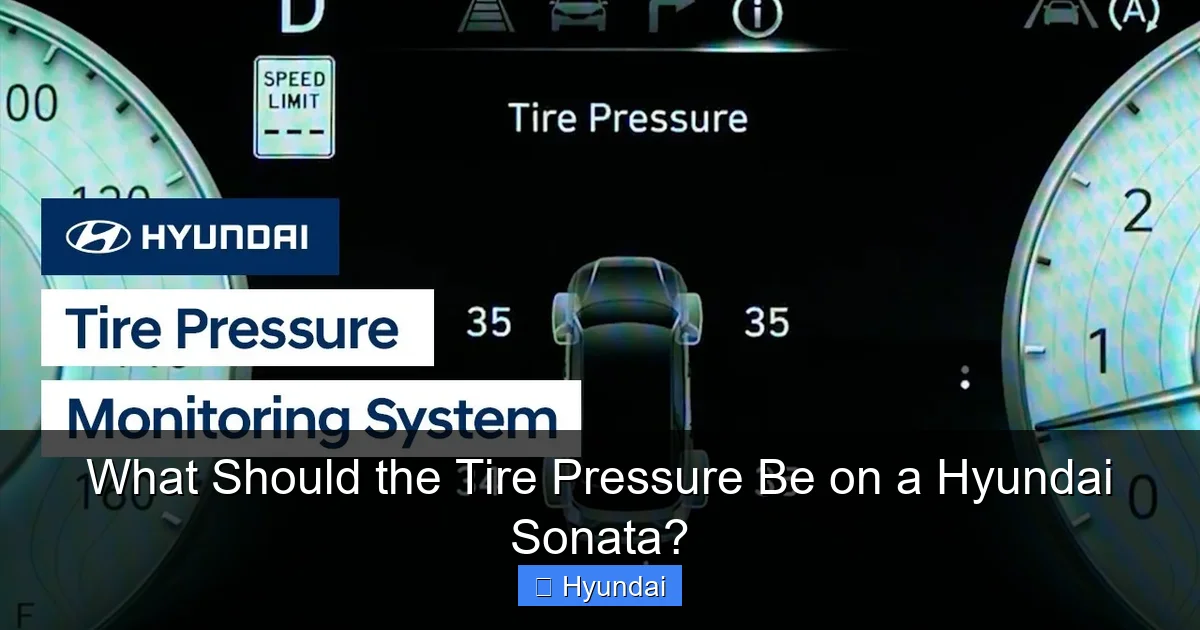
Since 2007, all vehicles sold in the U.S., including the Hyundai Sonata, have been required to have a Tire Pressure Monitoring System (TPMS). Your Sonata uses a direct TPMS, meaning each wheel has a small electronic sensor inside the valve stem that measures pressure and temperature and transmits that data wirelessly to the car’s computer.
Visual guide about What Should the Tire Pressure Be on a Hyundai Sonata?
Image source: hyundaihowtos.com
How TPMS Works and What the Light Means
The TPMS dashboard warning light is a horseshoe-shaped icon with an exclamation point in the center. When it illuminates steadily, it means the system has detected that one or more tires is at least 25% below the recommended pressure. For a Sonata with a 32 PSI spec, that means 24 PSI or lower. This is a serious safety warning, not a gentle reminder. You should stop as soon as safely possible and check your pressures. A flashing TPMS light (for 30-90 seconds then solid) usually indicates a system fault, such as a dead sensor battery or a malfunction, and requires a diagnostic scan.
Resetting the TPMS Light After Inflation
Once you’ve inflated your tires to the correct cold pressure, the TPMS light should turn off on its own after a few minutes of driving. If it doesn’t, you may need to perform a manual reset. The procedure varies by model year. For many Sonatas (2015+), you can reset it through the vehicle settings in the instrument cluster: go to “Vehicle Settings” > “Tire Pressure” > “TPMS Reset” and follow the prompts (usually driving at a steady speed above 30 mph for a few minutes). If the light persists, there may be a faulty sensor or a spare tire still mounted. Always ensure the spare is inflated to its high spec if it’s on the car. For detailed reset steps specific to your year, you might consult resources on resetting systems in other vehicles, as the principles are similar. For instance, the process to reset the tire pressure light on a Honda Civic involves a similar drive cycle, though button locations differ. Always refer to your Sonata’s manual first.
Practical Guide: How to Check and Adjust Your Sonata’s Tire Pressure
Knowing the theory is great, but doing it yourself is empowering and saves money. Here’s a no-nonsense, step-by-step guide to becoming a tire pressure pro for your Hyundai Sonata.
Tools You’ll Need: Pressure Gauge and Air Source
You need two things: a reliable tire pressure gauge and an air source. Digital gauges are easy to read and accurate. Stick-type (pencil) gauges are cheap and compact but can be less precise. A good quality analog dial gauge is a solid middle ground. For an air source, you can use a home air compressor (a small portable one is handy), the compressor at a gas station (often free or cheap), or a bike pump (slower but works). Invest in your own personal gauge; gas station ones are often abused and inaccurate.
Step-by-Step: Checking Pressure Correctly
1. Ensure Tires are Cold: Check in the morning or after the car has sat for hours.
2. Remove the Valve Cap: Unscrew the small black cap from the valve stem. Keep it in a clean place.
3. Press the Gauge On: Press the gauge’s nozzle firmly onto the valve stem. You should hear a brief hiss of air. Hold it straight and steady.
4. Read the Gauge: For a digital gauge, wait for the number to stabilize. For a dial or stick gauge, the hiss will stop, and the stick will pop out or the dial will show a reading.
5. Compare to Spec: Compare the reading to the PSI on your door jamb sticker for that tire position.
6. Repeat: Do this for all four tires. Don’t forget the spare if it’s a full-size one you use regularly.
7. Replace Caps: Screw the valve caps back on tightly to keep dirt and moisture out.
Adding or Releasing Air: Best Practices
If pressure is low, add air in short bursts from your air source, checking the gauge frequently. Overfilling is easy to do. If you overinflate, simply press the valve stem lightly with the gauge tip or a small tool to release air, then re-check. The goal is to hit the target PSI exactly. If pressure is high (common in hot weather after driving), let some air out in small amounts. Remember, when you add air to a cold tire, you’re setting its “cold” pressure. If you add air when the tire is warm, it will be overinflated once it cools down. For the most accurate result, always adjust pressure on cold tires.
The Real Cost of Incorrect Tire Pressure
Let’s connect the dots on why this matters beyond a dashboard light. Incorrect tire pressure has a cascade of negative effects.
Safety Risks: Blowouts, Handling, and Braking
Underinflated tires are the number one cause of tire failure. They flex excessively, building up internal heat that can lead to a blowout, especially at high speeds on highways. They also have unstable sidewalls, leading to poor, mushy handling, delayed steering response, and longer stopping distances—a major hazard in an emergency. Overinflated tires are rigid, reducing the contact patch with the road. This leads to a harsh, bouncy ride, poor traction (especially in wet conditions), and a higher likelihood of impact damage from potholes and debris, as the tire can’t absorb the shock.
Uneven Tire Wear and Reduced Tire Life
Your tire’s tread is its service life. Underinflation causes the outer edges of the tread to wear prematurely as they bear the brunt of the load. Overinflation causes the center of the tread to wear down quickly as it bulges outward. Both scenarios can ruin a set of $100+ tires thousands of miles early. Properly inflated tires wear evenly across the entire tread face, maximizing your investment. You’ll get the full treadlife warranty from the manufacturer.
Fuel Economy Impact: How PSI Affects MPG
Rolling resistance is the force that resists your tires rolling. Underinflated tires have high rolling resistance because they deform more as they roll. Your Sonata’s engine has to work harder to overcome this drag, burning more fuel. The U.S. Department of Energy estimates that maintaining proper tire pressure can improve fuel economy by up to 3%. For a Sonata that gets 30 MPG, that’s nearly 1 extra MPG, adding up to significant savings over a year of driving. It’s free miles just for checking a gauge.
Conclusion: Your Simple Path to Safety and Savings
We’ve covered a lot of ground, but the takeaway is beautifully simple. The correct tire pressure for your Hyundai Sonata is the number on the driver’s door jamb sticker, typically between 32 and 35 PSI for normal driving. Check it monthly with a reliable gauge when the tires are cold. Adjust it as the seasons change. Respect your TPMS light as a critical warning, not a maintenance reminder. And understand that this 30-second monthly task protects your family, saves you money at the pump and the tire shop, and ensures your Sonata performs exactly as Hyundai designed it to. It’s the easiest, cheapest, and most effective way to show your car some care. Make it a habit, and your Sonata will reward you with years of safe, comfortable, and efficient miles on the road.
Frequently Asked Questions
What should I do if my Hyundai Sonata doesn’t have a door jamb sticker?
If the sticker is missing, the definitive source is your vehicle’s owner’s manual. It will have the exact specifications for your model year and trim. You can also often find this information in online owner’s forums or by contacting a Hyundai dealership’s service department with your VIN.
How often should I check my Sonata’s tire pressure?
You should check your tire pressure at least once a month and before any long road trip. It’s also wise to check after a significant temperature change, such as the shift from summer to fall. Don’t rely solely on your TPMS light; by the time it comes on, your tires are already severely underinflated.
Can I use the maximum pressure listed on the tire sidewall?
No. The maximum pressure on the tire sidewall is the absolute limit the tire can hold, not the recommended pressure for your car. Inflating to that max will give a very harsh ride, poor handling, and cause rapid center-wear of the tread. Always use the vehicle manufacturer’s recommendation on your door jamb sticker.
What pressure should my Hyundai Sonata’s spare tire be?
If your Sonata has a temporary “donut” spare tire, it requires a much higher pressure than your main tires, typically 60 PSI. This pressure is also listed on your door jamb sticker, often in a separate line for the spare. Check it every six months, as these small tires lose pressure quickly.
Does the TPMS in my Sonata replace the need for manual checks?
Absolutely not. TPMS is a safety system designed to warn you of severe underinflation (25% below spec). It is not a maintenance system. Sensors can fail, and the system won’t alert you to a slow leak or a few PSI drop that still affects performance and wear. Regular manual checks are essential.
Is the tire pressure different for the front and rear on a Sonata?
For the vast majority of Hyundai Sonata models under normal load conditions, the recommended pressure is the same for both front and rear tires (e.g., 32 PSI all around). Only in specific, heavy-load scenarios would the rear pressure be increased, as specified on your door jamb placard.
