
Does the Mazda Cx 30 Have Blind Spot Monitoring

Yes, the 2026 Mazda CX-30 does offer Blind Spot Monitoring (BSM), but its availability depends on the trim level. This crucial safety feature is a core component of Mazda’s i-Activsense suite, becoming standard on most higher trims like the Premium, Premium Plus, and Grand Touring. For drivers of base Sport models, it may be an optional package or unavailable. Understanding which CX-30 you’re looking at is key, as BSM dramatically improves lane-change safety by alerting you to vehicles you can’t see in your mirrors.
Key Takeaways
- BSM is Part of i-Activsense: In the CX-30, Blind Spot Monitoring isn’t a standalone gadget; it’s a integrated feature within Mazda’s comprehensive i-Activsense driver-assistance technology suite.
- Trim-Dependent Availability: For the 2026 model year, BSM is standard on the Premium, Premium Plus, and Grand Touring trims. It is typically not standard on the base Sport trim, often requiring an upgrade to an optional package.
- How It Works: The system uses radar sensors mounted in the rear bumper to continuously scan the lanes adjacent to your vehicle. It provides both a visual indicator in the side mirror and an audible alert if you signal to change lanes when a vehicle is detected.
- It Often Includes Rear Cross-Traffic Alert: When your CX-30 is equipped with BSM, it almost always includes Rear Cross-Traffic Alert (RCTA), which warns you of approaching traffic when backing out of a parking spot.
- No Driver Input Needed: Once the vehicle is on and the system is active (it usually is by default), BSM works automatically in the background. There’s no need to manually turn it on or off for each drive.
- Aftermarket Options Exist: If your used or base-model CX-30 lacks BSM, you can explore aftermarket blind spot monitoring systems. However, these are not factory-integrated and require professional installation.
- Sensor Maintenance is Key: The radar sensors are located in the rear bumper. Keeping this area clean from dirt, snow, ice, and mud is essential for the system to function correctly.
📑 Table of Contents
- What is Blind Spot Monitoring and Why It Matters
- Mazda’s i-Activsense: The Brain Behind the CX-30’s Safety
- Blind Spot Monitoring Availability in the 2026 CX-30 Lineup
- How the CX-30’s Blind Spot Monitoring System Works
- CX-30 vs. Competitors: A Safety Tech Showdown
- Adding Blind Spot Monitoring to a CX-30 That Doesn’t Have It
- Practical Tips for Living with CX-30 Blind Spot Monitoring
- Conclusion
What is Blind Spot Monitoring and Why It Matters
Let’s talk about one of the most useful pieces of technology in modern cars: Blind Spot Monitoring, or BSM. If you’ve ever been on the highway, checked your mirrors, and started to change lanes only to hear a frantic horn blare or have to slam on your brakes, you’ve experienced the terror of a blind spot. That area just outside your direct field of vision, where your mirrors can’t see, is a major hazard. Blind Spot Monitoring is Mazda’s answer to this problem. It’s like having an extra set of eyes constantly watching the lanes beside you.
For a compact crossover like the Mazda CX-30, which is often used in busy city traffic and for highway commuting, this feature is more than a luxury—it’s a significant safety enhancement. It takes a huge amount of stress out of driving. You can make lane changes with far more confidence, knowing the system has your back. In 2026, with traffic volumes higher than ever, a reliable BSM system isn’t just a nice-to-have; for many drivers, it’s a non-negotiable must-have.
The Problem of Blind Spots
Blind spots exist because of the physical design of our vehicles and the limitations of mirrors. Even with perfectly adjusted mirrors, there are zones—typically starting from about 10 feet behind your car and extending out several lanes—that you simply cannot see. These zones are where other vehicles can hide, especially motorcycles and smaller cars. The danger is highest during lane changes on multi-lane roads and when merging onto highways. A quick glance over your shoulder can sometimes miss a vehicle, especially if it’s in your blind spot. BSM eliminates this guesswork.
How BSM Saves the Day
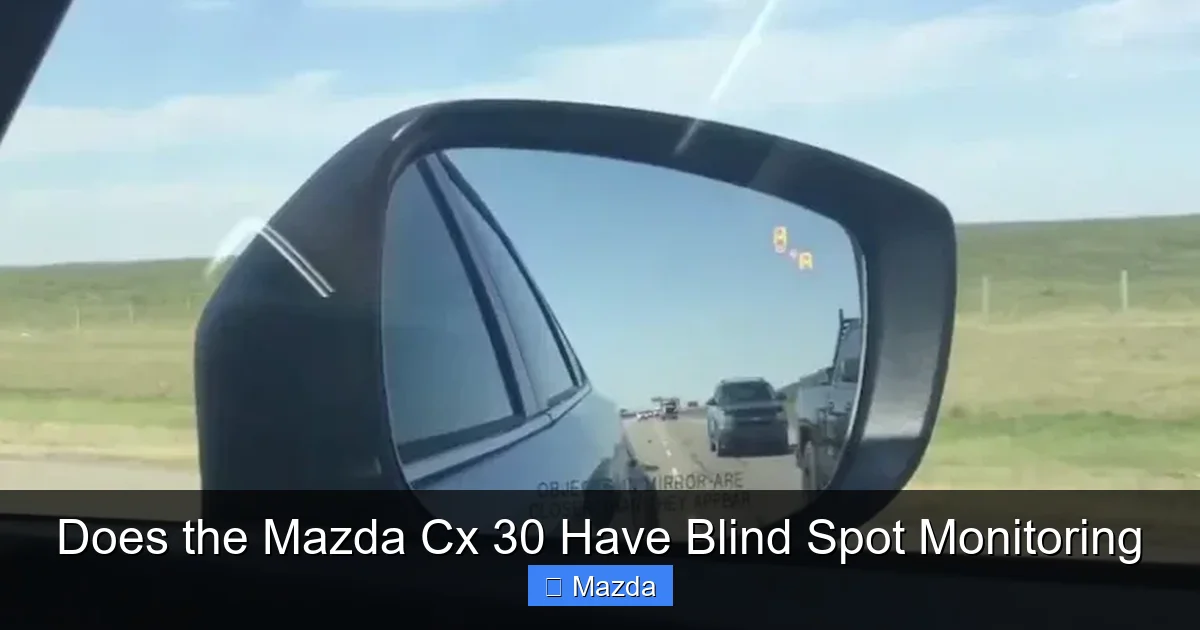
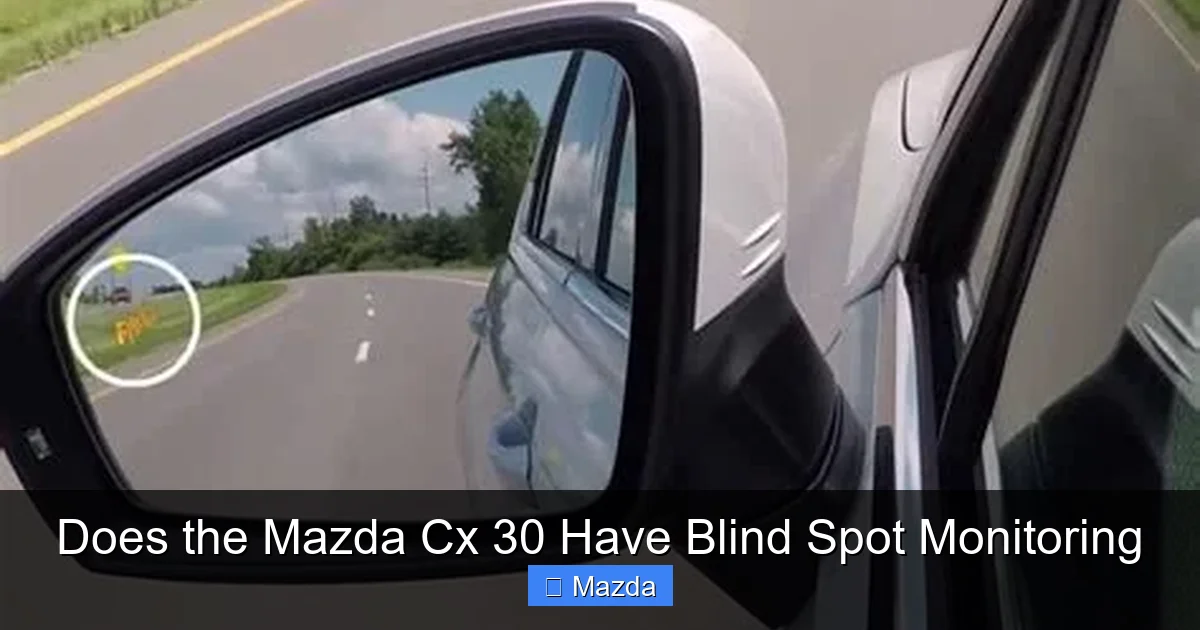
Instead of relying solely on your eyes, BSM uses radar technology to detect vehicles in those hidden zones. When a car enters your blind spot, a small amber (sometimes yellow) icon shaped like a car or lane lines illuminates in the corresponding side mirror or on the A-pillar near the window. If you activate your turn signal while that icon is lit, the light will usually start blinking, and you’ll hear a gentle but distinct warning chime. This dual alert—visual and audible—ensures you get the message even if you’re distracted or in a noisy environment. It’s a simple, elegant system that prevents sideswipe collisions, which are among the most common types of accidents.
Mazda’s i-Activsense: The Brain Behind the CX-30’s Safety
To understand Blind Spot Monitoring in the CX-30, you need to understand Mazda’s overall safety philosophy, which is packaged under the name i-Activsense. This isn’t just one feature; it’s a suite of advanced driver-assistance systems (ADAS) that work together using a combination of cameras, radar sensors, and lasers. Think of i-Activsense as the central nervous system of the CX-30’s safety features. It includes things like Smart City Brake Support (which can automatically apply the brakes in city traffic), Lane Departure Warning with Lane Keep Assist, Adaptive Cruise Control, and of course, Blind Spot Monitoring.
Visual guide about Does the Mazda Cx 30 Have Blind Spot Monitoring
Image source: cdn.cartipsdaily.com
What’s clever about Mazda’s approach is how seamlessly these systems integrate. The same radar sensors used for Adaptive Cruise Control often feed data to the BSM system. This integration means the systems are more reliable and less prone to false alerts because they’re cross-referencing information. For the driver, it means a cohesive experience where all safety tech feels like it’s working in harmony, not as separate, disjointed gadgets. The CX-30’s cabin design also supports this, with important warnings placed directly in your line of sight on the windshield or in the gauge cluster, minimizing the need to look away from the road.
A Suite of Smart Features
Beyond BSM, i-Activsense in the CX-30 typically includes:
- Smart Brake Support / Smart City Brake Support: Detects pedestrians and vehicles ahead at low speeds and can brake automatically.
- Lane Departure Warning System: Alerts you if you drift out of your lane without signaling.
- Lane Keep Assist: Provides gentle steering input to help keep you centered.
- Adaptive Cruise Control: Maintains a set distance from the car in front, slowing down and speeding up as needed.
- Rear Cross-Traffic Alert: Often bundled with BSM, warns of traffic when reversing.
- Driver Attention Alert: Monitors steering inputs to suggest a break if you seem drowsy.
Having BSM as part of this ecosystem means it’s not operating in a silo. The car’s computer is constantly processing data from multiple sources to give you the most accurate picture of your surroundings.
Blind Spot Monitoring Availability in the 2026 CX-30 Lineup
Now for the most important question: which 2026 Mazda CX-30 models actually come with Blind Spot Monitoring? Mazda has a reputation for bundling its best safety tech into higher trim levels. For the 2026 model year, the trend continues. BSM is not a standard feature across the entire lineup. It is most commonly found as a standard feature on the Premium, Premium Plus, and Grand Touring trims. On these models, you get the full i-Activsense suite, which includes BSM and Rear Cross-Traffic Alert, right out of the gate.
Visual guide about Does the Mazda Cx 30 Have Blind Spot Monitoring
Image source: autozonic.com
The base Sport trim is where things differ. Historically, the Sport trim has come with a more basic set of safety features, often including a rearview camera and basic brake assist, but omitting the full radar-based systems like BSM and Adaptive Cruise Control. For 2026, it’s highly likely the Sport trim will still not include BSM as standard. However, Mazda frequently offers an optional i-Activsense package or a technology package that adds these features to the Sport trim. If you’re shopping on a budget but want BSM, you’ll need to check the window sticker for that specific package. It may add a few thousand dollars to the price, but for many, the safety benefit is worth it.
Trim-by-Trim Breakdown (Projected for 2026)
Based on Mazda’s current trajectory, here’s a realistic projection for BSM availability:
- CX-30 Sport: Likely does NOT include BSM standard. May be available via an optional i-Activsense or Technology package.
- CX-30 Premium: Very likely INCLUDES BSM standard as part of the i-Activsense suite. This trim is where Mazda typically starts bundling the full safety package.
- CX-30 Premium Plus: Will definitely include BSM standard, along with additional comfort and tech upgrades.
- CX-30 Grand Touring: The top trim includes all i-Activsense features as standard, including BSM and RCTA.
Important: These are projections. When the official 2026 specifications are released, you must verify on Mazda’s website or by checking the vehicle’s window sticker (Monroney label). The label will have a clear list of all safety features. Don’t rely on a salesperson’s word alone; see it in writing.
The i-Activsense Package: What’s Included?
If you’re looking at a Sport trim and see an “i-Activsense package” offered, what does it typically add? Besides Blind Spot Monitoring and Rear Cross-Traffic Alert, this package almost always includes:
- Adaptive Cruise Control
- Lane Departure Warning with Lane Keep Assist
- Driver Attention Alert
- Smart Brake Support (with pedestrian detection)
It essentially upgrades your CX-30 from a safely equipped vehicle to one with a comprehensive, semi-autonomous safety net. This package is the key to getting BSM on the entry-level model.
How the CX-30’s Blind Spot Monitoring System Works
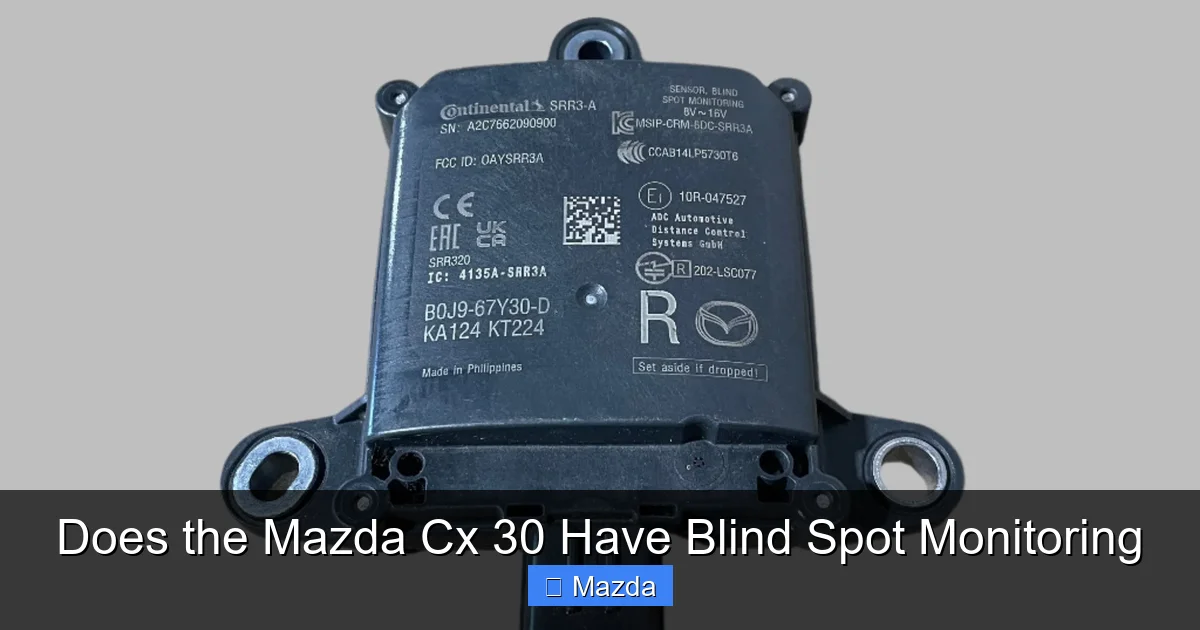
Knowing that your CX-30 has BSM is one thing; understanding how it works helps you trust it and use it correctly. The system is elegantly simple in its operation but sophisticated under the hood. It relies primarily on radar sensors. These are small, usually black, plastic-covered units embedded in the rear bumper, typically on both sides, near the wheel wells. They emit radio waves that bounce off objects and return, allowing the car’s computer to calculate the distance, speed, and trajectory of vehicles in adjacent lanes.
Visual guide about Does the Mazda Cx 30 Have Blind Spot Monitoring
Image source: raptorspares.com
These radar sensors have a range of roughly 30-50 feet behind and to the sides of your vehicle. They are constantly active whenever the CX-30 is moving above a certain speed (usually around 6-10 mph). They are not affected by darkness or most weather conditions like rain and fog, which is a major advantage over camera-based systems. However, they can be obstructed by heavy snow, mud, or dirt caked on the bumper, or by aftermarket bumper covers or bike racks.
The Tech Under the Hood: Radar and Cameras
While radar does the heavy lifting for BSM, it’s often supported by the forward-facing camera (used for Lane Keep Assist and Traffic Sign Recognition). This fusion of sensor data helps the system ignore objects that aren’t vehicles, like guardrails or parked cars, reducing false positives. The car’s computer processes this information in real-time. If a vehicle is detected in your blind spot and you haven’t signaled, nothing happens. The system is designed to be non-intrusive. It only alerts you when you take an action—activating a turn signal—that would put you on a collision course with that detected vehicle.
What You’ll See and Feel: Alerts and Warnings
The alert is designed to be impossible to miss but not startle you. Here’s the sequence:
- Detection: A vehicle enters your blind spot. A small, amber icon that looks like a car or two lane lines illuminates in the corresponding side mirror’s housing or on the outer edge of the digital instrument cluster or head-up display (if equipped). This is your passive warning: “Hey, something’s there.”
- Signal Activated: You click your turn signal to change lanes. The icon will begin to blink rapidly, and a audible chime will sound from the corresponding side (left chime for left lane change, right for right). This is the active warning: “Do not change lanes now!”
- Clear: Once the vehicle has passed or you abort the lane change, the signal turns off, and the icon disappears.
The sound is a distinct, digital tone—not the same as a parking sensor beep. It’s meant to convey urgency without causing panic. The visual cue is placed where your peripheral vision naturally falls when checking your mirror, making it easy to absorb without looking away from the road.
Real-World Scenarios: BSM in Action
Let’s make this practical. Imagine you’re on a three-lane highway in your CX-30, cruising in the middle lane. A fast-moving SUV is in your right blind spot. You want to pass a slow-moving truck ahead by moving right. You check your right mirror—it looks clear. But because the SUV is in your blind spot, you wouldn’t see it. You signal right. The BSM icon in your right mirror blinks, and a chime sounds. You immediately cancel the signal and stay in your lane. The SUV passes, and then you safely move over. Without BSM, you might have started the move and caused a serious accident.
Another common scenario: merging onto a highway. You’re on the on-ramp, accelerating to match traffic speed. You look over your shoulder and into your blind spot. It’s tense! With BSM, you get a clear indicator the moment a car enters your blind spot on the highway, giving you more time to adjust your speed or wait for a larger gap.
Pro Tip: BSM is a backup, not a replacement for good driving habits. You should still perform a quick shoulder check before any lane change. The system can fail, or a vehicle could be moving too fast to be detected in time. Use BSM as a second set of eyes that gives you confidence, not as an excuse to be lazy about checking.
CX-30 vs. Competitors: A Safety Tech Showdown
The compact crossover segment is incredibly competitive, and safety tech is a major battleground. How does Mazda’s BSM implementation in the CX-30 stack up against rivals like the Subaru Crosstrek, Honda HR-V, and Toyota Corolla Cross? Overall, Mazda’s i-Activsense is considered one of the most intuitive and well-integrated systems in the class. The blind spot monitoring is particularly praised for its clear, timely alerts and seamless integration into the driving experience.
Let’s take the Subaru Crosstrek as a prime example. Subaru’s EyeSight system is also highly regarded. It uses a stereo camera system rather than radar for many functions, including its version of blind spot monitoring (called Blind Spot Detection). Both systems are excellent. The Mazda system often gets points for its more pronounced and easily visible mirror-mounted alerts, while some drivers prefer Subaru’s chime. The key takeaway is that both brands prioritize safety, and you can’t go wrong with either. If you’re cross-shopping, you should read detailed comparisons. For a deep dive into the Crosstrek’s capabilities, you can see whether the Subaru Crosstrek has blind spot monitoring and how it compares.
The Honda HR-V and Toyota Corolla Cross also offer similar systems (Honda calls it Blind Spot Information System, Toyota calls it Blind Spot Monitor). They are all functionally very similar—radar-based, with mirror alerts and audible chimes. The differences often come down to tuning: how sensitive the system is, the volume of the chime, and the exact placement of the warning lights. The best way to judge is to take a test drive in each and see which interface you find most natural and least intrusive.
Why Mazda’s Implementation Stands Out
What sets Mazda apart is the holistic design. The i-Activsense alerts are perfectly integrated into the CX-30’s driver-centric cockpit. The warnings feel like a natural extension of the car, not an afterthought. The system’s logic is also very sound—it’s conservative enough to avoid constant false alerts from cars in adjacent lanes that are passing you, but sensitive enough to catch vehicles that are truly in your blind spot and on a collision course. This balance is hard to perfect, and Mazda has largely succeeded.
Adding Blind Spot Monitoring to a CX-30 That Doesn’t Have It
So you’ve found your dream used CX-30 or a great deal on a base Sport model, but it lacks the Blind Spot Monitoring feature. Can you add it after the fact? The short answer is: yes, but it’s complicated and not always recommended.
There are two paths: a factory retrofit (nearly impossible) or an aftermarket system.
Factory Retrofit: This would involve purchasing the original Mazda BSM hardware (radar sensors, wiring harnesses, the necessary control module) and having it professionally installed and calibrated by a Mazda dealer. In practice, this is extremely rare, often prohibitively expensive (likely costing more than the car’s value), and parts may not be available for a retrofit. Mazda does not design its systems to be easily added post-production.
Aftermarket Blind Spot Monitoring Systems
This is the more realistic route. Several reputable companies like Valeo, Bosch, and others sell universal blind spot monitoring kits. These systems typically include:
- Two radar sensors (similar to factory ones)
- A central control unit
- Visual alert modules (small LED lights that you mount on your A-pillars or dashboard)
- Audible alert speaker
Installation is the big hurdle. While some kits are marketed as “DIY,” installing them properly on a CX-30 is not a simple plug-and-play job. You need to:
- Precisely mount the radar sensors in the rear bumper, ideally in the same location Mazda uses. This often involves drilling holes or finding optimal spots.
- Run wiring from the rear bumper to the front of the vehicle, through the car’s interior or along the frame.
- Connect to a constant 12V power source and a switched ignition source.
- Mount the visual alert lights where they’re clearly visible but not obstructive.
- Ensure the system is calibrated correctly so it doesn’t give false alerts.
Given the complexity, professional installation by a car audio shop or a specialist in advanced driver-assistance systems is highly advised. This adds significant cost to the price of the kit itself.
Cost vs. Benefit Analysis
A complete, professionally installed aftermarket BSM system for a CX-30 could easily run $800 to $1,500 or more. For a used CX-30 valued at $20,000, that’s a 4-7% increase in cost. You must weigh this against the safety benefit. Is it worth it? For many, the peace of mind is invaluable. However, you must consider:
- Integration: It will not be integrated with your factory turn signals or gauge cluster. The alerts are separate.
- Reliability: Aftermarket systems can be less refined than factory systems, potentially with more false positives or missed detections.
- Resale: It may not add significant value to the car when you sell it, and a savvy buyer might see it as a non-factory modification.
If BSM is a top priority, the most straightforward path is to buy a CX-30 trim that already includes it. But if you’re committed to your current vehicle, an aftermarket system is a viable, if imperfect, solution. You can explore the detailed pros and cons of adding blind spot monitoring to your car in a dedicated guide.
Practical Tips for Living with CX-30 Blind Spot Monitoring
If you own or are about to buy a CX-30 with BSM, here are some practical tips to ensure it works perfectly for years to come.
Keep the Rear Bumper Clean
The radar sensors are behind the plastic covers in the rear bumper. During winter, a buildup of road salt, slush, and snow can coat these areas and severely impair the system’s ability to “see.” Make it a habit to rinse the rear bumper thoroughly when washing your car, especially in climates that use road salt. A quick wipe-down with a damp cloth during particularly messy weather can also help. If the system becomes disabled due to a sensor obstruction, a warning light will appear on your dashboard.
Understand the System’s Limits
BSM is fantastic, but it’s not magic. It has limitations:
- Speed: It typically only operates above a certain speed (e.g., 6-10 mph) and may turn off at very low speeds.
- Detection Range: It won’t detect vehicles that are too far behind you or vehicles that are entering your blind spot from very far away in the adjacent lane. It’s optimized for vehicles alongside you.
- Small Vehicles: Very small vehicles like motorcycles or bicycles may be harder to detect, or may not be detected at all. Always do a shoulder check for these.
- Weather: While radar works in rain and fog, extremely heavy precipitation can sometimes interfere.
- Fixed Objects: The system is designed to ignore guardrails, parked cars, and other stationary objects. But if you’re in a tight, winding road with a guardrail close to your lane, you might get an occasional false alert.
Knowing these limits helps you use the system as a powerful aid, not a crutch.
Don’t Ignore the Warning Light
If a small “BSM” or “i-Activsense” warning light illuminates on your dash and stays on, it means the system has been disabled due to a problem. Common causes are:
- Dirty or obstructed radar sensors.
- Extreme temperature affecting sensor performance.
- A temporary software glitch.
Try cleaning the rear bumper thoroughly and restarting the car. If the light persists, have it diagnosed by a Mazda technician. Driving with a malfunctioning BSM means you’re missing that layer of safety.
Use It to Build Better Habits
Let BSM reinforce good driving habits. When you see the alert, don’t just cancel your signal. Take that moment to confirm the vehicle’s position and speed in your mirror and over your shoulder. Let the system train you to be more aware of your blind spots even when it’s not actively alerting you. Over time, you’ll become a more intuitive and safer lane-changer, with or without the tech.
Conclusion
So, does the Mazda CX-30 have Blind Spot Monitoring? For the 2026 model year, the answer is a confident yes—on most trims. It’s a cornerstone of the excellent i-Activsense safety suite, standard on Premium, Premium Plus, and Grand Touring models, and likely available as an option on the base Sport. The system itself is one of the best in the compact SUV class, offering reliable, unintrusive radar-based alerts that significantly boost your confidence on the road.
If you’re shopping for a CX-30, make BSM a priority. Check the window sticker carefully. If you’re looking at a used model without it, consider the cost and complexity of adding an aftermarket system versus finding a better-equipped model. Ultimately, Blind Spot Monitoring is a life-saving feature that has become essential in modern driving. The Mazda CX-30, when equipped with it, provides a safe, engaging, and tech-savvy driving experience that competes strongly with any rival in its segment. Take a test drive, activate the turn signal on a busy road, and experience that moment of reassurance for yourself—it’s a small feature that makes a big difference every single day.
Frequently Asked Questions
Is Blind Spot Monitoring standard on all 2026 Mazda CX-30 trims?
No. For 2026, it is expected to be standard on the Premium, Premium Plus, and Grand Touring trims. The base Sport trim will likely not include it standard, but it may be available as part of an optional i-Activsense package. Always verify the exact features on the vehicle’s window sticker.
Can I turn the Blind Spot Monitoring system off?
Yes, you can temporarily disable BSM through the vehicle’s settings menu on the infotainment screen. However, it’s generally not recommended, as the system is designed to be a passive safety aid. It will typically reactivate automatically the next time you start the car.
Does the CX-30’s BSM work in heavy rain, snow, or fog?
Yes, because it uses radar, it is largely unaffected by darkness, rain, fog, or snow. However, a thick, heavy accumulation of snow or mud caked on the rear bumper can physically block the radar sensors, causing the system to malfunction. Keeping the sensor area clean is crucial for reliable operation in all weather.
What’s the difference between Blind Spot Monitoring and Rear Cross-Traffic Alert?
Blind Spot Monitoring (BSM) warns you about vehicles in your adjacent blind spots when you are driving forward and use your turn signal. Rear Cross-Traffic Alert (RCTA) is a related but separate feature that warns you about traffic crossing behind you when you are backing up, such as in a parking lot. In Mazda’s CX-30, these two features are almost always packaged together.
My BSM warning light is on. What should I do?
A persistent BSM warning light indicates the system is disabled. First, check and clean the radar sensors located in the rear bumper—they are likely obstructed by dirt, snow, or ice. If cleaning doesn’t resolve it, restart the vehicle. If the light remains on, schedule a diagnostic check with a Mazda dealer, as a sensor or system fault may require repair.
If my CX-30 doesn’t have factory BSM, is an aftermarket system worth it?
It depends. Aftermarket systems can be effective but are expensive ($800-$1,500+ with professional installation), not fully integrated, and may have reliability differences from the factory system. For many, it’s more cost-effective to purchase a CX-30 model that already includes the factory BSM as part of its i-Activsense package. Weigh the safety benefit against the cost and potential resale impact.
