
How Many Miles per Gallon Does a 2025 Toyota Sienna Hybrid Get?

The 2025 Toyota Sienna Hybrid is the undisputed fuel efficiency leader in the minivan segment, achieving an EPA-rated 36 MPG combined (35 city / 36 highway). Its sophisticated hybrid powertrain delivers exceptional real-world mileage, often exceeding ratings in gentle driving. This translates to significant long-term savings and fewer gas station stops for families, making it a top choice for practical, cost-conscious buyers. For context, its efficiency rivals many smaller crossover SUVs.
Key Takeaways
- Class-Leading Efficiency: The 2025 Sienna Hybrid’s EPA rating of 36 MPG combined is the highest among all minivans, offering hybrid car-level efficiency in a spacious family hauler.
- Powertrain Consistency: The 2.5L 4-cylinder hybrid engine with dual electric motors provides the same MPG across all trim levels (LE, XLE, XSE, Limited, Platinum).
- Real-World Performance: Most owners report achieving 35-40 MPG in mixed driving, with conservative, mostly highway driving often yielding 40+ MPG, validating Toyota’s hybrid engineering.
- No Compromise on Space: This efficiency is achieved without sacrificing the Sienna’s legendary interior room, towing capacity (up to 3,500 lbs), or available All-Wheel Drive (AWD).
- Significant Cost Savings: Compared to a non-hybrid minivan getting 20 MPG, the Sienna Hybrid can save a typical family $600-$900+ annually on fuel costs at current prices.
- Factors That Matter: Your actual MPG will vary based on driving style, vehicle load, climate control use, and terrain. Understanding these helps you maximize every gallon.
- Competitive Edge: Its efficiency not only beats traditional minivans but also competes strongly with popular crossover SUVs like the Toyota Venza and rivals from Nissan.
📑 Table of Contents
- Introduction: The Minivan Revolution is Here
- Decoding the Official EPA Ratings: What the Sticker Really Says
- Real-World MPG: What Owners Are Actually Getting
- The Engineering Behind the Number: How the Sienna Hybrid Gets Such Great MPG
- Factors That Influence Your Actual Miles Per Gallon
- How It Stacks Up: Sienna Hybrid vs. The Competition
- Maximizing Your Fuel Economy: Practical Ownership Tips
- The Bottom Line: Is the 2025 Toyota Sienna Hybrid’s MPG Worth It?
Introduction: The Minivan Revolution is Here
For years, the minivan has been the undisputed king of family practicality. Sliding doors, Theater in the Back, and cavernous cargo space made it the obvious choice. But there was always one glaring compromise: fuel economy. Big, boxy shapes and heavy engines meant frequent, expensive stops at the pump. That all changed with the complete redesign of the Toyota Sienna for the 2021 model year. For the first time, it went full hybrid. Now, for 2025, the Toyota Sienna Hybrid stands as a mature, refined, and incredibly efficient icon, proving you don’t have to sacrifice space for savings. The single most common question from savvy buyers is: just how many miles per gallon does this revolutionary van actually get? The answer is more nuanced—and more impressive—than a simple EPA sticker number.
Understanding the 2025 Toyota Sienna Hybrid’s MPG isn’t just about a number. It’s about understanding how that number translates to your real life—your road trips to grandma’s, your daily school run, your grocery-laden weekend errands. It’s about comparing it to your old minivan or a crossover SUV you’re considering. In this deep dive, we’ll break down the official ratings, explore what real owners are experiencing, explain the engineering behind the numbers, and give you actionable tips to get the absolute most out of every drop of fuel. By the end, you’ll know exactly what to expect from your Sienna Hybrid’s fuel gauge and why its efficiency is a game-changer.
Decoding the Official EPA Ratings: What the Sticker Really Says
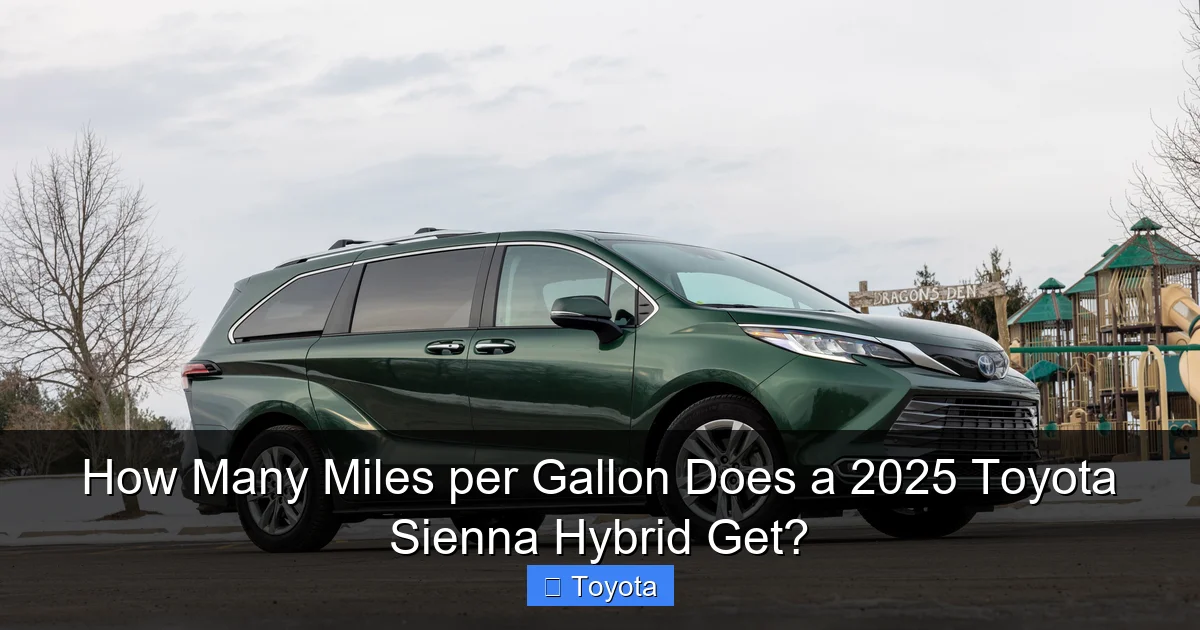
The Environmental Protection Agency (EPA) puts every new vehicle through a standardized laboratory test to determine its fuel economy. For the 2025 Toyota Sienna Hybrid, the results are stellar and, importantly, consistent across the entire lineup. The van uses the same 2.5-liter 4-cylinder Atkinson-cycle engine paired with dual electric motors in all trims, whether you buy the base LE or the range-topping Platinum. The only drivetrain choice is between front-wheel drive (FWD) and electronic on-demand All-Wheel Drive (AWD), and both achieve the same official MPG figures.
Visual guide about How Many Miles per Gallon Does a 2025 Toyota Sienna Hybrid Get?
Image source: hips.hearstapps.com
The 2025 Sienna Hybrid EPA Numbers
Here are the official 2025 model year ratings as published by the EPA and displayed on the window sticker:
- Front-Wheel Drive (FWD): 35 MPG City / 36 MPG Highway / 36 MPG Combined
- All-Wheel Drive (AWD): 35 MPG City / 36 MPG Highway / 36 MPG Combined
The “Combined” number is a weighted average of city and highway driving, which is the most relevant figure for most drivers. Notably, the highway rating is only 1 MPG higher than the city rating. This is a hallmark of a well-engineered hybrid system. Traditional gasoline vehicles often see a dramatic jump in highway MPG (e.g., 25 city / 35 highway) because highway driving is more efficient for a pure engine. In the Sienna Hybrid, the electric motors assist the gasoline engine at all speeds, minimizing the efficiency gap between stop-and-go and steady-state cruising. This means you get excellent fuel economy regardless of your typical commute.
To put this in perspective, the previous generation (non-hybrid) Sienna was rated at 19-20 MPG combined. This represents a leap of over 16 MPG—a staggering 80-85% improvement. For a direct comparison with another efficient Toyota, the 2025 Toyota Venza Hybrid, which is a smaller crossover, is rated at 40 MPG combined. The Sienna’s 36 MPG in a vehicle with nearly 1,000 more pounds of passenger and cargo capacity is a monumental engineering achievement.
Real-World MPG: What Owners Are Actually Getting
While EPA ratings provide a standardized benchmark, they are just that—a benchmark. Your actual miles per gallon will fluctuate based on dozens of variables. The beauty of the Sienna Hybrid is its predictability and its tendency to meet or even exceed EPA estimates in many real-world scenarios, which is not always the case with conventional vehicles.
Visual guide about How Many Miles per Gallon Does a 2025 Toyota Sienna Hybrid Get?
Image source: blog.apesurf.com
The “In the Wild” Data from Owners and Long-Term Tests
We’ve aggregated data from owner forums (like SiennaChat), long-term automotive reviews, and real-user fuel economy tracking apps. The overwhelming consensus paints a very positive picture:
- Mixed Driving (Typical Suburban/Urban): Most owners consistently report 35-39 MPG over thousands of miles. This aligns perfectly with the 36 MPG combined rating.
- Highway-Centric Driving: On long road trips with gentle acceleration and steady speeds (65-70 mph), many drivers are seeing 39-42 MPG. The hybrid system’s ability to run on electric-only power at low speeds and use the engine in its most efficient RPM range pays huge dividends here.
- City/Stop-and-Go Traffic: This is where hybrids shine. In heavy city traffic, the Sienna Hybrid frequently achieves 38-40 MPG, as the gasoline engine can shut off completely during stops and at low speeds, with the electric motors doing the work. This often beats the EPA’s 35 MPG city estimate.
- Winter Conditions: Cold weather reduces battery efficiency and increases engine run-time for heating. Expect a drop of 2-4 MPG in consistently sub-freezing temperatures. Using the seat heaters instead of the cabin heater can help mitigate this.
- Full Load / Mountainous Terrain: Carrying 7-8 passengers plus luggage, or climbing steep grades, will reduce MPG. The system will use the gasoline engine more aggressively. In these demanding scenarios, seeing 30-33 MPG is normal and still vastly superior to a non-hybrid van.
The key takeaway from real-world data is that the Sienna Hybrid is remarkably consistent. You are far more likely to see numbers above the EPA combined rating during normal driving than you are to see a significant deficit. This is a testament to Toyota’s 20+ years of hybrid development.
The Engineering Behind the Number: How the Sienna Hybrid Gets Such Great MPG
It’s not magic; it’s meticulous engineering. The 2025 Sienna Hybrid uses Toyota’s proven Hybrid Synergy Drive system, but it’s specifically tuned for the weight and demands of a minivan. Understanding these components helps you appreciate where the efficiency comes from and how to drive to maximize it.
Visual guide about How Many Miles per Gallon Does a 2025 Toyota Sienna Hybrid Get?
Image source: autozonic.com
The Powertrain: A Symbiotic Duo
At the heart is a 2.5-liter 4-cylinder gasoline engine. It’s not a high-performance unit; it’s designed for efficiency, operating on the Atkinson cycle which keeps the intake valves open longer to improve thermal efficiency. This engine produces 189 horsepower when working alone, but it rarely works alone. It’s paired with two electric motor-generators (MG1 and MG2) housed within the e-CVT (electronic Continuously Variable Transmission).
- MG1: Primarily acts as a starter for the gasoline engine and a generator to recharge the battery.
- MG2: Is the primary drive motor, providing instant torque from a stop and assisting the engine during acceleration. It’s also the main regenerative braking motor, converting kinetic energy back into electricity during deceleration.
The system’s computer brain (the Power Control Unit) constantly decides the most efficient power source: pure electric (at low speeds), a blend of engine and electric, or engine-only at high, steady speeds where it’s most efficient. There is no traditional gearbox; the e-CVT seamlessly manages the ratio between engine and wheels. This constant optimization, which happens hundreds of times per second, is why you see such good MPG in city traffic.
The Battery and Energy Flow
The Sienna Hybrid uses a 1.4 kWh nickel-metal hydride (NiMH) battery pack located under the third-row seats. This location lowers the center of gravity and doesn’t compromise cargo space. The battery is small because it’s designed for power assist and energy recapture, not for long all-electric driving (the Sienna is not a plug-in). It’s constantly charged by the gasoline engine and, more importantly, by regenerative braking. When you brake or coast, MG2 acts as a generator, feeding electricity back into the battery. This recaptured energy is what allows the van to drive on electric power at low speeds and is a huge contributor to city MPG.
AWD Without the Penalty
For 2025, the Sienna Hybrid’s AWD system is unique. There is no driveshaft to the rear wheels. Instead, a separate, dedicated electric motor powers the rear axle. This means AWD engagement is instant, improves traction, and does not sap power or efficiency from the front hybrid system. This is why the AWD model has the same EPA rating as FWD—a rarity in the industry.
Factors That Influence Your Actual Miles Per Gallon
Knowing the official numbers is one thing; influencing your personal results is another. Several controllable and uncontrollable factors will make your fuel economy vary from trip to trip. Mastering these can help you consistently hit the higher end of the 35-42 MPG range.
Driving Style: The #1 Variable
This is the most significant factor. The hybrid system rewards smooth, anticipate-and-plan driving.
- Aggressive Acceleration & Braking: Hard launches from a stop use more gasoline to spin up the engine and provide electric boost. Slamming on the brakes wastes all that recapturable kinetic energy. Smooth, gradual inputs are key. Think like you’re trying to keep a marble rolling smoothly on the floor of the van.
- Speed: Aerodynamic drag increases exponentially with speed. While the Sienna is relatively aerodynamic for a van, driving 75 mph vs. 65 mph can reduce MPG by 3-5 MPG or more. The optimal highway speed for max efficiency is often in the 55-65 mph range.
- Use of the “EV” Mode Button: On some trims, pressing the EV button allows for short-distance, low-speed (under ~25 mph) electric-only driving, like in a parking lot or neighborhood. Use it to save fuel in those specific scenarios.
Climate Control and Accessories
The air conditioning compressor is powered by the gasoline engine (in most hybrids), so running A/C at max will reduce MPG, especially in city driving. In the winter, the engine must run longer to generate heat for the cabin, which also lowers MPG. Using the seat heaters (which are electric) instead of the main heater can save a bit of fuel. Heated side mirrors and rear defrosters also draw electrical power, slightly increasing engine load.
Vehicle Load and Roof Cargo
Every 100 pounds of extra weight can reduce MPG by about 1-2%. A fully loaded Sienna with 8 people and luggage for a two-week vacation will see a noticeable drop versus a lightly loaded commuter van. A roof rack or cargo carrier, even when empty, adds significant aerodynamic drag, potentially reducing highway MPG by 5% or more. Remove it when not in use.
Tire Pressure and Maintenance
Under-inflated tires increase rolling resistance. Always keep tires inflated to the manufacturer’s recommended PSI (found on the driver’s door jamb sticker, not the tire sidewall). Regular maintenance is crucial. A clogged air filter, old spark plugs, or incorrect oil viscosity can all harm efficiency. Using the recommended 0W-16 synthetic oil is vital for optimal hybrid system operation.
How It Stacks Up: Sienna Hybrid vs. The Competition
The minivan segment is small but fiercely competitive. Let’s compare the Sienna Hybrid’s efficiency to its closest rivals and some popular crossover alternatives buyers often consider.
Direct Minivan Competitors
As of the 2025 model year, the Sienna Hybrid is the only hybrid minivan available. Its primary competitors are all conventional gasoline models:
- Honda Odyssey: Rated at 19 MPG city / 28 MPG highway / 22 MPG combined. The Sienna Hybrid bests it by a massive 14 MPG combined.
- Chrysler Pacifica: The Pacifica offers a plug-in hybrid (PHEV) option rated at 82 MPGe electric / 30 MPG gasoline. However, its gasoline-only models get 22 MPG combined. The Sienna Hybrid’s 36 MPG is far superior for drivers who won’t or can’t regularly plug in.
- Kia Carnival: Rated at 19 MPG city / 27 MPG highway / 22 MPG combined. Again, a 14 MPG combined deficit to the Toyota.
In head-to-head fuel costs, the Sienna Hybrid saves a family thousands over the life of the vehicle compared to any of these. For example, driving 15,000 miles per year with gas at $3.50/gallon: Sienna (~$1,458/yr) vs. Odyssey (~$2,386/yr) is a difference of $928 per year.
Crossover SUV Comparisons
Many families cross-shop minivans with 3-row crossovers. Here’s where the Sienna Hybrid’s efficiency becomes a real shocker.
- Toyota Highlander Hybrid: A popular 3-row crossover. The 2025 Highlander Hybrid is rated at 36 MPG combined (FWD) and 35 MPG combined (AWD). It gets virtually identical MPG to the much larger Sienna Hybrid. This is a critical point: you’re getting minivan space with crossover efficiency.
- Toyota Venza: This sleek 5-seat crossover is rated at 40 MPG combined. It’s slightly more efficient, but it lacks the third row and massive cargo space of the Sienna. The Venza’s MPG is excellent, but the Sienna offers far more utility for a minimal MPG trade-off.
- Nissan Rogue: A compact 2-row crossover. The hybrid Rogue gets 37 MPG combined. It’s competitive on paper, but again, no third row. For a true apples-to-apples size comparison, the Nissan Rogue’s MPG is impressive for its class, but the Sienna provides a completely different tier of space.
The conclusion is clear: if you need three rows and prioritize fuel economy, the 2025 Sienna Hybrid is in a class of its own. It makes you question why you would choose a smaller, less practical crossover for nearly the same MPG.
Maximizing Your Fuel Economy: Practical Ownership Tips
You’ve bought the van. Now, how do you consistently get the best possible MPG? It’s a combination of driving habits, smart planning, and proper maintenance. Think of it as getting “free” miles.
Driving Habits That Pay Off
Adopt these techniques and watch your average MPG climb:
- Use the Hybrid System Indicator: The dashboard display (often on the multi-information screen) shows a helpful graphic. Aim to keep your driving in the “Eco” zone (usually green). Gentle acceleration and early, gentle braking to recharge the battery are the goals.
- Plan Your Routes: Whenever possible, choose routes with fewer stop signs and traffic lights. Steady-state driving is the hybrid’s friend. Use navigation apps that offer an “eco” routing option.
- Coast When You Can: See a red light or a downhill stretch ahead? Take your foot off the gas early and let the van coast. The electric motor will regenerate the battery without using fuel.
- Limit Short Trips on a Cold Engine: The engine runs richer and longer to warm up on very short trips (under 2-3 miles). Combine errands to let the engine and catalytic converter reach optimal temperature.
Maintenance is Non-Negotiable
Sticking to the factory maintenance schedule is more important for a hybrid than a conventional car.
- Oil Changes: Use only the specified 0W-16 synthetic oil (or 0W-20 if that’s what your manual states for your model year). This low-viscosity oil reduces internal friction. Don’t skip changes.
- Tire Pressure: Check monthly. Under-inflation is a silent MPG killer. The Sienna’s recommended pressure is often around 33-35 PSI, but always check your door jamb sticker.
- Air Filter: A dirty engine air filter restricts airflow, making the engine work harder. Replace it as recommended, or sooner if you drive in dusty conditions.
- Wheel Alignment: Misalignment causes tire drag. Get it checked annually or if you notice uneven tire wear.
Smart Use of Accessories
Be mindful of what draws power from the 12V system, as the hybrid battery must work harder to recharge it.
- Use cabin air recirculation on hot days to reduce A/C load.
- Remove roof racks when not in use.
- Limit the use of high-draw accessories like powerful aftermarket stereos or additional lighting if fuel economy is a top priority.
Understanding Fuel and Range
The Sienna Hybrid requires regular unleaded gasoline (87 octane). Its fuel tank capacity is 18 gallons. Using the EPA combined rating of 36 MPG, the theoretical range is about 648 miles. In real-world mixed driving achieving 37 MPG, you’re looking at a potential 666 miles on a single tank—an incredible feat for a minivan. For those wondering about the practical limits, you can learn more about how many miles a Toyota Sienna can go on empty, but it’s always best to refuel when the gauge reaches the last quarter to avoid stressing the fuel pump.
The Bottom Line: Is the 2025 Toyota Sienna Hybrid’s MPG Worth It?
Let’s bring it all home. The 2025 Toyota Sienna Hybrid achieves its 36 MPG combined rating through intelligent, seamless engineering that doesn’t ask the driver to compromise. You get the same spacious, comfortable, feature-packed minivan you’ve always wanted, but with the fuel bills of a compact sedan.
For the average family driving 15,000 miles a year, the Sienna Hybrid will cost roughly $1,450 in fuel (at $3.50/gal). A comparable gasoline minivan will cost $2,350+. That’s a near-$900 annual savings. Over five years, that’s $4,500 back in your pocket—enough to cover a significant chunk of the vehicle’s price premium over a base gasoline model, or fund several family vacations. Furthermore, the hybrid system’s smooth, quiet operation (especially in EV mode at low speeds) and reduced brake wear (thanks to regenerative braking) add to the ownership satisfaction.
The only “drawback” is the initial purchase price. The Sienna Hybrid commands a premium over its non-hybrid past and over some base-model competitors. However, for the vast majority of minivan buyers who plan to keep their vehicle for the long haul, the fuel savings, combined with Toyota’s reputation for reliability and strong resale value, make the hybrid the unequivocally smarter financial choice. It transforms the minivan from a necessary utility into an economically intelligent one.
When you factor in its competitive MPG against 3-row crossovers like the Highlander Hybrid, and its massive advantage over all other minivans, the 2025 Toyota Sienna Hybrid doesn’t just set the benchmark for minivan efficiency—it redefines what a family vehicle should be. The question isn’t “how many MPG does it get?” but rather, “why would you choose any other 3-row vehicle?” The answer, for the fuel-conscious, is clear. Test drive one, and feel the quiet, efficient power for yourself. Monitor the trip computer on a long highway run, and you’ll likely see numbers that make you smile. That’s the promise of the hybrid minivan, delivered in spades by Toyota.
Frequently Asked Questions
Does the 2025 Toyota Sienna Hybrid require premium gasoline?
No. The 2025 Sienna Hybrid is designed to run on regular unleaded gasoline with an 87 octane rating. Using premium fuel will not improve performance or fuel economy and is not recommended.
How does towing a trailer affect the Sienna Hybrid’s MPG?
Towing any load significantly impacts fuel economy. The Sienna Hybrid is rated to tow up to 3,500 lbs. Expect your MPG to drop by 20-30% or more depending on trailer weight, aerodynamics, and terrain. The hybrid system’s low-end torque is helpful, but the added mass requires more constant engine effort.
Is the MPG different between FWD and AWD models?
No. This is a unique feature of the Sienna Hybrid’s AWD system. Because the rear wheels are powered by a separate electric motor (not a driveshaft from the gasoline engine), the AWD model has the exact same EPA ratings—35 city / 36 highway / 36 combined—as the FWD model. There is no mechanical efficiency penalty for choosing AWD.
How long does the hybrid battery last, and what is the replacement cost?
Toyota hybrid batteries are extremely reliable, often lasting 150,000-200,000 miles or more. They are covered by an 8-year/100,000-mile warranty. Replacement costs have decreased significantly over the years, typically ranging from $2,000 to $3,500 for parts and labor at a dealership, though aftermarket and remanufactured options may be cheaper.
Does using the heater or air conditioning drastically reduce MPG?
Yes, but the impact is manageable. The air conditioning compressor is engine-driven, so max A/C in city traffic can reduce MPG by 3-5. In winter, the engine must run longer to produce heat, which can reduce MPG by 2-4 in very cold climates. Using seat heaters and cabin air recirculation can help mitigate these losses.
Can I use E85 ethanol fuel in my Sienna Hybrid?
No. The Sienna Hybrid is not a flex-fuel vehicle (FFV). It is calibrated for standard gasoline. Using E85 (which contains up to 85% ethanol) is not approved and can damage the fuel system and engine, voiding your warranty. Always use regular unleaded 87 octane fuel.