
How Do You Reset the Service Engine Soon Light on a Toyota Camry?

The “Service Engine Soon” light on a Toyota Camry indicates a scheduled maintenance interval or a detected emissions issue, distinct from a critical “Check Engine” light. Resetting it is possible after addressing the root cause, typically via a manual procedure using the odometer button or an OBD2 scanner. However, resetting the light without fixing the underlying problem is unsafe and will cause it to return. Always diagnose the issue first, then follow the correct reset procedure for your specific model year.
Key Takeaways
- The “Service Engine Soon” light is primarily a maintenance reminder, not always an urgent fault code. It often signals scheduled service like oil changes, tire rotations, or minor emissions system checks, unlike the more severe “Check Engine” light.
- You should never reset the light without first diagnosing and resolving the indicated issue. Simply turning off the light ignores the problem, which can lead to more expensive damage, failed emissions tests, and unsafe driving conditions.
- The most common reset methods are the manual “ODO/TRIP” button sequence or using an OBD2 scanner. The manual method works for many maintenance reminders, while a scanner is necessary for clearing stored diagnostic trouble codes (DTCs) from the engine computer.
- Your Camry’s model year determines the exact reset procedure. Pre-2012 models often use a different key and button sequence than 2012-2017 or 2018+ models with more advanced multi-information displays. Consult your owner’s manual.
- If the light reappears shortly after resetting, the original problem was not fixed. This indicates a persistent fault that requires professional diagnosis with advanced tools to read live data and pinpoint the failing component.
- For persistent “Check Engine” codes (P0xxx, P2xxx), professional diagnosis is strongly recommended. These often involve complex emissions or drivetrain systems where incorrect repairs can be costly and dangerous.
📑 Table of Contents
Understanding Your Camry’s “Service Engine Soon” Light
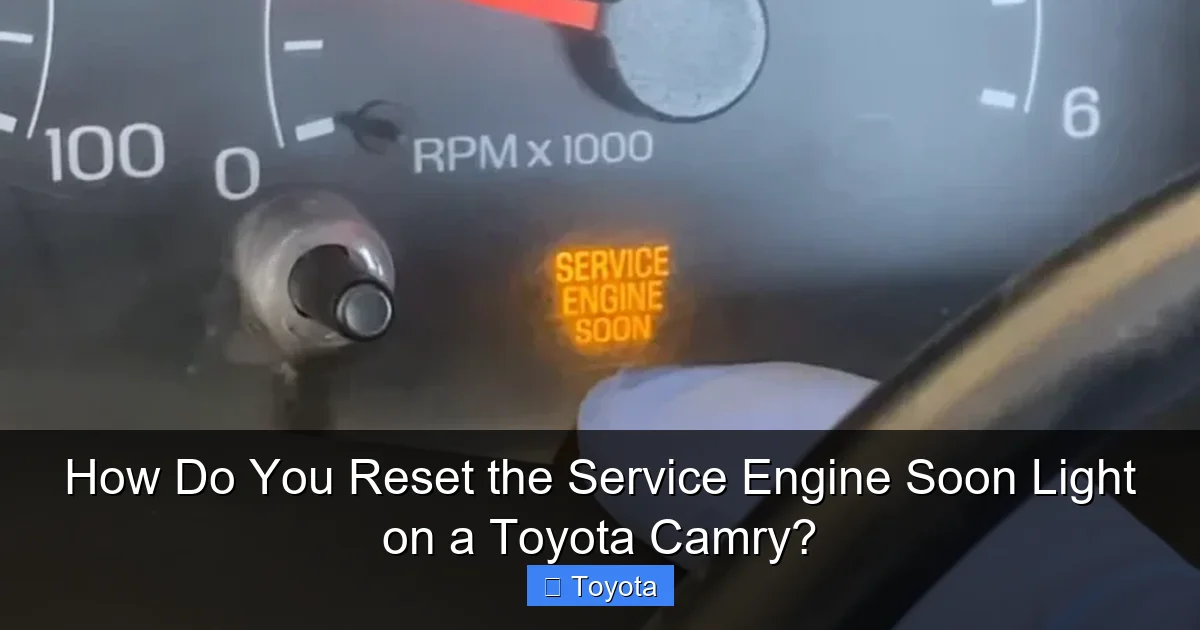
That little amber light on your dashboard, glowing with the words “Service Engine Soon,” can be a moment of panic or annoyance. Before you start hunting for the reset button, let’s get on the same page about what this light actually means on your Toyota Camry. It’s crucial to understand that this is not a one-size-fits-all warning. For decades, Toyota has used this light for two primary, but very different, purposes.
First, and most commonly, it acts as a sophisticated maintenance reminder. Your Camry’s computer tracks mileage, engine run time, and sometimes driving conditions to calculate when routine services are due. This could be an oil change, tire rotation, air filter replacement, or a general inspection. It’s your car’s way of saying, “Hey, it’s time for your 30,000-mile check-up!” Second, it can illuminate as a general malfunction indicator for certain non-critical emissions-related faults that don’t meet the stricter threshold for a solid “Check Engine” light. This is less common but still possible.
This is a key distinction from the more universally recognized “Check Engine” light (often the same icon but sometimes labeled differently). The “Check Engine” light typically indicates an active, detected fault that is affecting emissions performance and needs immediate attention. The “Service Engine Soon” light, while important, often starts as a polite reminder for scheduled care. However, this boundary can blur. A severe issue might trigger a “Service Engine Soon” light first in some model years. Therefore, the absolute golden rule is: Never reset the light without first investigating and correcting the reason it came on. Ignoring it is like tearing the battery out of your smoke detector instead of finding the fire.
The Two Faces of the Warning: Maintenance vs. Malfunction
How can you tell which one you’re dealing with? Sometimes, the behavior gives clues. A maintenance reminder often comes on steadily, not blinking, and may appear right when you start the car. It might also be accompanied by a message in your multi-information display (MID) like “MAINTENANCE REQUIRED” or a specific service item. A malfunction-related light might feel more urgent, possibly flashing during acceleration (a sign of a severe misfire), or it might be accompanied by noticeable drivability issues—rough idling, poor fuel economy, or a lack of power.
The only way to know for certain, especially for malfunction codes, is to perform a diagnostic scan. This is why the reset process is step two. Step one is always diagnosis.
Step 1: Diagnosis – The Non-Negotiable First Step
Before you touch any buttons or disconnect any batteries, you must understand why the light is on. Skipping this is the #1 mistake homeowners make, and it leads to the light coming right back on, often with a more serious problem.
Visual guide about How Do You Reset the Service Engine Soon Light on a Toyota Camry?
Image source: images.saymedia-content.com
Method A: The Simple Visual & Sensory Check. Start with the basics. Pop the hood. Check your oil level with the dipstick. Is it low or dirty? Look at your air filter housing—is it clogged with debris? Check all fluid levels: coolant, brake fluid, windshield washer fluid. Listen for strange noises. Feel for vibrations. Smell for anything unusual like burning oil or rich fuel. Sometimes, a loose or missing gas cap is the culprit! A cap that isn’t tightened properly can cause a small evaporative emissions (EVAP) leak, triggering the light. Tighten it until you hear several clicks. These simple checks solve a surprising number of “Service Engine Soon” illuminations, especially those related to maintenance reminders.
Method B: The OBD2 Scanner Read (Highly Recommended). This is the most reliable method. Every Camry from 1996 onward has an OBD2 (On-Board Diagnostics II) port, usually located under the dashboard near the steering column. You need a compatible scan tool. Here’s your toolkit option breakdown:
- Basic Code Readers ($20-$50): These will pull the stored Diagnostic Trouble Codes (DTCs) like P0420 or P0171. They tell you what system the computer is unhappy with but not why. They are good for a first look.
- Advanced Scanners / Apps ($50-$200+): Tools like the BlueDriver OBD2 scanner paired with a smartphone app, or professional-grade scanners like Autel or Launch, provide much more data. They can read manufacturer-specific codes (Toyota-specific codes start with “P1” or “B”), show live data streams (oxygen sensor readings, fuel trims), and often have “maintenance reset” functions built-in.
- Toyota Techstream / Professional Tools: Dealerships and master technicians use this software. It’s overkill for most but can access the deepest system controls and perform resets for systems like the Tire Pressure Monitoring System (TPMS) or maintenance lights.
Plug your scanner into the OBD2 port with the ignition on (engine off). Follow the device prompts to read codes. Write them down! A code like P0301 means “Cylinder 1 Misfire Detected.” That tells you where to start looking (spark plug, ignition coil, injector on cylinder 1). A code like P0420 means “Catalyst System Efficiency Below Threshold,” which could be an oxygen sensor or a failing catalytic converter—a more expensive fix. This diagnosis phase is where you earn your money or save it. A $20 scan to know the problem is cheaper than a $500 guess.
When to Seek a Professional Diagnosis
If your scan reveals multiple codes, complex codes (especially involving the transmission, ABS, or airbag systems), or codes that point to major components like the catalytic converter, it’s time to call a pro. Similarly, if you have no codes but the light is on, it might be a stubborn maintenance reminder or a sensor glitch that needs a professional-level scan tool to clear. For complex issues, especially those related to powertrain or emissions, a qualified mechanic with Toyota-specific knowledge is your best investment. They can interpret live data trends that a simple code reader misses.
Manual Reset Procedures (No Scanner Needed)
Once you have completed the necessary maintenance or repairs that triggered the light, you can perform the reset. The procedure varies significantly by Camry generation. Here are the most common methods, broken down by era. These methods are primarily for clearing the maintenance reminder interval. They will NOT clear stored diagnostic trouble codes (DTCs) from a malfunction. For those, you need a scanner.
Visual guide about How Do You Reset the Service Engine Soon Light on a Toyota Camry?
Image source: askmyauto.com
For 2012-2017 Camry Models (With Trip Meter Button)
This is the classic, widely applicable method for this generation. Your Camry has an “ODO/TRIP” button on the instrument cluster.
- Turn the ignition to the “ON” position (do not start the engine). All dashboard lights should illuminate.
- Press the “ODO/TRIP” button to cycle the display until you see the odometer (total mileage), not the trip meter.
- Turn the ignition OFF.
- While holding down the “ODO/TRIP” button, turn the ignition back to the “ON” position (again, do not start).
- Continue holding the button. You will see the odometer display dashes (“—–“) that then count down to “0”.
- Once the display shows “0” or returns to the normal odometer reading, release the button.
- Turn the ignition OFF, then start the engine. The light should be off.
Tip: If the “Service Engine Soon” light was triggered by a specific maintenance item (like “OIL”), this sequence might also reset that specific interval counter. However, some models require a separate reset for the oil life percentage via the steering wheel menu buttons. Check your manual.
For 2018+ Camry Models (With Multi-Information Display & Steering Wheel Controls)
The newer Camrys use the color MID and buttons on the steering wheel for most resets.
- With the car ON (engine running or in “ACC” mode), use the arrow buttons on the left side of the steering wheel to navigate to the “Settings” or “Vehicle Settings” menu on the MID.
- Scroll through the menu to find “Maintenance” or “Service Reset.”
- Select it. You may be prompted to confirm the reset or select which service interval to reset (Oil, Tire Rotation, etc.).
- Confirm the reset. The system should acknowledge it with a message like “Reset Complete.”
- Turn the car off and restart. The light should be extinguished.
On some trims, you may need to use the physical “DISP” or “INFO” button on the instrument cluster itself to access the maintenance reset menu. The owner’s manual is your ultimate guide here.
The “Old School” Method (Disconnecting the Battery)
This method is a blunt instrument and is generally not recommended for modern vehicles like the Camry unless you have no other option and have already fixed the problem. Why? Disconnecting the negative battery terminal for a few minutes will:
- Clear all stored adaptive learning data in the engine computer (ECU). Your Camry’s transmission shift points, idle air control, and fuel trim values will be forgotten, leading to a few days of slightly rough running as it relearns.
- Clear radio presets, seat memory, and clock settings.
- Potentially trigger other systems, like the steering angle sensor calibration, which may cause the VSC/TRAC lights to come on until a specific relearn procedure is done (often by driving a set pattern).
If you must do it: Open the hood, locate the negative (black) battery terminal, use a 10mm wrench to loosen the nut, remove the cable, and wait at least 10 minutes. Reattach firmly. You will likely need to perform the manual reset sequence afterward to clear the light, as the ECU memory is now blank. Only use this method if you’re prepared to deal with the side effects and have no scanner available for a proper reset.
Using an OBD2 Scanner to Clear Codes
This is the professional, clean, and preferred method for clearing any stored fault codes after repair. It directly communicates with the Powertrain Control Module (PCM) to erase the diagnostic data.
Visual guide about How Do You Reset the Service Engine Soon Light on a Toyota Camry?
Image source: askmyauto.com
- Ensure the ignition is ON (engine off).
- Plug your OBD2 scanner’s cable into the port under the dash. It’s trapezoidal-shaped and only fits one way.
- Turn on the scanner. It will communicate with the car and display a menu.
- Navigate to the “Diagnostics” or “Read Codes” section. Select “Engine” or “Powertrain.”
- Read and document all stored codes. Cross-reference them online or with a mechanic to ensure the repair was successful.
- After verifying repairs, navigate to the “Erase Codes” or “Clear DTCs” function.
- Confirm the action. The scanner will send the command to the PCM to wipe its memory.
- Disconnect the scanner. Turn the ignition OFF for a few seconds, then restart the engine.
The “Service Engine Soon” light should now be off. However, the true test is a drive cycle. The PCM will run a series of self-tests (monitors) as you drive. If the problem is truly fixed, all monitors will eventually set to “Complete” and the light will stay off. If the problem persists, the light will return, often with the same code, within a few drive cycles. A key advantage of a good scanner is that it can also check the status of these monitors (e.g., Oxygen Sensor, Catalyst, EVAP) to confirm the system is fully ready.
Choosing the Right Scanner for Your Camry
Don’t buy the cheapest generic scanner. For a Toyota, you need one that supports:
- OBD2 Generic Codes: All scanners do this.
- Manufacturer-Specific (Enhanced) Codes: Crucial for Toyota. Codes starting with P1xxx (e.g., P1135) are Toyota-specific and often point to sensor calibration or system-specific faults that generic readers miss.
- All Systems Access: Ideally, access to ABS, SRS (airbag), and body modules, though for the engine light, Powertrain is key.
- Maintenance Reset Function: Some scanners have a dedicated menu to reset the maintenance required light/interval, which is separate from clearing DTCs.
The aforementioned BlueDriver is an excellent budget-friendly choice that covers these bases for most Camry owners. For more comprehensive access, consider an Autel MaxiCOM or similar.
Why the Light Might Come Back Immediately (Or Soon After)
You followed the steps, the light went out, and you felt great. Then, 50 miles later, it’s back on. This is frustrating but incredibly informative. It means the underlying fault was not resolved. Here are the most common scenarios:
The “Fix” Wasn’t a Fix
This is the most frequent cause. You replaced the spark plug for the P0301 code, but you didn’t inspect the ignition coil or the fuel injector for that cylinder. The coil was cracked and arcing, and the new plug didn’t solve it. The PCM detected the misfire again and relit the light. Always diagnose the cause of the code, not just replace the part associated with it. For a code like P0171 (System Too Lean), the cause could be a vacuum leak, a dirty MAF sensor, or weak fuel pressure. Guessing is expensive.
Incomplete Repair or Poor Quality Part
Did you use a cheap aftermarket oxygen sensor that failed out of the box? Did you not reconnect a sensor harness securely? Did you forget to clear the code on a replaced component (like a new throttle body) that needed a specific initialization procedure? Double-check all your work. Ensure all electrical connectors are clicked into place, hoses are secure, and any new parts are from reputable brands.
The Problem is Intermittent
Some faults only appear under specific conditions—high engine load, specific engine temperatures, or after driving for an hour. You might not have reproduced the conditions during your test drive. The PCM stores a “pending” or “confirmed” code. A pending code might not turn on the light immediately but will turn it on if the fault reoccurs. This is where live data scanning while driving (with a passenger operating the scanner) is invaluable to catch the fault in action.
Multiple, Related Issues
Cars are complex systems. An exhaust leak before the oxygen sensor can cause lean codes (P0171) and catalyst efficiency codes (P0420). Fixing the O2 sensor alone won’t solve it. The root cause is the exhaust leak. A systematic approach is needed. Sometimes, one failed part can damage another. A severely misfiring engine can overfill the catalytic converter with unburned fuel, destroying it. You might need to replace both the ignition component and the cat.
When to Call a Professional: Beyond the DIY Reset
There is a clear line between a simple maintenance reset and a complex diagnostic/repair. Here are the definitive signs it’s time to call a certified Toyota technician or a trusted independent mechanic with advanced scan tools.
You Have Complex or Multiple Diagnostic Trouble Codes
If your scan shows more than 2-3 codes, especially if they span different systems (e.g., an engine code AND a transmission code), you have a networked problem. This often requires professional-level diagnostics to trace circuit issues or shared sensor failures. Codes like P0016 (Crankshaft/Camshaft Position Sensor Correlation) are critical and can involve timing chain/belt issues—a major repair.
You Lack the Tools, Knowledge, or Confidence
If you’re not comfortable working around the engine bay, using multimeters, or interpreting live data streams (like fuel trim values going highly positive or negative), it’s safer to hire a pro. A mistake in diagnosing an emissions or drivetrain issue can cost thousands. The investment in a professional diagnosis (often $100-$150) is cheap insurance against a misdiagnosis.
The Light is Flashing
A steadily illuminated “Service Engine Soon” or “Check Engine” light is a “warning.” A flashing light is a “crisis.” It indicates a severe, immediate problem, most commonly a cylinder misfire bad enough to risk overheating and destroying the catalytic converter. If your light is flashing, pull over safely as soon as possible and shut off the engine. Do not drive it. Call for a tow. This is non-negotiable for your safety and to prevent catastrophic engine damage.
Post-Repair, the Light Returns Instantly
If you’ve made a repair, cleared the codes, and the same code and light return within one or two drive cycles, your repair was ineffective or you’ve missed a related component. This is the point where a second opinion or professional intervention is crucial to avoid throwing more parts at the problem blindly.
For any of these scenarios, a professional will use a high-end scanner to monitor sensor data in real-time while performing tests like a smoke test for vacuum leaks, a fuel pressure test, or a cylinder leak-down test. They have the experience to see patterns in data that a DIYer cannot. Remember, the goal is a permanent fix, not just a temporary light shut-off.
Frequently Asked Questions
Can I drive my Camry with the Service Engine Soon light on?
It depends on the cause. If it’s a simple maintenance reminder like an oil change, you can drive it for a short period but should schedule service promptly. If it’s an active diagnostic trouble code, especially one causing drivability issues, you should limit driving. A flashing light means you should stop driving immediately and have it towed.
How do I reset the Service Engine Soon light without a scanner?
For many 2012-2017 models, use the “ODO/TRIP” button method: turn ignition ON, press ODO/TRIP to show odometer, turn ignition OFF, hold ODO/TRIP while turning ignition ON, wait for dashes to count to zero. For 2018+ models, use the steering wheel menu to find the Maintenance Reset option. This only resets maintenance reminders, not diagnostic codes.
Will disconnecting the battery reset the Service Engine Soon light?
Yes, it will clear the computer’s memory and turn off the light, but it’s a last resort. It will also reset all your vehicle’s learned settings (radio, idle, transmission shifts), may trigger other warning lights requiring relearn procedures, and does not fix the underlying problem. The light will return quickly if the issue persists.
How much does it cost to reset the Service Engine Soon light at a dealership?
A simple maintenance light reset is often a quick, free service if you’re already there for another appointment. For a diagnostic scan to find and fix the problem before resetting, expect to pay a diagnostic fee of $80-$150, which is typically applied to the repair if you proceed with them.
Is it better to reset it myself or take it to a mechanic?
If you have already performed the specific maintenance (oil change, tire rotation) indicated, a DIY reset using the manual method is perfectly fine. If the light came on unexpectedly or you have symptoms like poor running, take it to a mechanic for diagnosis first. Never reset a light without addressing the cause.
Why does my Service Engine Soon light keep coming back after I reset it?
This is the most important clue: the underlying problem was not fixed. The vehicle’s computer detected the same fault again. You need a proper diagnosis to identify the root cause, not just the symptom code. Repeating the reset without repair is pointless and can lead to more damage.
