
What Is the Difference Between a Toyota Corolla and a Cross?

The Toyota Corolla is a traditional, fuel-efficient sedan focused on comfort and value, while the Corolla Cross is a compact crossover SUV offering more cargo space, a higher seating position, and available all-wheel drive. Your choice hinges on priorities: sedan agility and MPG versus SUV versatility and capability.
If you’re shopping for a reliable, affordable Toyota, you’ve almost certainly come across two very similar names: Corolla and Corolla Cross. It’s easy to see why there’s confusion. They share a nameplate, much of their engineering, and a reputation for bulletproof reliability. But under the skin and behind the badge, they are designed for very different types of drivers and lifestyles. Think of them as siblings—one is the sensible, efficient older sibling, and the other is the more adventurous, practical younger one. This guide will break down every meaningful difference between the Toyota Corolla sedan and the Toyota Corolla Cross, helping you decide which one truly fits your life.
Key Takeaways
- Core Identity: The Corolla is a longstanding sedan; the Corolla Cross is a taller, more versatile crossover SUV built on the same platform.
- Space & Cargo: The Cross provides significantly more rear headroom, cargo volume, and a higher, easier-to-load hatchback versus the sedan’s trunk.
- Drivetrain Options: The Corolla is front-wheel drive only. The Corolla Cross offers an available intelligent AWD system for better traction in snow or light off-road conditions.
- Fuel Efficiency: The sedan Corolla generally achieves slightly higher EPA-estimated MPG due to its lower weight and more aerodynamic shape.
- Ride & Handling: The Corolla offers a lower center of gravity and a sportier, more connected driving feel. The Cross trades some handling agility for a smoother, more SUV-like ride over bumps.
- Target Driver: Choose the Corolla for commuting, value, and efficiency. Choose the Cross for active lifestyles, more cargo, and a commanding view of the road.
- Pricing: The Corolla Cross starts at a slightly higher manufacturer’s suggested retail price (MSRP) than the base Corolla sedan, reflecting its added utility.
📑 Table of Contents
- The Design Philosophy: Sedan Staple vs. Crossover Contender
- Interior Space & Practicality: Trunk vs. Hatch
- Performance & Efficiency: Powertrain Parity
- Drivetrain & Capability: The AWD Divide
- Technology & Safety: A Shared, Modern Suite
- Target Audience: Which One Is For You?
- Conclusion: Two Excellent Choices, Different Paths
The Design Philosophy: Sedan Staple vs. Crossover Contender
To understand the difference, you must first appreciate their fundamental design intents. The Toyota Corolla is the world’s best-selling car for a reason. For decades, it has represented the pinnacle of the practical, affordable, and fuel-efficient sedan. Its design DNA is about maximizing interior space within a sleek, aerodynamic, three-box shape that prioritizes low wind resistance and a planted, stable feel at highway speeds. It’s a classic.
Exterior Styling and Presence
The current Corolla sedan features a more aggressive, sport-inspired design than its predecessors, with a sweeping hood line and a rear that hints at performance. However, its profile is unmistakably that of a traditional sedan: a long hood, a short trunk deck, and a sloping roofline that culminates in a conventional trunk lid. It sits low to the ground, which aids its sporty aesthetic and handling.
The Corolla Cross, introduced for the 2021 model year, takes the Corolla’s mechanical core and wraps it in the body of a compact crossover SUV. This means a tall, upright one-box shape. The hood is shorter, the windshield is more vertical, and the roofline is nearly flat from front to rear. The defining feature is the high-mounted rear hatch gate that opens to a large, square cargo area. Its stance is taller, giving it a more commanding view of the road and easier entry and exit. It’s designed to look capable and versatile, even if most owners will never leave pavement.
Dimensions and Proportions
The numbers tell the story of their different missions.
- Length: Very similar (~182-183 inches), as they share a platform.
- Width: Nearly identical, offering a comparable cabin width.
- Height: This is a major difference. The Corolla Cross stands about 5-6 inches taller than the Corolla sedan. This translates directly to more headroom and a higher seating position.
- Ground Clearance: The Cross has approximately 8.1 inches of ground clearance, versus roughly 5.5 inches for the Corolla sedan. That extra 2.5 inches makes a noticeable difference when navigating steep driveways, snowy roads, or pothole-filled streets.
Interior Space & Practicality: Trunk vs. Hatch
This is where the choice becomes intensely personal. Both cars are surprisingly roomy for their class, but they use their space in fundamentally different ways.
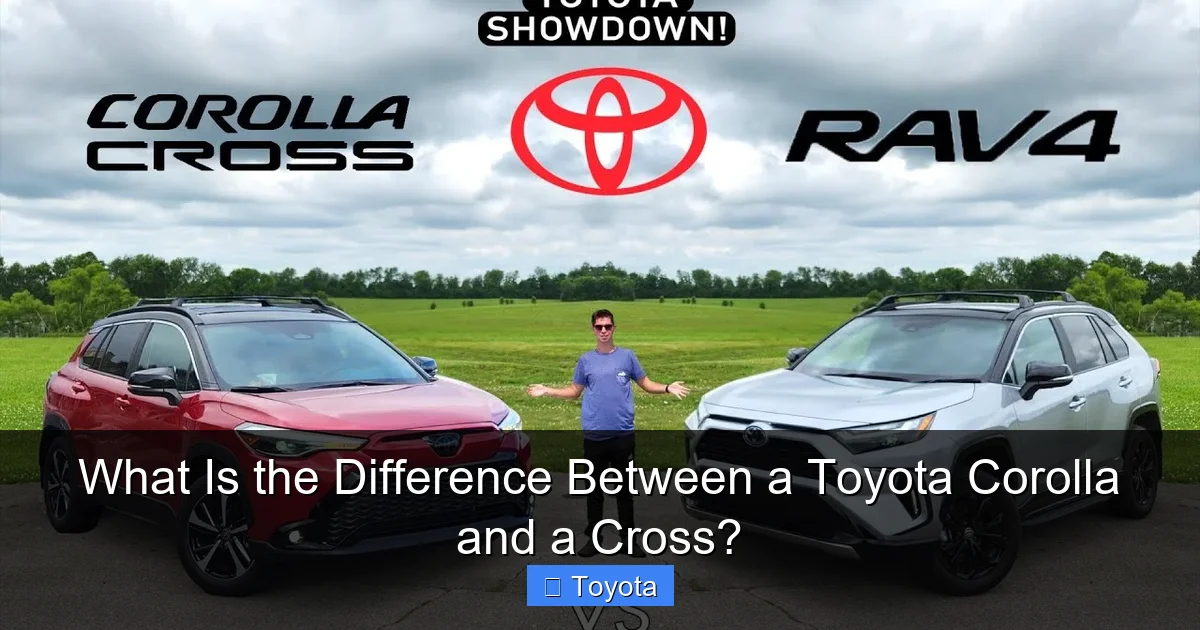
Visual guide about What Is the Difference Between a Toyota Corolla and a Cross?
Image source: i.ytimg.com
Passenger Comfort and Seating
Front-seat occupants will find very similar legroom and shoulder room in both vehicles. The driving position, however, is worlds apart. In the Corolla sedan, you slide down into the cabin, with the dashboard stretching out before you. It feels engaging and driver-focused. In the Corolla Cross, you sit higher up, almost at table height, looking out over a shorter hood. This “commanding view” is a huge plus for many drivers, especially those who feel cramped in low-slung sedans or have difficulty getting in and out of cars.
Rear-seat passengers also notice a difference. While rear legroom is competitive in both, the Corolla Cross’s taller greenhouse (the window area) provides a more open, airy feel. The sedan’s sloping rear roofline can make the rear seat feel slightly more claustrophobic for taller passengers, especially on longer trips. For families with growing teens or adults who frequently ride in back, the Cross’s extra headroom is a tangible benefit.
Cargo Capacity: The Defining Practical Difference
This is the single biggest functional divergence. The Corolla sedan has a traditional trunk with a fixed rear window and a lid that opens upward. It offers a respectable 13.1 cubic feet of cargo space. It’s great for luggage, groceries in bags, and items that fit neatly inside. However, loading bulky items like a large dog crate, a flat-pack furniture box, or a mountain bike with the front wheel on can be a challenge due to the tall, narrow trunk opening and the lip at the cargo floor.
The Corolla Cross, with its wide-opening liftgate, offers a massive 25.5 cubic feet of cargo space behind the rear seats—nearly double the sedan’s capacity. That number swells to about 66 cubic feet with the rear seats folded, creating a flat, voluminous load floor from the tailgate to the front seats. Loading is exponentially easier. You can slide in heavy items without lifting them over a high lip, and the square shape is perfect for最大化利用空间. If your lifestyle involves camping gear, sports equipment, DIY projects, or frequent trips to the garden center, the Cross’s hatch utility is a game-changer. For a deeper dive into the specific mechanics of the Cross’s fuel door and other practical features, you might find our guide on how to open the gas tank on a Toyota Corolla Cross useful.
Performance & Efficiency: Powertrain Parity
Here, the siblings are much more closely related, which is good news for everyone.
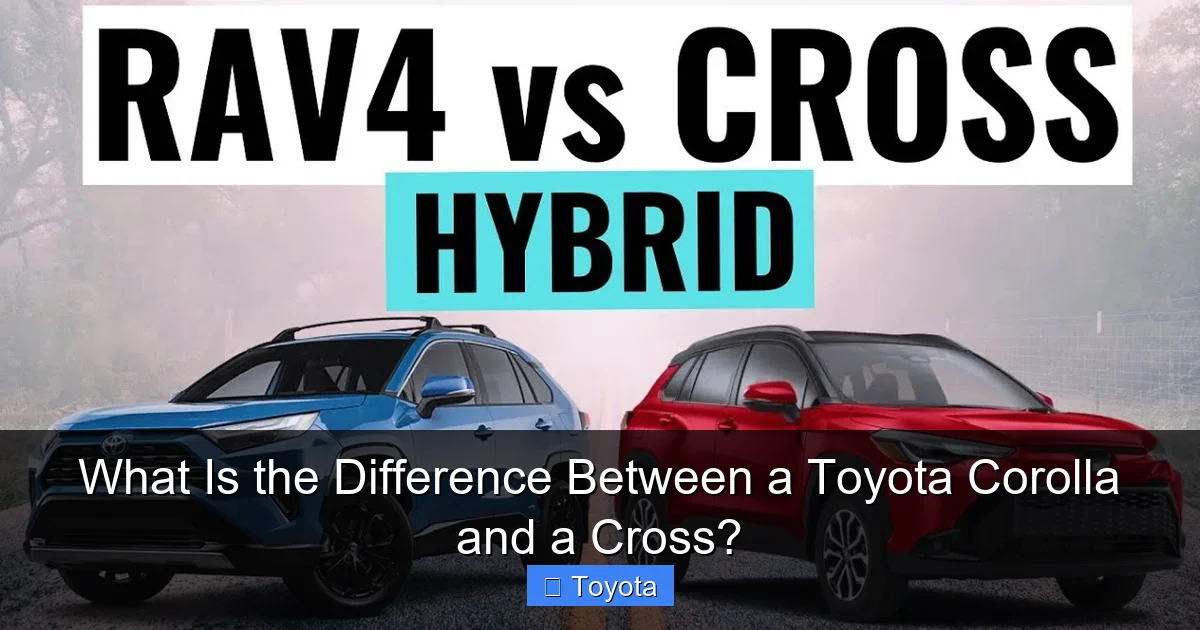
Visual guide about What Is the Difference Between a Toyota Corolla and a Cross?
Image source: i.ytimg.com
Engine and Powertrain
Both the Corolla sedan and Corolla Cross are powered by the same proven 2.0-liter four-cylinder engine (in most mainstream trims). This engine, paired with a continuously variable transmission (CVT) designed to simulate gear shifts, produces 169 horsepower and 151 lb.-ft. of torque. The driving experience is nearly identical: adequate, smooth, and focused on efficiency rather than excitement. Acceleration is leisurely but sufficient for merging and passing. The CVT can make the engine sound busy under hard acceleration, but it’s effective at keeping the car in its optimal power band for fuel savings.
There is also a hybrid powertrain available for the Corolla sedan (and separately for the Cross, as the Corolla Cross Hybrid). The hybrid system combines a gasoline engine with electric motors for even greater fuel efficiency, though with a different, quieter driving character. If your primary goal is minimizing fuel stops, the hybrid versions of either model are the pinnacle of efficiency.
Real-World Fuel Economy
This is where the slight physical differences between the two vehicles have an impact. The Corolla sedan’s lower weight and more aerodynamic shape give it a small but measurable edge in fuel economy. For example, the front-wheel-drive (FWD) Corolla sedan with the 2.0L engine is EPA-rated at up to 31 mpg city / 40 mpg highway. The FWD Corolla Cross with the same engine is rated at 31 mpg city / 34 mpg highway. The difference is most noticeable on long highway drives, where the sedan’s sleek profile slices through air more efficiently. In stop-and-go city traffic, the numbers are nearly identical. The hybrid models of both vehicles achieve exceptional numbers, often in the 50 mpg range combined.
Drivetrain & Capability: The AWD Divide
This is the single most significant mechanical difference and a key decision point for buyers in colder climates or with specific needs.
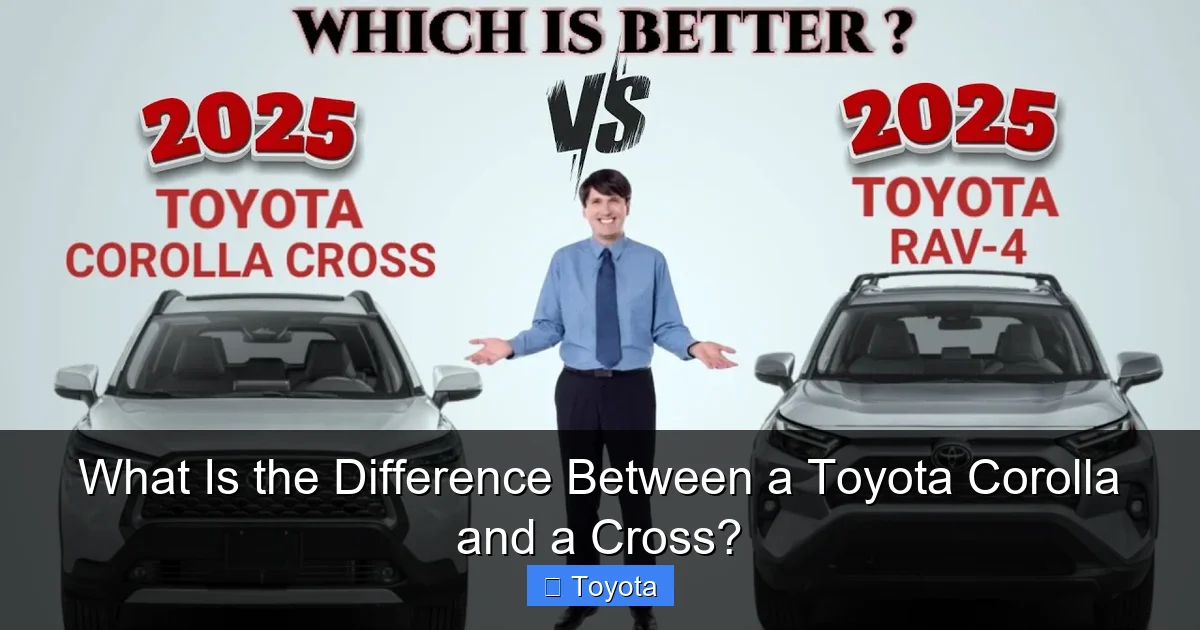
Visual guide about What Is the Difference Between a Toyota Corolla and a Cross?
Image source: i.ytimg.com
Front-Wheel Drive Standard
Every Toyota Corolla sedan comes standard with front-wheel drive (FWD). Power is sent to the front tires, which is perfectly adequate for dry and wet pavement. However, in snow, ice, or on loose surfaces, FWD cars can struggle for traction, especially when accelerating or climbing hills.
Available All-Wheel Drive on the Cross
The Toyota Corolla Cross offers an available Toyota-developed “intelligent” all-wheel drive (AWD) system. It’s not a rugged, lockable system for serious off-roading. Instead, it’s a predictive, on-demand system that can send up to 50% of the engine’s torque to the rear wheels when it senses slip. It’s designed primarily for enhanced stability and confidence on slippery roads—think snowy mornings, wet leaves, or gravel driveways. For anyone living in regions with winter weather, the peace of mind and real-world traction advantage of AWD is a major point in the Cross’s favor. It transforms the vehicle from a fair-weather friend to a capable all-season companion. This system is not available on the Corolla sedan at all.
Towing and Light Duty
Neither vehicle is a tow truck. The Corolla sedan is not rated for towing. The Corolla Cross, with its more robust crossover architecture and available AWD, has a maximum towing capacity of 1,500 pounds when properly equipped. This is enough for a small utility trailer, a personal watercraft, or a light camper. It opens up a world of light-duty utility the sedan simply cannot offer. For context, Toyota’s larger RAV4 has a much higher capacity; you can explore the specifics of that class in our article on what is the towing capacity of a Toyota RAV4.
On the tech front, the two models are remarkably similar, as they share much of their infotainment and safety hardware.
Infotainment and Connectivity
Both offer Toyota’s latest audio multimedia system, which includes a standard touchscreen (8-inch or available 12.3-inch depending on trim), wireless Apple CarPlay and Android Auto, and standard Wi-Fi Connect via the Toyota app. USB ports are plentiful. The user interface is the same, meaning the learning curve is zero if you switch between them. Higher trims on both models offer premium audio systems and advanced navigation.
Toyota Safety Sense 3.0
This is a major win for both. Every single Corolla sedan and Corolla Cross comes standard with the latest Toyota Safety Sense 3.0 suite. This includes:
- Pre-Collision System with Pedestrian Detection
- Full-Speed Range Dynamic Radar Cruise Control
- Lane Departure Alert with Steering Assist
- Road Sign Assist
- Proactive Driving Assist (new for 2024 models)
This means you get a comprehensive suite of active driver-assist technologies as standard equipment, regardless of which model you choose. It’s a huge value proposition.
Target Audience: Which One Is For You?
After all the specs and comparisons, this is the most important section. The best car is the one that fits your life.
Choose the Toyota Corolla Sedan If…
You prioritize maximum fuel efficiency above all else. You do most of your driving on highways and want the quietest, most stable ride at speed. You rarely need to haul bulky items and are happy with a traditional trunk for luggage and groceries. You prefer a lower, sportier driving position. Your budget is tighter, and you want the absolute lowest starting price and best long-term value. You live in a warm climate with minimal snow and don’t need AWD. Your daily commute is the primary duty, and you want the car that will do it for the least amount of money per mile.
Choose the Toyota Corolla Cross If…
You want a higher seating position and easier access. You frequently carry cargo that doesn’t fit neatly in a sedan trunk—think strollers, sports gear, or home improvement items. You live in an area with snow, ice, or rough roads and value the security of available all-wheel drive. You have small children or pets and appreciate the easier loading height of a hatchback. You want a more versatile, “do-it-all” vehicle for weekend adventures, even if they’re just to the trailhead or farmer’s market. The slight penalty in highway fuel economy is a worthy trade-off for the massive gain in everyday utility and capability.
Conclusion: Two Excellent Choices, Different Paths
The Toyota Corolla and Corolla Cross are both fantastic vehicles that uphold Toyota’s legendary reputation for reliability and value. They are not competitors in a vacuum; they are different tools for different jobs. The Corolla sedan is the refined, efficient master of the road, perfect for the commuter who wants low cost of ownership and a smooth, car-like drive. The Corolla Cross is the adaptable, capable all-rounder, perfect for the active family or individual who needs more space, a higher view, and the confidence of available AWD, all wrapped in a compact, easy-to-park package.
Your decision should boil down to one question: what do you need your vehicle to do? If the answer centers on efficient point-A-to-point-B travel with minimal fuss, the Corolla is your champion. If your answer involves hauling, exploring, and tackling less-than-ideal weather with a smile, the Corolla Cross is your versatile partner. You truly can’t go wrong with either, but now you know exactly which one is right for you.
Frequently Asked Questions
Is the Toyota Corolla Cross just a taller Corolla?
Essentially, yes. The Corolla Cross uses the same platform, engine, and core technology as the Corolla sedan but is wrapped in a taller crossover SUV body. This fundamentally changes its utility, ride height, and available drivetrain (AWD).
Which is more fuel-efficient, the Corolla or the Corolla Cross?
The Corolla sedan is slightly more fuel-efficient, especially on the highway, due to its lower weight and more aerodynamic shape. The difference is most pronounced in EPA estimates, with the Cross sacrificing about 6 highway MPG for its added utility and height.
Does the Corolla Cross have more cargo space than the Corolla?
Absolutely. The Corolla Cross has nearly double the cargo space behind the rear seats (25.5 cu ft vs. 13.1 cu ft) thanks to its hatchback design. With the rear seats folded, the Cross offers a massive 66 cu ft versus the sedan’s 15.1 cu ft.
Can you get all-wheel drive in a regular Corolla sedan?
No. The Toyota Corolla sedan is only available with front-wheel drive. All-wheel drive is an exclusive option on the Corolla Cross (and the Corolla Hybrid, which uses a different hybrid-specific AWD system).
Is the Corolla Cross more expensive than the Corolla?
Yes. The Corolla Cross has a slightly higher starting MSRP than the base Corolla sedan, reflecting its added crossover utility, standard higher seating position, and the option of AWD. The price gap varies by trim but is typically a few thousand dollars.
Which is better for a family with small children?
For most families, the Corolla Cross is the more practical choice. The higher seating position makes loading car seats easier, the wide hatch provides simpler access for strollers and gear, and the extra cargo space is invaluable for all the paraphernalia that comes with kids. The available AWD is also a safety plus in winter conditions.