
How Much Does It Cost to Replace Brakes on a Toyota Camry

Replacing the brakes on a Toyota Camry typically costs between $300 and $800 per axle, depending on your model year, trim level, and whether you choose OEM or aftermarket parts. Front brakes are usually more expensive than rear brakes. A complete brake job (pads, rotors, and hardware) will be at the higher end of that range, while a simple pad slap is at the lower end. Always get multiple quotes and consider the long-term value of quality parts for your safety.
Key Takeaways
- Total cost varies widely: Expect to pay $300-$800 per axle for a full pad and rotor replacement, with front brakes costing more than rear.
- Parts choice is a major factor: OEM Toyota parts are pricier but often come with a warranty; high-quality aftermarket can offer savings.
- Labor rates differ by region: Shop hourly rates can range from $80 to $150+, significantly impacting your final bill.
- Your Camry’s year and trim matter: Hybrid models and higher trims (XLE, XSE) may have larger, more expensive brake components.
- DIY can save money but has risks: A pad-only replacement is manageable for skilled DIYers, but rotor work requires tools and expertise.
- Don’t ignore other components: Mechanics often recommend replacing calipers, hardware, and lubing slides at the same time for a true “complete” job.
- Regular inspection prevents costly damage: Worn pads can destroy rotors and calipers, turning a $400 job into a $1,500+ repair.
📑 Table of Contents
- So, Your Toyota Camry Needs New Brakes. Now What?
- The Big Picture: What’s Included in a “Brake Job”?
- Breaking Down the Cost: Parts vs. Labor
- How Your Specific Camry Model Changes the Price
- DIY vs. Professional Installation: Where Do You Save?
- Smart Strategies to Save Money (Without Sacrificing Safety)
- The Maintenance Mindset: Making Your Brakes Last Longer
- Final Thoughts: Safety First, Cost Second
So, Your Toyota Camry Needs New Brakes. Now What?
Let’s be real. Hearing a screech, a squeal, or a grinding noise from your Toyota Camry’s wheels is enough to make any driver’s stomach drop. It’s not just an annoying sound; it’s your car’s way of saying, “Hey, I need some attention up here!” Brakes are your single most important safety system. When they need service, the big question is always, “How much is this going to hurt my wallet?”
We’re here to give you the complete, no-nonsense breakdown of the cost to replace brakes on a Toyota Camry. This isn’t a guess from a quick internet search. This is a detailed look at what you’re actually paying for, why prices differ, and how you can make the smartest decision for your specific car and budget. We’ll talk parts, labor, model years, and even touch on whether you should consider doing it yourself. By the end, you’ll walk into any repair shop or parts store armed with the knowledge to get a fair price and keep your reliable Camry stopping safely for years to come.
The Big Picture: What’s Included in a “Brake Job”?
Before we dive into dollars and cents, we need to clear up a huge point of confusion. When someone says “brake replacement,” they could mean several different things, and the cost changes dramatically with each one. It’s crucial to know exactly what you’re being quoted for.

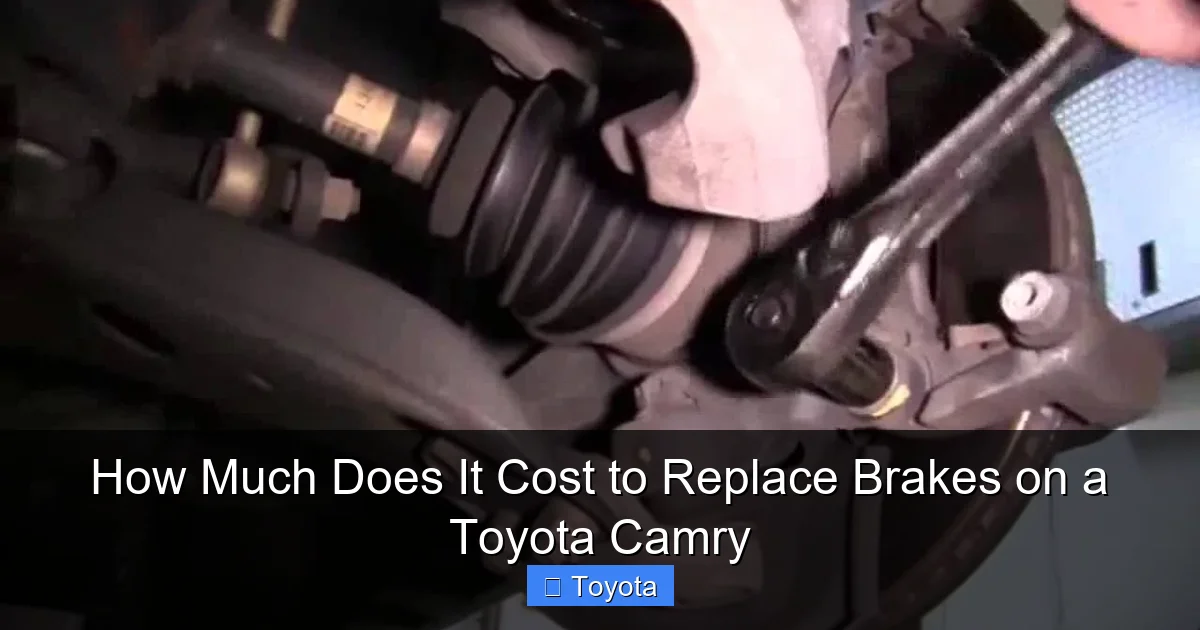
Visual guide about How Much Does It Cost to Replace Brakes on a Toyota Camry
Image source: i.ytimg.com
The Three Levels of Brake Service
Think of brake service like a menu. You can order the appetizer, the main course, or the full tasting menu.
- Pad Slap (The Appetizer): This is the most basic and cheapest service. The technician removes the old brake pads and installs new ones. They might clean the caliper slides and hardware, but the rotors are left untouched. This is only a viable option if your rotors are perfectly smooth, within thickness spec, and have no grooves or warping. Cost: $150 – $300 per axle.
- Pad & Rotor Replacement (The Main Course): This is what most people mean by a “complete brake job.” Both the friction material (pads) and the metal disc they squeeze (rotor) are replaced. It’s the standard recommendation when rotors are worn, grooved, or warped. This is the most common quote you’ll get. Cost: $300 – $800 per axle.
- The Full Tasting Menu: This is the most comprehensive and expensive service. It includes new pads, new rotors, new caliper slide pins and hardware (the clips and springs), and often a caliper rebuild or replacement if needed. It may also include brake fluid flush. This is done on high-mileage vehicles or if calipers are sticking. Cost: $600 – $1,200+ per axle.
Always ask the shop, “What exactly does this price include?” A low quote for just pads can suddenly double if they find bad rotors once the wheels are off.
Breaking Down the Cost: Parts vs. Labor
For a standard pad and rotor replacement on a typical Camry, the total bill is usually split roughly 50/50 between parts and labor. But that split can change based on your choices.
Visual guide about How Much Does It Cost to Replace Brakes on a Toyota Camry
Image source: i.ytimg.com
The Parts Price Tag: OEM vs. Aftermarket
This is where you have the most control. The cost of the physical brake components can vary wildly.
- OEM (Original Equipment Manufacturer): These are parts made by Toyota or their direct suppliers (like Akebono or Advics). They’re what was on your car when it rolled off the lot. Pros: Perfect fit, guaranteed quality, often come with a 12-month/12,000-mile warranty. Cons: They are the most expensive option. A set of front pads and rotors from a Toyota dealer can easily run $400-$600+.
- Premium Aftermarket: Brands like Brembo, Akebono (who also makes OEM), Power Stop, and EBC. These are high-quality, often performance-oriented parts. They can be equal to or even better than OEM. Prices are typically 15-30% lower than OEM. A great middle ground for quality and cost.
- Standard Aftermarket: The generic brands found at most auto parts stores. Quality can be inconsistent. They are the cheapest, often 40-50% less than OEM. For a daily driver like a Camry, decent standard aftermarket is acceptable, but you may get more brake dust and slightly less longevity.
Real-World Example: For a 2020 Toyota Camry SE (a very common model), a quick online check shows OEM front pads/rotors from a dealer could be ~$550. A premium aftermarket kit from a brand like Power Stop might be ~$350. A standard aftermarket kit could be ~$220. That’s a $330 swing just in parts before labor is even added.
The Labor Equation: Why It’s Not Just “Hourly Rate x Time”
Brake jobs seem simple, but there’s more to it than unbolting old parts and bolting on new ones. A proper job includes:
- Rotor Removal & Cleaning: Caliper bolts are often seized. The rotor can be rusted to the hub. This can add significant time.
- Caliper Service: The caliper piston must be compressed (sometimes requiring a special tool for rear calipers). Slide pins must be cleaned, lubed, and new boots installed. This is critical for even pad wear.
- Hardware Replacement: The anti-rattle clips and springs are cheap parts but are usually replaced because they’re corroded and brittle. Reusing them is a false economy.
- Bedding/Pad Installation: New pads need a specific surface and sometimes a special shim or compound.
- Torquing: Every bolt must be torqued to spec with a proper torque wrench. This takes time.
A good mechanic will book 1.5 to 2.5 hours per axle for a full pad/rotor job. At a shop charging $120/hour, that’s $180 – $300 in labor alone. Dealerships often have higher labor rates ($140-$180/hr) but may have more specialized Toyota technicians.
How Your Specific Camry Model Changes the Price
Not all Toyota Camrys are created equal when it comes to brakes. Here’s how your specific vehicle impacts the bottom line.

Visual guide about How Much Does It Cost to Replace Brakes on a Toyota Camry
Image source: i.ytimg.com
Model Year & Generation
The current Camry (XV70, 2018-present) has different brake setups than the previous generation (XV60, 2012-2017). Parts availability and pricing can vary. Older Camrys (like 2007-2011) might have cheaper, more common parts, but finding quality replacements for older models can sometimes be trickier.
Engine & Trim Level (The Big Factor)
This is a huge one. A base-model Camry L with a 2.5L 4-cylinder has smaller, lighter brakes than a Camry XSE V6 or a TRD model.
- 4-Cylinder Models (L, LE, SE): Generally have the smallest, most affordable brake components. They are the lowest cost for parts.
- V6 Models (XLE V6, XSE V6): Have larger front brakes to handle the extra power. Front rotors and pads are bigger and more expensive. Rear brakes are often similar to the 4-cylinder.
- Hybrid Models (LE Hybrid, XLE Hybrid): These use regenerative braking, which means the conventional friction brakes (pads/rotors) do less work and often last much longer. However, when they do need service, the parts are usually specific to the Hybrid model and can carry a premium. Don’t assume Hybrid brakes are cheaper; they’re often different.
- TRD Model: The Toyota Camry TRD comes with upgraded brakes from the factory—larger rotors and red calipers. Replacing these with OEM-level parts will be significantly more expensive than a standard Camry SE.
Example: A set of front pads and rotors for a 2022 Camry LE 4-cylinder might be $350 (aftermarket). The same service on a 2022 Camry XSE V6 could be $500-$550 for larger, V6-specific parts.
DIY vs. Professional Installation: Where Do You Save?
The allure of saving a few hundred dollars on labor is strong. But brake work is one area where DIY can be a fantastic save or a costly mistake.
When DIY Makes Sense (The Pad-Only Job)
If your rotors are in perfect shape (measured with a micrometer for thickness and runout), and you only need pads, this is a perfect beginner-to-intermediate DIY project. You need basic tools: socket set, C-clamp or brake caliper tool, jack and stands, and a good torque wrench. You’ll save 100% on labor. Cost: $100 – $250 for parts.
The Risks of DIY (Rotors & Calipers)
The moment rotors are involved, the complexity and risk jump.
- Stuck/Broken Bolts: Caliper bracket bolts or rotor retaining screws can be rusted solid. Applying too much force can break them, turning a $400 job into a $1,000+ caliper bracket or hub assembly replacement.
- Improper Torque: Over-torquing can stretch or break bolts. Under-torquing is a major safety hazard. You need a calibrated torque wrench and the factory specs.
- Caliper Issues: If a caliper piston doesn’t retract smoothly or a slide pin is seized, you may need a new caliper. Diagnosing this requires experience.
- Rotor Runout: Installing a new rotor incorrectly (not cleaning the hub surface, not torquing lug nuts in star pattern) can cause dangerous vibration (pulsation) that feels like a warped rotor immediately after installation.
Bottom Line: If you’re comfortable with tools, have done brake jobs before, and your rotors are the only issue, DIY is viable. If there’s any rust, seized parts, or if you’re unsure, pay a professional. Your safety and the safety of others on the road is not worth a $200 labor save. Remember, a botched brake job can lead to a total brake failure. It’s better to view professional installation as an insurance policy on your safety.
Smart Strategies to Save Money (Without Sacrificing Safety)
You don’t have to choose between financial ruin and unsafe brakes. Here’s how to be a savvy consumer.
1. Get Multiple, Detailed Quotes
Never just take the first quote. Call 2-3 reputable independent shops and a dealership. Give them your exact Camry’s year, make, model, and trim (found on your driver’s door jamb sticker). Ask them to break down the quote: “Can you itemize the cost for front pads, front rotors, labor hours, and any hardware?” This lets you compare apples to apples. A shop quoting $550 for “front brakes” might be using OEM parts, while another at $450 might be using aftermarket.
2. Buy Parts Yourself (If Using an Independent Shop)
Many independent shops will install customer-supplied parts for a reduced labor rate. This gives you full control over part quality and price. You can hunt for deals on premium aftermarket pads and rotors online or at big-box stores. Crucially: Call the shop first. Some won’t warranty the work if you supply your own parts, as they can’t guarantee the part’s quality. This is a common and acceptable policy.
3. Consider “Pad-Only” Only If Truly Viable
If a shop says you only need pads, get a second opinion. Ask them to show you the rotors. Are they scored? Can you feel groves with your fingernail? Are they below the minimum thickness stamped on the edge? If the answer is yes to any, you need rotors. A pad slap on bad rotors is a waste of money as the new pads will be destroyed in weeks.
4. Don’t Neglect the Rear
On many modern Camrys, the rear brakes are drum brakes (especially on base models). Drum brakes are cheaper to replace than discs, but they also wear out and can cause pulling or noise. A full “brake job” often means front AND rear. Make sure your quote specifies which axle(es) are being done. Replacing only the fronts because they’re worn, while the rears are shot, will lead to imbalance and poor braking.
5. Bundle for Savings
If your Camry is due for other services (like an oil change, transmission fluid, or coolant flush), see if the shop will bundle them. They might offer a discount on the total labor. It also saves you a separate trip and diagnostic fee later. While you’re budgeting for brake service, it’s a good time to think about other maintenance. For instance, if you notice a leak, checking the cost to fix an oil leak at the same time can be efficient.
The Maintenance Mindset: Making Your Brakes Last Longer
The best way to manage brake costs is to delay the need for replacement as long as safely possible. Good driving habits are your free brake maintenance.
Drive Smoothly, Stop Smoothly
Aggressive, last-minute braking is the #1 killer of brake pads. It generates extreme heat and friction. Practice the “one-second rule”: look far ahead and anticipate traffic. Coast when you can. This gentle slowing preserves both pads and rotors. Highway driving causes very little brake wear; city stop-and-go is the real wearer.
Your Vehicle’s Weight Matters
A fully loaded Camry (roof rack, cargo, passengers) puts more stress on the brakes. If you’re a frequent road-tripper with a loaded roof carrier, your brakes will wear faster than a car that’s always empty. Be mindful of your load.
Regular Inspection is Non-Negotiable
Every oil change or tire rotation, ask the mechanic to quickly check your brake pad thickness (they have a tool for it) and look at the rotors. Catching worn pads at 3mm (new is typically 8-12mm) before they grind to the rotor saves you from a rotor replacement. Most shops will do this for free as part of a multi-point inspection. Don’t skip it.
The Right Fluids & Components
Brake fluid is hygroscopic—it absorbs water from the air over time. Old, water-laden fluid can corrode internal brake system components (calipers, master cylinder). A brake fluid flush every 2-3 years is cheap insurance against expensive caliper or master cylinder failures down the line. Also, when replacing pads, ensure the shop uses new, high-quality hardware (clips, shims). Reusing old, corroded hardware causes pads to drag and wear unevenly.
Final Thoughts: Safety First, Cost Second
So, how much does it cost to replace brakes on a Toyota Camry? The honest answer is: it depends. A basic pad job on a 4-cylinder base model from an independent shop using good aftermarket parts might land you at $350-$500 total for both front axles. A full pad and rotor job on a V6 or Hybrid at a dealership with OEM parts can easily hit $900-$1,400 for the front axle alone.
Your takeaway should be this: get educated, get multiple specific quotes, and never compromise on the quality of the core safety components. A brake failure is catastrophic. Spending a little more on better parts or a reputable shop is an investment in your peace of mind and the safety of your family. Treat your Camry’s brakes with the respect they deserve, and your trusty sedan will continue to be the safe, reliable hauler it was built to be for many more miles. And while you’re keeping your Camry in top shape, you might also consider cosmetic upkeep—some owners choose to wrap their Toyota Camry to protect the original paint from road debris and sun damage, which is another smart way to maintain your vehicle’s long-term value.
Frequently Asked Questions
What are the signs my Toyota Camry brakes need replacing?
Listen for high-pitched squealing (wear indicator), grinding (metal-on-metal), or feel a pulsation in the pedal/steering wheel (warped rotor). Also, check pad thickness visually through the wheel spokes; if less than 1/4 inch, they’re worn.
How often do brakes need to be replaced on a Camry?
There’s no set mileage. It depends heavily on driving style. Front brakes on a Camry typically last 30,000-70,000 miles. Highway drivers can see 70k+, while aggressive city drivers may need them at 25k. Always inspect them regularly.
Is it cheaper to replace brakes at a dealership or an independent shop?
Generally, independent shops are 15-30% cheaper on labor and often on parts. Dealerships use OEM parts and have Toyota-specific training, but you pay a premium for both. For a Camry, a reputable independent shop is often the best value.
Should I replace all four brakes at once?
Not necessarily. Brake wear is proportional to the vehicle’s weight distribution and driving habits. Typically, front brakes wear 2-3 times faster than rear brakes due to weight transfer during braking. It’s common to replace fronts twice before rears need service. Always inspect all wheels.
Can I just replace the pads and not the rotors?
Only if your rotors are above the minimum thickness, have no grooves, and are not warped. A shop should measure them with a micrometer. If they’re worn or damaged, new pads will be destroyed quickly and you’ll have poor braking performance.
What’s the average cost for a complete brake job (all four wheels) on a Camry?
For a full pad and rotor replacement on all four wheels on a typical 4-cylinder Camry using quality aftermarket parts, budget $600 – $1,200 total. For a V6 or Hybrid, or with OEM parts, it can range from $1,000 to $1,800+. Always get an itemized quote specific to your VIN.
