
How Do You Turn Off the Service Engine Soon Light on a Toyota Camry?

Never just turn off the Service Engine Soon light without fixing the underlying problem first. This light is your Camry’s way of telling you something is wrong with the emissions or engine system. The only correct way to reset it is to diagnose the issue with an OBD2 scanner, perform the necessary repair, and then clear the code. Ignoring the cause can lead to expensive damage and failed emissions tests.
Key Takeaways
- The Service Engine Soon light indicates an emissions-related fault. It is not a maintenance reminder like the “MAINT REQUIRED” light.
- You must diagnose and repair the problem before resetting the light. Simply turning it off will mask the issue, causing more damage and higher repair costs later.
- An OBD2 scanner is the essential tool for this job. It reads the specific trouble code that triggered the light, pointing you to the faulty component or system.
- Common causes range from a loose gas cap to faulty oxygen sensors. Start with the simplest, most likely issues before assuming major failure.
- After a successful repair, the light resets automatically or can be cleared manually. Driving the car through a specific cycle may also turn it off once the computer sees the problem is resolved.
- If the light flashes, pull over safely and shut off the engine immediately. A flashing light signals a severe misfire that can destroy your catalytic converter.
- When in doubt, consult a professional. Some diagnostic work requires advanced knowledge and tools to avoid misdiagnosis.
📑 Table of Contents
Understanding Your Toyota Camry’s Service Engine Soon Light
Let’s be honest: seeing that little yellow light illuminate on your dashboard—the one that says “Service Engine Soon”—can send a jolt of anxiety through any driver. Your mind races with thoughts of costly repairs and being stranded. But what does it really mean, and more importantly, what should you actually do about it? This comprehensive guide will walk you through everything you need to know about dealing with this light on your Toyota Camry, from understanding its true meaning to the safe and correct way to make it go off for good.
First, a critical distinction: the “Service Engine Soon” light (often called the Check Engine Light) is completely different from your Camry’s “MAINT REQUIRED” light. The latter is a simple mileage-based reminder for routine oil changes and basic maintenance. You can reset that yourself after an oil change. The Service Engine Soon light, however, is tied directly to your car’s On-Board Diagnostics (OBD-II) system. It means the engine computer (ECU) has detected a problem that could increase your vehicle’s emissions. It’s a warning from your car’s brain that something isn’t operating within its expected parameters.
What It Actually Means
When your 1996 or newer Camry’s Service Engine Soon light comes on, it means the ECU has stored at least one Diagnostic Trouble Code (DTC). This code is a specific alphanumeric identifier, like P0171 (System Too Lean) or P0420 (Catalyst System Efficiency Below Threshold). The light itself is a general warning; the code is the specific diagnosis. The ECU constantly monitors dozens of sensors and systems—oxygen sensors, fuel trims, ignition system, evaporative emissions (EVAP) system, and more. When a reading falls outside the acceptable range, it sets a code and turns on the light to get your attention.
How It Differs from the Maintenance Light
It’s easy to confuse the two, but they serve entirely different purposes. The maintenance light on a Toyota, including the Camry, is a simple countdown timer based on mileage and sometimes engine run time. It’s purely for scheduled upkeep. You can find instructions for that in your owner’s manual or through resources on how to turn off the maintenance light on a Toyota. The Service Engine Soon light is an urgent diagnostic alert. Confusing these can lead you to ignore a serious problem by simply resetting a maintenance timer.
Why You Should Never Just “Turn It Off”
Here is the most important rule: Do not use a code reader or disconnect the battery to erase the light without first addressing the underlying issue. This is not a shortcut; it’s a recipe for disaster. Think of it like ignoring a fever by taking a cold bath. The symptom (the light) goes away temporarily, but the illness (the mechanical problem) worsens unseen.
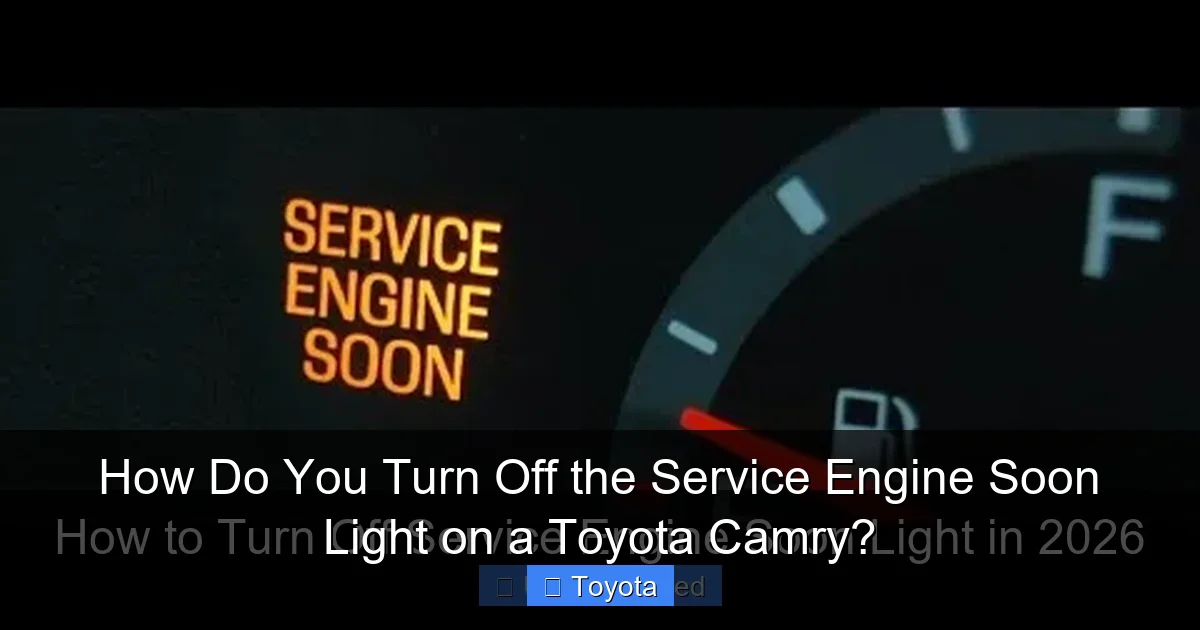
Visual guide about How Do You Turn Off the Service Engine Soon Light on a Toyota Camry?
Image source: enginelightfixers.com
The Danger of Ignoring Root Causes
That small, steady light is your first line of defense against escalating damage. A faulty oxygen sensor, for example, will cause your engine to run inefficiently, burning more fuel and potentially overheating the catalytic converter. A misfiring cylinder (often indicated by a flashing light) can dump unburned gasoline into the exhaust, destroying the expensive catalytic converter within minutes. By simply resetting the light, you silence the alarm but allow the problem to fester. What might have been a $200 sensor replacement can turn into a $2,000+ catalytic converter replacement. Furthermore, you will fail your mandatory emissions test, as the test equipment will see the light is on or that the ECU has incomplete readiness monitors.
Real-World Examples of What Can Happen
Consider a common Camry issue: a failing mass airflow sensor (MAF). It might cause a P0101 code. If you clear the code and keep driving, your engine will run poorly, fuel economy will plummet, and you risk damaging spark plugs and the catalytic converter from an incorrect air/fuel mixture. Another example is a P0440 code for an EVAP system leak, often caused by a loose or faulty gas cap. While this seems minor, a large leak can affect engine performance. But if you ignore a small leak, it can grow, and a compromised EVAP system can lead to fuel vapor leaks, which are both an environmental hazard and a fire risk in extreme cases.
The Diagnostic Process: Finding the Real Problem
The path to turning off that light starts not with a reset, but with a diagnosis. This is the non-negotiable first step. You need to know the specific trouble code(s) to understand what the ECU is complaining about. This requires an OBD-II scanner.
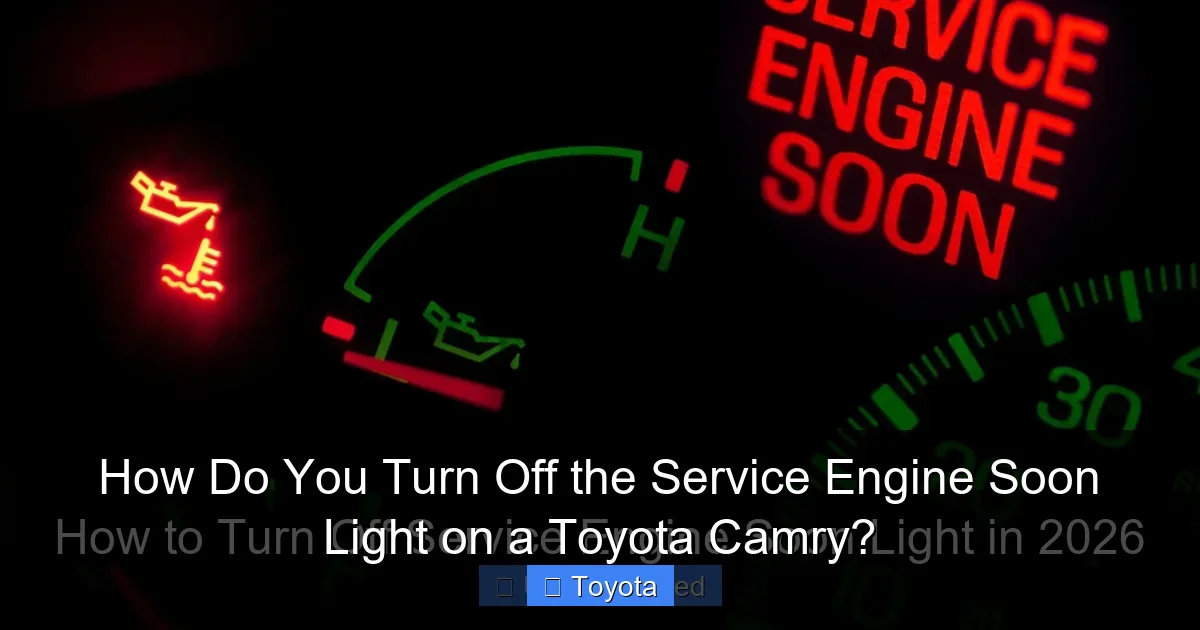
Visual guide about How Do You Turn Off the Service Engine Soon Light on a Toyota Camry?
Image source: enginelightfixers.com
Reading the Trouble Codes
1. Locate the OBD-II Port: Under the dashboard, just below the steering column on the driver’s side, you’ll find a 16-pin trapezoidal connector. This is your Camry’s diagnostic port.
2. Connect Your Scanner: Plug your OBD2 code reader into the port. Turn your ignition to the “ON” position (do not start the engine).
3. Read Codes: Follow your scanner’s instructions to communicate with the car’s computer and retrieve stored codes. You may get one code or several. Note them down exactly as they appear (e.g., P0301, P0302).
4. Research the Code: A code tells you what system is affected and how it’s out of spec, but not always the exact failed part. For example, a P0301 code means “Cylinder 1 Misfire Detected.” The cause could be a bad spark plug, ignition coil, fuel injector, or even a vacuum leak. You must now perform targeted troubleshooting based on the code. Your owner’s manual or reputable online automotive resources can provide the manufacturer’s specified troubleshooting procedures for each code.
Common Toyota Camry Trouble Codes
While hundreds of codes are possible, some are frequent on Camrys. A P0171/P0174 (System Too Lean) often points to a vacuum leak or dirty MAF sensor. P0420/P0430 (Catalyst Efficiency Below Threshold) usually means a failing catalytic converter, but can also be caused by a bad oxygen sensor or exhaust leak before the converter. P0300-P0304 (Random/Multiple Cylinder Misfire or specific cylinder) requires checking ignition components. P0440-P0446 are EVAP system codes, with a loose gas cap being the prime suspect for P0440. Always start with the simplest, most accessible checks for any code.
- Gas Cap: Ensure it’s tightened until it clicks. Inspect the seal for cracks. A loose cap is a top cause of EVAP codes.
- Air Intake: Check for cracked or disconnected hoses from the air filter box to the throttle body.
- Spark Plugs & Coils: On many Camry models, a failed ignition coil on a specific cylinder is a common misfire cause. Swapping coils between cylinders and rechecking codes can confirm this.
- Oxygen Sensors: These wear out. Bank 1 Sensor 1 (before the cat) is a common failure point.
How to Reset the Light After a Repair
Once you have identified the faulty component and successfully completed the repair—replaced the gas cap, changed the oxygen sensor, fixed the vacuum leak—the Service Engine Soon light will often turn off on its own. The ECU runs a series of self-tests called “drive cycles.” After the repair, it needs to see that the fault is gone and that all systems pass their tests over a certain number of drive cycles (usually 1-3). However, you can manually clear the codes to turn off the light immediately after you’re confident the repair is sound.
Visual guide about How Do You Turn Off the Service Engine Soon Light on a Toyota Camry?
Image source: i.ytimg.com
Method 1: Using an OBD2 Scanner (The Best Way)
This is the professional and most reliable method. After your repair:
- Reconnect your OBD2 scanner to the port.
- Turn the ignition to “ON.”
- Use the scanner’s menu to find the “Clear Codes” or “Erase DTCs” function.
- Execute the clear command. The light should go out immediately.
- Crucially: Do not disconnect the scanner or turn off the ignition yet. Use the scanner to check the status of the “MIL” (Malfunction Indicator Lamp) and the “Readiness Monitors.” The light is off, but the monitors will show as “Incomplete” or “Not Ready.” You must now drive the car under varying conditions (city, highway, idle, deceleration) to allow the ECU to re-run all its tests. Once all monitors show “Ready” or “Complete,” the ECU is fully verified. If the problem was truly fixed, the light will stay off. If it wasn’t, the code will return and the light will illuminate again after the drive cycle.
Method 2: The Battery Disconnect (Use with Caution)
This older method can clear codes but also resets other systems.
- Turn off the engine and remove the key.
- Open the hood and locate the negative (-) battery terminal.
- Using a 10mm wrench, loosen the nut on the negative cable clamp and remove the cable from the terminal.
- Secure the cable so it cannot touch the terminal (tape it or hang it).
- Wait at least 10-15 minutes. This allows residual power to drain from the car’s modules, clearing their memory.
- Reconnect the negative cable and tighten the nut securely.
- Start the car. The light may be off, but you will likely need to perform a drive cycle for the monitors to set. Also, be prepared for your radio to ask for a code, your power windows to need re-initialization, and your idle to be rough for the first few minutes as the ECU relearns fuel trims.
Warning: On some newer vehicles, disconnecting the battery can cause issues with the ECU’s adaptive learning or even trigger the security system. Consult your owner’s manual first. For a Camry, this method generally works but the scanner method is superior.
Method 3: Driving Cycle (The Automatic Reset)
If you are confident your repair is correct, you can simply drive the car normally. The ECU will constantly check for the fault. If the repaired component’s signal is now within spec for a pre-programmed number of “warm-up cycles” (engine started from cold, driven until fully warmed up, then shut off), it will automatically turn off the light. This can take several days of normal driving. This method has the downside of driving with an illuminated light, which may cause anxiety and will cause you to fail an emissions test if conducted during this period.
When to Seek Professional Help
While many common codes are DIY-friendly, some situations absolutely require a qualified technician.
Complex or Multiple Codes
If your scan reveals multiple codes from different systems (e.g., an oxygen sensor code and a fuel trim code), the issues may be related or there could be a underlying problem like a major vacuum leak or wiring issue affecting multiple sensors. Diagnosing these interdependencies requires experience. Similarly, codes for complex systems like the Variable Valve Timing (VVT-i) or direct injection systems on newer Camrys often need advanced diagnostics beyond a simple code read.
Flashing MIL
A flashing Service Engine Soon light is a dire emergency. It indicates a severe engine misfire that is likely dumping raw fuel into your exhaust. Stop driving immediately in a safe location, shut off the engine, and have the vehicle towed to a repair shop. Continuing to drive even a short distance with a flashing light will almost certainly destroy your catalytic converter, leading to a repair bill in the thousands.
Safety-Related Codes
Some codes relate to safety systems. For instance, if your scan tool shows a code related to the airbag system (like on the Toyota Camry SRS), do not attempt to reset it yourself. Airbag systems are explosive and must be handled by professionals with specific safety knowledge. Resources on how to reset the airbag light on a Toyota Camry are for informational purposes only and stress professional intervention.
Preventing Future Illuminations
The best way to deal with the Service Engine Soon light is to prevent it from coming on in the first place. This comes down to proactive maintenance and addressing small issues before they trigger a fault.
Stick to Your Maintenance Schedule
Follow the severe or standard maintenance schedule in your owner’s manual religiously. This includes timely oil changes, air filter replacements, and spark plug changes. A clogged air filter can cause a lean condition. Worn spark plugs cause misfires. Both will set codes.
Address Minor Symptoms Immediately
Notice a slight rough idle? A small fuel smell? Decreased fuel economy? A new rattle? Don’t wait for the light. These are often the early warnings that a sensor is failing or a small leak has developed. Investigate and fix it while it’s still simple and cheap. For instance, a minor evaporative emissions leak that triggers a P0440 can often be solved by replacing a $15 gas cap or a $20 purge valve, rather than waiting for it to cause bigger problems.
Use Quality Fuel and Parts
Poor quality fuel can cause deposits and lead to misfires or oxygen sensor contamination. Stick to reputable stations. When replacing sensors or components, use OEM or high-quality aftermarket parts. Cheap, inferior parts can fail prematurely and trigger the very light you’re trying to avoid.
Conclusion: Knowledge is Power (and Savings)
That Service Engine Soon light on your Toyota Camry is not an enemy to be silenced; it’s a valuable communication tool from your vehicle’s sophisticated computer. The goal is never simply to “turn it off.” The goal is to listen to what it’s saying, diagnose the specific message using an OBD2 scanner, perform the correct repair, and then clear the code. By following this process, you protect your investment, ensure your car runs efficiently and cleanly, pass emissions tests, and avoid the cascade of costly failures that come from ignoring a small problem. Remember, a little knowledge and a $30 code reader can save you hundreds, even thousands, of dollars. If the diagnosis feels beyond your comfort zone, a trusted mechanic is always a wise investment. Your Camry will thank you with many more miles of reliable service.
Frequently Asked Questions
Can I drive my Toyota Camry with the Service Engine Soon light on?
It depends. If the light is steady and the car is running normally, you can drive it cautiously to get it diagnosed. However, if the light is flashing, the engine is misfiring, or you notice severe performance issues, you must stop driving immediately and have the car towed. Driving with a flashing light will destroy the catalytic converter.
How much does it typically cost to fix the problem causing the light?
The cost varies wildly based on the code. A simple loose gas cap is free to fix. A bad oxygen sensor might cost $200-$400. A failing catalytic converter can exceed $1,500. The diagnostic fee at a shop is usually $80-$120, which is a worthwhile investment to identify the exact problem before throwing parts at it.
Will disconnecting the battery reset the Service Engine Soon light?
Yes, disconnecting the negative battery terminal for 10-15 minutes will clear the codes and turn off the light. However, this is not a recommended solution because it does not fix the underlying problem. The light will return once the car’s computer completes its drive cycle and redetects the fault. It also resets other vehicle systems, requiring you to re-initialize radio presets and window settings.
What if the light comes back on after I reset it?
If the light returns after a reset and drive cycle, it means the repair was either not successful or the diagnosis was incomplete. The fault is still present. You must re-scan for codes, as a new code may have appeared or the same code may have returned, indicating the component you replaced was not the root cause or that a related component has now failed.
Is it safe to use a generic OBD2 code reader from an auto parts store?
Yes, for reading and clearing generic OBD-II codes. Any basic OBD2 scanner will retrieve the standard trouble codes (P0xxx, P2xxx) that apply to all 1996+ vehicles. However, it may not access manufacturer-specific codes (P1xxx) or advanced Toyota system data. For most common issues, a basic reader is perfectly adequate for diagnosis and resetting.
How long does it take for the light to go off after fixing the problem?
If you clear the code with a scanner, it goes off immediately. The car then needs to complete its “drive cycle” to set all readiness monitors, which can take 50-100 miles of mixed driving (including specific conditions like steady highway speed and idle). If you don’t clear the code, the ECU will automatically turn off the light once it verifies the problem is gone over 1-3 warm-up cycles, which could take several days of normal driving.
