
How Many Miles per Gallon Does a Toyota Venza Hybrid Get?

The 2023-2024 Toyota Venza Hybrid delivers impressive fuel efficiency, with EPA estimates of up to 40 MPG combined. In real-world driving, owners consistently report 38-42 MPG, making it one of the most efficient gas-powered midsize SUVs. Its sophisticated hybrid system and lightweight design are key to this performance.
Key Takeaways
- Understanding How Many Miles Per Gallon Does a Toyota Venza Hybrid Get?: Provides essential knowledge
📑 Table of Contents
- Introduction: The Midsize SUV Efficiency Leader
- Official EPA Fuel Economy Ratings: The Sticker Number
- Real-World MPG: What Owners Are Actually Getting
- How the Venza Hybrid System Achieves Such High MPG
- Practical Tips to Maximize Your Venza Hybrid MPG
- Venza Hybrid vs. The Competition: A Fuel Economy Perspective
- Frequently Asked Questions (FAQs)
Introduction: The Midsize SUV Efficiency Leader
If you’re shopping for a midsize SUV that doesn’t demand frequent stops at the gas station, the Toyota Venza Hybrid should be at the very top of your list. It has quickly earned a reputation as a fuel-sipping standout in a crowded segment. But the big question on every buyer’s mind is: how many miles per gallon does a Toyota Venza Hybrid get? The answer is more nuanced than a single number, as real-world efficiency depends on driving conditions, habits, and vehicle configuration.
This article dives deep into the official ratings, real-world owner experiences, the technology behind the numbers, and practical tips to help you maximize every drop of fuel. Whether you’re comparing it to non-hybrid SUVs or other hybrids, understanding the Venza’s MPG capabilities is crucial for making an informed decision.
Official EPA Fuel Economy Ratings: The Sticker Number
The U.S. Environmental Protection Agency (EPA) puts every new vehicle through standardized tests to assign its official fuel economy estimates. These are the numbers you see on the window sticker at the dealership. For the Toyota Venza Hybrid, the ratings are exceptionally strong for a vehicle of its size and capability.
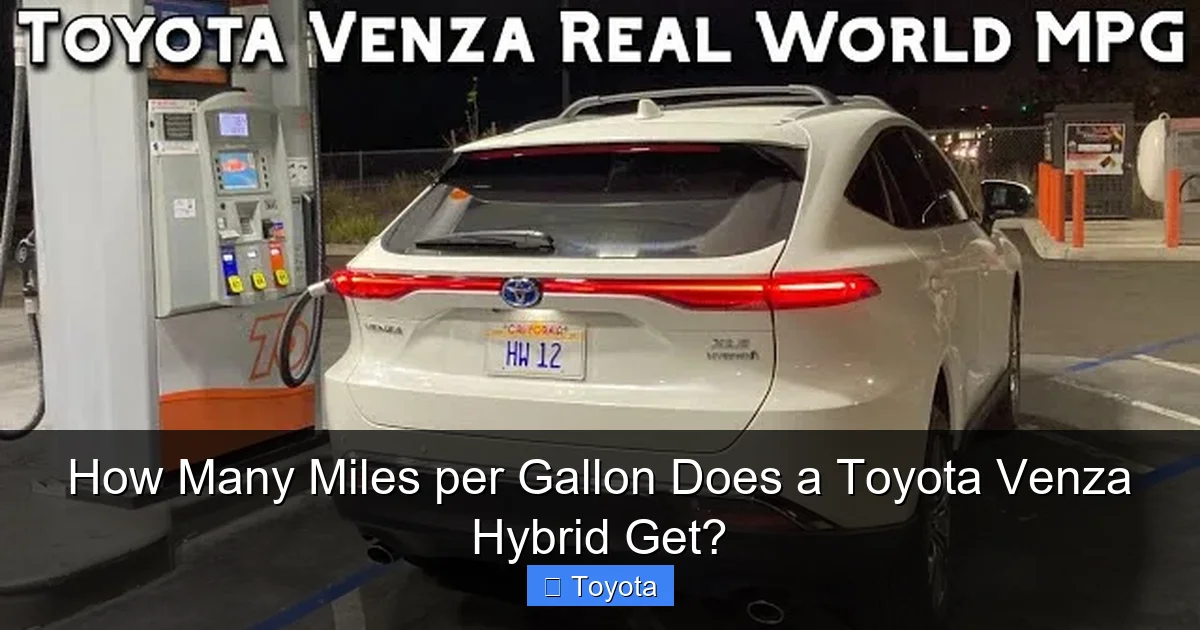
Visual guide about How Many Miles per Gallon Does a Toyota Venza Hybrid Get?
Image source: i.ytimg.com
2023-2024 Model Year Breakdown
For the current model years, the Venza Hybrid is only offered with one powertrain: a 2.5-liter four-cylinder engine paired with two electric motors (one for each axle, providing standard AWD). Here are the official EPA estimates:
- 2024 Toyota Venza Hybrid: 41 MPG city / 39 MPG highway / 40 MPG combined
- 2023 Toyota Venza Hybrid: 40 MPG city / 37 MPG highway / 39 MPG combined
Note: The slight increase for 2024 models is due to minor tuning and calibration updates. Always check the specific window sticker of the exact vehicle you’re considering.
How These Numbers Compare in the Segment
To truly appreciate these figures, let’s see how the Venza Hybrid stacks up against key competitors. Most conventional (non-hybrid) midsize SUVs struggle to break 25 MPG combined. Even some other hybrids in the class can’t match the Venza’s efficiency.
- Honda Passport (V6, AWD): 21 city / 25 highway / 22 combined
- Ford Edge (AWD): 21 city / 28 highway / 24 combined
- Hyundai Santa Fe Hybrid (AWD): 33 city / 30 highway / 32 combined
- Kia Sorento Hybrid (AWD): 34 city / 30 highway / 32 combined
The Venza Hybrid’s 40 MPG combined is a full 8-18 MPG better than its closest gas-powered rivals. It also holds a clear advantage over other hybrid midsize SUVs. If you want to see how a non-hybrid Venza performs, you can check the official ratings for the discontinued gas-only model here, though it’s no longer in production.
Real-World MPG: What Owners Are Actually Getting
EPA tests are conducted in controlled lab conditions. Your actual miles per gallon will vary based on your commute, terrain, climate, and driving style. This is where owner forums, long-term automotive reviews, and real-world data become so valuable. The consensus on the Venza Hybrid is remarkably positive.
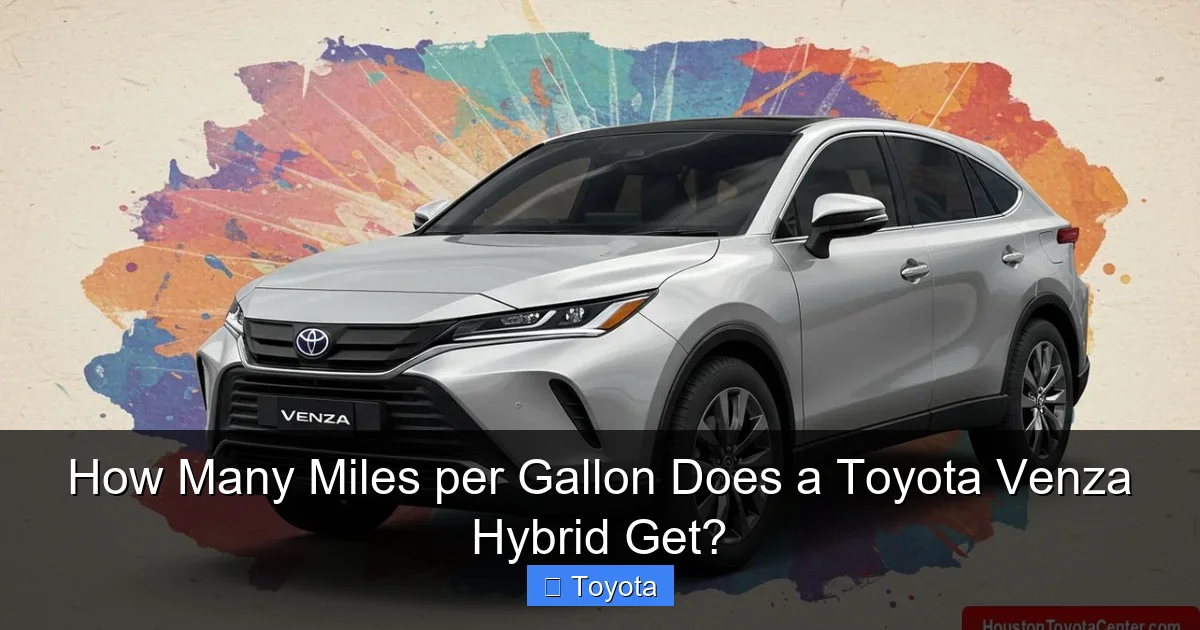
Visual guide about How Many Miles per Gallon Does a Toyota Venza Hybrid Get?
Image source: houstontoyotacenter.com
Owner Reports and Long-Term Test Data
After thousands of miles of collective owner reporting and testing by publications like Edmunds and Consumer Reports, a clear pattern emerges:
- Mixed Driving (City/Highway): Most owners report an easy 38-42 MPG combined, with many hovering right around the 40 MPG mark. This aligns perfectly with the EPA’s 40 MPG combined estimate.
- Predominantly Highway Cruising: On steady, flat highway trips at 65-70 mph, fuel economy can actually dip slightly to the mid-30s MPG range due to higher, steadier speeds. The EPA highway number (39 MPG) is a realistic expectation here.
- Stop-and-Go City Driving: This is where the hybrid system shines. In heavy city traffic, MPG often exceeds 40 MPG, sometimes reaching the mid-40s. The electric motors handle low-speed movement, and the gas engine only runs when needed.
- Winter Driving: Cold weather reduces battery efficiency and increases engine run-time for heating. Expect a drop of 2-5 MPG in very cold climates, which is typical for all hybrids.
Factors That Influence Your Venza’s MPG
To understand the range, consider these variables:
- Speed: Aerodynamic drag increases exponentially with speed. Driving 75 mph vs. 65 mph on the highway can cost you 3-5 MPG.
- Terrain: Hilly or mountainous roads require more energy for climbing, reducing MPG. The Venza’s regenerative braking recaptures some energy on descents, but it can’t fully offset the climb penalty.
- Climate Control: Using the air conditioner in summer or the heater in winter places an extra load on the engine, lowering MPG. The Venza’s heat pump (in newer models) is more efficient than a traditional heater.
- Load and Cargo: Carrying heavy roof racks, towing (Venza is not rated for towing), or a fully loaded vehicle increases weight and drag, reducing efficiency.
- Tire Pressure: Under-inflated tires increase rolling resistance. Maintain the recommended pressure (usually on the driver’s door jamb sticker) for optimal MPG.
How the Venza Hybrid System Achieves Such High MPG
You can’t talk about Venza MPG without explaining the brilliant engineering behind it. Toyota’s hybrid technology is decades in the making, and the Venza benefits from a latest-generation system.
Visual guide about How Many Miles per Gallon Does a Toyota Venza Hybrid Get?
Image source: houstontoyotacenter.com
The Toyota Hybrid System (THS II) Explained Simply
At its heart, the system is about using the right power source at the right time. The 2.5L gasoline engine is optimized for efficiency, not peak power. The electric motors provide instant torque for acceleration. A smart computer (the Power Split Device) constantly manages this interplay.
- Electric-Only Mode: At low speeds and light acceleration (e.g., parking lots, city cruising under 30 mph), the Venza can run on battery power alone. The engine stays off, using zero gasoline. The “EV Mode” button lets you manually encourage this for short distances.
- Hybrid Mode: This is the default and most common state. The gas engine and electric motors work together. The engine can also generate electricity to recharge the battery.
- Engine-Only Mode: At steady, higher highway speeds, the system may disconnect the electric motors and let the gas engine run directly for peak efficiency.
- Regenerative Braking: This is the magic trick. When you brake or coast, the electric motors act as generators, converting kinetic energy back into electricity to recharge the battery. This recaptures energy that would be lost as heat in traditional brakes.
Why Standard AWD Doesn’t Hurt MPG Much
Most hybrids with AWD use a heavy, power-robbing mechanical transfer case. The Venza uses an “e-AWD” system. The rear wheels are powered by a dedicated electric motor. There’s no mechanical connection to the front wheels. This means:
- No constant drivetrain losses from spinning a driveshaft and rear differential.
- The rear motor only engages when needed for traction, saving energy.
- The system is lighter than a traditional AWD setup.
This elegant solution is why the Venza Hybrid’s AWD system has a negligible impact on its fuel economy compared to the front-wheel-drive versions of other hybrids.
Practical Tips to Maximize Your Venza Hybrid MPG
While the Venza is efficient by design, your driving habits can unlock even more miles per gallon. Think of it as a game: you’re the pilot of a very efficient machine.
Driving Techniques for Every Trip
- Drive Smoothly: This is the #1 rule. Anticipate traffic flow to avoid hard acceleration and braking. Smooth inputs keep the system in its most efficient operating range.
- Use Cruise Control on Flat Highways: Maintaining a constant speed is more efficient than constant throttle adjustments.
- Embrace the “EV Mode” Button: Use it in slow-moving traffic, parking lots, or for short residential stretches (<1 mile). It encourages the car to stay in electric-only mode as much as possible. The battery will recharge quickly once you accelerate.
- Monitor the Hybrid System Indicator: The multi-information display shows power flow. Try to keep the needle in the “Eco” zone and maximize the time the battery icon is lit (indicating electric drive).
- Limit Idling: The Venza automatically shuts off the engine at stoplights (Auto Start-Stop). Don’t manually cancel it. If you’re stopped for more than 30 seconds, consider turning the engine off manually if it’s safe and comfortable to do so.
Maintenance and Care for Long-Term Efficiency
- Stick to Recommended Oil: Use 0W-16 or 0W-20 synthetic oil as specified. Thinner oil reduces internal engine friction.
- Keep Tires Properly Inflated: Check pressure monthly. Under-inflation by just 3-4 PSI can lower MPG by 1-2%.
- Replace Air Filters Regularly: A clogged engine air filter makes the engine work harder. Follow the severe service schedule if you do a lot of city driving.
- Use Genuine Toyota Parts: When replacing brakes, use quality pads and rotors. The regenerative braking system handles most stopping, but the friction brakes must be in good condition for safety and to avoid drag.
Venza Hybrid vs. The Competition: A Fuel Economy Perspective
Choosing a midsize SUV often means comparing the Venza to other popular models. From a pure MPG standpoint, the Venza Hybrid is in a class of its own among gas-electric hybrids. Let’s look at a few key rivals.
Head-to-Head with Other Hybrid Midsize SUVs
- vs. Hyundai Santa Fe Hybrid / Kia Sorento Hybrid: These excellent competitors offer more traditional third-row space in the Sorento. However, their EPA combined ratings top out at 32 MPG. The Venza Hybrid offers 8 more MPG combined, a massive difference in annual fuel costs. The trade-off is less passenger and cargo space.
- vs. Ford Escape Hybrid / Kia Sportage Hybrid (Compact SUVs): These smaller, compact hybrids can achieve similar or slightly higher MPG (up to 44 MPG combined in some trims). But they offer significantly less interior room and towing capacity. The Venza provides a larger, more premium cabin with only a minor MPG penalty for the extra size.
- vs. RAV4 Hybrid: Toyota’s smaller sibling is even more efficient (40 city/41 highway). The Venza trades a tiny bit of peak MPG for a vastly more luxurious, quiet, and comfortable ride, along with a more car-like handling demeanor. If you want maximum space and luxury in a Toyota hybrid SUV, the Venza is the pick.
Why You Might Choose a Non-Hybrid (And Their MPG Reality)
Some buyers prioritize upfront cost, towing capacity, or specific brand loyalty. If you’re looking at conventional gas rivals like the Nissan Rogue (which gets about 26-27 MPG combined) or the Honda Passport (22 MPG combined), be prepared for a significant increase in fuel spending over 5 years. The Venza Hybrid’s fuel savings can often offset its higher initial price over the ownership period. For context on how other popular models perform, you can look at the fuel economy of vehicles like the Nissan Versa or even performance models like the Dodge Challenger to see the vast spectrum of efficiency in the automotive market.
Frequently Asked Questions (FAQs)
Does the Toyota Venza Hybrid require premium gasoline?
No. The Venza Hybrid is designed to run on regular unleaded gasoline (87 octane). Using premium fuel offers no performance or efficiency benefit and is not recommended by Toyota.
How big is the fuel tank, and what is the estimated driving range?
The Venza Hybrid has a 14.5-gallon fuel tank. Using the EPA combined rating of 40 MPG, its estimated driving range is about 580 miles on a single tank. In real-world mixed driving achieving 38-42 MPG, you can expect a reliable 500-600 miles between fill-ups.
Can I reset the trip meter to track my MPG accurately?
Yes. The Venza has multiple trip meters (A and B). Reset Trip A or B after each fill-up. Drive normally for several hundred miles, then refill the tank. Divide the miles driven (shown on the trip meter) by the gallons added. This will give you your actual MPG for that period.
Is the Venza Hybrid’s battery expensive to replace, and how long does it last?
The hybrid battery is designed to last the life of the vehicle, often exceeding 150,000-200,000 miles. Toyota warrants it for 8 years/100,000 miles. Replacement costs are significant (several thousand dollars), but failures are extremely rare. The battery is also recyclable.
Does using the air conditioning significantly reduce the Venza’s MPG?
Yes, but the impact is less than in a conventional car. The A/C compressor is electrically driven, which is more efficient than a belt-driven compressor on a gas engine. Expect a drop of 2-4 MPG in very hot, stop-and-go traffic with the A/C on max. Using the “Eco” A/C mode helps minimize the impact.
How does the Venza Hybrid’s MPG compare to the discontinued gas-only Venza?
The gas-only Venza (pre-2021) with the 3.5L V6 engine achieved an EPA combined rating of 22-24 MPG. The new Venza Hybrid’s 40 MPG combined represents a staggering ~70% improvement in fuel efficiency over its predecessor, highlighting the dramatic leap in hybrid technology.
Frequently Asked Questions
What is How Many Miles Per Gallon Does a Toyota Venza Hybrid Get??
How Many Miles Per Gallon Does a Toyota Venza Hybrid Get? is an important topic with many practical applications.
