
How Do You Turn Off the Tpms Light on a 2010 Toyota Camry?

The TPMS (Tire Pressure Monitoring System) light on your 2010 Toyota Camry illuminates when tire pressure is low or a sensor is faulty. You cannot simply “turn off” the light without addressing the underlying issue first. The correct process involves checking and inflating all tires to the recommended PSI, then using the dedicated TPMS reset button located under the dash. If the light persists after a proper reset, it indicates a problem like a dead sensor battery or damage that requires professional diagnosis. Always prioritize safe tire pressure over just resetting a warning light.
Key Takeaways
- TPMS is a safety system: It’s designed to warn you of under-inflated tires, which can cause poor handling, increased wear, and blowouts. Ignoring the light is dangerous.
- Fix the cause before resetting: The light will only stay off if the actual problem—usually low tire pressure—is corrected. Resetting without fixing is temporary and unsafe.
- Your 2010 Camry has a reset button: Unlike some older models, your Camry features a physical TPMS reset button, making the process a simple DIY task after proper inflation.
- Temperature changes trigger the light: Cold weather naturally lowers tire pressure, often causing the TPMS light to come on in the morning. Re-inflating tires usually resolves it.
- A persistent light means a fault: If the light remains on after inflating tires and resetting, a TPMS sensor is likely damaged or its battery is dead, requiring replacement.
- Driving with the light on is risky: Under-inflated tires overheat, wear unevenly, and can fail. Get the issue diagnosed promptly for your safety and fuel economy.
- Resetting is quick: The actual reset process takes less than a minute once tires are properly inflated and you’ve located the reset button.
📑 Table of Contents
- Understanding Your 2010 Toyota Camry’s TPMS
- Why the TPMS Light Comes On: It’s Not Always “Low Air”
- The Golden Rule: Fix the Problem, Then Reset
- Step-by-Step: How to Turn Off the TPMS Light on a 2010 Camry
- What If My Camry Doesn’t Have a Reset Button?
- Common Mistakes and Troubleshooting
- When the Light Won’t Stay Off: Time for a Professional
Understanding Your 2010 Toyota Camry’s TPMS
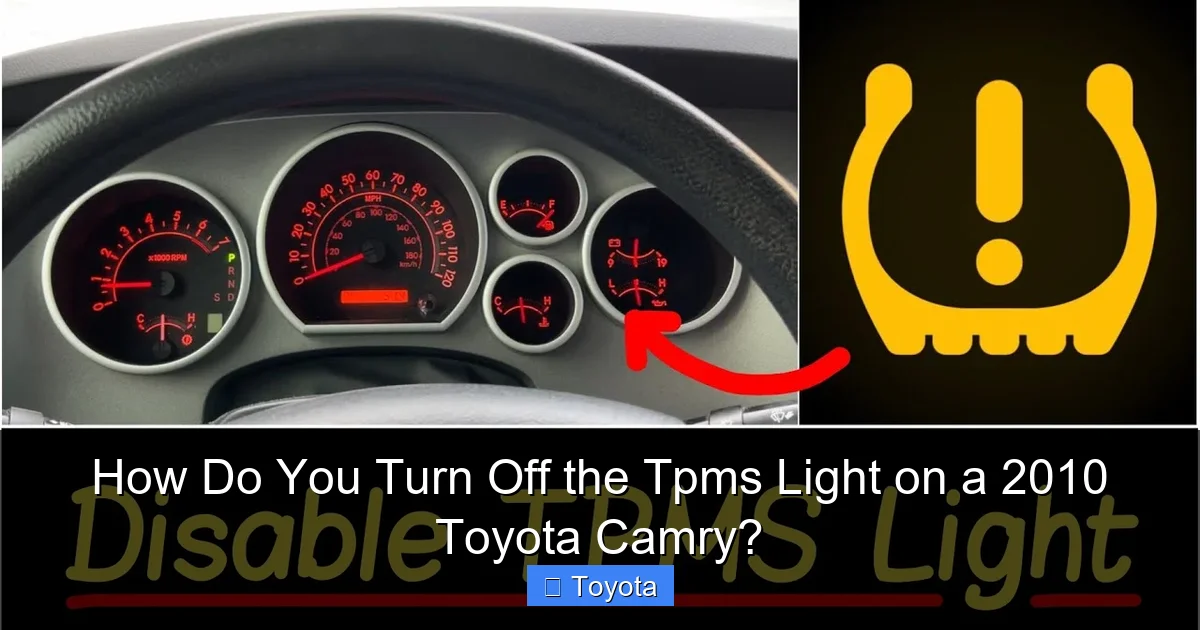
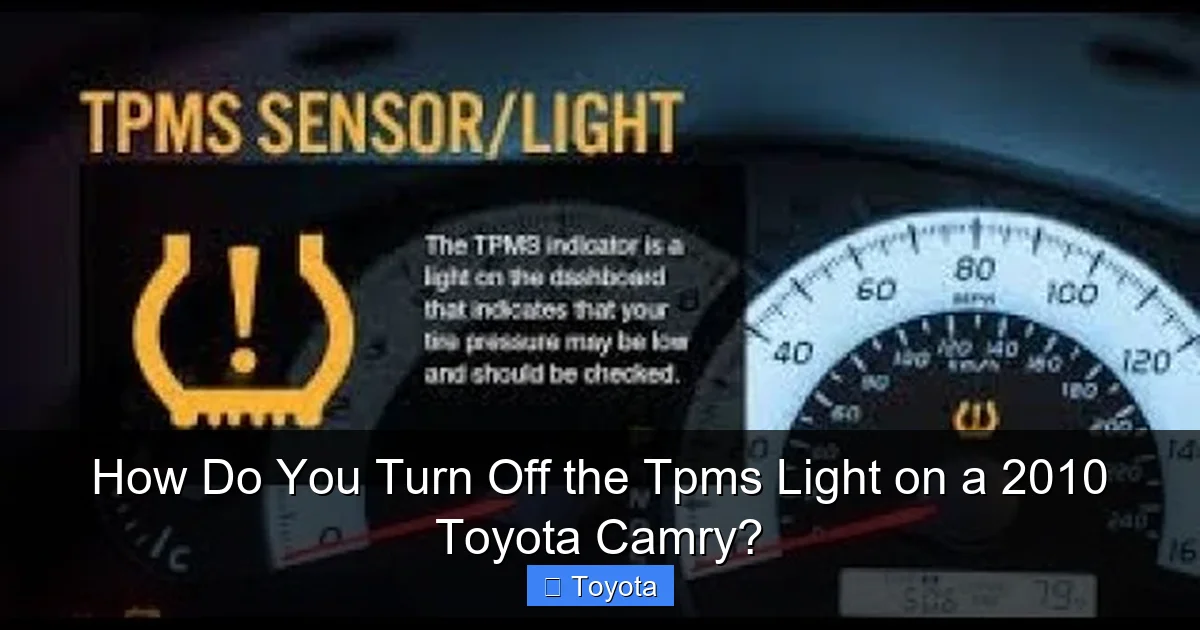
That little yellow symbol that looks like a cross-section of a tire with an exclamation point in the middle is your Tire Pressure Monitoring System (TPMS) warning light. In your 2010 Toyota Camry, it’s not just another “dummy” light. It’s a critical safety feature mandated by law to help prevent accidents caused by improper tire inflation. When this light glows steadily on your dashboard, it’s your car’s way of saying, “Hey, one or more of my tires needs air!” Understanding how this system works is the first step to knowing how to handle it correctly.
The 2010 Camry uses a direct TPMS. This means each wheel has a small electronic sensor valve stem inside. These sensors constantly monitor the air pressure inside each tire and transmit that data wirelessly to your car’s computer. If the pressure in any tire drops 25% or more below the manufacturer’s recommended level, the system triggers the warning light on your dash. Some systems also provide a readout of which tire is low, but the base model Camry typically just illuminates the general warning light. It’s a fantastic system, but like any technology, it requires a proper response when it alerts you.
Why the TPMS Light Comes On: It’s Not Always “Low Air”
While under-inflation is the most common culprit, it’s important to know that the TPMS light can activate for several reasons. Jumping straight to the reset without considering these can lead to the light returning quickly or masking a real problem.
Visual guide about How Do You Turn Off the Tpms Light on a 2010 Toyota Camry?
Image source: seventrumpet.com
The Usual Suspect: Actual Low Tire Pressure
This is the number one reason. Air naturally seeps out of tires over time—about 1 PSI per month is normal. A slow leak from a nail or a damaged valve stem can cause a more rapid loss. Seasonal temperature changes are a huge factor. For every 10°F drop in temperature, tire pressure decreases by about 1-2 PSI. That’s why you often see the TPMS light come on during the first cold morning of fall or winter. The air inside the tire contracts, reducing pressure. The solution is to check all four tires (and the spare, if equipped) with a proper tire pressure gauge and inflate them to the pressure listed on the sticker inside your driver’s door jamb, not the number printed on the tire sidewall.
Faulty or Dead TPMS Sensor
These sensors are battery-powered, and the batteries typically last 7-10 years. Your 2010 Camry is now well into that range. A dead sensor battery will cause the system to lose signal from that wheel, triggering the light. Sensors can also be physically damaged during tire service (like if a tire technician drags it across a rim) or by road debris. A damaged sensor simply won’t send a signal or will send erroneous data.
System Malfunction or Interference
Rarely, the issue could be with the vehicle’s receiving module. After installing new tires or wheels, especially aftermarket ones, the system may need to be reprogrammed to recognize the new sensors. Strong radio frequency interference can sometimes temporarily disrupt the signal, but this is uncommon.
The Golden Rule: Fix the Problem, Then Reset
This is the most crucial concept. The TPMS reset button is not a “dismiss” button for an annoyance. It is a tool to re-initialize the system after you have corrected the tire pressure or replaced a sensor. If you simply press the reset button while tires are still under-inflated, the light will come right back on after a short drive because the sensor data hasn’t changed. The proper sequence is always:
Visual guide about How Do You Turn Off the Tpms Light on a 2010 Toyota Camry?
Image source: i.ytimg.com
- Diagnose: Check all tire pressures with a reliable gauge.
- Correct: Inflate or deflate tires to the exact spec (typically 32 PSI for a 2010 Camry, but always verify your door jamb sticker).
- Drive: Drive the car for 5-10 minutes at speeds above 15-20 mph. The system will automatically re-check pressures. If all are now within spec, the light should turn off on its own. If it doesn’t, proceed to step 4.
- Reset: Use the manual reset button to force the system to relearn the current sensor positions and pressures.
If the light returns immediately after a correct reset, you have a persistent fault, most likely a bad sensor. For more on dashboard warning lights and what they mean, you can read our general guide on how to turn off the maintenance light on a Toyota, which covers a different but related system.
Step-by-Step: How to Turn Off the TPMS Light on a 2010 Camry
Assuming you’ve already checked and set all your tire pressures to the correct level, here is the definitive procedure for your 2010 Toyota Camry. The process is straightforward because your model year has a dedicated reset button.
Visual guide about How Do You Turn Off the Tpms Light on a 2010 Toyota Camry?
Image source: i.ytimg.com
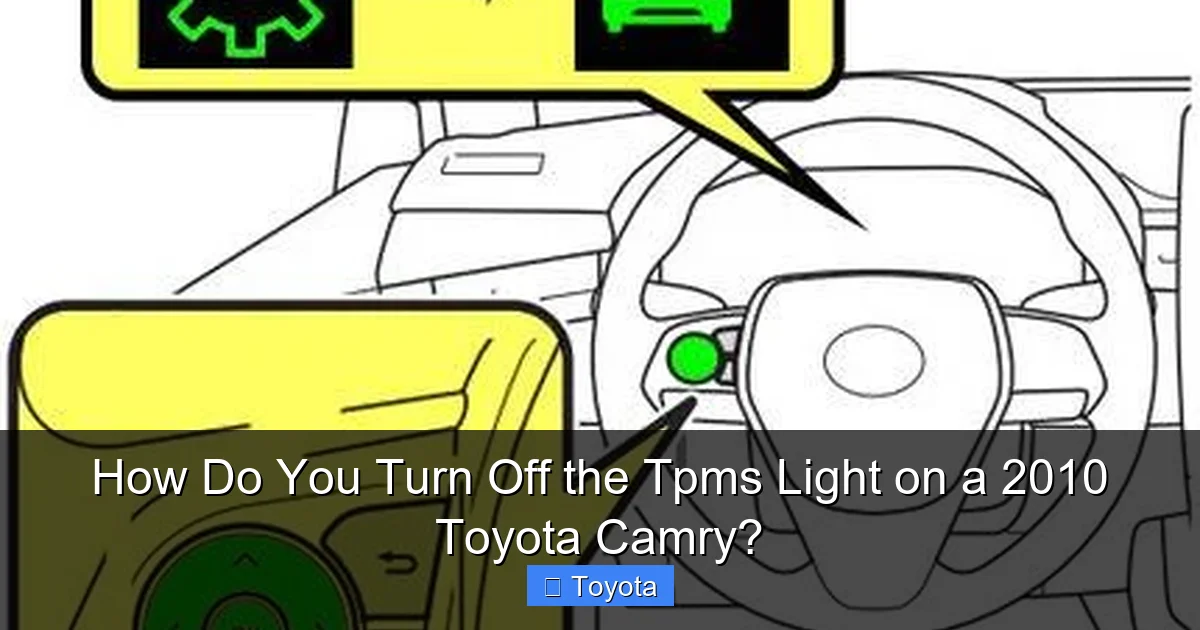
Step 1: Locate the TPMS Reset Button
The button is small, usually black or gray, and is located on the lower dashboard area, to the left of the steering column, near the hood release. It’s often behind or just below a small plastic cover. You may need to get on your knees on the driver’s side floor mat and look up. It is explicitly labeled “TPMS” or with the TPMS symbol. On some models, it might be inside the fuse panel cover on the driver’s side end of the dashboard. Take your time to find it. If you’re struggling, our specific guide on where the TPMS reset button is on a Toyota Camry has detailed photos for different model years.
Step 2: Prepare the Vehicle
- Ensure the ignition is in the OFF position.
- All doors, hood, and trunk should be closed.
- Tire pressures must be set correctly. This is non-negotiable.
Step 3: Execute the Reset Sequence
- Turn the ignition key to the ON position (the position right before starting the engine, where all dash lights come on). Do not start the engine.
- Press and hold the TPMS reset button. You’ll need to hold it for several seconds.
- Continue holding the button until you see the TPMS warning light on the dash blink three times. Once it blinks three times, you can release the button.
- After releasing the button, the light should turn off. If it stays on for more than a few seconds, repeat the process, ensuring you hold the button long enough to see the three blinks.
- Start the engine and drive the car normally for about 10-15 minutes. The system will go through a “relearning” process as you drive. The light should remain off. If it comes back on during this drive, stop and re-check your tire pressures.
What If My Camry Doesn’t Have a Reset Button?
While the 2010 Camry does have a button, it’s worth noting the alternative method for older Toyotas or other brands that lack one. If your vehicle’s TPMS is a “learning” type that requires sensor ID registration (rare for this era), the reset might involve a more complicated drive-cycle procedure or a scan tool. However, for your specific 2010 Camry, the physical button method is standard. Do not attempt to disconnect the battery to reset the light. This will reset many other systems (radio presets, clock, steering angle sensor) and will not necessarily clear a TPMS fault. It’s an unnecessary hassle. Always use the designated TPMS button for this job.
Common Mistakes and Troubleshooting
Even with the right steps, things can go wrong. Here’s how to avoid pitfalls:
- Mistake: Resetting with low pressure. This is the #1 error. The system has memory. If pressures are low, it will immediately flag the fault again. Always use a high-quality digital or dial gauge, not a pencil-type or gas station gauge, for accuracy.
- Mistake: Not holding the button long enough. You must hold it until you see the light blink three times. A quick press won’t do anything.
- Mistake: Ignoring a flashing light. A steadily illuminated TPMS light means low pressure in one or more tires. A flashing TPMS light usually indicates a system malfunction, such as a dead sensor or a communication error. If your light flashes for more than a few seconds and then stays solid, it’s a fault code, not just low pressure. A reset won’t fix this; you need a diagnostic scan.
- Mistake: Forgetting the spare tire. If your Camry has a full-size spare mounted on the wheel, it likely has a TPMS sensor too. Check its pressure as well. Some temporary “donut” spares do not have sensors.
- Mistake: Not driving after reset. The system needs a short drive cycle to confirm all sensors are reporting correctly. Don’t expect the light to go off instantly while parked.
When the Light Won’t Stay Off: Time for a Professional
If you have followed all these steps—verified perfect pressure, performed the reset correctly, and driven the vehicle—but the TPMS light returns, it’s time to visit a tire shop or your mechanic. They will use a professional TPMS scan tool to read the specific fault code from your car’s computer. This will tell them exactly which sensor (e.g., “Left Front Sensor – No Signal”) is problematic. The solution is usually replacing the faulty sensor. Remember, TPMS sensor batteries are not serviceable; the entire sensor unit must be replaced. This is also a good time to consider if you recently had tire work done. Sometimes, a sensor can be damaged during mounting/dismounting, and the shop that did the work may be responsible. For other dashboard lights that require professional attention, like an airbag light on a Toyota Camry, the diagnostic process is similar but far more complex.
Frequently Asked Questions
Can I just ignore the TPMS light if my tires look fine?
No. Tires can look fine but be under-inflated by 25% or more, which is enough to trigger the light. Driving on under-inflated tires is unsafe, causes premature wear, reduces fuel economy, and increases the risk of a blowout. Always address the light promptly.
How often should I check my tire pressure?
You should manually check your tire pressures at least once a month and before any long trip. Do not rely solely on the TPMS light, as it only warns you after pressure is already dangerously low. Use a good quality gauge for accurate readings.
Will disconnecting the battery turn off the TPMS light?
No. Disconnecting the battery will reset many electronic systems but will not clear a TPMS fault. The light will simply reappear once the system re-initializes and detects the same pressure issue or sensor fault. Always use the dedicated TPMS reset button after correcting the pressure.
My 2010 Camry doesn’t seem to have a TPMS button. What do I do?
All 2010 Toyota Camrys are equipped with a TPMS reset button. It is located on the lower dashboard, to the left of the steering column, often behind a small cover. Look carefully in that area. If you absolutely cannot find it, consult your owner’s manual or a Toyota dealership for its exact location.
Why does my TPMS light keep coming back on after I reset it?
This indicates the underlying problem was not fixed. The most likely causes are: 1) You didn’t actually get all tires to the correct pressure, 2) You have a slow leak in a tire, or 3) One of the TPMS sensors is faulty or its battery is dead. A professional scan is needed to diagnose a persistent fault.
How long does the TPMS reset process take?
The actual button-press reset takes about 5-10 seconds. However, you must first ensure all tires are properly inflated. After the reset, you must drive the car for 10-15 minutes at speeds above 15 mph for the system to complete its relearning cycle. So, plan for about 20-30 minutes total.
