
How Do You Turn Off the Vsc Light on a 2010 Toyota Corolla

The VSC (Vehicle Stability Control) light on your 2010 Toyota Corolla illuminates when the system detects a problem or has been manually turned off. Simply resetting the light without addressing the underlying issue is temporary and unsafe. The proper approach involves diagnosing the cause—often a faulty sensor, steering angle calibration, or low battery—before performing a reset. For persistent lights, professional diagnosis with a scan tool is essential.
Key Takeaways
- Safety First: The VSC system is a critical safety feature. A lit VSC light means the system is offline, reducing your car’s stability in slippery conditions.
- Reset vs. Repair: You can reset the light, but if the fault returns, it indicates a real problem that needs fixing, not just clearing.
- Common Triggers: Loose gas caps, weak batteries, faulty wheel speed sensors, and steering angle sensor calibration issues are frequent culprits.
- Simple Reset: Often, turning the car off and on, or performing a specific button sequence, will turn the light off if the system re-initializes successfully.
- Professional Help: If the light persists after a reset or comes back immediately, a mechanic must read the specific trouble codes.
- Related Systems: The VSC light often illuminates alongside the TRAC (Traction Control) and check engine lights, as they share sensors.
- Don’t Ignore It: Driving with a non-functional VSC system increases the risk of loss of control, especially during emergency maneuvers.
[FEATURED_IMAGE_PLACEHOLDER]
📑 Table of Contents
- Understanding the VSC Light in Your 2010 Toyota Corolla
- The “Quick Fix”: How to Reset the VSC Light Yourself
- Why the VSC Light is On: The Real Underlying Causes
- A Step-by-Step Diagnostic and Reset Guide
- Safety Implications: Why You Shouldn’t Just “Turn It Off and Forget It”
- VSC Light vs. Other Dashboard Lights: What’s the Connection?
- Conclusion: Your Path to a Clear Dashboard
Understanding the VSC Light in Your 2010 Toyota Corolla
So, you’re driving your trusty 2010 Toyota Corolla, and suddenly, a little icon that looks like a car with squiggly lines underneath it lights up on your dashboard. That’s your VSC light. It’s easy to feel a mix of confusion and annoyance. What does it mean? Is your car safe to drive? And most pressing of all: how do you turn the VSC light off on a 2010 Toyota Corolla?
First, let’s get one thing straight. VSC stands for Vehicle Stability Control. It’s a sophisticated computer system that helps keep your car pointed where you’re steering, especially during sudden turns or on slick surfaces. It does this by automatically applying brake pressure to individual wheels and sometimes reducing engine power. When the VSC light is on, that entire safety net is disabled. Your car will still drive, but you’ve lost a key layer of electronic stability assistance. That’s why understanding this light is so important—it’s not just an annoyance; it’s a warning.
The reason the light is on can range from something wonderfully simple to something that needs a mechanic’s attention. Our goal here is to walk you through every possibility, starting with the easiest, safest ways to try and turn it off. We’ll cover what the light means, the step-by-step reset procedures, the most common reasons it comes on, and, crucially, when you must put the wrench down and call a pro.
The “Quick Fix”: How to Reset the VSC Light Yourself
Before you panic or head to a repair shop, there are a few simple, non-invasive things you can try. These methods attempt to reset the system’s computer and are successful if the light came on due to a temporary glitch or a minor, self-correcting issue. Think of them as the “turn it off and on again” of your car’s stability system.
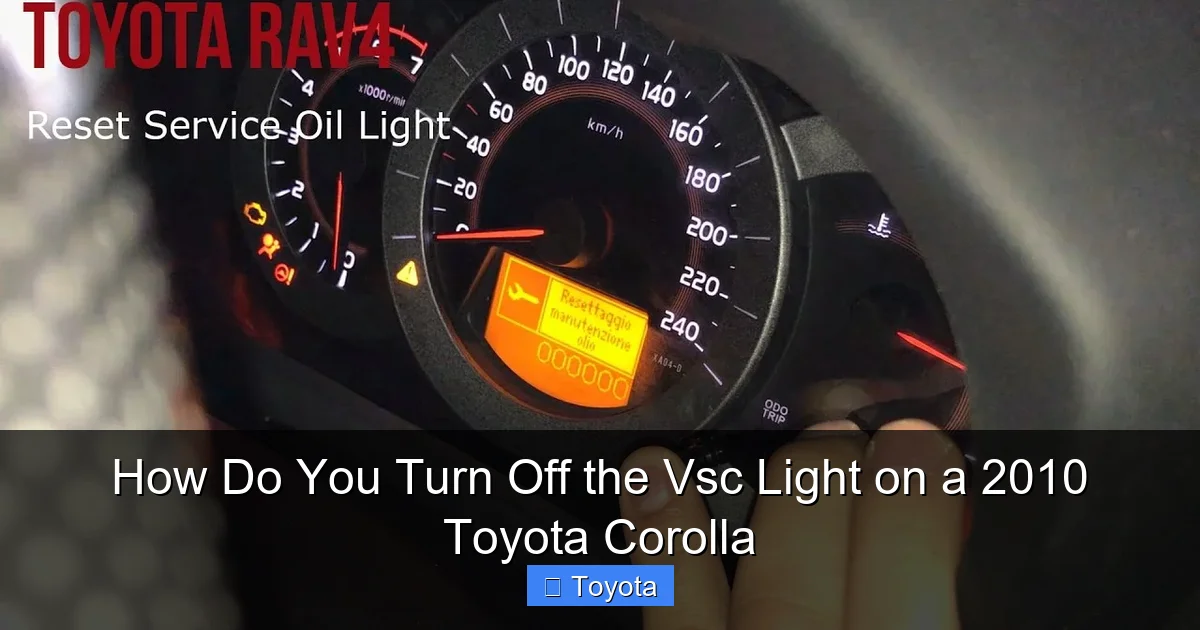
Visual guide about How Do You Turn Off the Vsc Light on a 2010 Toyota Corolla
Image source: i.ytimg.com
Method 1: The Simple Power Cycle
This is your absolute first step. It sounds too simple to work, but it often does. The VSC system, like all your car’s computers, can sometimes get confused. A full power cycle clears its temporary memory.
- Step 1: Bring your Corolla to a complete stop in a safe location. Park it, and turn the engine completely off. Remove the key (if you have a traditional key) or press the start/stop button to ensure all systems are off.
- Step 2: Open the driver’s door and get out. This is important because it confirms the car is fully “asleep.” Wait for about 60 seconds. This allows all the control modules to fully power down and reset their capacitors.
- Step 3: Get back in, buckle up, and start the engine normally. Watch the dashboard. All warning lights, including the VSC light, should illuminate briefly as the system performs a self-check (this is normal). Then, they should all turn off after a few seconds.
- Result: If the VSC light stays off, you’ve solved it! The system likely just needed a refresh. Drive cautiously for a few minutes to see if it returns.
Method 2: The “VSC OFF” Button Reset
Your Corolla has a physical button, usually labeled “VSC OFF” or with the same stability control icon, located on the dashboard or center console near the HVAC controls. This button is designed to let you manually turn the system off for specific driving conditions (like being stuck in deep snow). Sometimes, this button can be accidentally pressed, or its state can become miscommunicated to the computer.
- Step 1: With the engine running and the car in Park (or Neutral), locate the VSC OFF button.
- Step 2: Press and release the button. You should see the VSC OFF indicator (usually a light with the same icon but the word “OFF” underneath) illuminate on your dash, confirming the system is disabled. Press the button again to turn it back on. The VSC OFF light should go out.
- Step 3: Now, press and hold the VSC OFF button for about 3-5 seconds. You might hear a beep or see the TRAC (Traction Control) light flash briefly. This is the system performing a reset sequence.
- Step 4: Release the button. Drive the car normally. Check if the main VSC light (the one that was originally on) has gone out after a short drive.
Pro Tip: This button reset is also the standard procedure to turn the system back on after you’ve intentionally disabled it for stuck-in-snow situations. It’s a good habit to check this button if the light comes on unexpectedly.
Method 3: Check the Gas Cap! (Seriously)
This is one of the most common and overlooked triggers for the VSC light on a 2010 Corolla. Your car’s EVAP (evaporative emission) system monitors the fuel tank for leaks. A loose or faulty gas cap is the #1 cause of a check engine light, but it can also trigger the VSC and TRAC lights because these systems share data with the engine computer (ECM).
- Action: Turn off the engine. Go to the fuel filler door. Remove the gas cap and re-seat it firmly. You should hear at least 3-4 clicks as it tightens. Ensure the cap’s seal is clean and undamaged.
- Next: Perform the Simple Power Cycle (Method 1) after tightening the cap. The computer needs to re-test the EVAP system. If the cap was the issue, the VSC light (and possibly the check engine light) will often turn off after a few drive cycles.
If you’re unsure about your gas cap, a new OEM-style cap is inexpensive and a great preventative measure. You can find guides on how to open the gas tank on a Toyota Corolla if you need a refresher.
Why the VSC Light is On: The Real Underlying Causes
If the simple resets above didn’t work, the VSC light is telling you there’s a genuine fault that the system cannot correct. The light itself is a symptom. To truly “turn it off” for good, you must fix the cause. Here are the most frequent technical reasons for a persistent VSC light on a 2010 Corolla.
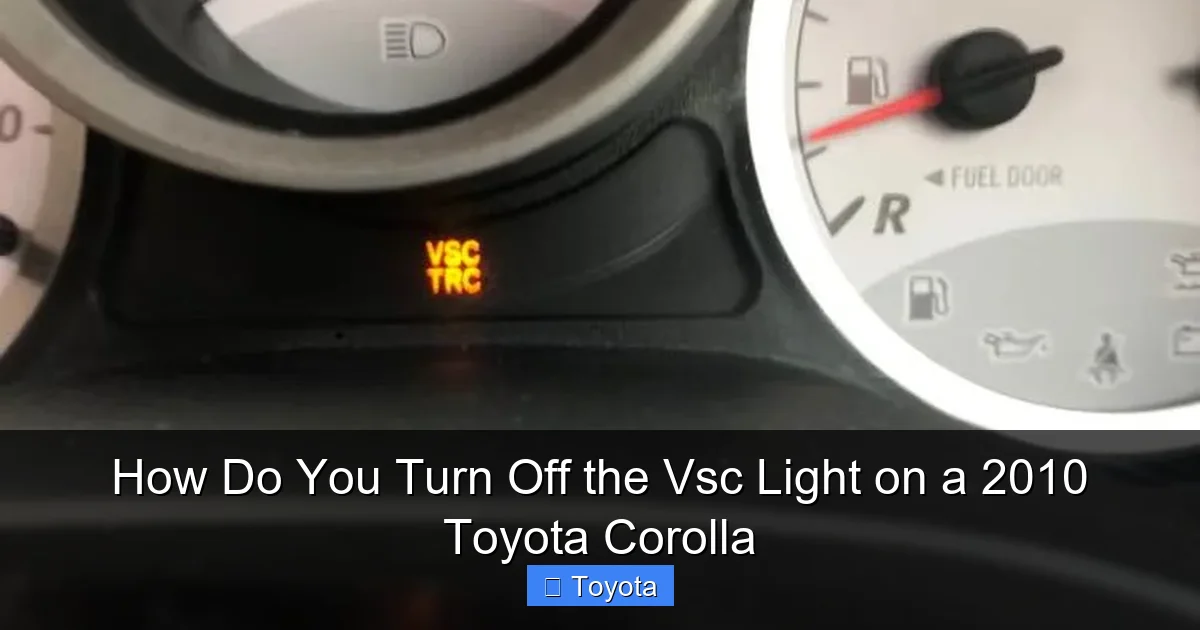
Visual guide about How Do You Turn Off the Vsc Light on a 2010 Toyota Corolla
Image source: toyotaowners.b-cdn.net
The Usual Suspect: Wheel Speed Sensors
The VSC system’s brain relies heavily on data from the four wheel speed sensors (the same ones used by your ABS system). These sensors tell the computer how fast each wheel is spinning. If one sensor is dirty, damaged, or has a bad connection, it sends faulty or no data. The VSC computer sees this as a critical failure and shuts down, illuminating the VSC and often the ABS light.
- What it looks like: The light comes on after hitting a puddle or deep snow. It might flicker during hard cornering. You might also notice the ABS light is on.
- Diagnosis: A mechanic will scan for wheel speed sensor codes (like C0200, C0201, etc.) and may test each sensor’s output voltage and resistance.
The Steering Angle Sensor (SAS) Calibration
This sensor tells the VSC computer which direction you’re steering. If the sensor gets out of calibration—which can happen after a steering wheel alignment, a minor accident, or even a dead battery—it thinks your wheels are pointed straight when they’re actually turned. The VSC system gets confused and disables itself.
- Symptom: The VSC light comes on after a battery disconnect or alignment. The steering wheel may feel slightly “off-center” when driving straight.
- The Fix: This isn’t a DIY job for most. It requires a professional-grade scan tool to perform a SAS calibration procedure. Simply resetting the light won’t fix it; the sensor must be recalibrated.
Low System Voltage / Weak Battery
Your 2010 Corolla’s electrical system is the backbone for all these computers. A weak or failing battery, or a poor connection at the battery terminals or ground points, can cause voltage drops. This makes the sensitive VSC/ABS module go into a “fault” mode to protect itself.
- Check: If your battery is original (13+ years old!) or you’ve had slow cranking, dim lights, or other electrical gremlins, test the battery voltage. It should be ~12.6V with the engine off and ~14V with it running. Clean any white/green corrosion from the terminals.
- Note: A dead battery jump-start can sometimes trigger these lights, which should clear after a good drive as the battery recharges. If they don’t, the battery may need replacing.
Faulty Yaw Rate or Lateral G Sensor
This is a more complex sensor, usually part of the Airbag/SCS (Supplemental Restraint System) module cluster. It measures the car’s side-to-side rotation and forward/backward sway. If it fails, the VSC has no way to know if the car is sliding sideways and will shut down.
- Diagnosis: Requires advanced scan tools to read the airbag/SCS module. Codes will point directly to this sensor. Replacement often involves the entire airbag sensor assembly.
Problems with the Brake System
Since VSC works by braking individual wheels, any major issue with the brake system can trigger a shutdown. This includes low brake fluid, a faulty brake fluid level sensor, or a problem with the ABS pump/motor circuit.
- Action: Check your brake fluid reservoir under the hood. Is it low? Top it up to the “MAX” line with the correct DOT fluid (usually DOT 3). If it’s low, you likely have worn brake pads or a leak—get that inspected immediately.
A Step-by-Step Diagnostic and Reset Guide
Okay, let’s put it all together into a logical action plan. Follow these steps in order. This is your roadmap from a lit VSC light back to a safe, stable car.
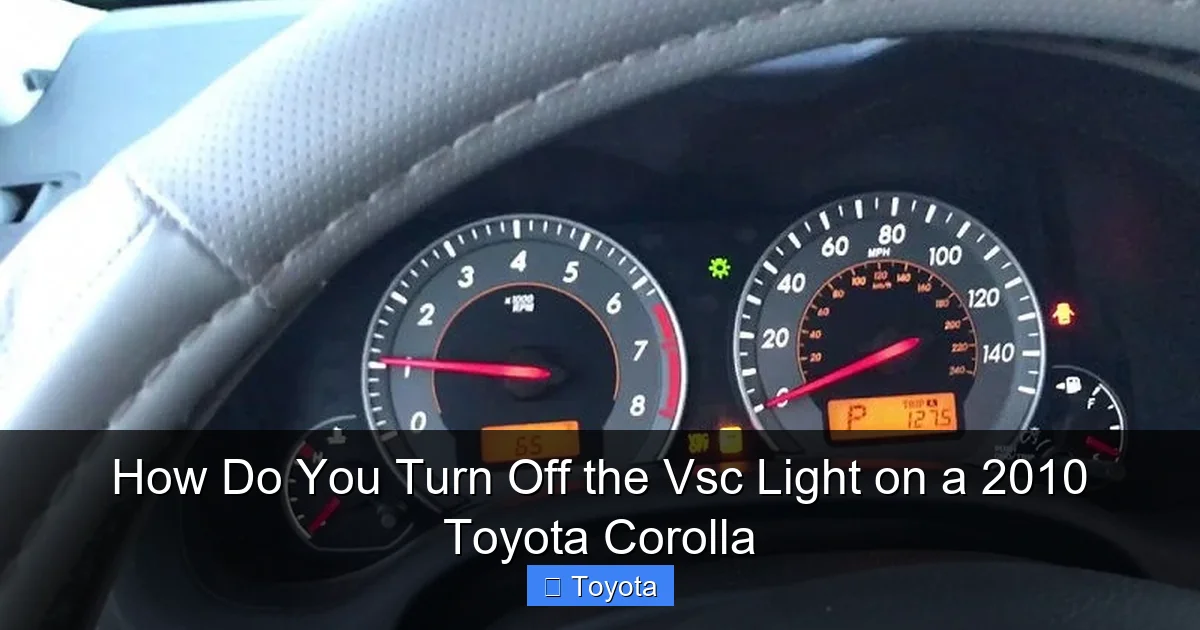
Visual guide about How Do You Turn Off the Vsc Light on a 2010 Toyota Corolla
Image source: guidemechanic.com
Step 1: The Immediate Safety Assessment
Before you do anything else, assess your driving conditions. Are you on dry pavement? Is it raining or icy? Remember, with the VSC off, your car is more prone to oversteer or understeer in emergency maneuvers. Drive with extra caution, avoid hard cornering, and increase your following distance. Do not attempt aggressive driving. The light is a warning to drive more defensively until it’s fixed.
Step 2: Perform the Basic Reset Procedures
Go back to the top of this article and execute Method 1 (Power Cycle) and Method 2 (VSC OFF Button Reset) in sequence. Then, Method 3 (Check Gas Cap). After each method, drive the car normally for 10-15 minutes to see if the light returns. Sometimes the system needs a “drive cycle” to complete its self-tests.
Step 3: Visual and Basic Electrical Inspection
If the light is still on, it’s time for a simple look under the hood and around the wheels.
- Battery: Check terminals for corrosion. Clean with a baking soda/water mix and a wire brush if needed. Tighten the clamps.
- Brake Fluid: Locate the master cylinder reservoir (usually behind the engine, near the firewall). Check the level. Top up if low, but investigate why.
- Wheel Sensors: Visually inspect each wheel hub area. Look for obvious damage to the wiring harness leading to the sensor. It should be intact, not rubbing against the tire or suspension. Give each sensor a gentle tug to ensure it’s secure.
Step 4: Scan for Trouble Codes (The Most Important Step)
This is the non-negotiable step for a permanent fix. You need to know what the car’s computer is complaining about. You have two options:
- Option A (DIY): Buy or borrow an OBD2 scanner that can read enhanced ABS/SCS codes. Many basic code readers only read engine/check engine light codes (P-codes). You need one that accesses the ABS and SCS modules. Look for codes starting with “C” (Chassis) like C0200 (Right Rear Wheel Speed Sensor), C1241 (Steering Angle Sensor), or U0121 (Lost Communication with VSC/ABS Module).
- Option B (Professional): Take it to a reputable mechanic or a Toyota dealership. They have the proprietary Toyota Techstream software or equivalent high-end scanners. This is the best course of action if you’re not comfortable with this step. Tell them specifically: “My VSC light is on. Please scan the ABS and SCS modules for codes.”
Why this is critical: Guessing and replacing parts (like a wheel sensor) without a code is a costly waste of money. The code tells you exactly which circuit or sensor has failed.
Step 5: Repair Based on the Code
Once you have the specific code, you can research the exact repair. Here’s a general guide:
- Wheel Speed Sensor Codes (C02xx): Often, cleaning the sensor and the toothed reluctor ring on the axle/hub with brake cleaner fixes it. If the sensor is physically damaged or tests out of spec, replace it. Sometimes the issue is a damaged wire harness; repair the wire.
- Steering Angle Sensor Codes (C124x, C133x): This almost always requires a professional calibration after any repair or replacement. The sensor itself may need replacing if faulty.
- Communication/Network Codes (U0xxx): These point to wiring problems, blown fuses, or failed control modules. Check fuses related to the ABS/SCS system (see owner’s manual). Inspect wiring bundles for chafing or corrosion.
- Yaw Rate Sensor Codes: Typically requires replacement of the sensor assembly, which is part of the airbag sensor cluster. This is a serious, safety-critical repair best left to professionals.
Step 6: The Final Reset
After the repair is completed, the fault code must be cleared from the system’s memory. The mechanic will do this with their scan tool after verifying the repair. If you did the repair yourself, you can clear the code with your OBD2 scanner. Then, perform the Power Cycle (Method 1) one more time. Start the car and ensure the VSC light stays off during a test drive. The system should re-initialize and become active again.
Safety Implications: Why You Shouldn’t Just “Turn It Off and Forget It”
Let’s be absolutely clear about the risks. The VSC system is not a luxury feature; it’s a mandated safety system. Studies show it significantly reduces single-vehicle crashes and fatalities. When the VSC light is on, that protective layer is gone.
Imagine you’re taking a curve a bit too fast on a wet road. Without VSC, the car is much more likely to understeer (plow forward) or oversteer (spin out). The system would normally intervene by braking the outer front wheel and reducing power to help you stay on your intended path. You are now solely responsible for correcting any slide with your steering and throttle skills—a task even experienced drivers can fail at in a split second.
Furthermore, a persistent VSC light often indicates a problem with the shared wheel speed sensors, which also feed data to your ABS. This means your anti-lock braking system might also be compromised, especially on slippery surfaces where ABS is most valuable. You could experience wheel lock-up during hard braking.
The Bottom Line: Treat a lit VSC light as a “Service Vehicle Stability Control” message, not a “Turn Off This Annoying Light” message. Driving with it on means you are accepting reduced safety margins. Get it diagnosed and fixed properly.
VSC Light vs. Other Dashboard Lights: What’s the Connection?
On your 2010 Corolla, these warning lights are often part of a family. Understanding their relationships can help you diagnose faster.
- VSC Light + TRAC Light: These are brothers. The TRAC (Traction Control) system prevents wheel spin during acceleration. They use the same wheel speed sensors and often the same control module. If one is on, the other usually is too. A problem with a wheel sensor will likely trigger both.
- VSC Light + Check Engine Light (MIL): This combination is a big clue. The engine computer (ECM) has detected a serious fault that affects emissions or engine performance, and it’s telling the VSC/ABS module to stand down because the overall vehicle stability might be compromised by the engine issue. A loose gas cap is a classic trigger for this duo.
- VSC Light + ABS Light: This is the most direct link. The ABS (Anti-lock Braking System) is the foundation for VSC. If the ABS system has a fault, VSC cannot function and will disable itself, lighting its own icon. Always assume your ABS is also offline if the VSC light is on.
- Other Related Lights: You might also see the brake warning light (exclamation point in a circle) if there’s a serious brake system issue. Or, if the steering angle sensor is the culprit, you might not see another light, but the steering wheel may feel off.
Because these systems are so interconnected, a comprehensive scan of the Engine, ABS, and SCS (Airbag/SCS) modules is always required for an accurate diagnosis. Don’t just read the engine codes and stop there.
Conclusion: Your Path to a Clear Dashboard
So, how do you turn off the VSC light on a 2010 Toyota Corolla? The answer has two parts. The simple reset procedures—the power cycle, the button reset, and tightening the gas cap—are your first, free, and easy attempts. They work for transient glitches. But if the light returns, you have a real fault.
The true, permanent way to “turn off” the VSC light is to diagnose and repair the underlying problem. This means getting the specific trouble codes from the ABS and SCS modules, identifying whether it’s a wheel sensor, a steering angle calibration, a wiring issue, or something more serious, and making the correct repair. Only then should you clear the codes and reset the system.
Your 2010 Corolla is a fantastic, reliable car, and its VSC system is a vital part of that reliability. A lit VSC light is your car’s way of asking for a little help. By following this guide—starting with the simple resets, moving to basic checks, and culminating in a professional scan if needed—you can restore your car’s full safety capabilities and drive with confidence again. Remember, when in doubt, the safest and most cost-effective path is to let a qualified technician with the right tools read the codes and guide the repair. Your safety, and the safety of others on the road, is worth that investment.
Frequently Asked Questions
Can I just disconnect the battery to turn off the VSC light?
Disconnecting the battery is essentially a more drastic version of the power cycle. It will clear temporary codes and may reset the system. However, it will also reset other systems like your radio presets and engine idle adaptations. More importantly, if the fault is still present, the light will simply come back on after the car completes its re-learn procedures. It doesn’t fix the problem.
My VSC light came on after I hit a big puddle. What should I do?
This is a classic wheel speed sensor issue. Water can temporarily short a sensor or cause a bad connection. First, safely perform the power cycle and VSC button reset. If the light returns, you likely have a wheel speed sensor that is now faulty or a damaged wiring harness from the impact. Get it scanned to identify which wheel sensor is affected.
Is it safe to drive to the mechanic with the VSC light on?
Yes, but with extreme caution. The car is mechanically sound and will drive. However, you must drive more defensively. Avoid sudden steering, hard acceleration, or emergency braking on wet/slippery roads. Increase your following distance. Treat every drive as if conditions are worse than they are, because your electronic safety nets are offline.
How much does it typically cost to fix a VSC light?
The cost varies wildly by the cause. A simple gas cap replacement is $15. A single wheel speed sensor might cost $100-$250 for the part plus labor. A steering angle sensor calibration is often $80-$150. If the problem is a faulty SCS module (which houses the yaw rate sensor), costs can jump to $500-$1000+ for parts and labor. This is why getting an accurate diagnosis via a scan is the critical first step.
Will an oil change or tire rotation affect my VSC light?
Not directly. However, if during a tire rotation the tire pressure is not set correctly, or if a wheel speed sensor connector is accidentally disturbed, it could trigger a fault. Also, if the car is lifted and the steering wheel is turned off-center without the ignition on, it can throw off the steering angle sensor calibration, causing the VSC light to come on. A reputable shop will be aware of this.
My VSC and check engine lights came on at the same time. Is that bad?
It’s a very specific and common combination. It strongly points to an engine-related issue that the VSC system has deemed serious enough to shut down. The #1 cause is a loose or faulty gas cap creating an EVAP system leak. Other causes can include a faulty mass airflow sensor (MAF), severe misfires, or issues with the throttle body. Start by checking and tightening your gas cap, then have the engine codes read. Fixing the engine problem will almost certainly turn both lights off.
