
At What Speed Do Toyota Hybrid Cars Switch from Battery to Gas

There is no single, fixed speed at which all Toyota hybrid cars switch from battery to gas power. The transition is a sophisticated, real-time decision made by the vehicle’s computer based on multiple factors like acceleration demand, battery charge level, and driving conditions, not just speed. Understanding this helps you drive more efficiently and appreciate hybrid technology’s seamless operation.
Key Takeaways
- No Universal Speed Limit: Toyota hybrids do not switch at a specific mph/kmh. The engine starts based on power demand, not just velocity.
- Battery Charge is Critical: A depleted high-voltage battery (State of Charge) is the primary trigger for the gas engine to start and recharge it.
- Acceleration Trumps Speed: Hard acceleration from a stop or while moving will almost always trigger the engine, regardless of current speed.
- Model Variations Exist: Switching behavior can differ between models (e.g., Prius vs. RAV4 Hybrid) due to different motor/generator sizes and tuning.
- Eco Mode Delays Switching: Selecting the EV/Eco mode prioritizes electric-only driving, delaying engine start until higher demand or lower battery charge.
- Cold Weather Affects Timing: A cold engine and battery may cause the gas engine to start more frequently to warm up and maintain optimal performance.
- It’s a Seamless Process: The switch is designed to be smooth and often imperceptible, managed by the hybrid synergy drive system without driver input.
📑 Table of Contents
- Debunking the Myth: There Is No “Switch Speed”
- The Real Triggers: What Actually Makes the Engine Start?
- How Different Toyota Hybrid Models Behave
- Practical Tips to Maximize Electric-Only Driving
- What About Plug-in Hybrids (PHEVs) like the RAV4 Prime?
- The Bottom Line: It’s All About the Computer
- Frequently Asked Questions (FAQs)
Debunking the Myth: There Is No “Switch Speed”
If you’ve ever wondered, “At what speed does my Toyota hybrid turn on the gas engine?” you’re not alone. It’s one of the most common questions new hybrid owners ask. The short, surprising answer is: there is no predetermined speedometer number. You won’t find a placard in your owner’s manual that says “Engine engages at 43 mph.” That’s because Toyota’s hybrid system, called Hybrid Synergy Drive, isn’t a simple on/off switch triggered by a speed sensor. It’s a brilliantly complex computer-controlled ballet between your electric motors and the gasoline engine, constantly adjusting based on a dozen variables to maximize efficiency and power.
Thinking in terms of a fixed speed is a relic of understanding how conventional cars or even some early hybrids worked. In your Toyota hybrid, the gas engine can start at a complete stop, at 25 mph, or not start at all until you’re going 60 mph, depending entirely on the situation. The “when” is about need, not speed. Let’s pull back the curtain and see what really makes that decision.
The Real Triggers: What Actually Makes the Engine Start?
To understand the switching logic, think of your hybrid’s high-voltage battery as a fuel tank for electricity. The car’s computer, the Hybrid Vehicle Control ECU, is the head engineer managing this tank and the two power sources. It’s constantly asking and answering questions:

Visual guide about At What Speed Do Toyota Hybrid Cars Switch from Battery to Gas
Image source: i.ytimg.com
- How much power does the driver want right now? (This comes from the throttle pedal position).
- How much electricity is in the battery? (This is the State of Charge, or SOC).
- What’s the car currently doing? (Speed, gradient, HVAC load, etc.).
- What’s the optimal efficiency map for this model?
The engine will start when the sum of these factors indicates that using gasoline is more efficient than using battery power alone, or when the battery needs recharging. Here are the primary, real-world triggers you’ll experience:
1. The Battery is Low (The Most Common Reason)
This is the #1 reason your engine starts, especially during gentle, around-town driving. Your hybrid battery doesn’t get recharged by plugging in (unless it’s a plug-in hybrid); it’s recharged by the gas engine and regenerative braking. If you’ve been driving on electric power alone (EV mode) for a few miles, the battery’s SOC will drop. Once it hits a pre-set lower threshold (often around 20-30%), the computer will start the gas engine not primarily to drive the wheels, but to act as a generator to top up the battery. You might be cruising at 35 mph on a flat road, and the engine will fire up briefly to “refuel” the battery, then shut off again. This is perfectly normal and a key part of the system.
2. You Demand More Power (Acceleration)
This is the trigger you feel most dramatically. When you press the accelerator pedal firmly—to merge onto a highway, pass a car, or climb a steep hill—the computer instantly calculates that the electric motors alone cannot provide the required torque (twisting force) quickly enough. It then commands the gas engine to start and work in tandem with the electric motors for maximum combined power. This can happen at any speed, from 0 to 70 mph. A gentle press might keep the engine off at 50 mph, but a hard press at 20 mph will make it roar to life. The rate of acceleration request is more important than the current speed.
3. Cold Engine and Cabin Heating
On a cold morning, your hybrid behaves differently. The engine needs to warm up to operate efficiently and to provide heat for the cabin (since hybrids use an electric water pump, but the heat source is still engine coolant). When you first start the car, the engine will often run continuously for a minute or two to warm up, regardless of speed or battery charge. It will also run more frequently when you have the heater on high, as it needs to generate warm coolant. So, during your first few miles of a cold-weather commute, expect the engine to be on more often, even at low speeds.
4. High Electrical Loads
Your hybrid’s battery also powers the air conditioner, radio, lights, and other accessories. On a scorching hot day with the A/C on max, the electrical load is huge. If the battery SOC is marginal, the computer may start the gas engine to provide enough electrical power via its generator, even if you’re driving gently at a steady speed. The engine might be running, but you might not feel it directly powering the wheels—it’s acting as a power plant.
5. Specific Driving Modes
Your Toyota likely has an EV Mode button (on models like the Prius, RAV4 Hybrid, Corolla Hybrid). When activated (and when conditions allow: light throttle, gentle speed, warm battery), it prioritizes electric-only driving and will aggressively delay engine start, even under moderate acceleration. Conversely, using a Sport mode often allows the engine to engage more readily for a more responsive feel. The mode you select directly influences the switching threshold.
How Different Toyota Hybrid Models Behave
While the core principles are the same, the exact calibration differs between models, reflecting their intended use and powertrain specifics.
Visual guide about At What Speed Do Toyota Hybrid Cars Switch from Battery to Gas
Image source: media.npr.org
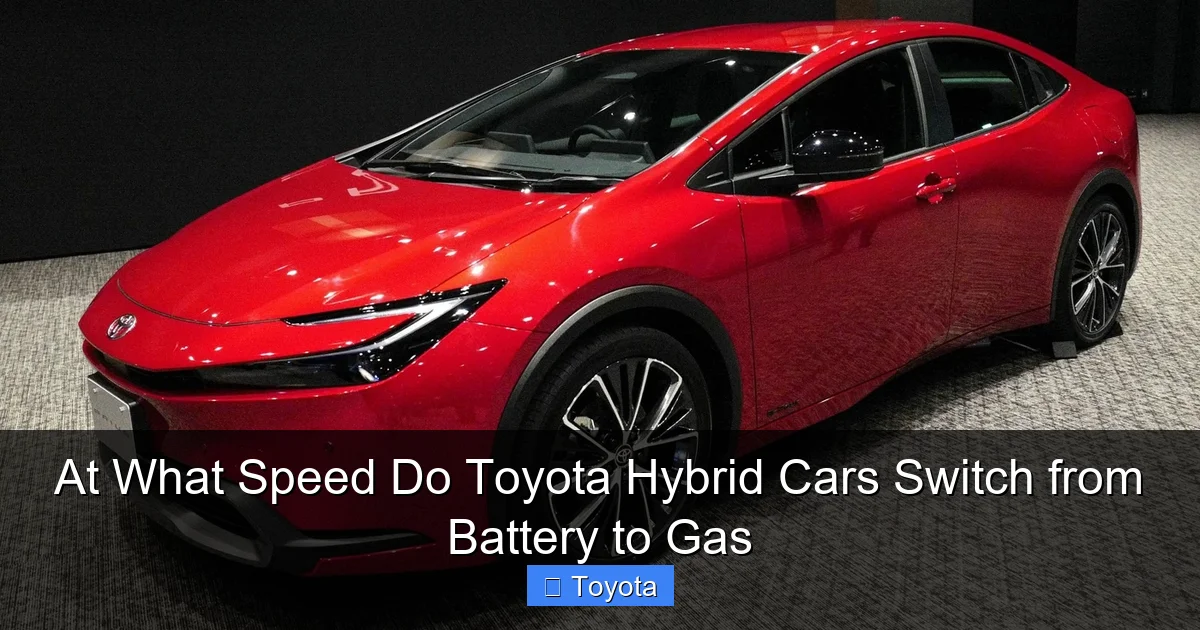
Toyota Prius: The Efficiency Benchmark
The iconic Prius is tuned for maximum fuel efficiency in city and suburban driving. It’s exceptionally good at staying in EV mode at low speeds (under 25 mph) with gentle throttle input, provided the battery has a charge. On the highway, it will often run on engine power at steady cruise (65-70 mph) because that’s a more efficient operating point for the gasoline engine. The transition between the two is exceptionally smooth. The Prius Prime plug-in hybrid can drive up to ~25 miles on electricity alone without the engine ever starting, regardless of speed (within legal limits).
Toyota RAV4 Hybrid: Power for the People
The popular RAV4 Hybrid has a more powerful gasoline engine and larger electric motors than the Prius, as it’s a compact SUV. This means it can stay in electric mode at slightly higher speeds and under slightly more load than a Prius, but the engine also feels more powerful when it does engage. You might find the engine starting around 40-45 mph during hard acceleration, whereas a Prius might hold off until 35 mph for the same pedal input. Its extra weight also means battery drain is quicker under heavy A/C use, potentially triggering earlier engine starts for recharging.
Toyota Camry Hybrid: The Smooth Sedan
The Camry Hybrid is tuned for a balance of efficiency and the quiet, refined ride expected of a midsize sedan. Its transition is virtually invisible. It will readily use electric power at low and moderate speeds in city traffic. On the highway, it settles into a steady engine-driven cruise efficiently. The 2.5L hybrid system is robust, and the engine management is geared toward smoothness over absolute EV range.
Toyota Highlander Hybrid & Sienna Hybrid: The Family Haulers
These larger three-row vehicles have the most powerful hybrid systems in the Toyota lineup (except the Land Cruiser). The added mass means the electric motors have more work to do. You’ll likely see the engine engage more frequently under full passenger and cargo load, even at moderate speeds, to provide the necessary power. However, their systems are also designed to maximize electric-only operation in low-speed, low-load situations like parking lots or quiet neighborhood streets.
Practical Tips to Maximize Electric-Only Driving
Want to see that “EV” light on your dash more often and keep the gas engine quiet? You can’t change the computer’s logic, but you can drive in a way that encourages it to use the battery first.
Visual guide about At What Speed Do Toyota Hybrid Cars Switch from Battery to Gas
Image source: images.cars.com
Drive with a Light Foot
This is the golden rule. Smooth, gentle acceleration from a stop is the single biggest factor. Pretend there’s an egg under your right foot. The slower you build speed, the longer the car will stay in EV mode. Hard acceleration is an instant “engine on” command.
Anticipate Traffic and Use Regenerative Braking
Look ahead. When you see a red light or slowing traffic, ease off the accelerator early. Your car will use regenerative braking to capture that kinetic energy and convert it back into electricity for the battery, increasing your SOC and giving you more EV range for the next move. This also reduces brake wear. Understanding how to maximize regen is a key skill for hybrid efficiency.
Plan Your Speeds for Steady Cruising
On the highway, maintaining a steady, moderate speed (e.g., 60-65 mph) is often more efficient than speeding up and slowing down. At a steady cruise, the system will choose the most efficient power source, which is often the gasoline engine directly driving the wheels at its optimal RPM. Fighting this by trying to force EV mode at 70 mph is futile and will just drain your battery quickly, causing the engine to work harder later to recharge it.
Use EV Mode Button Strategically
If your car has an EV Mode button, use it! It tells the computer, “Do everything you can to avoid starting the engine.” It’s perfect for short trips in quiet neighborhoods, parking lots, or congested city centers where speeds are low. Just remember its limits: it won’t work if you need hard acceleration, the battery is very low, or it’s very cold. For a deep dive on maintaining your hybrid’s health and battery, check out our guide on how to charge a Toyota hybrid battery safely and correctly.
Manage Climate Control
In extreme temperatures, the engine will run more to provide cabin heat or to power a massive A/C compressor. Use seat heaters and ventilated seats (if equipped) which draw less power than the main A/C compressor. Pre-condition the cabin while the car is still plugged in (for plug-in models) or use the remote start to use grid power before you unplug/drive off.
What About Plug-in Hybrids (PHEVs) like the RAV4 Prime?
Plug-in hybrids add a new layer. They have a much larger battery that can be charged from an external power source. In these vehicles, the “switch” is fundamentally different. The gasoline engine will not start at all until you have depleted your all-electric range (often 40-50 miles), unless you deliberately force it by using hard acceleration or certain conditions. You can drive a RAV4 Prime from 0 to 85 mph (its EV top speed) on battery power alone, with the engine completely off. Once the EV range is exhausted, it seamlessly transitions to behave like a standard hybrid, with the same logic described above. The existence of a large, pre-charged battery completely changes the initial driving experience and when the engine first becomes available as a power source.
The Bottom Line: It’s All About the Computer
So, to directly answer the question: Your Toyota hybrid does not switch from battery to gas at a set speed. It switches based on a complex, instantaneous calculation of driver demand, battery state, vehicle speed, temperature, and selected drive mode. The system is designed to be as efficient as possible, which means using the electric motor’s instant torque at low speeds and low loads, and the gasoline engine’s efficiency at steady, higher-speed cruising. The “switch” is not a moment to fear but a testament to the engineering that lets you have a quiet, fuel-efficient ride in the city and capable performance on the highway. The best way to see it in action is to drive gently and watch the energy flow display on your dashboard—you’ll see the engine start and stop based on need, not a speedometer number.
Frequently Asked Questions (FAQs)
Can I force my Toyota hybrid to stay in electric mode at higher speeds?
Not really. While EV Mode button encourages electric-only use, it has limits. At higher speeds (typically above 45-50 mph) or under significant acceleration demand, the system will automatically start the gas engine for safety and performance, regardless of the button. You cannot override this logic.
Will the engine start if my hybrid battery is fully charged?
Yes, but not to charge the battery. If the battery is at 100% State of Charge and you demand hard acceleration, the engine will start to provide additional power alongside the electric motors. However, during gentle driving with a full battery, the system will often try to use just the electric motor to preserve that charge for later.
Is it bad for the hybrid battery if the engine starts too often?
No. The system is designed for this. Frequent engine starts are normal and are part of the battery’s recharging cycle. What can be detrimental is consistently deep-cycling the battery (letting it get very low regularly) or exposing it to extreme heat. The computer manages battery health meticulously.
Does using the heater or A/C make the engine start more?
Yes, significantly. The cabin heater relies on engine coolant, so a cold engine will run to produce heat. The A/C compressor is electrically driven but draws substantial power from the high-voltage battery. If the battery SOC drops due to A/C use, the engine may start to recharge it, even if you’re driving gently.
Why does my engine sometimes start when I’m stopped at a red light?
This is usually for one of two reasons: 1) The battery is low and the engine is acting as a generator to recharge it while the car is stationary, or 2) The engine is warming up after a cold start. Once the battery is sufficiently charged or the engine is warm, it will shut off again at the stoplight.
Do all Toyota hybrids behave the same way?
No. While the core Hybrid Synergy Drive logic is similar, the exact tuning differs between models like the Prius, RAV4 Hybrid, and Camry Hybrid due to different engine sizes, motor outputs, and vehicle weights. A RAV4 Hybrid may engage its engine under lighter load than a lighter Prius, for example. Always refer to your specific owner’s manual for the most accurate information about your vehicle.
Frequently Asked Questions
What is At What Speed Do Toyota Hybrid Cars Switch From Battery to Gas?
At What Speed Do Toyota Hybrid Cars Switch From Battery to Gas is an important topic with many practical applications.
