
Why Is the Check Engine Light Blinking on My 2007 Toyota Camry

A blinking check engine light on your 2007 Toyota Camry is a critical warning sign, not something to ignore. It almost always indicates a severe engine misfire that is allowing unburned fuel to enter the exhaust system, which can quickly destroy your catalytic converter and cause major engine damage. You must stop driving the vehicle immediately and have it towed to a trusted mechanic for a diagnostic scan. Common culprits include faulty spark plugs, ignition coils, or fuel injectors. Addressing this issue promptly is essential to avoid expensive repairs and ensure your safety on the road.
Key Takeaways
- A blinking check engine light means severe, immediate damage is occurring. Unlike a steady light, a blink indicates a problem serious enough to potentially harm the catalytic converter or engine within minutes.
- Engine misfires are the #1 cause. This happens when fuel fails to ignite in one or more cylinders, often due to worn spark plugs, bad ignition coils, or faulty fuel injectors.
- Stop driving the car the moment the light blinks. Continuing to drive, even a short distance, can turn a $300 repair into a $3,000+ catalytic converter replacement.
- You need a professional OBD-II diagnostic scan. The stored trouble codes (like P0300-P0304) will pinpoint which cylinder is misfiring and guide the repair.
- Repairs are often urgent and not DIY for most people. While replacing spark plugs is manageable, diagnosing the root cause of a persistent misfire typically requires professional tools and expertise.
- Regular maintenance prevents this. Following your Camry’s service schedule for spark plugs, ignition components, and fuel system cleaning is the best defense against a blinking light.
- Other dashboard warnings may appear alongside it. A blinking light might be accompanied by a rough idle, loss of power, or a flashing red oil pressure light, all confirming the need to shut down the engine.
[FEATURED_IMAGE_PLACEHOLDER]
📑 Table of Contents
- Understanding the Check Engine Light: Your Car’s Cry for Help
- Common Causes of a Blinking Check Engine Light in a 2007 Toyota Camry
- The Seriousness of a Blinking Light: Why You Must Stop Now
- What to Do Immediately When the Light Starts Blinking
- Diagnosing the Problem: From Code to Cause
- Repair Options and Costs for a 2007 Toyota Camry
- Preventive Maintenance: Your Best Defense
- Conclusion: Heed the Warning, Protect Your Investment
Understanding the Check Engine Light: Your Car’s Cry for Help
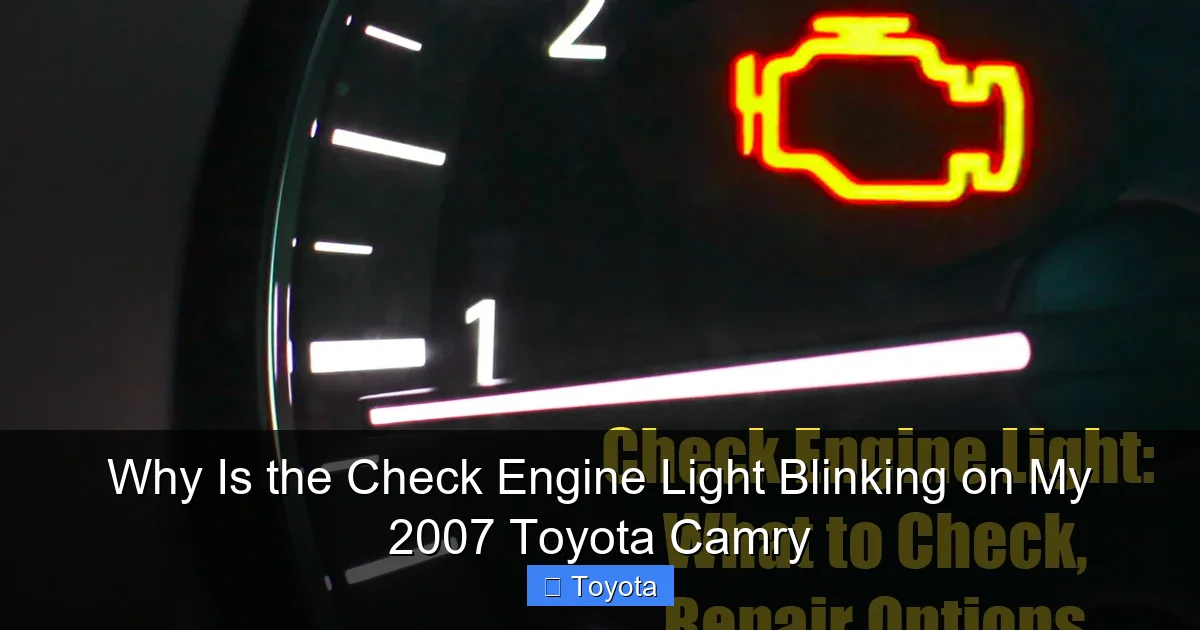
That little amber light on your dashboard, shaped like an engine, is your car’s most direct line of communication. It’s the vehicle’s way of saying, “Hey, something’s not right under the hood, and I need your attention.” For a 2007 Toyota Camry, known for its reliability, seeing this light can be especially unsettling. But here’s the crucial distinction you must understand: a steady, solid check engine light is a “yellow alert.” It means, “Get this checked out soon.” A blinking or flashing check engine light is a “red alert.” It means, “SHUT DOWN THE ENGINE RIGHT NOW or face catastrophic consequences.”
The technical term for this light is the Malfunction Indicator Lamp (MIL). It’s controlled by your Camry’s Engine Control Unit (ECU), a powerful computer that monitors dozens of sensors and systems every second. When the ECU detects a fault that could increase emissions—which is its primary regulatory concern—it turns the light on. When that fault is so severe that it threatens to damage the emissions system or the engine itself, the ECU activates a blinking protocol to demand immediate, unequivocal action from the driver. This isn’t a suggestion; it’s a command.
The Solid vs. Blinking Light: A World of Difference
Many drivers treat a solid check engine light as an inconvenience, something to “get around to” at the next oil change. That’s a risky game, but a blinking light removes all ambiguity. The ECU only blinks the light when it detects a misfire that is severe enough to potentially overheat and melt the catalytic converter. Here’s the destructive chain reaction: a cylinder misfires, meaning the air-fuel mixture fails to ignite. This sends a massive dose of unburned, raw fuel straight into the exhaust manifold. That fuel then ignites inside the super-hot catalytic converter, causing it to overheat to temperatures far beyond its design limit. Once a catalytic converter melts, it’s a paperweight. The replacement cost for a 2007 Camry’s converter can easily exceed $1,500, not to mention the labor. The misfire itself can also wash oil from the cylinder walls, causing internal engine damage, or overload other cylinders, leading to further mechanical stress.
In short, a solid light is a warning. A blinking light is a countdown to expensive destruction. If you see it blink, your immediate reaction must be to safely pull over and turn off the engine. For more on general check engine light causes, you can read our detailed guide on why a Toyota Camry’s check engine light comes on.
Common Causes of a Blinking Check Engine Light in a 2007 Toyota Camry
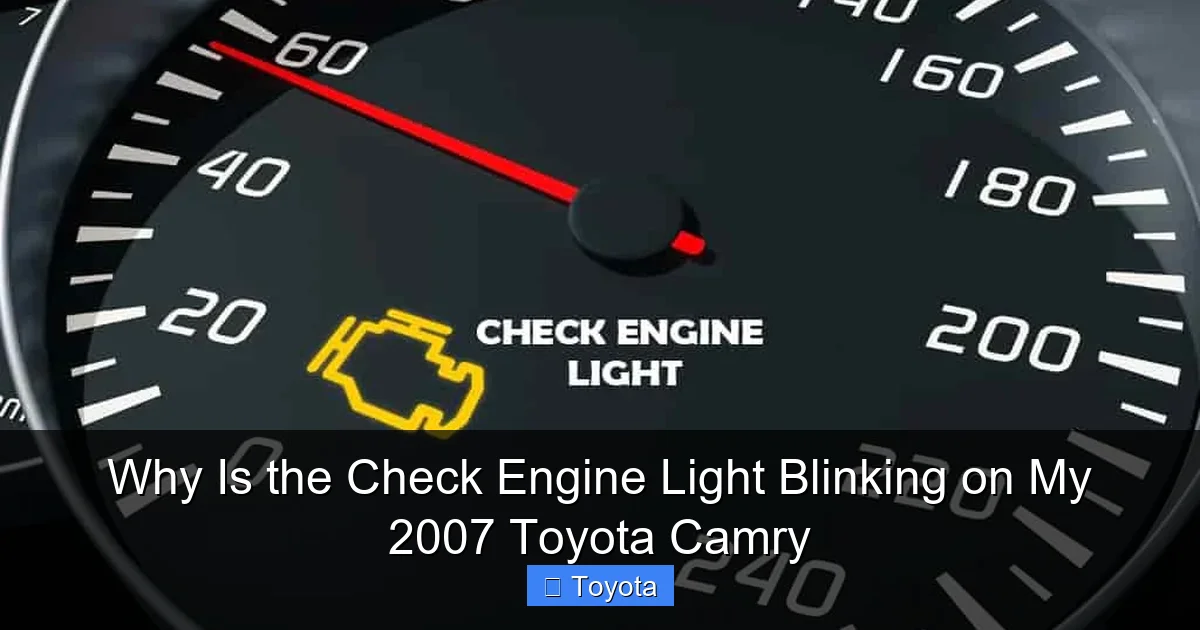
Your 2007 Camry was offered with two primary engines: the reliable 2.4-liter 4-cylinder (2AZ-FE) and the powerful 3.5-liter V6 (2GR-FE). While both are robust, they share common failure points that can trigger a catastrophic misfire and that terrifying blink. The ECU will store a specific Diagnostic Trouble Code (DTC) when it blinks, which will almost always be in the P0300-P0304 (for 4-cylinders) or P0300-P0306 (for V6) range. These are “misfire detected” codes, with the last digit indicating the specific cylinder (e.g., P0302 is cylinder 2 misfire).
Visual guide about Why Is the Check Engine Light Blinking on My 2007 Toyota Camry
Image source: mechstudies.com
1. Ignition System Failures: The Most Frequent Offender
This is the #1 culprit, especially on higher-mileage Camrys. The ignition system’s job is to create a high-voltage spark to ignite the air-fuel mixture. If it fails, you get a misfire.
- Worn Spark Plugs: The 2.4L engine in your 2007 Camry recommends spark plug replacement every 120,000 miles, but many fail earlier. Worn electrodes create a weak or inconsistent spark. If one plug fails completely, that cylinder will misfire violently, triggering the blink. Inspecting and replacing all four (or six) plugs is often the first step.
- Failed Ignition Coils: Your Camry uses individual coil-on-plug (COP) ignitions. Each cylinder has its own coil. These coils are known to fail, especially as the vehicle ages. A failed coil means zero spark for that cylinder. A quick swap of coils between cylinders and reading the subsequent DTC can confirm a bad coil. It’s a common and relatively inexpensive fix.
- Damaged Spark Plug Wires (4-cylinder only): While the V6 uses COPs, the 2.4L 4-cylinder may still use traditional wires in some variants. Cracked, worn, or carbon-tracked wires can leak spark to the engine block, causing a weak or no spark at the plug.
2. Fuel System Problems: Drowning the Combustion Chamber
For combustion to happen, you need the right air-fuel ratio (about 14.7:1). A misfire can also occur if the fuel mixture is wrong.
- Leaking or Clogged Fuel Injectors: An injector that is stuck wide open will flood a cylinder with fuel, which cannot ignite properly (or at all) and will wash away cylinder wall lubrication. Conversely, a completely clogged injector creates a lean condition (too much air) that can also cause a misfire under load.
- Faulty Fuel Pressure Regulator or Pump: Low or erratic fuel pressure can cause lean misfires across multiple cylinders. A failing pump might not deliver enough volume, especially when demanded.
- Contaminated Fuel: While less common, bad gasoline with water or excessive impurities can prevent proper combustion.
3. Mechanical Engine Issues: The Big, Expensive Problems
These are less frequent but much more severe. They indicate internal engine wear or failure.
- Low Compression: Worn piston rings, burned valves, or a blown head gasket can cause a cylinder to lose compression. Without compression, the air-fuel mixture cannot be compressed to the point of ignition. This is a major repair.
- Intake/Exhaust Leaks: A major vacuum leak (e.g., a disconnected hose, cracked intake manifold) can introduce extra air, leaning out the mixture and causing a misfire. An exhaust leak before the oxygen sensor can also confuse the ECU’s fuel calculations.
4. Sensor and Electronic Failures: The Wrong Information
The ECU relies on sensor data to calculate fuel and spark. Bad data leads to bad decisions.
- Bad Crankshaft or Camshaft Position Sensors: These sensors tell the ECU the exact position of the engine’s rotating assembly. If the signal is lost or erratic, the ECU doesn’t know when to fire the spark plugs or injectors, causing a random or specific cylinder misfire and a blink.
- Faulty Oxygen (O2) Sensors: While a bad O2 sensor usually causes a solid light, a complete failure can sometimes lead to such a corrupted fuel trim that a misfire occurs.
It’s important to note that a problem in one area can cause a symptom in another. For instance, a severely clogged catalytic converter can create backpressure so high it mimics a misfire. However, a blinking light almost always starts with the ignition or fuel system directly causing a cylinder to not fire.
The Seriousness of a Blinking Light: Why You Must Stop Now
Let’s be brutally clear about the financial and mechanical consequences of ignoring a blinking check engine light in your Camry. This is not a “drive it to the shop” situation. This is a “call a tow truck” situation.
Visual guide about Why Is the Check Engine Light Blinking on My 2007 Toyota Camry
Image source: i.ytimg.com
The Catalytic Converter: The First and Most Expensive Victim
The catalytic converter is your car’s emissions hero. It uses precious metals (platinum, palladium, rhodium) as a catalyst to convert harmful exhaust gases (carbon monoxide, hydrocarbons, nitrogen oxides) into less harmful ones (carbon dioxide, nitrogen, water vapor). It operates at extremely high temperatures (800-1,200°F). When raw, unburned fuel from a misfiring cylinder enters this superheated chamber, it ignites like a blowtorch. This causes the converter’s internal substrate (a ceramic or metallic honeycomb) to melt, collapse, and clog. The symptoms of a melted converter include a severe loss of power, a sulfur-like “rotten egg” smell, and eventually, a solid check engine light with codes for inefficient catalyst (P0420). The cost? For a 2007 Camry, a quality OEM replacement converter can cost $1,200-$2,200 installed. A cheaper aftermarket one might last a year. This damage happens in minutes of driving with a blinking light.
Engine Damage: The Domino Effect
The misfiring cylinder is also being damaged. Unburned fuel washes away the thin film of oil that lubricates the piston ring and cylinder wall. This causes accelerated wear, increased oil consumption, and low compression. Furthermore, the unburned fuel can dilute your engine oil, reducing its lubricating properties and causing wear on bearings and other moving parts. In a V6, if one bank is misfiring badly, it can put excessive load on the opposite bank, stressing that side of the engine. If the misfire is due to a mechanical issue like a broken valve spring, you could be actively destroying the cylinder head.
Safety and Drivability Risks
A car with a severe misfire is unpredictable. It will shake or vibrate violently, making it difficult to control. Acceleration will be poor and uneven. You may experience stalls at stoplights. This is not just inconvenient; it’s dangerous, especially in traffic or on highways. The unburned fuel can also backfire, potentially causing a fire under the hood if it ignites in the intake manifold or exhaust manifold. If you notice a blinking light along with a flashing airbag light or other multiple warnings, the situation is even more critical.
What to Do Immediately When the Light Starts Blinking
Your actions in the next 60 seconds are critical. Do not panic, but act with decisive urgency.
Visual guide about Why Is the Check Engine Light Blinking on My 2007 Toyota Camry
Image source: samarins.com
Step 1: Safely Pull Over and Shut Down
As soon as you recognize the light is blinking (not just solid), signal and move your Camry to the safest possible location off the road—a parking lot, wide shoulder, or side street. Once stopped, turn off the engine. Do not attempt to “make it to the next exit” or “drive a few blocks home.” The damage clock starts ticking the moment you start the engine with the underlying fault present.
Step 2: Assess the Symptoms
Before you call for help, take a quick mental note. This information is gold for the mechanic. Ask yourself:
- Was the engine running roughly, shaking, or vibrating?
- Did I hear any backfiring (popping) from the exhaust?
- Was there a loss of power or difficulty accelerating?
- Did the engine temperature gauge spike?
- Did any other lights come on, like the red oil pressure light or battery light?
- What were you doing when it happened? (Hard acceleration, cruising, idling?)
Step 3: Call for Professional Help
This is not a moment for amateur diagnosis. Call a roadside assistance service or a towing company. Explain you have a “blinking check engine light indicating a severe engine misfire” and need a tow to your trusted repair shop. If you’re a member of an auto club like AAA, use their services. If you have a good relationship with a local mechanic, call them directly for advice and to arrange the tow. Do not restart the engine to “see if it’s still blinking.” The fault is still there.
If you are in an extremely dangerous location (like a busy highway) and must move the car a very short distance to safety, do so with extreme caution, at low speed, and with hazard lights on. But understand you are risking further damage with every revolution of the engine.
Diagnosing the Problem: From Code to Cause
Once your Camry is at the shop, the technician will begin a systematic diagnosis. The process always starts with the same tool: an OBD-II scanner.
The OBD-II Scan: Reading the ecu’s Cry for Help
The On-Board Diagnostics II (OBD-II) port, located under the driver’s side dash, is the key. The mechanic plugs in a scan tool, which reads the stored Diagnostic Trouble Codes (DTCs). For a blinking light, you will see at least one code in the P030X range. For example:
- P0300: Random/Multiple Cylinder Misfire Detected. This means the ECU senses misfires but can’t isolate it to one cylinder, or it’s jumping around.
- P0301, P0302, P0303, P0304: Misfire Detected in Cylinder 1, 2, 3, or 4 (for the 4-cylinder).
- P0305, P0306: For the V6 engine.
This code is the starting point. It tells the mechanic which cylinder is the culprit. From there, the “diagnostic tree” begins. The mechanic will also look at “freeze frame data,” which captures the engine conditions (RPM, load, temperature) at the moment the fault occurred. This can provide clues. For instance, a misfire that only occurs at high RPM points to a different issue than one that occurs only at idle.
From Code to Component: The Process of Elimination
With the bad cylinder identified, the technician performs tests. The classic method for an ignition-related misfire is the “swap test.” For a code like P0302 (cylinder 2 misfire), they might swap the ignition coil from cylinder 2 with the coil from cylinder 1. They then clear the codes and run the engine. If the new code is P0301, the misfire moved to cylinder 1. This proves the coil from cylinder 2 is bad. If the code stays on P0302, the problem is in the cylinder itself—likely the spark plug or a mechanical issue. They would then inspect and likely replace the spark plug in that cylinder. If the plug looks fine, they might perform a compression test or a leak-down test to check for mechanical issues. For fuel-related misfires, they might use a noid light to see if the injector is pulsing, or measure fuel pressure with a gauge. Sensor issues are tested with multimeters or by monitoring live sensor data on the scan tool. A comprehensive guide on reading these codes can be found in our article about general Toyota Camry check engine light causes.
Repair Options and Costs for a 2007 Toyota Camry
The repair bill depends entirely on the root cause. Here’s a breakdown of common fixes and their typical cost ranges (parts + labor). Prices vary by region and shop.
The “Good” Scenarios (Relatively Inexpensive)
- Spark Plugs: If the issue is simply worn plugs on a 4-cylinder, replacing all four is a straightforward job. Cost: $150 – $300.
- Single Ignition Coil: Replacing one failed COP coil on a 4-cylinder or one bank on a V6. Cost: $200 – $400 per coil.
- All Ignition Coils (4-cylinder): If multiple coils are showing age, replacing all four preventatively is wise. Cost: $600 – $1,000.
- Fuel Injector: Replacing a single clogged or leaking injector. Cost: $250 – $500.
- Vacuum Hose: A major disconnected or cracked hose is cheap and easy. Cost: $50 – $150.
The “Bad” Scenarios (Very Expensive)
- Catalytic Converter Replacement: If you drove with a blinking light, this is now almost certainly needed. This is the big one. Cost: $1,500 – $2,500+.
- Major Engine Repair: If low compression from worn rings, a broken timing component, or a blown head gasket is the cause, you’re looking at a rebuild or replacement. Cost: $3,000 – $6,000+.
- Fuel Pump/Assembly: A failing pump that causes lean conditions might need replacement. Cost: $600 – $1,200.
- Crankshaft/Camshaft Sensor: While not as bad as a converter, replacing these sensors and the labor can add up. Cost: $300 – $700.
DIY vs. Professional Repair: A Critical Decision
For the mechanically inclined, replacing spark plugs and even ignition coils on a 2007 Camry is a very doable weekend project with basic tools. However, diagnosing the cause of a blinking light is not typically a DIY task. You are troubleshooting a system with many interdependent parts. Misdiagnosis is common and costly. You might replace a coil thinking it’s bad, only to find the misfire persists because of a leaking injector. The professional diagnostic fee ($100-$200) is the best money you’ll spend. It prevents you from throwing parts at the car randomly. If the diagnosis points to a simple, obvious fix like a single bad coil, you can then decide to buy the part and pay for just the labor, or do it yourself if confident. But for anything involving the fuel system or internal engine, professional repair is non-negotiable.
Preventive Maintenance: Your Best Defense
The best way to deal with a blinking check engine light is to ensure it never happens. Your 2007 Camry, if well-maintained, can easily surpass 300,000 miles. Follow this regimen:
Stick to the Factory Service Schedule
Toyota’s recommendations for the 2.4L and 3.5L engines are your bible. Key items:
- Spark Plugs: The manual says every 120,000 miles, but many mechanics recommend replacing them at 90,000-100,000 miles as a preventive measure, especially on the 4-cylinder. Don’t wait for a misfire.
- Ignition Coils: There’s no set “replace at” interval. They are wear items. If your Camry has over 150,000 miles and you’re having a coil replaced, consider replacing all of them. The labor is the same, and the others are likely not far behind.
- Fuel Filter: Replace every 30,000-60,000 miles. A clogged filter strains the fuel pump and can cause lean conditions.
- Air Filter: Replace every 15,000-30,000 miles. A dirty filter reduces performance and can affect fuel mixture.
- PCV Valve: Replace every 30,000 miles. A stuck PCV valve can cause oil leaks and rough idle.
Use Quality Parts and Fluids
Always use Toyota-specified or high-quality OEM-equivalent spark plugs (like Denso or NGK, which are often OEM for Toyota). Use the correct viscosity and type of oil—for the 2007 Camry, that’s typically 5W-20 or 5W-30. Using the wrong oil can cause increased friction and wear over time. Use top-tier gasoline from reputable stations; Chevron, Shell, and Mobil are generally excellent. Cheap, low-quality fuel can have inconsistent detonation qualities and contaminants that harm injectors and combustion chambers.
Address Small Problems Before They Grow
A solid check engine light is your early warning system. If you see it come on, get it scanned immediately. A code for a “small evap leak” (P0440, P0441) is not urgent, but a code for a “catalyst efficiency below threshold” (P0420) might mean your converter is starting to fail. Catching a failing O2 sensor early can save the converter. Ignoring a solid light is how you end up with a blinking one. You can also learn about other common Toyota issues, like a blinking AC light, which while different, is another example of a warning indicator that needs prompt attention.
Conclusion: Heed the Warning, Protect Your Investment
Your 2007 Toyota Camry has likely been a faithful and reliable companion. A blinking check engine light is its most desperate, urgent plea for help. It is not a design flaw or a minor quirk; it is the direct result of a severe mechanical or electronic failure that is actively destroying your engine and exhaust system. The financial cost of ignoring it ranges from several hundred to several thousand dollars. The safety cost is immeasurable. The solution is straightforward in principle, though complex in execution: stop the car, get a professional diagnosis, and repair the specific fault identified. Do not reset the light yourself without fixing the problem—it will just blink again, and the damage will progress. Invest in the diagnostic fee. Trust a reputable mechanic. View this not as an inconvenience, but as a critical, life-saving intervention for your vehicle. By respecting this warning and committing to rigorous preventive maintenance, you can keep your Camry’s engine running smoothly and reliably for years to come.
Frequently Asked Questions
Why is my check engine light blinking and not solid?
A blinking check engine light indicates a severe engine misfire that is allowing unburned fuel to enter the exhaust system. This is an urgent condition that can destroy the catalytic converter within minutes of driving. A solid light indicates a less immediate emissions-related problem.
How urgent is a blinking check engine light?
It is a maximum urgency, “stop driving immediately” situation. You should pull over safely, turn off the engine, and have the vehicle towed to a repair shop. Continuing to drive will almost certainly cause expensive damage.
Can I keep driving with a blinking check engine light?
No. You should not drive the car at all with a blinking light. Even a short drive can melt the catalytic converter, leading to a repair bill of $1,500 or more. The risk of engine damage and a breakdown is also extremely high.
What does a blinking check engine light mean on a Toyota?
On any Toyota, including the Camry, a blinking light means the engine computer has detected a misfire severe enough to risk catalytic converter damage. The most common causes are failed spark plugs, ignition coils, or fuel injectors.
Will the check engine light turn off by itself after a misfire?
No. The light will stay on (or blink again if the problem recurs) until the underlying fault is repaired and the trouble codes are cleared with a scan tool. Simply disconnecting the battery is a temporary fix that will not solve the problem and will cause the light to return.
Can I reset the check engine light myself after fixing the problem?
Yes, but only after the repair is complete. You can reset it by disconnecting the battery for a few minutes or using an OBD-II scan tool. However, if the repair was not successful or there is another issue, the light and codes will return. For proper reset procedures on different models, resources like our guide on resetting a Toyota Corolla’s check engine light show the general process, but the priority is always fixing the cause first.