
How Many Miles Can a 2015 Toyota Corolla Go on a Full Tank

A 2015 Toyota Corolla with a full 13.2-gallon tank can officially travel between 364 and 448 miles, depending on driving conditions. Its EPA rating of 28-36 MPG provides a solid baseline, but real-world range varies with city vs. highway driving, weather, and vehicle maintenance. Understanding these factors helps you plan trips and avoid running out of gas.
So, you’re behind the wheel of a 2015 Toyota Corolla. It’s a car known for its reliability, its thriftiness, and its uncanny ability to just keep going. You’ve just filled up the tank, the needle is happily resting on ‘F,’ and a natural question pops into your head: just how far can this thing actually take me before I need to do this again? It’s a smart question for planning road trips, managing a weekly commute, or simply understanding your machine better. The answer isn’t just one number; it’s a story about engineering, driving habits, and a little bit of math. Let’s crack that story wide open.
The 2015 Toyota Corolla, specifically the popular LE and S trims, came standard with a 1.8-liter 4-cylinder engine paired with a continuously variable transmission (CVT). This powertrain was designed with one primary mission: efficient, dependable transportation. The cornerstone of our range calculation is two simple, published numbers: the size of the fuel tank and the car’s Environmental Protection Agency (EPA) fuel economy rating. From there, we build a complete picture of what you can realistically expect on pavement.
Key Takeaways
- Official EPA Range: The 2015 Corolla’s EPA combined rating of 31-33 MPG translates to an estimated 364-448 miles per full tank, based on its 13.2-gallon fuel capacity.
- Real-World Variance: Actual mileage can drop 15-20% in heavy city traffic or extreme weather, reducing your total range significantly from the EPA estimate.
- The Gas Light Buffer: When the low fuel light illuminates, you typically have 30-50 miles remaining, giving you a crucial safety margin to find a station.
- Maintenance is Key: Proper tire inflation, clean air filters, and regular oil changes are critical for achieving the best possible fuel economy and maximum range.
- Model Comparison: The Corolla’s range is competitive within its class, generally offering more miles per tank than larger sedans like the Avalon but less than hybrids.
📑 Table of Contents
Understanding the Numbers: Tank Size and EPA Ratings
Before we talk about real-world driving, we must establish the theoretical maximum. This is our starting point, the “best-case scenario” number that the engineers and the EPA agree upon under controlled laboratory conditions.
The Fuel Tank: Your Gasoline Reservoir
The 2015 Toyota Corolla is equipped with a fuel tank that holds 13.2 gallons of gasoline. This is a fairly standard size for a compact sedan of its era. It’s not a massive tank like you’d find in a full-size SUV, but it’s not a tiny city-car tank either. This 13.2-gallon capacity is our constant—the total volume of fuel you’re starting with after a fill-up. Everything that follows determines how many miles you’ll extract from each of those gallons.
EPA Fuel Economy: The Official Scorecard
The EPA tests every vehicle on a chassis dynamometer, simulating specific city and highway driving cycles to produce its famous MPG (miles per gallon) figures. For the 2015 Corolla with the 1.8L engine and CVT, the official ratings are:
- City: 28 MPG
- Highway: 36 MPG
- Combined: 31 MPG (for LE) / 33 MPG (for S trim, due to slightly different tires/aerodynamics)
Let’s do the basic math. Using the combined rating of 32 MPG as a middle ground:
13.2 gallons x 32 MPG = 422.4 miles
If you live in a perfect, steady-state highway world, you might see:
13.2 gallons x 36 MPG = 475.2 miles
And in the worst-case, constant-stop-and-go city scenario:
13.2 gallons x 28 MPG = 369.6 miles
So, on paper, your range is a sliding scale between roughly 370 and 475 miles. But here’s the crucial part: that “combined” number is a weighted average. Most drivers’ actual “combined” mileage falls somewhere between the city and highway numbers based on their personal drive mix. For the average person, a realistic expectation is between 364 and 448 miles on a full tank.
Real-World Factors That Change Your Range
Now we leave the lab and hit the real road. The EPA numbers are a fantastic benchmark, but they are not a promise. Your actual miles per tank can swing dramatically based on several key factors. Understanding these is the key to managing your fuel and setting accurate expectations.
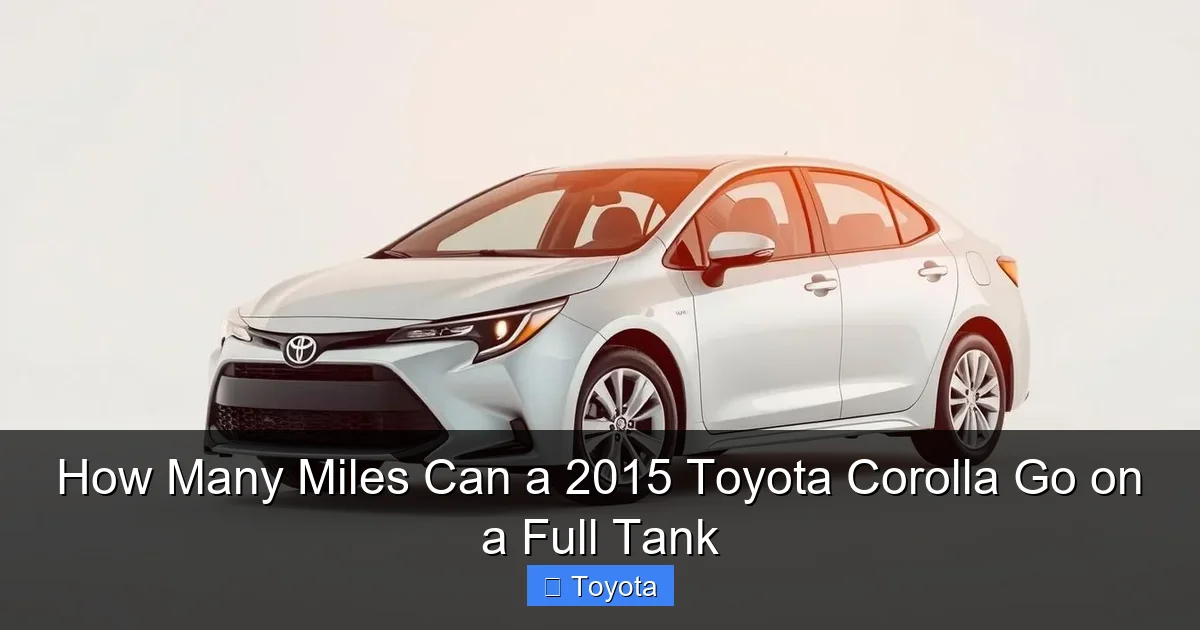
Visual guide about How Many Miles Can a 2015 Toyota Corolla Go on a Full Tank
Image source: vehiclerides.com
Driving Style and Environment
This is the biggest variable. Are you a gentle, anticipatory driver who coasts to red lights and accelerates slowly? Or do you have a lead foot, treating every green light as a drag race? Aggressive driving—rapid acceleration and hard braking—can reduce fuel economy by up to 30% in city traffic. Your environment is just as powerful. Driving uphill consistently, into a strong headwind, or in extreme temperatures (both hot with A/C and cold with a heater) forces the engine to work harder, burning more fuel per mile. A winter commute with a cold engine and defroster on can easily knock 3-5 MPG off your average.
Vehicle Load and Aerodynamics
That 13.2-gallon tank capacity doesn’t change, but the weight you’re carrying does. A car loaded down with heavy cargo, multiple passengers, or a roof rack creates more mass for the engine to move and increases aerodynamic drag. A fully loaded Corolla on a highway road trip might see its highway MPG drop from 36 to 32 or lower. Even something as simple as keeping unnecessary items in the trunk adds up over thousands of miles.
Tire Health and Pressure
This is a massively important, often overlooked factor. Under-inflated tires create more rolling resistance, which is a direct drag on fuel efficiency. The Corolla’s recommended tire pressure is typically 32-33 PSI (check your driver’s door jamb sticker for your specific tires). Driving with tires at 28 PSI can reduce your fuel economy by 0.3% for every 1 PSI below the recommendation. Over a full tank, that can mean losing 10-15 miles of range. Furthermore, the type of tires matters. The factory eco-focused tires on the Corolla are designed for low rolling resistance. If you’ve replaced them with aggressive all-terrain or performance tires, you will see a noticeable hit to your MPG and thus your total range.
The Gas Light: Your Final Warning and Reserve Fuel
This is the moment every driver dreads: the low fuel warning light flickers on. In the 2015 Corolla, this is typically a yellow, pump-shaped icon on the dashboard. Many people panic when they see it, but it’s actually a helpful feature designed to give you a buffer. The light doesn’t come on when the tank is empty; it comes on when there is a reserve of fuel left.
Visual guide about How Many Miles Can a 2015 Toyota Corolla Go on a Full Tank
Image source: vehiclebright.com
How Many Miles After the Light Comes On?
This is a common follow-up question to our main topic. While the exact reserve varies slightly, most owner reports and automotive experts agree that a 2015 Corolla has approximately 30 to 50 miles of driving range remaining after the gas light illuminates. This “reserve” is not a precise amount you should test. It’s a safety margin. Factors like your driving style (gentle vs. aggressive) and whether you’re on the highway or in the city will determine if you get 30 miles or closer to 50 from that reserve. It is never advisable to regularly drive with the light on. Consistently running your tank extremely low can cause damage to the fuel pump (which is cooled by gasoline) and allow sediment from the bottom of the tank to be sucked into the fuel system. For more specific insights on this warning system, you can read about how many miles you can drive after the gas light comes on in a Toyota Corolla.
Why You Should Refuel Soon, Not Later
Beyond protecting your fuel system, there’s a practical reason to fill up shortly after the light comes on: peace of mind and planning. That 30-50 mile buffer is for getting to a gas station, not for extending your weekly fuel stops by another day. Using it as intended means you’re never truly “on empty.” It’s a smart habit to refuel when you have about a quarter-tank left, which also helps keep your fuel fresher.
Maximizing Your Miles Per Tank: Practical Tips
You now know the range is a spectrum, not a fixed number. The goal is to consistently hit the higher end of that spectrum. Here’s how to get the most miles from your 13.2 gallons.
Visual guide about How Many Miles Can a 2015 Toyota Corolla Go on a Full Tank
Image source: vehiclebright.com
Drive Smarter, Not Harder
This is the single most effective method. Practice smooth acceleration and braking. Use cruise control on flat highways to maintain a steady speed. Observe the traffic flow ahead to avoid unnecessary braking. These habits alone can improve your real-world MPG by several points, directly adding 20-30 miles to your total range per tank.
Maintenance Matters: The Foundation of Efficiency
- Oil Changes: Use the recommended viscosity (likely 0W-20 for the 2015 Corolla). Fresh, clean oil reduces internal engine friction.
- Air Filter: A clogged air filter starves the engine of air, forcing it to burn more fuel. Check it at every oil change; replace it if dirty.
- Spark Plugs: Worn spark plugs misfire, wasting fuel. The 2015 Corolla’s iridium plugs have a long life (120,000 miles), but it’s a critical check item. You can learn more about the specific number of spark plugs in your Toyota Corolla and their service interval.
- Tire Pressure: Check monthly and before long trips. Inflate to the door jamb sticker specification, not the max on the tire sidewall.
Smart Refueling and Accessories
When you do fill up, do it correctly. Ensure the nozzle is seated properly to avoid vapor lock issues that can trigger the check engine light. Avoid “topping off” the tank after the pump clicks; this can force liquid fuel into the evaporative system. Also, be mindful of accessories. That large, heavy roof-top carrier or bike rack might be convenient, but it’s a constant aerodynamic penalty. Remove it when not in use.
Comparing the Corolla to Its Peers and Family
Context is everything. How does the Corolla’s range stack up? It’s helpful to compare it to other Toyotas and its segment rivals.
Within the Toyota Family
The Corolla is the efficient, compact workhorse. Its larger sibling, the Toyota Avalon, is a full-size sedan with a larger engine and a bigger gas tank (18.5 gallons), but its MPG is lower (around 21-31 MPG). Its net range is often similar or slightly less despite the bigger tank. The hybrid Camry, with its 43-44 MPG rating and similar tank size, would crush the Corolla’s range, potentially exceeding 500 miles. Even the minivan-focused Toyota Sienna, with its larger tank and decent highway MPG, offers a comparable or greater total distance but at a much higher fuel cost per mile.
In the Compact Sedan Segment
In 2015, the Corolla’s direct competitors were the Honda Civic, Hyundai Elantra, and Mazda3. They all had similar fuel tank sizes (12-13 gallons) and very competitive EPA ratings (often 28-39 MPG). The differences in real-world range between these models were usually a matter of a few dozen miles at best. The Corolla consistently ranked near the top for predicted fuel economy and reliability, making its range both dependable and predictable. Its strength wasn’t a wildly high MPG number, but a consistent, trustworthy delivery of its rated economy over the long term.
Long-Term Ownership and the Myth of “Miles to Empty”
As a 2015 model, many Corollas on the road today have 100,000+ miles. Does age affect the range? Yes, but usually not dramatically if well-maintained.
Age, Wear, and Efficiency
Over time, components like oxygen sensors, fuel injectors, and the catalytic converter can become less efficient. Engine compression can drop slightly. These factors can slowly erode fuel economy, perhaps reducing your MPG by 1-2 over 150,000 miles. However, a well-cared-for Corolla with its simple, proven 1.8L engine is remarkably resilient. The biggest threat to long-term range is neglect: skipping oil changes, ignoring check engine lights, and driving on under-inflated tires. A car that has been meticulously maintained will retain its original EPA-range capability far longer than one that hasn’t.
Focus on the Trip, Not Just the Tank
Finally, it’s important to shift perspective. Obsessing over the exact miles between fill-ups can lead to “running on fumes” anxiety. A better approach is to use your Corolla’s average MPG display (if equipped) as your guide. Reset it at each fill-up. Watch how your driving habits and conditions change that number. If you see it drop from 35 MPG to 29 MPG, you’ll know why your range is shorter that week. This turns a static number (miles per tank) into a dynamic feedback tool for better driving and maintenance. For general insights into vehicle longevity, you might explore how many miles a car can last, which highlights how reliability impacts long-term ownership costs.
Frequently Asked Questions
What is the actual, real-world range of a 2015 Toyota Corolla?
While the EPA suggests 364-448 miles, most real-world drivers report an average range of 350-400 miles per full tank, depending heavily on their mix of city and highway driving and current weather conditions.
How many gallons of gas does a 2015 Toyota Corolla hold?
All 2015 Toyota Corolla trims (LE, S, etc.) have a fuel tank capacity of 13.2 gallons.
Does using premium gas increase the range of a 2015 Corolla?
No. The 2015 Corolla’s 1.8L engine is designed for regular unleaded gasoline (87 octane). Using premium provides no benefit to performance, fuel economy, or range and is a waste of money.
How does the Corolla’s range compare to a hybrid like the Prius?
The 2015 Prius, with a smaller tank but much higher MPG (around 50), could travel 550-600+ miles on a single tank—significantly farther than any Corolla model.
Is it bad to let my Corolla run completely out of gas?
Yes. Running the tank completely empty can overheat and damage the in-tank fuel pump, which relies on gasoline for cooling and lubrication. It can also suck sediment into the fuel system, clogging filters and injectors. Always refuel when the low fuel light comes on.
What is the best way to check my Corolla’s actual fuel range?
>The most accurate method is to reset your trip odometer or average MPG readout at each fill-up. Drive normally until you refuel again. Divide the miles driven by the gallons of fuel you added. This gives you your true, personal miles-per-gallon figure for that specific period. Multiply that by 13.2 to get your personal range.
