
How to Tow a 4×4 Jeep on a Dolly

Towing a 4×4 Jeep on a dolly is almost always a recipe for catastrophic and expensive damage to your vehicle’s transfer case and drivetrain. Unlike 2WD cars, 4×4 systems require all wheels to rotate freely or be completely disconnected. The only universally safe method for any 4×4 Jeep is flatbed towing. This guide details exactly why dolly towing is dangerous, what your Jeep’s manual truly says, and the step-by-step correct procedure for preparing your vehicle for safe transport on a flatbed trailer.
So, you need to tow your trusty 4×4 Jeep. Maybe you’re moving, your engine gave up, or you’re taking it to a trailhead far from home. Your first thought might be, “I’ll just rent a tow dolly and save some cash.” Stop right there. If you own a Jeep Wrangler, Grand Cherokee, Gladiator, or any vehicle with a traditional 4×4 system, putting it on a dolly is one of the most dangerous and expensive mistakes you can make. It’s not just a bad idea; it’s a direct path to turning a simple tow into a multi-thousand-dollar transmission and transfer case rebuild. This guide will walk you through exactly why, drawing a clear line between what you might think you know and what your Jeep’s mechanical reality actually demands.
Key Takeaways
- Dolly towing a 4×4 Jeep will likely destroy the transfer case: With the front or rear wheels lifted on a dolly, the driveshafts and transfer case components are forced to spin without lubrication, causing immediate and severe internal damage.
- Your Jeep’s owner’s manual is the final authority: It will explicitly state “flatbed only” or provide a complex, model-specific procedure for disconnecting the drivetrain, which is not feasible for a simple dolly setup.
- Part-time vs. full-time 4×4 systems both suffer: Even if you place the transfer case in neutral, the differentials (especially front) are still mechanically locked and will be damaged when the wheels are dragged.
- The only safe towing method is a flatbed or trailer: This keeps all four wheels off the ground, eliminating any rotation or stress on the drivetrain, transfer case, and differentials.
- If flatbed is unavailable, a full trailer is the second-best option: All wheels are on the trailer’s axles, but you must still secure the vehicle properly to prevent movement and strain on suspension components.
- Never assume “N” in your transfer case makes it safe: Neutral in a part-time system only disconnects the front and rear driveshafts from each other; it does not disconnect the wheels from the differentials or driveshafts.
- Improper towing voids warranties and is costly: Repairs for a fried transfer case or differential can easily exceed $5,000, making a $200 flatbed tow the far smarter investment.
📑 Table of Contents
- Understanding Your Jeep’s 4×4 Drivetrain: It’s Not Like a Minivan
- What Your Jeep’s Owner’s Manual Actually Says (Hint: It’s Not “Check With Dealer”)
- The Devastating Mechanics of Dolly Towing Damage
- Safe and Correct Methods for Towing Any 4×4 Jeep
- Step-by-Step: How to Properly Prepare Your 4×4 Jeep for Flatbed Towing
- Special Considerations for Modern Jeep Models
- Conclusion: Protecting Your Investment is Non-Negotiable
Understanding Your Jeep’s 4×4 Drivetrain: It’s Not Like a Minivan
To understand why a dolly is a disaster, you first need a simple picture of what’s happening under your Jeep. A 2WD car is straightforward: the engine turns the transmission, which turns a driveshaft, which turns the rear differential, which turns the rear wheels. The front wheels just roll freely. Towing it with the front wheels on the ground is fine because nothing connects the front wheels to the drivetrain.
A 4×4 Jeep is a web of mechanical connections. The power from the transmission goes to the transfer case. The transfer case is the brain of the system. It has a set of gears and a clutch pack (in modern automatic 4x4s) or a mechanical linkage (in older manual systems). Its job is to split power between the front driveshaft and the rear driveshaft. Each of those shafts connects to a front differential and a rear differential, which then turn the wheels on their respective axles.
The Critical Difference: Part-Time vs. Full-Time 4×4
This is where people get confused. Most traditional Jeeps, like the Wrangler and Gladiator, use a part-time 4×4 system. This means the front and rear axles are mechanically locked together when you engage 4WD. In 2WD mode, the front axle is disconnected from the driveshaft via a clutch pack or a shiftable collar, but the front wheels are still bolted to the front differential, which is bolted to the front axle housing. That front differential is still connected to the front driveshaft, which is connected to the transfer case.
Full-time 4×4 systems, found in many Grand Cherokees and older models, have a center differential that allows the front and rear wheels to spin at different speeds on pavement. They are always mechanically connected. The principle for towing damage, however, is tragically similar.
What “Neutral” in the Transfer Case Actually Means
Here’s the big myth. You think, “I’ll just put the transfer case in Neutral (N).” In a part-time system like a Jeep Wrangler’s, this neutral position disconnects the front driveshaft from the rear driveshaft and the transmission. It allows you to tow with all four wheels on the ground for very short distances (like a few feet to reposition) without damaging the transfer case. It does NOT disconnect the wheels from the differentials or the driveshafts. The front wheels are still rigidly attached to the front differential, which is still attached to the front driveshaft. If you lift the front wheels on a dolly and drag them along the road, you are forcibly spinning the front differential, front driveshaft, and the input shaft of the transfer case. With no engine running, there is zero lubrication being pumped to these components. Metal grinds against metal instantly. It’s like running your engine without oil, but it happens in seconds.
What Your Jeep’s Owner’s Manual Actually Says (Hint: It’s Not “Check With Dealer”)
Let’s go to the source. Pull out your Jeep’s owner’s manual. Go to the “Towing” or “Recreational Towing” section. You will find language that is unequivocal. For a 2023 Jeep Wrangler 4xe, it states: “Recreational towing (towing behind a motorhome, etc.) is not recommended. The only approved method of transporting this vehicle is with a flatbed truck or trailer.” For a standard gasoline Wrangler with a manual transmission, it might provide a complex procedure involving removing the front driveshaft, which is not something you do roadside. For automatic transmission models, it almost universally says “flatbed only.”
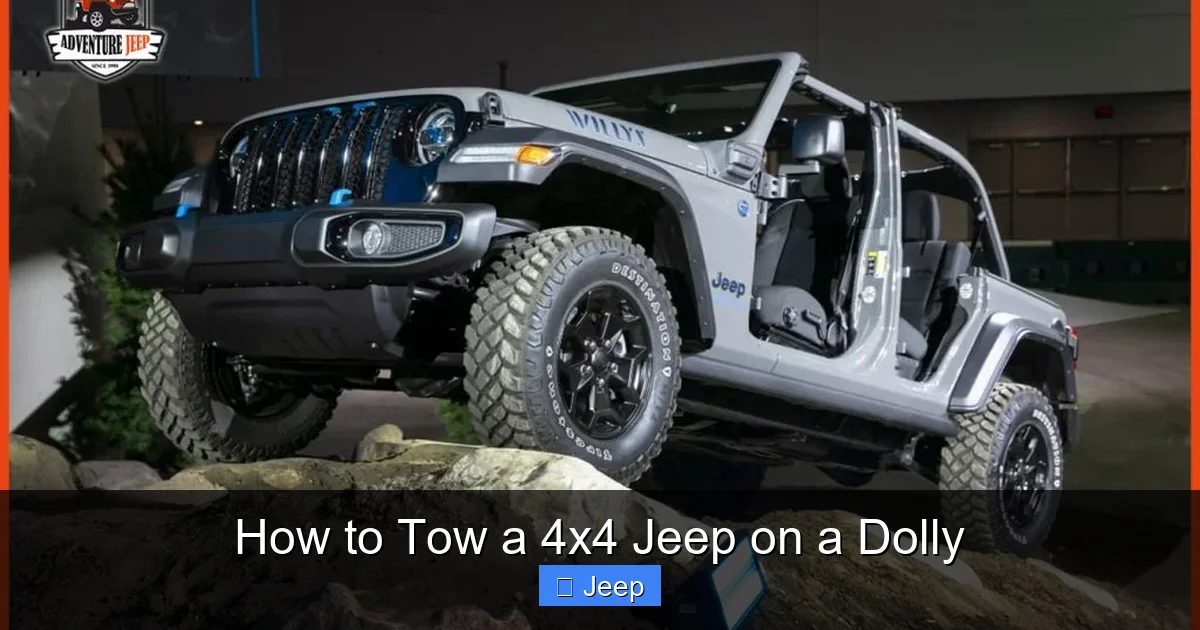
Visual guide about How to Tow a 4×4 Jeep on a Dolly
Image source: adventurejeep.com
The same is true for the Jeep Gladiator and most Grand Cherokee models with 4×4. The manual will not say “you can use a dolly if you put it in neutral.” It will explicitly forbid it or require a procedure that is impractical for a casual tow. If your manual is missing, a quick call to a Jeep dealership’s service department will get you the same answer. They see the aftermath of dolly towing regularly—smoked transfer cases with burnt-smelling oil and shredded bearings. That call costs less than a tow dolly rental and could save you thousands.
Why Manufacturers Design Them This Way
This design isn’t a conspiracy to make towing expensive. It’s a trade-off for capability. The robust, part-time 4×4 system in a Wrangler is what lets it crawl over rocks and ford deep water. That same robustness means all the components are always connected in a mechanical chain when the wheels are on the ground. There is no “freewheel” mechanism like in a front-wheel-drive car’s transaxle. The system is built for strength and direct power transfer, not for being dragged with two wheels in the air.
The Devastating Mechanics of Dolly Towing Damage
Let’s get graphic about what happens inside your Jeep when you tow it on a dolly. Imagine your front wheels are on the dolly, and your rear wheels are on the ground. The tow vehicle starts pulling. The rear wheels turn. That turns the rear driveshaft, which turns the rear differential, which is connected to the rear output shaft of the transfer case. The transfer case, with its internal clutches or gears, now tries to turn the front output shaft because the front and rear are mechanically linked in 2WD mode. But the front wheels are being dragged by the dolly. They are not turning at the same speed as the rear wheels (especially on turns). This creates a massive binding force.
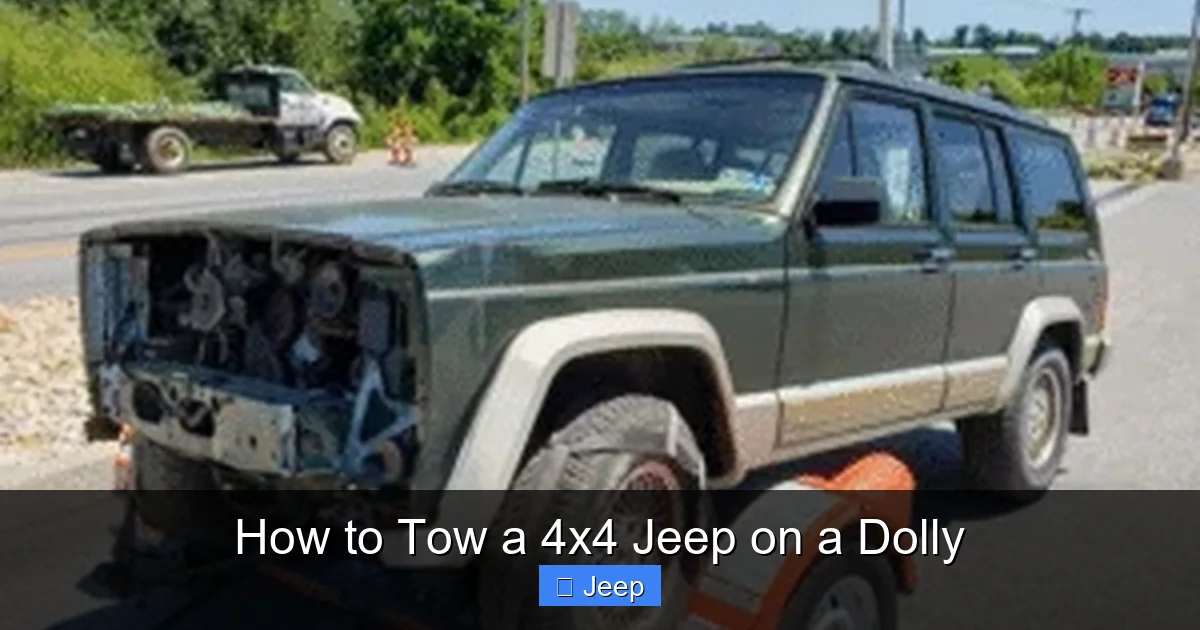
Visual guide about How to Tow a 4×4 Jeep on a Dolly
Image source: adventurejeep.com
Now, consider the lubrication. Transfer cases are not like engines. They don’t have a pump that runs off the input shaft. They are lubricated by splash and slosh. When your engine is off and the Jeep is static, the oil sits in the bottom. As the components start to spin without being submerged in oil (because they’re not submerged when tilted or spinning slowly), they run dry. Within 100 feet of towing, you have generated extreme heat and friction.
- The Transfer Case: This is the first and most expensive victim. The clutch packs in an automatic system overheat and weld themselves together. Gears in a manual system strip and shatter. Bearings seize. The case itself can warp from heat. A new transfer case for a Jeep Wrangler can cost $3,000-$5,000 for the part alone, plus 10+ hours of labor.
- The Front Differential: Since the front wheels are on the dolly, the front differential’s pinion and ring gear are being forced to spin while the axle shafts are held stationary relative to the dolly’s rotation. This wrecks the spider gears and bearings.
- The Front Driveshaft and U-Joints: These components are not designed to spin at high speed while disconnected from the engine. They can become imbalanced and vibrate violently, potentially causing a catastrophic failure that damages other components.
- The Transmission (Indirectly): While the transmission output is disconnected in neutral (on some models), the extreme stress and heat from the binding transfer case can send shockwaves back through the system, potentially harming output shaft bearings or seals.
The damage is often not apparent immediately. You might tow it a mile, unhook, and drive away thinking you got lucky. But microscopic metal particles are now circulating in the oil. The heat has weakened components. The failure could come 50 miles later, or 500 miles later, leaving you stranded with a vehicle that won’t move and a repair bill that makes the tow dolly rental seem like a joke.
Safe and Correct Methods for Towing Any 4×4 Jeep
If dolly towing is off the table, what are your options? There are two correct ways and one “sometimes acceptable” way with major caveats.
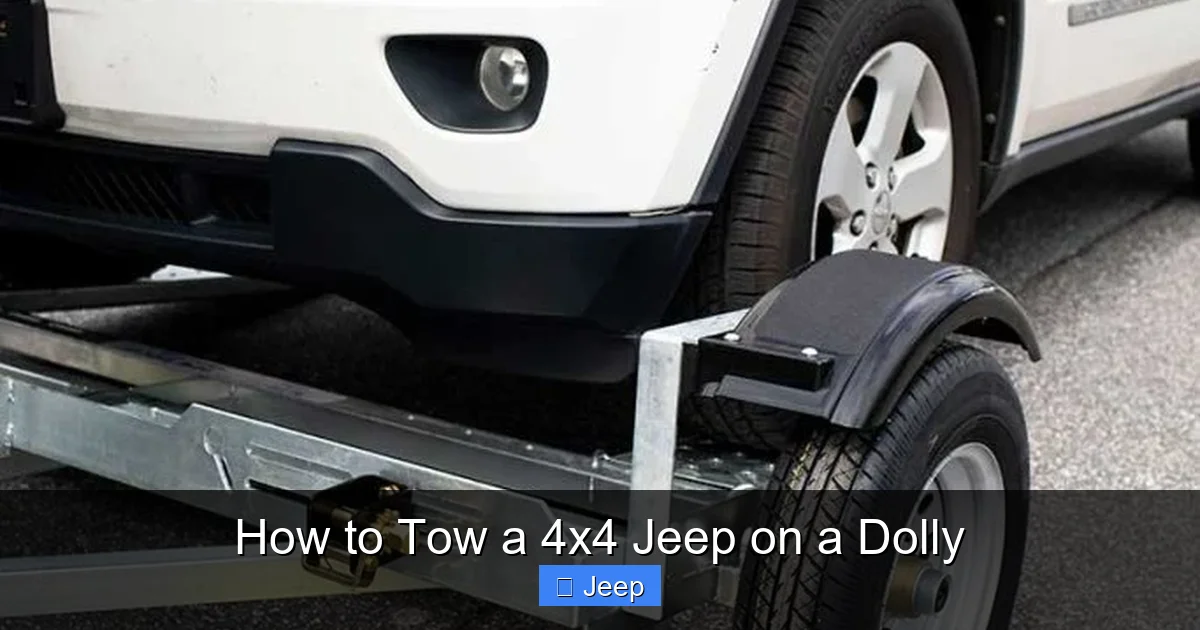
Visual guide about How to Tow a 4×4 Jeep on a Dolly
Image source: cartowdolly.com
Method 1: Flatbed Towing (The Gold Standard)
This is the only method recommended for all 4×4 Jeeps without exception. A flatbed truck or trailer keeps all four wheels completely off the ground. The vehicle is winched or driven onto the bed and secured at the designated tie-down points (usually the factory tow hooks or reinforced frame sections). There is zero rotation of any drivetrain component. The wheels spin freely as the truck moves, but they are not connected to anything in the Jeep. This is 100% safe. Always ensure the tow operator uses soft straps or proper wheel chocks and does not strap to the axles or suspension components.
Method 2: Full Trailer (A Very Good Second Choice)
A full trailer, like a car hauler or an enclosed trailer, is also perfectly safe. All four wheels are on the trailer’s own axles. The procedure is the same as flatbed: secure the Jeep to the trailer using the proper frame tie-downs. The key here is that the trailer’s wheels are doing all the turning, not your Jeep’s wheels. This method is excellent for long-distance moves or frequent towing needs if you own a trailer.
Method 3: “Two-Wheel Lift” Towing (Extreme Caution & Model-Specific)
This is where a tow truck lifts only the front wheels off the ground (for rear-wheel-drive Jeeps in 2WD mode) or only the rear wheels (for front-wheel-drive Jeeps, which Jeeps are not). This is not a dolly. It’s a tow bar that connects to the front axle or frame, lifting just the front tires. For a 4×4 Jeep, this is only safe if you can completely disconnect the driveshaft(s) from the differential(s). On some older Jeep models with a removable front driveshaft, this is a procedure outlined in the manual. You would have to crawl under the vehicle, unbolt the front driveshaft from the front differential, and secure it out of the way. This is a dirty, difficult, and time-consuming job not suited for most people. For the vast majority of modern 4×4 Jeeps with automatic transmissions and no user-serviceable driveshaft disconnect, this method is just as damaging as a dolly. Assume it is not an option unless your manual explicitly provides a step-by-step for it.
Step-by-Step: How to Properly Prepare Your 4×4 Jeep for Flatbed Towing
So you’ve booked a flatbed. Great! There are still important steps to take to protect your vehicle and ensure a smooth process. These are universal best practices.
Before the Tow Truck Arrives
- Engage the Parking Brake: This prevents the vehicle from rolling on the bed.
- Put the Transmission in Park (Automatic) or Gear (Manual): This is a secondary restraint.
- Turn Off All Accessories: Lights, radio, etc.
- Check Tire Pressure: Ensure tires are properly inflated. A severely under-inflated tire can be damaged on the winch or by the straps.
- Remove Personal Items and Loose Accessories: Take off any roof racks, spare tires from the rear door, or anything that could catch wind or shift.
- Know Your Tie-Down Points: Familiarize yourself with the reinforced tow hooks or factory-provided tie-down loops on your Jeep’s frame. Do not let the tow operator strap to the bumper, axles, or control arms.
During Loading and Securing
Watch the process. The operator should use soft straps or chains with protective sleeves. They should winch the Jeep on slowly and evenly. The Jeep should be centered on the bed. Once on the bed, they will secure it. There should be a minimum of four tie-downs—two at the front and two at the rear—attached to solid frame points. The straps should be tightened until the suspension is slightly compressed, but not so tight that they bend or stress suspension components. The vehicle should not be able to shift forward, backward, or side-to-side if you push on it firmly.
After the Tow: Unloading
When you arrive at your destination, inspect the vehicle before it’s unstrapped. Ensure the parking brake is still set. Once unstrapped, the operator will winch or drive it off. Be prepared to catch it if it rolls, though the parking brake should hold. Once on the ground, release the parking brake, put it in park/neutral, and start it up. Listen for any unusual noises before driving away.
Special Considerations for Modern Jeep Models
Newer Jeeps have added layers of complexity. The Jeep Wrangler 4xe (plug-in hybrid) has specific warnings. Its electronics are even more sensitive. Towing it incorrectly can damage the high-voltage battery system or the hybrid transmission. The manual for these models is absolute in its “flatbed only” directive. For Jeeps with electronic transfer case selectors (like the Selec-Terrain system), there is no manual lever to put in neutral. The “Neutral” setting is for flat towing with all wheels down, but again, this is only for very specific, short-distance scenarios and still requires the driveshaft to be disconnected on many models. Do not experiment.
For Jeep Grand Cherokees with Quadra-Trac II or Quadra-Drive II, the system is full-time with a limited-slip center differential. There is no true neutral that disconnects the drivetrain. Dolly towing will destroy the center differential. The manual will say “towing with all four wheels on the ground is not recommended” or “flatbed only.”
If you own a classic Jeep with a simple, manual part-time transfer case and a removable front driveshaft, you might have a dolly option if you are willing to perform the driveshaft removal every single time you tow. This is a significant hassle and risk of improper re-installation. For 99% of owners, flatbed remains the answer.
Conclusion: Protecting Your Investment is Non-Negotiable
Towing a 4×4 Jeep on a dolly isn’t a gamble with good odds; it’s a guaranteed loss. The mechanical reality of a connected drivetrain makes it impossible to drag two wheels without destroying the components that make your Jeep a Jeep. The upfront cost of a flatbed tow is a fraction of the price of a new transfer case. It’s an insurance policy for your vehicle’s mechanical health. Always, always, consult your owner’s manual first. When in doubt, call the dealership. Insist on a flatbed. Explain to the tow company that you have a 4×4 and require a flatbed; a reputable company will not try to talk you into a dolly. Your Jeep is an investment in adventure and capability. Protecting that investment during transport means respecting its engineering. Choose the right method, sleep soundly knowing your transfer case is safe, and enjoy the many miles your Jeep will take you under its own power.
Frequently Asked Questions
Can I tow a Jeep Wrangler on a dolly if I put the transfer case in neutral?
No. Putting the transfer case in neutral only disconnects the front and rear driveshafts from each other. It does not disconnect the wheels from the differentials and driveshafts. Dragging the front wheels on a dolly will still spin the front differential and front driveshaft input shaft without lubrication, causing severe damage.
What about a Jeep Grand Cherokee? Can it be dolly-towed?
Almost all 4×4 Jeep Grand Cherokee models require flatbed towing. They use full-time 4×4 systems with center differentials that are always mechanically connected. There is no safe way to disconnect the drivetrain for dolly towing. The owner’s manual will explicitly state “flatbed only.”
Is there any situation where dolly towing a 4×4 Jeep is acceptable?
Only in a very narrow, model-specific case: some older Jeep models with a manual part-time transfer case and a user-removable front driveshaft. Even then, you must physically remove and secure the front driveshaft every time. For all modern Jeeps and the vast majority of models, the answer is a definitive no.
My Jeep has a manual transmission. Does that change anything?
It changes the procedure slightly but not the outcome. A manual transmission may allow you to put the transfer case in neutral more easily, but the fundamental problem remains: the wheels are still rigidly connected to the differentials. Dragging them on a dolly will damage the differentials and driveshafts just as an automatic would.
What is the difference between a dolly and a flatbed that makes one safe and one dangerous?
A dolly lifts only two wheels off the ground, meaning the other two wheels (and their connected drivetrain components) are still on the pavement and must be dragged. A flatbed lifts all four wheels completely off the road. With all wheels off the ground, no part of the Jeep’s drivetrain is forced to rotate, eliminating all risk of damage.
If I accidentally towed my 4×4 Jeep on a dolly, what symptoms should I look for?
After towing, check for: a grinding, whining, or growling noise from the front end or transfer case area; difficulty shifting into or out of 4WD; a burning smell (like overheated oil); or fluid leaks from the transfer case or differentials. If any of these appear, have the transfer case and differentials inspected immediately by a specialist. Damage often manifests as a complete failure shortly after the tow.
