
Is Tesla Mobile Connector Waterproof

The Tesla Mobile Connector (formerly the Mobile Connector) is NOT officially waterproof or rated with an IP (Ingress Protection) score. It is designed for indoor or sheltered outdoor use only. While it can handle light moisture like a brief drizzle or high humidity, it is not built to withstand direct, prolonged exposure to heavy rain, snow, or submersion. Protecting it with a cover and storing it properly is crucial for safety and longevity.
Key Takeaways
- No Official Waterproof Rating: Tesla does not assign an IP rating to the Mobile Connector, meaning its resistance to water and dust is not certified.
- Indoor/Sheltered Use Only: The official guidance is to use and store the connector in dry, protected locations away from direct elemental exposure.
- Light Moisture Tolerance: The connector can typically survive incidental contact with water (e.g., wet hands, light rain) but is not designed for sustained wet conditions.
- Risk of Damage & Hazard: Water ingress can cause internal corrosion, short circuits, and pose a serious electrocution or fire risk, voiding the warranty.
- Protection is Mandatory: Using a dedicated waterproof cover and always storing it dry are non-negotiable practices for safe ownership.
- Adapter Compatibility: When using J1772 adapters (for non-Tesla EVs like some plug-in Jeeps), the entire connection point becomes more vulnerable and requires extra care.
[FEATURED_IMAGE_PLACEHOLDER]
📑 Table of Contents
- Understanding “Waterproof”: What IP Ratings Really Mean
- The Tesla Mobile Connector: Official Specifications & Guidance
- Real-World Performance: What Happens When It Gets Wet?
- Essential Protection Strategies for Your Mobile Connector
- Charging Non-Tesla EVs: The Jeep & Adapter Factor
- The Bottom Line: Safety, Warranty, and Smart Ownership
Understanding “Waterproof”: What IP Ratings Really Mean
Before we talk about Tesla’s charger, we need to speak the language of water resistance. You’ve seen those “IP68” ratings on your phone. IP stands for Ingress Protection. The first digit (0-6) is dust protection. The second digit (0-8) is water protection. An IP65 rating means it’s dust-tight and can handle low-pressure water jets from any direction. IP67 means it can survive being submerged in 1 meter of water for 30 minutes. Here’s the critical fact: Tesla does not publish an IP rating for the Mobile Connector. This silence is the loudest statement of all. It means the device has not been engineered, tested, or certified to meet any specific international standard for water or dust tightness.
Why Tesla Doesn’t Rate It
The Mobile Connector is classified as a “mobile” or “portable” EVSE (Electric Vehicle Supply Equipment). Its core design philosophy prioritizes convenience, cost, and weight over rugged, all-weather durability. It’s meant to be carried in your trunk, plugged into a standard 120V or 240V outlet in your garage, carport, or a friend’s covered patio. It’s an accessory, not a permanent, wall-mounted home charging station like the Tesla Wall Connector, which has a more robust enclosure and is typically installed by an electrician in a protected location. The absence of an IP rating is a clear signal: treat it like your smartphone, not your scuba diving watch.
The Tesla Mobile Connector: Official Specifications & Guidance
Let’s go straight to the source. Tesla’s own documentation for the Mobile Connector is carefully worded. The user guide states the unit is for “indoor or outdoor use in a dry location.” The product listing on Tesla’s website describes it as “portable” and ideal for “travel.” The included manual warns: “Do not expose the Mobile Connector to rain, snow, or other precipitation.” This isn’t vague marketing speak; it’s a specific directive. The manufacturer explicitly states the connector is not designed to be left out in the elements.
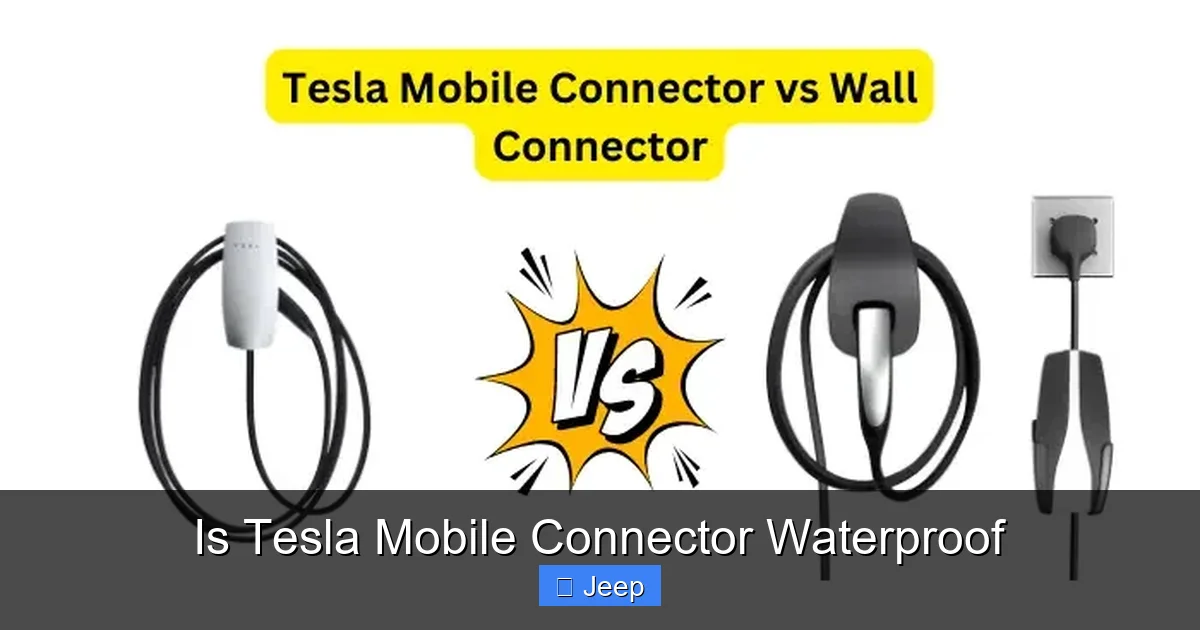
Visual guide about Is Tesla Mobile Connector Waterproof
Image source: teslord.com
Comparing to the Wall Connector
Contrast this with the Tesla Wall Connector. Its specifications include an IP55 rating, meaning it’s protected against low-pressure water jets from any direction and limited dust ingress. This makes it suitable for permanent outdoor installation on a house or garage wall, where it will face rain and sprinklers. The Wall Connector has a heavier-duty, gasketed enclosure. The Mobile Connector’s plastic casing has seals, but they are designed to keep out incidental splashes from a wet hand or a puddle you might accidentally step in while carrying it—not a downpour. This design difference explains the price disparity and their intended use cases.
Real-World Performance: What Happens When It Gets Wet?
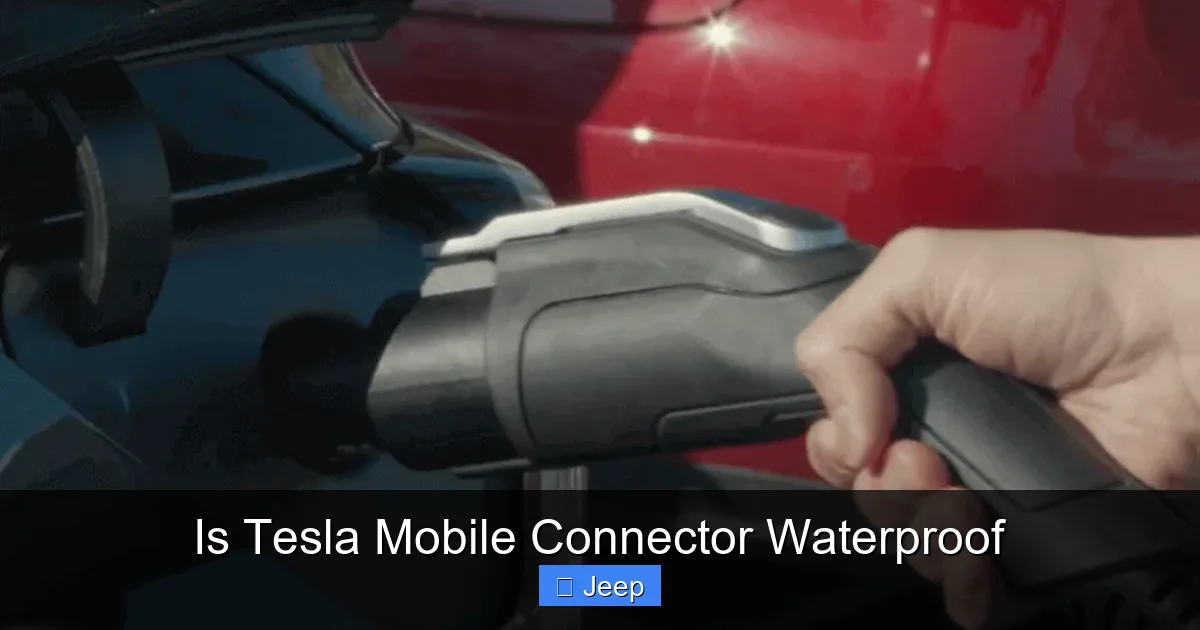
So, people use it outside anyway. What’s the reality? Thousands of Tesla owners have inadvertently left their Mobile Connector out in a sprinkle or a sudden shower. The anecdotal consensus is mixed but leans toward caution. The connector may survive a brief, light rain if the plug ends are pointing downward, allowing water to run off. The charging cable itself has a decent outer jacket. The main vulnerability is the connection points: the NEMA 14-50 plug (or 5-15, etc.) and the Tesla connector that plugs into your car. These areas have small gaps and are not sealed like a marine-grade connector.
Visual guide about Is Tesla Mobile Connector Waterproof
Image source: evsguy.com
Signs of Water Intrusion & Damage
If water gets inside, you might not see immediate failure. Corrosion is the silent killer. Look for:
- Green/white crusty residue on the metal pins inside the connector or plug.
- Error messages on the car’s touchscreen like “Charging Fault” or “Check Connector.”
- Intermittent charging that starts and stops.
- A tripped GFCI breaker in your outlet (a good safety feature, but a sign something is wrong).
Once corrosion starts, it can permanently damage the connector’s internal circuitry, leading to expensive repairs or replacement. Water and high-voltage electricity are a dangerous combination, and the connector’s safety features (like ground fault protection) are its last line of defense.
Essential Protection Strategies for Your Mobile Connector
Given its limitations, protecting your $300-$500 investment is simple and cheap. The rule is: Never assume it’s waterproof. Always assume it’s vulnerable.
- Use a Dedicated Waterproof Cover: This is the single most effective step. Companies like Lectron, EVSE Adapter, and others sell neoprene or silicone covers that slip over the entire connector and cable when not in use. They are inexpensive and provide a barrier against rain and dew.
- The “Drip Loop” Technique: When you coil the cable for storage or even while plugged in (if the cable is long), create a downward loop near the connector. This prevents water from traveling down the cable and into the connector’s socket.
- Strategic Storage: Keep it in your trunk, not on the ground next to your car. A simple waterproof bag or tote is a great addition. If you must leave it outside, hang it on a hook under a covered porch or eave, connector-end down.
- Dry Before Plugging In: Always wipe down the connector pins and the cable ends with a dry cloth before connecting it to your car or outlet. This removes any moisture that could be trapped.
- Inspect Regularly: Check the connector and plug for any signs of moisture, dirt, or damage before every use. A quick visual check takes five seconds.
Charging Non-Tesla EVs: The Jeep & Adapter Factor
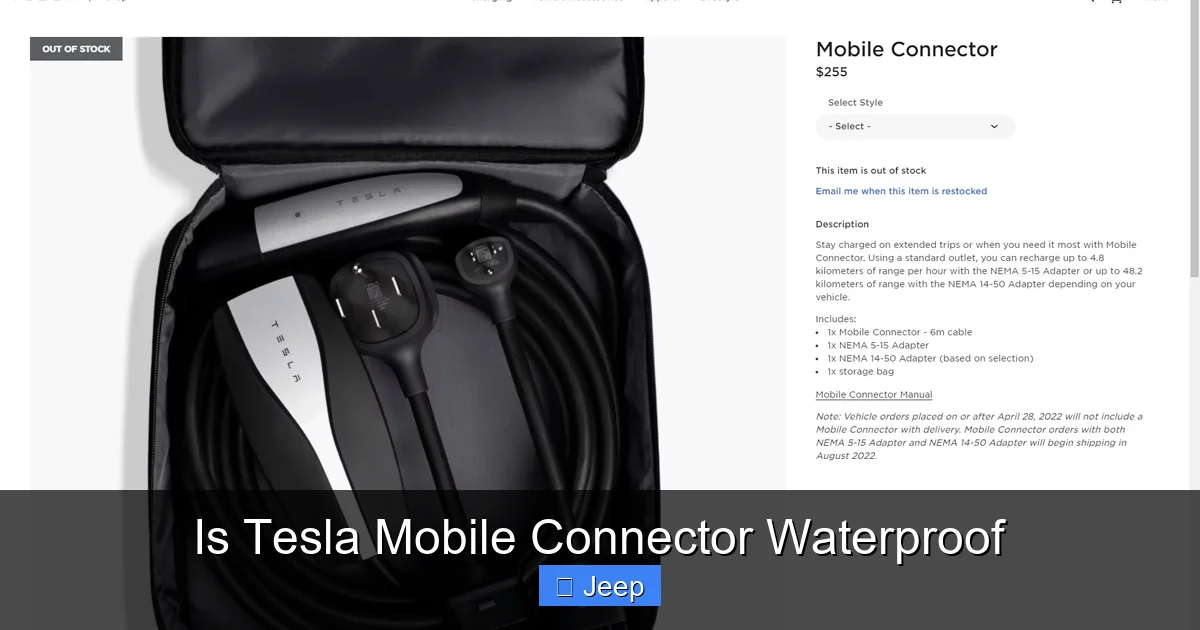
Here’s where it gets interesting for our Jeep-focused readers. Many modern plug-in hybrid and electric vehicles from other brands, including the Jeep Wrangler 4xe and the upcoming Jeep Recon, use the industry-standard J1772 charge port. Tesla’s Mobile Connector can charge these vehicles, but you must use a J1772 adapter (sold by Tesla or third parties). This adapter creates an additional connection point between the Mobile Connector and the car’s port. Every connection point is a potential leak path for water. When using an adapter:
- The entire assembly (Mobile Connector -> Adapter -> Car) is only as strong as its weakest seal.
- Ensure the adapter is fully seated and locked. A slight gap can funnel water directly inside.
- Be extra vigilant about keeping the adapter connection dry. Consider a small rubber cap or cover for the adapter’s female end when not connected to the car.
- This setup is even less weather-resistant than charging a Tesla directly. The need for protective covers becomes even more critical.
This versatility is a huge benefit of the Mobile Connector system, but it comes with a heightened responsibility for care in wet conditions. For those using it with a Jeep or other J1772 vehicle, treating the entire charging kit as non-waterproof is essential.
Visual guide about Is Tesla Mobile Connector Waterproof
Image source: driveteslacanada.ca
The Bottom Line: Safety, Warranty, and Smart Ownership
Let’s be brutally clear. Tesla designed the Mobile Connector for convenience, not for being left out in a storm. Using it in a manner contrary to its design—like permanently mounting it outside or routinely charging in heavy rain without protection—is done entirely at your own risk. Water damage is almost certainly not covered under Tesla’s limited warranty for the connector. The risk isn’t just a broken charger; it’s the potential for electrical hazards. A compromised connector can create a path for electricity to energize the cable jacket or connector housing, creating a shock risk. It can also cause internal arcing and fire. The safety interlocks and GFCI protection are there as a final safeguard, but they are not a substitute for keeping the equipment dry.
The smart owner’s approach is simple: treat your Mobile Connector like a precision electronic tool. Bring it out, use it, and put it away. Invest $20 in a good cover. Store it in the dry cargo bin of your Tesla or a sealed tote in your Jeep’s cargo area. By respecting its limitations, you’ll get years of reliable, safe service from this versatile piece of kit, whether you’re charging a Tesla, a Jeep 4xe, or any other compatible EV.
Frequently Asked Questions
Can I charge my Tesla in the rain using the Mobile Connector?
Technically, you can if you are actively supervising the charge and the connector and cable are not sitting in a puddle. However, it is strongly discouraged. The connector is not waterproof, and rain can seep into the connection points. For safety, only charge in dry, sheltered conditions.
What should I do if my Mobile Connector gets rained on?
Immediately unplug it from both the car and the wall outlet. Wipe it down thoroughly with a dry cloth, especially the connector pins and plug prongs. Inspect for any moisture inside the connector. Allow it to air dry completely in a warm, dry place for at least 24 hours before using it again.
Will using a J1772 adapter (for my Jeep) make it more or less waterproof?
It makes the overall charging setup less water-resistant. The adapter introduces a second connection point that is not sealed against the elements. You must be extra careful to keep the adapter-car connection dry and ensure both connections are fully seated before charging.
Is there any difference in water resistance between the different plug types (5-15, 14-50, etc.)?
No. The waterproofing (or lack thereof) is a characteristic of the Mobile Connector’s main body and cable. The plug end (NEMA 5-15, 14-50, 10-30, etc.) is a standard, non-waterproof electrical plug. All versions have the same vulnerability at the plug and connector interfaces.
Can I leave my Mobile Connector plugged into the wall outlet outside under a covered patio?
It is not recommended. “Covered” does not mean “dry.” Humidity, dew, wind-driven rain, and sprinklers can all introduce moisture. The safest practice is to only plug it in when you are actively using it and to store it away immediately after.
How does the Mobile Connector’s lack of waterproofing compare to public DC Fast Chargers?
Public DC fast chargers (like Superchargers) are industrial-grade, permanently installed equipment with high IP ratings (often IP54 or higher). They are built to withstand constant outdoor exposure. The Mobile Connector is a consumer-grade, portable device by comparison, with durability traded for portability and cost.
