
Where Is the Jack in a Jeep Wrangler?

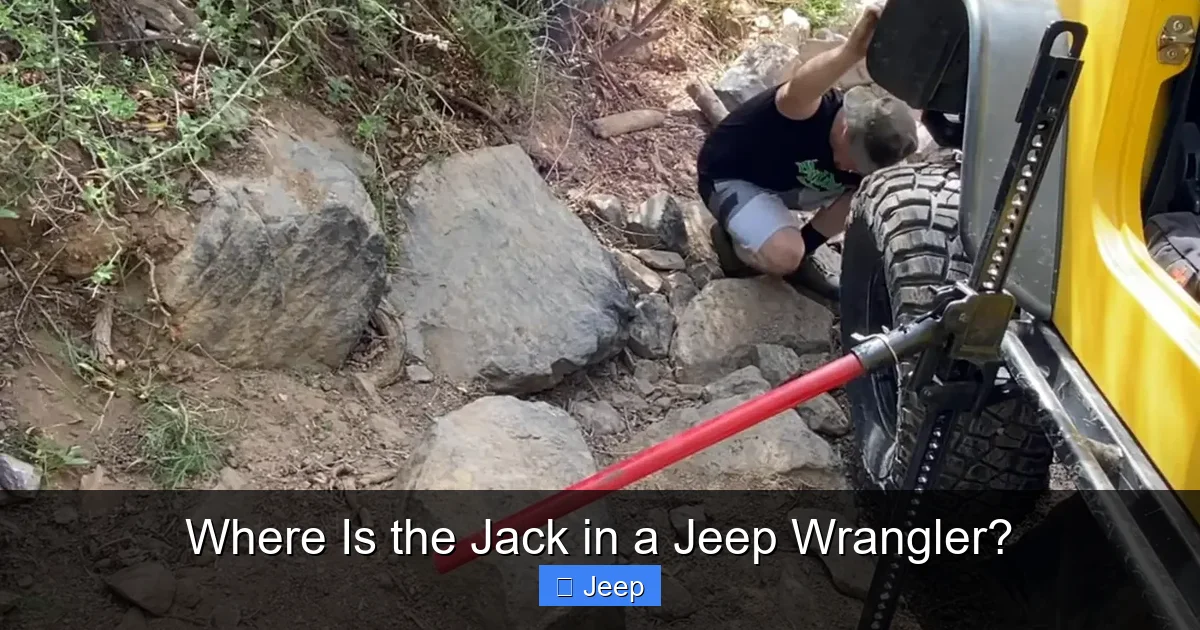
Finding the jack in your Jeep Wrangler isn’t as straightforward as in a regular car. Its location changes significantly between the TJ (1997-2006), JK/JLU (2007-2018), and JL (2019+) generations. Typically, it’s stored in a dedicated compartment under the rear passenger seat, inside the rear cargo area, or mounted on the rear bumper. Always consult your owner’s manual first, as your specific model year and trim package determine the exact spot. Knowing this location is critical for safely changing a tire on the trail or roadside.
So, you’ve got a flat tire on your Jeep Wrangler. You pop the trunk… or do you? You start looking around, and the panic sets in. Where is the thing? It’s not under the hood like in your old sedan. It’s not in the side compartment. Your Wrangler, that magnificent, purpose-built machine, seems to have hidden its most essential recovery tool. Sound familiar? You’re not alone. The location of the jack in a Jeep Wrangler is one of the most common and frustrating first-time owner questions. It’s a puzzle that changes its answer depending on which year and model you own. But don’t worry, we’re going to solve that puzzle for you, generation by generation, and turn that frustration into confident preparedness.
The reason for this scavenger hunt is simple: design philosophy. A Wrangler is a tool for adventure, not just a commuter car. Every inch of interior and cargo space is precious. Storing a bulky scissor jack in the passenger cabin would be a waste of that space, so engineers got creative, tucking it away in clever, sometimes obscure, nooks. The solution evolved dramatically from the classic TJ to the modern JL. Understanding where is the jack in a Jeep Wrangler for your specific model is the first step in being a true, self-reliant Wrangler owner. It’s about more than just changing a tire; it’s about knowing your tool.
Key Takeaways
- The jack’s location depends on your Wrangler’s generation: TJ models often have it under the rear seat or in a bumper bracket, while JK/JLU and JL models commonly store it in a rear cargo well or under the rear seat.
- Your owner’s manual is the final authority: Factory locations can vary by trim level (Sport, Sahara, Rubicon) and optional packages, so the manual provides the definitive map for your specific vehicle.
- Safety is non-negotiable: Never work under a vehicle supported only by the factory scissor jack. It’s designed for tire changes only, not for crawling underneath. Always use jack stands on solid ground.
- Aftermarket jacks offer more flexibility: Many owners replace the factory scissor jack with a more robust bottle jack or hi-lift jack, which changes storage requirements and often requires custom mounting solutions.
- Regular inspection is key: Check your jack, handle, and lug wrench for rust, damage, or missing parts at least twice a year. A compromised jack is useless when you need it most.
- Practice before you need it: Familiarize yourself with the jack’s operation and your Wrangler’s lift points in a safe, controlled environment like your driveway. Trail-side panic is not the time for a first attempt.
📑 Table of Contents
- The Great Jeep Wrangler Jack Hunt: Why Location Changes So Much
- Generation by Generation: Where Your Jack Hides
- Aftermarket Jacks: A Whole New Hunting Game
- Step-by-Step: Accessing and Using Your Wrangler’s Factory Jack
- Maintenance and Care: Your Jack is a Lifesaver, Treat It Like One
- Troubleshooting: What If My Jack is Missing or Broken?
- Conclusion: Knowledge is Your Best Recovery Tool
The Great Jeep Wrangler Jack Hunt: Why Location Changes So Much
Before we dive into the specific hiding spots, let’s understand the “why.” The Jeep Wrangler’s primary mission is off-road capability. This dictates everything from ground clearance to interior layout. The factory-provided jack is a compromise—it’s small, light, and designed for emergency tire changes on relatively level ground, not for serious off-road recovery. Because it’s not a heavy-duty tool, it doesn’t get prime real estate. Instead, it’s stashed in places that don’t interfere with daily driving or passenger comfort but are accessible when needed.
The Guiding Principle: Your Owner’s Manual
I cannot say this enough: the absolute, 100% correct answer for your vehicle is in your owner’s manual. It has diagrams specific to your model year and trim. If you have the manual, use it. If you don’t, you can often find digital copies online from Jeep’s owner portal. However, we can give you the overwhelming probabilities based on the three major Wrangler generations. Keep in mind that special editions (like the Rubicon, Sahara, or Willys) and optional packages (like the Trailer Tow or Heavy-Duty Electrical groups) can sometimes alter these standard locations.
Generation by Generation: Where Your Jack Hides
Let’s break it down by the three main Wrangler families. This is the core of your where is the jack in a Jeep Wrangler investigation.
Visual guide about Where Is the Jack in a Jeep Wrangler?
Image source: jeeprunner.com
The TJ Era (1997-2006): The Classic, Simple Storage
The TJ, with its iconic round headlights and classic straight-six or 4.0L inline-six engine, is beloved for its simplicity. Its jack storage reflects that era’s straightforward design.
- Primary Location: Under the Rear Passenger Seat. In most TJs, the rear seat is a bench that folds and removes. Lift the front edge of the rear seat cushion—it should flip up. Underneath, you’ll often find a metal bracket or a felt-lined bin housing the scissor jack and lug wrench. This is the most common spot.
- Secondary Location: Rear Bumper Mount. Some TJ models, particularly base Sport trims, came with a small bracket welded or bolted to the inside of the rear bumper beam. The jack would slide into this bracket. Check under the rear bumper, behind the spare tire carrier if equipped. You might need to feel around in the dark with a flashlight.
- What You’ll Find: A small, basic scissor jack (often black) and a single, T-handle lug wrench. It’s minimal but functional for a 32″ or 33″ tire.
The JK & JLU Era (2007-2018): The Modern, Space-Efficient Solution
The introduction of the JK (and its four-door variant, the JKU, later renamed JLU) brought a longer wheelbase and a much more sophisticated interior. Storage became more integrated.
- Primary Location: The Rear Cargo Well. This is the #1 spot for most JK/JKU models. Look at the flat cargo floor in the back. In the very front, closest to the rear seats, there is often a recessed, rectangular area covered by a thin, carpeted panel or a hard plastic lid. This “well” is designed to hold the spare tire’s lowering mechanism and the jack and tools. Lift or pry off this cover. You’ll see the jack and tools nestled in the well, sometimes in a fabric bag.
- Secondary Location: Under the Rear Seat (Two-Door JK). In the two-door JK, the rear seat is smaller and sometimes the jack is stored in a compartment accessible by lifting the rear seat cushion, similar to the TJ. However, the cargo well is still more common.
- A Note on Rubicons: The Rubicon trim, with its heavier-duty axles and larger tires, sometimes received a slightly different jack storage location or a more robust jack. The cargo well is still your first stop, but if it’s empty, check under the rear seat thoroughly.
The JL Era (2019-Present): The Refined, Accessible Design
The current JL generation refined the JK’s concepts. The interior is more premium, and storage is even better thought out.
- Primary Location: Rear Cargo Floor Panel. Almost universally, the JL stores the jack and tools in a dedicated compartment under the rear cargo floor. The rear cargo area has a flat, removable floor panel (often held by clips or a couple of screws). Lift this entire panel. Underneath, you’ll find a molded plastic tray or bin perfectly sized for the scissor jack, lug wrench, and often the tow hook as well. It’s clean, dry, and out of the way.
- Four-Door (JLU) Specifics: The JLU’s longer cargo area makes this under-floor compartment even more spacious and standard across all trims, from Sport to Rubicon.
- Two-Door (JL) Specifics: The two-door JL also uses the under-floor compartment, but due to the shorter cargo area, it’s a tighter fit. It’s still the primary location.
Aftermarket Jacks: A Whole New Hunting Game
Many Wrangler owners quickly realize the factory scissor jack is… lacking. It’s small, unstable on soft ground, and requires a lot of pumping. The popular upgrade is a bottle jack (like a 3-ton or 5-ton) or a legendary Hi-Lift Jack. If your Wrangler has an aftermarket jack, all bets are off regarding factory locations. Owners get creative.
Visual guide about Where Is the Jack in a Jeep Wrangler?
Image source: jeeprunner.com
Common Aftermarket Jack Storage Solutions
- Mounted on the Rear Bumper: A dedicated bumper-mounted carrier is the most popular solution. The jack is secured with U-bolts or a custom bracket. It’s accessible but exposed to the elements.
- Inside the Cargo Area: Many simply place the bottle jack on the floor behind the rear seats. It’s simple but takes up valuable space. Some build custom slide-out trays under the rear seat or cargo floor.
- Under the Hood: Some larger bottle jacks find a home in the engine bay, secured to the inner fender well. This keeps it out of the passenger compartment but makes it less accessible if you have a front flat.
- Dedicated Storage Bags: A heavy-duty canvas bag holds the jack and handle, which is then strapped down to the cargo tie-down points.
If you can’t find the jack in any of the factory spots, your previous owner likely installed an aftermarket solution. A thorough search of the rear cargo area (including under all panels and seats) and a look at the rear bumper for mounting hardware are your best bets.
Step-by-Step: Accessing and Using Your Wrangler’s Factory Jack
Let’s say you’ve found it. Now what? Using the jack correctly is as important as finding it.

Visual guide about Where Is the Jack in a Jeep Wrangler?
Image source: jeepautocare.com
1. Locate and Retrieve
Based on your generation, access the compartment. For JL/JK cargo wells, you may need to remove the spare tire first if it’s sitting on top of the cover. For under-seat storage, flip the seat cushion up. Pull out the jack, the lug wrench (or socket and breaker bar), and any adapters.
2. Prepare the Vehicle
This is the most critical safety step. Park on firm, level ground. Engage the parking brake. Put the transmission in Park (or Reverse for a manual). Place wheel chocks on the opposite side of the vehicle from the tire you’re changing. For a front flat, chock a rear wheel. For a rear flat, chock a front wheel. Never rely on the parking brake alone on a slope.
3. Identify the Factory Lift Point
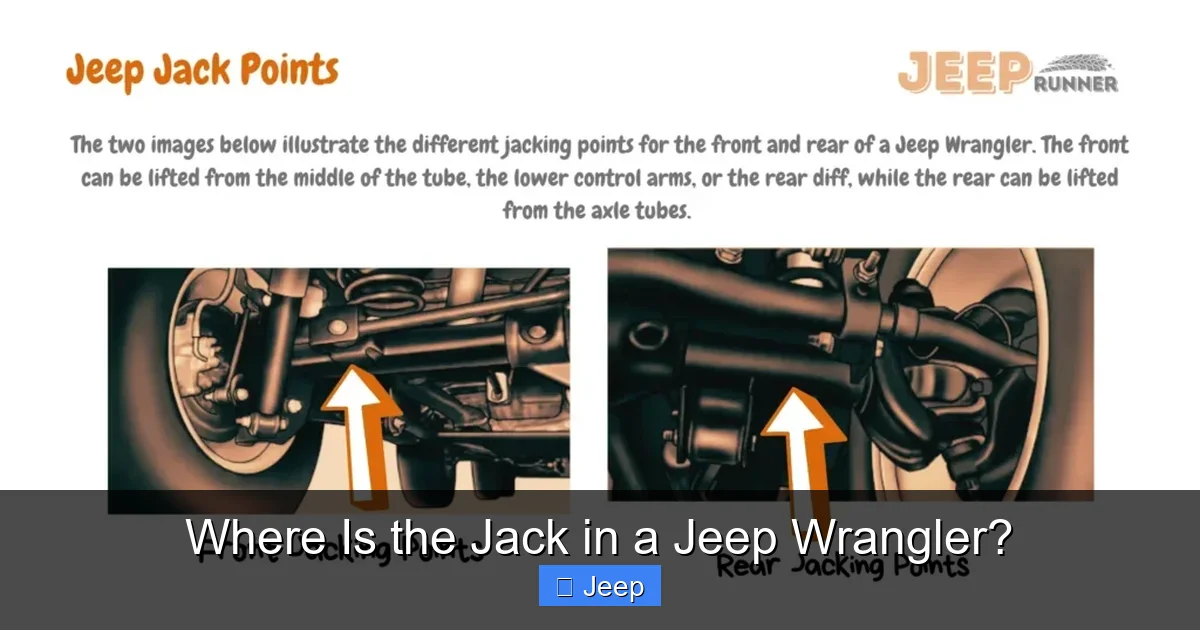
Your Wrangler has reinforced metal pinch points along the frame rail, just behind the front wheels and in front of the rear wheels. These are the only places you should place the jack pad. Look for a small, flat, reinforced rectangular area on the frame. Do not jack on the axle housing, control arms, or any part of the body/unibody. The factory scissor jack’s pad is small and must sit squarely on this pinch point. If you have an aftermarket bumper with a built-in jack point, that’s also acceptable.
4. Jack, Change, and Lower
Position the jack. Crank the handle to raise the vehicle just enough so the flat tire is off the ground. Loosen the lug nuts before fully raising the wheel (they’ll be easier to break loose with the vehicle’s weight on them). Remove the nuts, take off the tire, put on the spare, hand-tighten the nuts, lower the vehicle, and then torque the nuts in a star pattern to the proper specification (usually around 100 ft-lbs for steel wheels, check your manual).
Maintenance and Care: Your Jack is a Lifesaver, Treat It Like One
That jack sits in your Wrangler for years, forgotten. Then, one day, your life depends on it. Neglect is its worst enemy.
Biannual Check-Up
Every spring and fall, when you’re rotating tires or checking fluids, pull out the jack and tools.
- For Scissor Jacks: Open and close it fully. Does it move smoothly? Is there any rust on the screw mechanism or bending in the frame? Check the lifting pad for wear. Spray a light coat of WD-40 on the screw thread.
- For Bottle/Hi-Lift Jacks: Check the hydraulic ram for leaks. Pump it up and down. Ensure the pump piston moves freely. Check the lifting pad (or “foot”) for cracks.
- For All Tools: Inspect the lug wrench/socket for rounding. Make sure the jack handle (if separate) is present and not bent. Rust is the enemy; a wire brush and a smear of grease on threads can prevent seizing.
Clean and Dry
After a muddy off-road adventure, your jack compartment might be full of dirt and water. Wipe down the jack and tools before storing them. If the storage well is wet, dry it out. Moisture causes rust, which can cause a jack to fail catastrophically.
Troubleshooting: What If My Jack is Missing or Broken?
You’ve searched every factory spot, crawled under the vehicle, and still… nothing. Or you found it, but the handle is missing and the jack is rusted solid. Now what?
Confirm It’s Truly Missing
Re-check the owner’s manual location for your exact VIN. Call a Jeep dealer’s parts department with your VIN; they can look up the factory storage location. Sometimes, the jack is tucked behind a panel you didn’t think to remove.
Replacement Options
- OEM Replacement: The safest and simplest route. You can order a factory jack and tool kit from a Jeep dealer or a reputable online parts retailer (like Mopar). This ensures it fits perfectly in the original spot. Cost is typically $100-$250.
- Aftermarket Upgrade: This is the perfect opportunity to get that bottle jack or Hi-Lift you’ve been considering. You’ll need to factor in the cost of the jack itself ($50-$300+) and potentially a mounting bracket or storage solution.
- Used: Check Jeep forums, Craigslist, or eBay for a used factory jack from someone parting out a similar Wrangler. Just be sure to inspect it carefully for damage and smooth operation.
Remember, a missing jack is a major safety liability. Do not delay in replacing it. If you must drive with a flat, go extremely slowly and plan your route to avoid major hazards. Your goal is to get to a safe place to install the spare, not to drive on the flat rim.
Conclusion: Knowledge is Your Best Recovery Tool
The question where is the jack in a Jeep Wrangler has a definitive, but variable, answer. It lives under the rear seat in your TJ, in the front cargo well of your JK/JLU, or beneath the cargo floor of your JL. But the real answer goes deeper. The jack’s location is a lesson in your vehicle’s design, a testament to its efficiency, and a critical piece of your self-reliance toolkit. Finding it, checking it, and knowing how to use it transforms you from a driver into a capable Wrangler owner. That feeling of confidence when you pull that tool from its hidden spot on a lonely road is worth the initial hunt. So, take 15 minutes today. Find your manual, locate your jack, and give it a test run in the driveway. When the unexpected happens, you’ll be ready. That’s the Jeep way.
Frequently Asked Questions
Where is the jack on a 2023 Jeep Wrangler JL?
On the 2023 JL Wrangler (both 2-door and 4-door), the factory jack is stored in a compartment under the removable rear cargo floor panel. Lift the entire carpeted floor panel to access the molded plastic bin containing the jack and lug wrench.
Do all Jeep Wranglers come with a jack from the factory?
Yes, every new Jeep Wrangler is legally required to come with a basic emergency tire-changing kit, which includes a scissor jack and a lug wrench. However, the storage location varies by model year and generation as detailed above.
Can I use an aftermarket bottle jack instead of the factory scissor jack?
Absolutely, and many owners do for better stability and lifting capacity. However, you must ensure it’s rated for your Wrangler’s weight (a 3-ton or 5-ton jack is sufficient) and you must have a secure, dedicated storage solution for it, as it won’t fit in the factory compartment.
What size jack does a Jeep Wrangler need?
For a factory tire change, the small scissor jack is adequate. For a more versatile and safer option, a 3-ton (6,000 lb) bottle jack is highly recommended for all Wrangler models, as it provides a more stable lifting platform, especially on uneven ground.
Can I change a Jeep Wrangler tire without a jack?
Technically, yes, using a ramp or by rocking the vehicle, but this is extremely dangerous, unpredictable, and not recommended. A proper jack and jack stands are the only safe way to lift a vehicle for a tire change. Never work under a Wrangler supported only by a jack.
Where is the safest place to store the jack in my Wrangler?
The safest place is the factory-designed compartment for your specific model year, as it is secure, dry, and won’t become a projectile in a sudden stop. If using an aftermarket jack, ensure it is strapped down firmly to a solid anchor point like a cargo tie-down loop or a custom bracket to prevent it from sliding around while driving.
