
What Jeep Wrangler Years Should You Avoid?

Not all Jeep Wranglers are created equal. While famous for their durability, certain model years and generations suffer from widespread, costly problems. The most critical years to avoid are the early JK models (2007-2011) with the 3.8L V6 and TIPM electrical issues, and the first model year of the current JL generation (2018). The YJ and TJ eras have their own age-related concerns, but the JK’s first half is widely considered the weakest link in the modern Wrangler’s lineup. Always get a pre-purchase inspection and check for specific TSBs before buying.
So, you’re thinking about buying a Jeep Wrangler. That’s awesome. You’re eyeing a vehicle with unmatched off-road capability, a vibrant community, and a legacy that’s practically woven into American culture. But here’s the thing your enthusiast friend might not tell you upfront: some years are significantly better than others. Buying the wrong used Wrangler can transform your dream of top-down, trail-conquering freedom into a garage-bound nightmare of endless repairs and frustration.
This guide isn’t about scaring you away. It’s about empowering you. We’re going to cut through the folklore and fanboyism to look at the cold, hard data — owner complaints, mechanic repair logs, and known factory defects — to pinpoint exactly which Jeep Wrangler years to avoid. Think of this as your essential pre-purchase decoder ring. We’ll break it down by generation, highlight the specific model years that are chronic problem children, and give you the practical tools to vet any potential purchase, whether it’s a $5,000 YJ project or a $40,000 late-model JL.
Key Takeaways
- The 2007-2011 Jeep Wrangler JK is the biggest red flag: This period features the underpowered and thirsty 3.8L V6 engine combined with notorious TIPM (Totally Integrated Power Module) electrical failures and severe “death wobble” issues.
- First-year JL models (2018) have teething problems: As an all-new redesign, the 2018 JL experienced a higher-than-average rate of electronic glitches, infotainment bugs, and some early 2.0L turbo engine concerns.
- The 1997-1999 Jeep Wrangler TJ has automatic transmission pitfalls: Models with the optional 4-speed automatic (AW4) and the base 2.5L 4-cylinder are prone to premature transmission failure and head cracking.
- Rust is a universal enemy, especially on older YJs (1987-1995): Frame corrosion is a serious safety and structural issue on any unmodified YJ, making many 30-year-old examples more costly to restore than they’re worth.
- The 2012-2013 JK with the 3.6L Pentastar V6 is a sweet spot: This is the first year of the significantly improved Pentastar engine, which fixed the 3.8L’s major shortcomings. These models are generally reliable and represent great value.
- Always verify a specific vehicle’s service history: A well-maintained “problem year” can be better than a neglected “good year.” Focus on documented maintenance, especially of the transmission, cooling system, and electrical components.
- Pre-purchase inspections are non-negotiable: Spend $150-$250 on a mechanic who specializes in Jeeps. They will check for death wobble components, rust, TIPM faults, and transmission health that you will miss.
📑 Table of Contents
- Understanding the Generations: YJ, TJ, JK, JL
- The Biggest Red Flag: The 2007-2011 Jeep Wrangler JK with the 3.8L V6
- First-Year Blues: The 2018 Jeep Wrangler JL
- The Earlier Eras: YJ and TJ Problem Areas
- Model-Specific Year-to-Year Breakdown
- How to Shop Smart: Your Action Plan
- Conclusion: Your Dream Wrangler is Out There
Understanding the Generations: YJ, TJ, JK, JL
Before we dive into the bad years, you need to understand the four main generations of the modern Jeep Wrangler. Each has a distinct character, engineering philosophy, and set of common flaws. The years to avoid are almost always clustered at the beginning of a new generation, when engineers are working out kinks, or when a critically flawed component was used for an extended run.
The YJ (1987-1995): The Square-Bodied Classic
The YJ was the first Wrangler, replacing the legendary CJ series. It’s instantly recognizable by its square headlights and more car-like, wider track. These are classic, simple machines. The major concerns here aren’t design flaws as much as they are the relentless march of time and corrosion. Any 30-year-old vehicle will have aging components, but the YJ’s frame and body mounts are notoriously susceptible to rust, especially in northern and coastal states. A rusted frame is a non-starter for safety and structural integrity. Mechanically, the 2.5L 4-cylinder and 4.2L 6-cylinder carbureted engines are reliable but low-powered, and parts availability can be a mixed bag.
The TJ (1997-2006): The Round-Headed Revival
The TJ returned to the classic round headlights and introduced the long-lived, beloved 4.0L inline-six engine. This is arguably the most mechanically simple and robust generation. The 4.0L is a tank. However, its Achilles’ heel lies in the optional 3-speed automatic transmission (in 1997) and the 4-speed automatic (AW4 from 1998 onward) when paired with the weaker 2.5L 4-cylinder engine. These transmissions are known to fail prematurely under stress. Also, early TJs (1997-1999) with the 2.5L can suffer from head cracking due to overheating, a serious and expensive repair.
The JK (2007-2018): The Modern Era Begins
This is where things get complicated and where our biggest warnings lie. The JK was a massive, controversial redesign. It became longer, wider, heavier, and more “civilian-friendly” with its four-door “Unlimited” model. It also brought two new engines: the disastrous 3.8L V6 and the savior 3.6L Pentastar V6. The first half of the JK run (2007-2011) is, by a wide margin, the most problematic period in modern Wrangler history. We’ll detail why shortly. The second half (2012-2018) with the 3.6L is a completely different, much more reliable story.
The JL (2018-Present): Refinement and New Tech
The current JL generation refined the JK’s formula with more aluminum, a lighter weight, and a host of new technology — including a controversial touchscreen and multiple new engine options. As a clean-sheet design, 2018 models suffered from first-year bugs. The switch to a mild-hybrid system (eTorque) on some models and the new 2.0L turbo four-cylinder also introduced new, albeit less widespread, failure modes. By the 2020 model year, most of these early JL bugs were worked out.
The Biggest Red Flag: The 2007-2011 Jeep Wrangler JK with the 3.8L V6
If you take away one thing from this article, let it be this: avoid the 2007-2011 Jeep Wrangler JK models equipped with the 3.8L V6 engine. This isn’t a minor quibble; it’s a consensus across owner forums, mechanic shops, and reliability surveys. This engine-transmission combo represents a perfect storm of poor performance, terrible fuel economy, and connected systemic failures. If you see a cheap JK from this era, remember you are not getting a deal; you are inheriting a multi-front repair project.
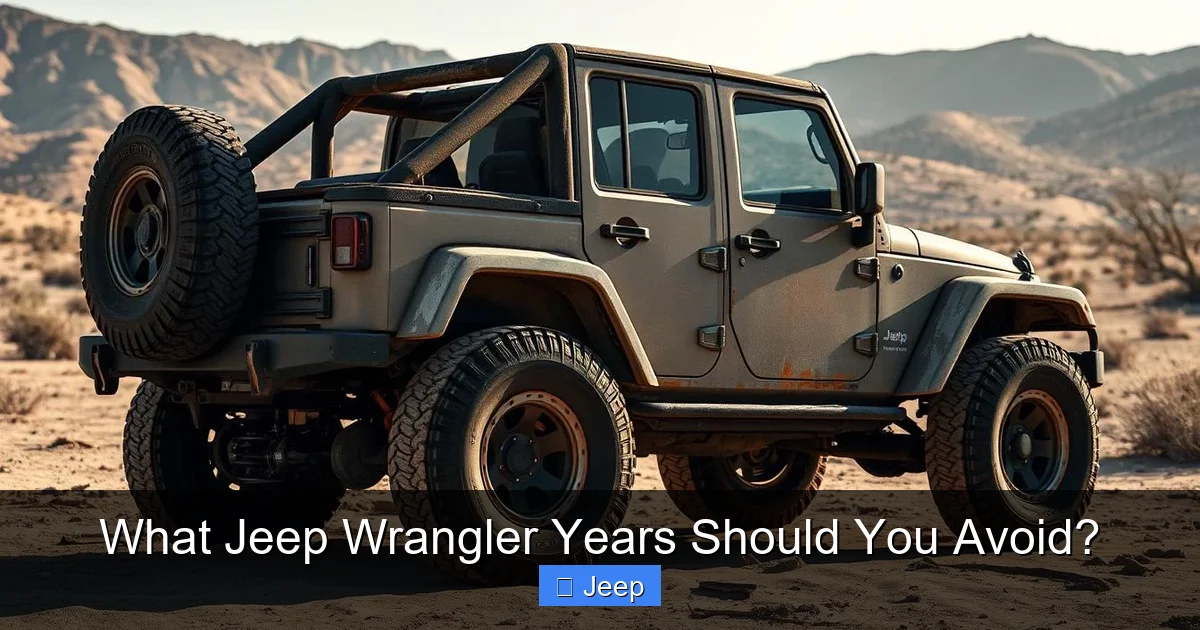
Visual guide about What Jeep Wrangler Years Should You Avoid?
Image source: automotivesimple.com
The Underpowered and Thirsty 3.8L V6
The 3.8L was not a new engine; it was a carryover from the minivan world (specifically, the Chrysler Town & Country). It was never meant for a rugged, boxy SUV with the aerodynamics of a barn door. The results were predictably bad. It produced a meager 202 horsepower and 237 lb-ft of torque — numbers that felt anemic even when new. Paired with the Wrangler’s weight and tall gearing, acceleration was painfully slow. The real kicker? Fuel economy. You’d be lucky to see 15 MPG combined. Owners universally describe it as a “gas guzzling dog.”
The TIPM Nightmare: Total Electrical Failure
But the engine was only part of the problem. The 2007-2011 JK introduced the TIPM (Totally Integrated Power Module), a fancy name for the vehicle’s main electrical fuse and relay box. In these early JKs, the TIPM is a notorious failure point. When it goes, it can take out multiple systems simultaneously: your wipers, power windows, door locks, and even the engine control module can die. The vehicle might not start, or it might die while driving. The TIPM itself is an expensive dealer-only part, and the labor to replace it is intensive. This is not a simple fuse problem; it’s a major, costly computer module failure that plagued thousands of these models. Chrysler issued multiple service bulletins and eventually a class-action lawsuit regarding TIPM failures.
The Infamous “Death Wobble”
While “death wobble” can affect any solid-axle vehicle, the 2007-2011 JK had a particularly severe and common incidence due to a combination of factors. The front track bar and steering components were often inadequate from the factory, and the heavy front end of the V6 model exacerbated the issue. At highway speeds (typically 50-70 mph), hitting a slight bump could trigger a violent, uncontrollable shaking of the entire front end that felt like the wheels were coming off. It was terrifying and dangerous. While fixable with aftermarket steering upgrades (track bars, drag links, control arms), it was a widespread, unfixed factory flaw that required owner intervention to solve safely. Many used JKs from this era still have the weak stock components, making them a serious hazard.
First-Year Blues: The 2018 Jeep Wrangler JL
When an all-new generation launches, it’s almost guaranteed to have teething problems. The 2018 JL was no exception. While it fixed the 3.8L’s sins with the excellent 3.6L Pentastar (as a carryover from the later JK), it introduced a whole new set of electronics and systems that weren’t fully debugged.
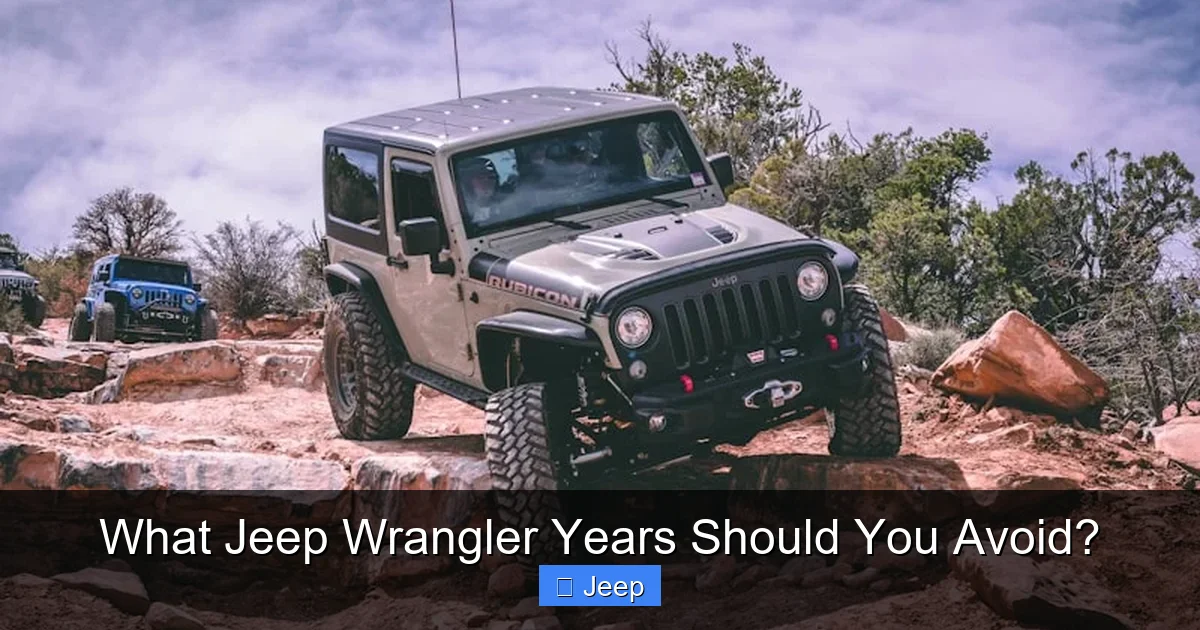
Visual guide about What Jeep Wrangler Years Should You Avoid?
Image source: dashlights.net
Electronics and Infotainment Glitches
The JL’s Uconnect infotainment system was a major step forward in capability, but in 2018, it was also famously buggy. Owners reported constant system crashes, Bluetooth pairing nightmares, slow touchscreen response, and GPS that would simply freeze. The digital gauge cluster also had its share of software glitches. These aren’t just annoyances; a frozen backup camera screen or a dead digital speedometer are safety issues. Most of these bugs were addressed via software updates in subsequent model years, but a 2018 model may have never had all updates applied or may have hardware that’s simply prone to failure.
The 2.0L Turbo “Hurricane” Engine Issues
The 2018 JL introduced a new 2.0L turbocharged four-cylinder engine (marketed as the “Turbo”). It promised better fuel economy and more low-end torque. However, early reports from owners and mechanics indicated some concerning patterns. There were documented cases of excessive oil consumption, carbon buildup on the intake valves (a common issue with direct-injection turbo engines), and in rare cases, catastrophic engine failure due to faulty oil pumps or other internal components. While the 2.0L didn’t have the widespread, fundamental flaws of the 3.8L, its early production run carries more risk than the proven 3.6L V6. If you’re looking at a 2018-2019 JL with the 2.0L, an exhaustive engine history and compression test are absolutely critical.
The Earlier Eras: YJ and TJ Problem Areas
For the classic and older Wrangler buyer, the concerns shift from catastrophic design flaws to the harsh realities of age and specific component weaknesses.
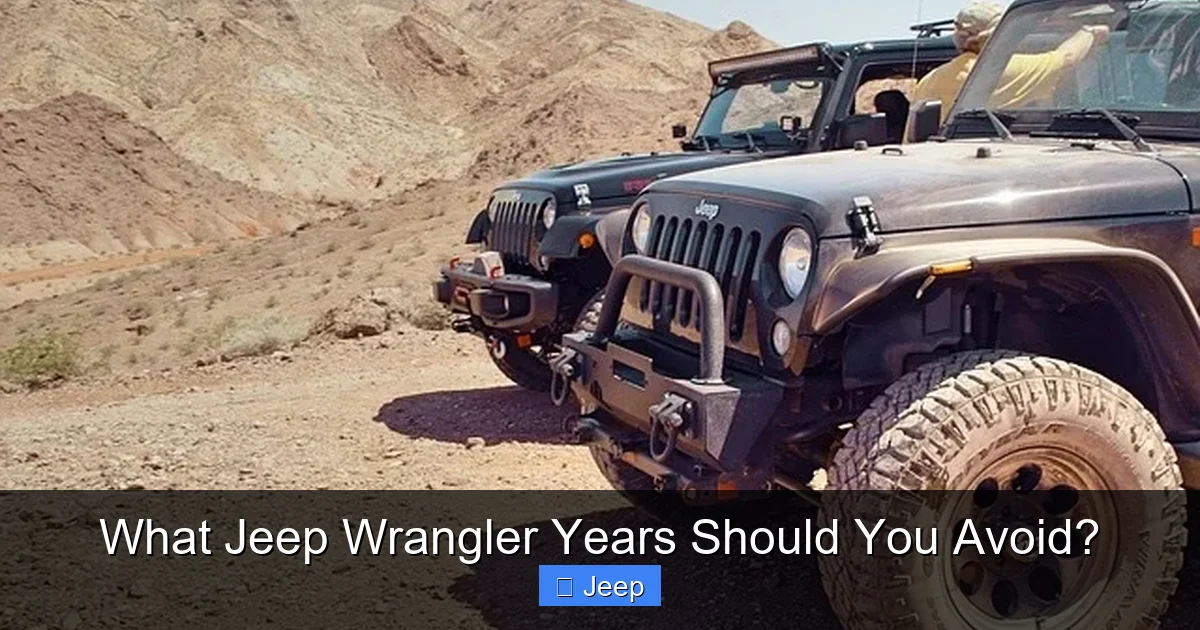
Visual guide about What Jeep Wrangler Years Should You Avoid?
Image source: jeeprunner.com
YJ (1987-1995): Rust and Obsolescence
Your primary enemy with a YJ is rust. The frame rails, body mounts, and rear axle housings are notorious for corrosion, especially in states that use road salt. A surface-rusted YJ can be a fun project, but a Wrangler with a rotted-through frame is unsafe and economically unfixable. Check the frame at all mounting points, the rear axle tubes, and the rear wheel wells. Mechanically, the carbureted 2.5L and 4.2L engines are simple and repairable, but finding specific, NOS (New Old Stock) parts for the 4.2L can be a challenge. The 1987-1990 models with the Peugeot transmission are also best avoided due to parts scarcity.
TJ (1997-1999): The 2.5L and Automatic Transmission Combo
The TJ is beloved for its 4.0L engine, but the base model 2.5L 4-cylinder paired with the automatic transmission (either the 3-speed in ‘97 or the 4-speed AW4 from ‘98-‘99) is a known weak spot. The 2.5L makes very little power, and the automatic transmissions in these years are not robust enough for the torque demands, leading to premature failure. If you want a TJ, your best bet is a 2000-2006 model with the 4.0L and a manual transmission, or at the very least, a 4.0L with an automatic. Also, be vigilant for the “head crack” issue on the 1997-1999 2.5L engines, which often requires a head replacement or a new engine.
Model-Specific Year-to-Year Breakdown
Let’s get granular. Here is a quick-reference list of the most problematic individual years for each generation.
- Avoid YJ: 1987-1990 (Peugeot trans), any with severe frame rust. The very first model year (1987) had the least refined components. Focus on 1991-1995 if you must have a YJ, and only if rust-free.
- Avoid TJ: 1997-1999 (2.5L + Auto), 1997 (3-speed auto). The 2000 model year saw significant improvements across the board. 2003-2006 are considered the pinnacle of the TJ era.
- Avoid JK: 2007-2011 (ALL with 3.8L V6). This is the #1 rule. The 2012 model year is the single most important “avoid-to-seek” transition in Wrangler history. The 2012+ with the 3.6L Pentastar is a different, vastly superior vehicle. Within the good years (2012-2018), be aware of isolated TIPM reports still popping up, but they are nowhere near the epidemic level of the 3.8L years.
- Avoid JL: 2018 (all), 2019 (2.0L Turbo). The 2018 model year is the one to skip. For the 2.0L Turbo engine, consider waiting until at least the 2020 model year for more proven reliability. The 3.6L V6 in the JL is excellent from the start, but a 2018 will still have the infotainment gremlins.
How to Shop Smart: Your Action Plan
Knowing which years to avoid is only half the battle. Here is your concrete checklist for evaluating any used Wrangler, regardless of year.
The Pre-Purchase Inspection (PPI) is Your Bible
Do not buy a Wrangler without a PPI from a trusted, Jeep-savvy independent mechanic. This $150-$250 investment will save you thousands. Tell the mechanic specifically to check for: death wobble components (track bar, tie rod ends, ball joints, control arms), transmission fluid condition and any slipping, TIPM history (they can scan for codes), signs of coolant leaks (critical on the 3.8L), and frame rust. They should also perform a “road test” specifically looking for any wobble at speed.
Get the Vehicle History and Service Records
A clean Carfax or AutoCheck report is a start, but it’s not enough. You need to see service records. A Wrangler with a stack of oil change receipts, transmission service records, and documented TIPM replacements (if applicable) is worth more than a pristine report with no history. Ask the seller: “Can I see all the repair invoices?” If they hesitate, walk away.
Know the VIN and Check for TSBs
Decode the VIN to confirm the exact engine, transmission, and model year. Then, use a service like the NHTSA website or a paid service (e.g., AllDataDIY) to check for any open or past Technical Service Bulletins (TSBs) for that specific vehicle. A TSB is a factory acknowledgment of a common problem. If a Wrangler has multiple TSBs for the same issue (like TIPM or death wobble) that haven’t been addressed, it’s a massive red flag.
Frame Rust Inspection Guide
Get underneath the vehicle with a flashlight and a magnet. A magnet will stick to steel but not to filler or bondo used to hide rust. Run it along the main frame rails from front to back. Tap with a hammer — solid steel has a distinct “thud,” while rusted metal sounds hollow or flaky. Pay special attention to the front frame horns (where the bumper mounts), the rear axle mounting points, and the crossmembers. Any significant rust, holes, or flaking is a deal-breaker.
The “Too Good to Be True” Price Trap
If you see a 2009 Jeep Wrangler JK for $8,000, it is not a steal. It is priced to sell because it likely has a failing TIPM, a toasted transmission, or a rusted frame that the seller knows will cost thousands to fix. The market correctly prices problematic years lower. Use the Kelley Blue Book or Edmunds value for the same year, make, and model as your baseline. If the price is significantly below, there is a reason. That reason is almost always a major, costly flaw.
Conclusion: Your Dream Wrangler is Out There
The goal of this guide is not to make you paranoid. The Jeep Wrangler, particularly from the 2012 JK onward with the 3.6L Pentastar and into the refined JL era, is a fantastic, capable, and relatively reliable vehicle. The key is avoiding the specific years that are poisoned by fundamental engineering mistakes. Steer clear of the 2007-2011 JK 3.8L, be cautious of first-year JLs (2018), and always inspect older YJs and TJs for rust and specific transmission issues. By arming yourself with this knowledge and committing to a thorough pre-purchase inspection, you can confidently navigate the used Wrangler market and drive away in a Jeep that will bring you joy for years to come, not a week-long visit to the repair shop. Do your homework, be patient, and your reward will be the open road and the trail, not the service lane.
Frequently Asked Questions
Is the 2020 Jeep Wrangler reliable?
Yes, the 2020 JL Wrangler is generally considered very reliable. It benefits from several years of production refinement after the problematic 2018 launch. The 3.6L V6 engine is proven, and most early software bugs have been fixed. It’s one of the best years in the current JL generation to buy used.
What is the most reliable Jeep Wrangler engine?
The undisputed champion is the 3.6L Pentastar V6, introduced in the 2012 JK and carried forward to the JL. It offers excellent power, good fuel economy for a Wrangler, and a long track record of durability. The older 4.0L inline-six in TJs is also famously bulletproof, but it’s less powerful and efficient.
Should I avoid all Jeep Wrangler Unlimited (4-door) models?
No. The 4-door model itself is not the problem. The issues are tied to engine and model year, not the number of doors. A 2012-2018 Jeep Wrangler Unlimited with the 3.6L V6 is an excellent, reliable choice. The problematic years (2007-2011 JK with 3.8L, 2018 JL) affect both 2-door and 4-door models equally.
What is the “death wobble” and how much does it cost to fix?
Death wobble is a violent, high-speed front-end shimmy that can make the vehicle feel uncontrollable. It’s caused by worn or weak steering and suspension components. A proper fix involves replacing multiple parts (track bar, drag link, control arms, ball joints) with heavy-duty aftermarket components, typically costing $1,500 to $3,000+ in parts and labor. It’s a key reason to avoid early JK models and to always inspect these components on any used Wrangler.
Are there any years of the Jeep Wrangler that are considered “good”?
Absolutely. The standout “best value” years are the 2012-2018 Jeep Wrangler JK with the 3.6L Pentastar engine. You get the refined, reliable powerplant without the 3.8L’s flaws, and the price is often more affordable than the newer JL. For the current generation, 2020 and newer JL models are excellent. For classics, the 2003-2006 TJ with the 4.0L engine is widely regarded as the peak of that generation’s reliability and refinement.
Can a “bad year” Wrangler be saved with enough money?
Technically, yes. You can replace a failed TIPM, rebuild a transmission, fix rust with new metal, and upgrade the entire front suspension to cure death wobble. However, these repairs easily total $5,000 to $10,000 or more. Often, by the time you invest that money, you could have bought a clean, “good year” model to begin with. The economics usually favor avoiding the problem years entirely unless you are a dedicated restorer with a very low purchase price.
