
Jeep Cherokee Won’t Start with Push Button

If your Jeep Cherokee won’t start with the push button, it’s rarely a simple dead battery. The issue typically stems from the key fob’s communication, a faulty brake light switch, a weak starter battery, or a problem with the ignition system itself. You can often diagnose and fix the key fob or brake switch yourself, but battery or steering wheel lock issues may require professional help. Understanding your vehicle’s specific push-button start system is the first step to getting back on the road.
Key Takeaways
- Key Fob Issues Are Common: A dead key fob battery or a malfunctioning fob is the most frequent reason a push-button Jeep Cherokee won’t start, as the car won’t receive the “go” signal.
- The Brake Pedal Switch Is Critical: The vehicle must detect the brake pedal is pressed to start. A failed brake light switch will prevent ignition, even with a good key fob and battery.
- Battery Problems Are Deceptive: The main battery may have enough charge for lights but not the high current needed for the starter. Corrosion or a failing alternator can also cause intermittent no-starts.
- Steering Wheel Lock Can Bind: If the steering wheel is turned and locked against the lock mechanism, the ignition won’t engage. Gently wiggling the wheel while pressing the button can often free it.
- Start/Stop Button Itself Can Fail: The physical button is an electrical switch. Internal wear or damage can prevent it from completing the circuit to start the engine.
- Always Check the Basics First: Before assuming a major fault, verify the key fob battery, ensure you’re pressing the brake pedal firmly, and confirm the vehicle is in Park or Neutral.
- Some Issues Need a Dealership: Problems with the keyless entry control module, the vehicle’s CAN bus network, or complex security system errors often require dealer-level diagnostic tools.
📑 Table of Contents
Understanding Your Jeep Cherokee’s Push-Button Start System
That sleek, keyless push-button start in your Jeep Cherokee is supposed to be convenient. You hop in, press the brake, hit the button, and go. So when you press that button and absolutely nothing happens—or you hear a series of frustrating clicks—it can feel incredibly confusing. This system isn’t just a simple on/off switch; it’s a complex conversation between your key fob, the car’s computer, and several safety interlocks. Before you panic or call a tow truck, it helps to understand what’s supposed to happen when you press that start button.
The process begins the moment you touch the door handle. The car’s antennas wake up the key fob in your pocket or bag. The fob broadcasts a unique, encrypted code back to the vehicle. If the code matches what the car’s keyless entry control module expects, it “recognizes” you. Then, when you sit down, press the brake pedal (a crucial safety step), and press the start button, the module sends a signal to the starter relay, which sends power to the starter motor to crank the engine. If any link in this chain is broken—a weak fob battery, a switch that doesn’t tell the computer you’re pressing the brake, or a main battery that can’t spin the starter—the sequence aborts, and your Cherokee stays silent. This knowledge turns a scary “it won’t start” into a logical diagnostic path.
The Most Common Culprits: Why Your Jeep Cherokee Won’t Start
When your push-button Jeep Cherokee refuses to cooperate, the cause falls into a handful of predictable categories. Let’s break down the usual suspects, starting with the simplest and most frequent.
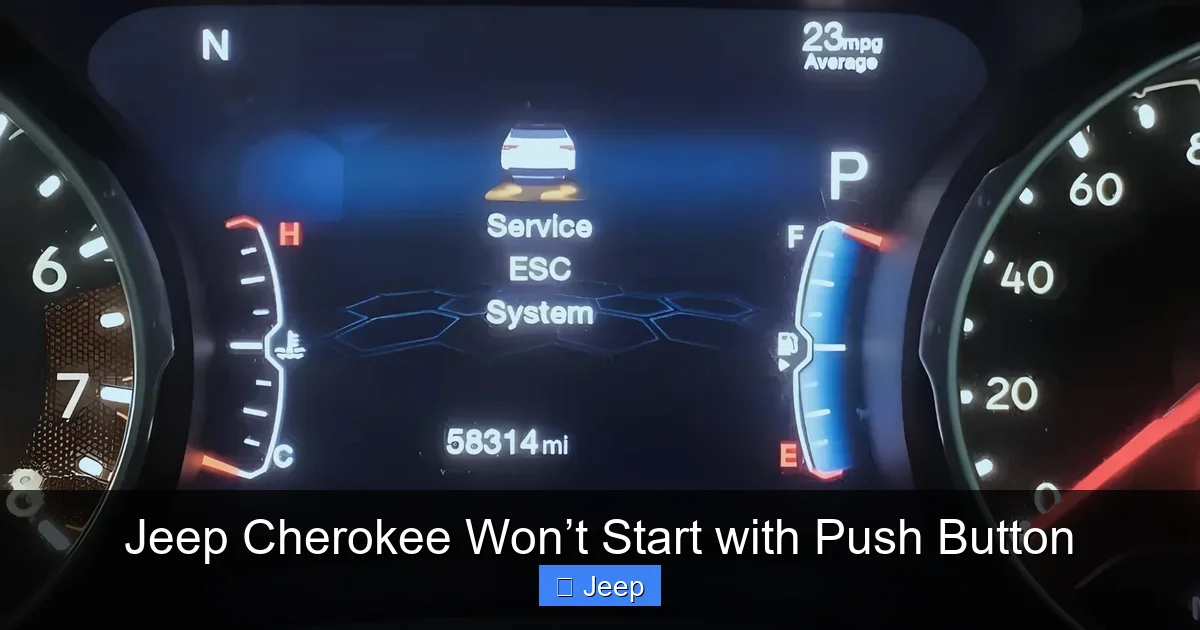
Visual guide about Jeep Cherokee Won’t Start with Push Button
Image source: jeepinside.com
The Silent Key Fob: Your “Key” Is Actually a Radio Transmitter
Your key fob isn’t just a plastic key; it’s a sophisticated radio transmitter. Its internal coin-cell battery powers the chip that talks to your car. If that tiny battery gets low (they last 1-3 years typically), the signal becomes too weak for the car’s antennas to detect, especially if the fob is deep in a bag or far from the vehicle. The car thinks you’re an unauthorized driver and locks you out of the starting sequence. You might still be able to lock/unlock the doors manually because that uses a different, lower-power signal from the fob’s physical key blade or a secondary circuit. A quick test is to hold the fob directly against the start button (some models have a designated spot on the steering column). If it starts then, the fob battery is almost certainly dead. Replacing it is a cheap and easy fix you can do yourself. If a new battery doesn’t help, the fob itself may be damaged or its internal chip faulty.
The Brake Pedal Switch: The Unseen Gatekeeper
This is a massively common failure point. Your Jeep Cherokee is designed so you must have your foot on the brake to start. A small switch, usually located above the brake pedal arm, tells the car’s computer, “Yes, the brake is pressed.” If this switch wears out, gets stuck, or breaks, the computer never gets that signal. It’s a critical safety interlock. The symptoms are classic: you press the brake, the brake lights might not come on (check them!), and pressing the start button does absolutely nothing—no cranking, no clicking. Sometimes the switch is just misaligned. You might be able to adjust it manually, but often it needs replacement. It’s a relatively inexpensive part, but accessing it can require some basic pedal well exploration.
The Starter Battery: Not All “Drain” Situations Are Obvious
Yes, a completely dead 12V battery will prevent starting. But more often, the battery is weak, not dead. It might have enough residual charge to light the dashboard and run the radio, but it can’t deliver the massive burst of current (hundreds of amps) needed to crank the engine over. This is especially true in cold weather. Corrosion on the battery terminals is a classic villain—it creates high resistance, blocking the flow of that starting current. You might see a white, crusty buildup on the posts. Cleaning the terminals with a battery terminal cleaner and a wire brush can sometimes restore connection. A battery with a bad cell can also hold a surface charge (read 12V on a meter) but collapse under load. The best test is a load test at a parts store, which is usually free. If your battery is older than 3-4 years, it’s a prime suspect. If you’ve recently had a new battery installed and it won’t start, the issue might be with the battery itself being defective or the terminals not being tightened properly. In such cases, referring to guides on why a car won’t start with a new battery can provide specific troubleshooting steps beyond the basics.
The Steering Wheel Lock: When Mechanical Meets Electrical
Most modern vehicles, including the Jeep Cherokee, have an electronic steering wheel lock as part of the anti-theft system. When you turn the wheel and remove the key (or in a push-button, when you open the door), the lock engages. To start, the system must first disengage this lock. If the steering wheel is turned and the lock is pressed against its stop (like when parked against a curb), it can bind. The car’s computer might not be able to disengage it, thinking there’s a theft attempt. The result is a no-start, sometimes accompanied by a flashing security light on the dash. The fix is often a simple maneuver: while pressing the brake pedal, gently turn the steering wheel left and right to take pressure off the lock mechanism, then press the start button. It can take a few tries. If this doesn’t work, the lock motor or its control module may be faulty.
The Start Button Itself: A Worn-Out Electrical Switch
The big button on the dashboard is more than just a plastic cap. Underneath is an actual electrical switch. Over years of use, with thousands of presses, the internal contacts can wear out, get dirty, or break. If the switch fails, it can’t complete the circuit to tell the car’s computer to start the sequence. Symptoms vary: sometimes it does nothing, sometimes it feels loose or doesn’t click. You might need to press it multiple times or hold it down. Diagnosing this usually requires checking for power at the switch connector, which is a job for someone comfortable with automotive electrical systems or a mechanic.
Diagnostic Steps You Can Take at Home
Before you resign yourself to a repair bill, work through this logical, step-by-step checklist. Start with the fastest, freeest checks and move to more involved ones.

Visual guide about Jeep Cherokee Won’t Start with Push Button
Image source: jeepinside.com
Step 1: The Key Fob Battery Swap
This is the easiest first step. If you have a spare key fob, try it immediately. If the spare starts the car, your primary fob’s battery is dead. If you don’t have a spare, locate the emergency physical key hidden inside your fob (usually a small slider or button). Use it to unlock the driver’s door. Some Jeeps will allow you to start the car by pressing the fob against the start button if the battery is low. Check your owner’s manual for the exact location (often a marked spot on the steering column or center console). If it starts when held against the button, replace the CR2032 or similar coin battery in the fob. It’s a simple job—usually just prying open the fob with a flat tool.
Step 2: Verify the Brake Pedal Switch is Working
Sit in the driver’s seat. Press the brake pedal firmly. Do your brake lights come on? Have someone check from behind the vehicle, or carefully reverse towards a wall at night to see the reflection. If the brake lights don’t illuminate, the brake light switch is the prime suspect. You can often adjust it by loosening its mounting bracket and moving it closer to the pedal arm until the lights activate when the pedal is slightly depressed. If adjustment doesn’t work or the switch feels broken, it needs replacement. Parts stores carry generic or specific replacements for a few dollars.
Step 3: Listen and Feel for Starter Activity
Have a helper turn the key to the “ON” position (or press the start button without the brake, if your Cherokee allows it in “ON” mode) while you listen closely under the hood. Do you hear a faint click from the engine bay? That click is the starter solenoid engaging. If you hear a click but the engine doesn’t crank, the solenoid is working but the starter motor itself may be faulty, or the battery is too weak to turn the engine over. If you hear nothing at all—no click, no crank—the signal isn’t reaching the starter. This points back to the key fob/security system, the brake switch, or a wiring issue between the ignition switch and the starter relay.
Step 4: Check the Main Battery and Connections
Grab your multimeter (or borrow one). Set it to DC volts. Touch the red probe to the positive (+) battery terminal and the black probe to the negative (-) terminal. A healthy, fully charged battery should read 12.6 volts or higher. Anything below 12.4 volts is discharged. Now, while your helper attempts to start the car, watch the voltage. If it plummets down to 9V or lower and the engine struggles or doesn’t crank, the battery is weak. If it stays at 12V but the car doesn’t start, the starter circuit isn’t engaging. Next, inspect the battery terminals. Are they clean, tight, and free of white/green corrosion? If not, disconnect the negative cable first (safety first!), then the positive. Clean the posts and clamps with a battery terminal brush and a baking soda/water solution. Reconnect tightly, positive first, then negative. A poor connection here can mimic a dead battery.
Fixes for Common Push-Button Start Issues
Once you’ve diagnosed the likely problem, here’s how to address the most common ones.
Visual guide about Jeep Cherokee Won’t Start with Push Button
Image source: jeepinside.com
Replacing a Key Fob Battery
This is the most common and easiest fix. Locate the small seam on your fob. Use a small flathead screwdriver or a plastic pry tool to gently separate the two halves. Inside, you’ll see a small circular coin battery, likely a CR2032. Note the orientation (the positive side is usually facing up). Pop out the old battery, insert the new one the same way, and snap the fob back together. Test it by locking and unlocking the doors before attempting to start. If the fob still doesn’t work with a new battery, it may have suffered water damage or internal failure, requiring a replacement fob, which often needs to be programmed to your vehicle by a dealer or locksmith.
Replacing the Brake Light Switch
This part is usually located up under the dash, above the brake pedal. You’ll need to remove any knee blocker or trim panel to access it. It’s typically held by two small nuts or clips. Unplug the electrical connector, remove the old switch, and install the new one in the reverse order. Before tightening, press the brake pedal by hand and ensure the switch’s button is fully depressed. Adjust the switch position if the brake lights don’t come on when you press the pedal in the car. This is a straightforward DIY for most, but if you’re uncomfortable working under the dash, a mechanic can do it in 15 minutes.
Jump-Starting or Replacing the Starter Battery
If your battery is simply discharged (lights were left on), a jump start will likely get you going. Use proper jumper cables, connecting positive to positive and negative to a clean metal ground on the engine block or chassis, away from the battery. Let the donor car run for a few minutes before trying to start your Cherokee. If the battery is old or fails a load test, replacement is the only cure. When installing a new battery, ensure it’s the correct size, type (AGM vs. flooded), and has at least the same Cold Cranking Amps (CCA) rating. After replacement, your Cherokee may need to “relearn” some parameters, but it should start normally. If it still won’t start with a brand-new, fully charged battery, the problem lies elsewhere in the starting circuit. For broader context on no-start situations even with a good battery, you might explore resources like car won’t start but battery is fine, which covers similar electrical gremlins.
Freeing a Bound Steering Wheel Lock
This is a gentle, physical fix. Insert the key (or have the key fob in the car). Place your hands at 9 and 3 o’clock on the steering wheel. Apply firm, steady pressure in one direction (usually the direction the wheel is turned). While holding that pressure, press the brake pedal firmly and press the start button. You should feel a slight release as the lock disengages. If it’s really stuck, try the opposite direction. Never use violent jerking motions, as this can damage the lock mechanism or steering column.
When to Call a Professional: Beyond DIY Fixes
Not all problems are for the home mechanic. If you’ve worked through the key fob, brake switch, and battery with no success, it’s time to call in the experts. Here’s when professional diagnostic equipment and expertise are essential.
Complex Security System Errors
The Jeep Cherokee’s Totally Integrated Power Module (TIPM) or its Wireless Control Module (WCM) governs the push-button start and immobilizer system. These are sophisticated computers. A fault code stored here, a software glitch, or a failure in the RF (radio frequency) receiver module can prevent the car from recognizing your key fob, even with a perfect battery. These systems often require a dealer-level scan tool (like the wiTECH system) to read proprietary codes, reflash software, or program new keys/fobs. A generic OBD2 scanner you rent from an auto parts store will not communicate with these modules.
Starter Motor or Solenoid Failure
If you hear a single, loud click from the starter area but the engine doesn’t turn, the starter solenoid may be working but the starter motor itself is burnt out or mechanically jammed. Replacing a starter motor usually requires lifting the vehicle and unbolting it from the engine bellhousing—a job that can be physically demanding and requires proper torque on the bolts. Incorrect installation can damage the flexplate/flywheel.
Wiring Harness and CAN Bus Network Issues
Modern cars like the Cherokee use a Controller Area Network (CAN bus) for all electronic modules to talk to each other. A frayed wire, corroded connector, or damaged harness near the steering column (common in vehicles with adjustable pedals or tilt steering) can interrupt the signal from the start button to the engine control module. Diagnosing this requires a multimeter, wiring diagrams, and a methodical process of checking for power and ground at various points—a task best left to a professional auto electrician or a dealer technician.
Preventing Future Push-Button Start Problems
A little proactive care can save you from being stranded.
Replace Key Fob Batteries Proactively: Don’t wait for failure. Every 2-3 years, swap out the coin cell battery in all your fobs. It costs $5 and takes 60 seconds. Keep spare batteries in your glove compartment.
Keep Battery Terminals Clean and Tight: Once a year, inspect your battery terminals. If you see any corrosion, clean it immediately with a terminal brush and a baking soda solution. Apply a thin coat of dielectric grease to the terminals after tightening to prevent future corrosion.
Don’t Ignore the Check Engine or Security Lights: A persistent security light or a check engine light (especially with codes related to the immobilizer or starting system) is a warning. Have it scanned before it leaves you stranded.
Practice the Steering Wheel Wiggle: Make it a habit, when parking, to straighten the wheels before turning off the engine and exiting. This takes pressure off the steering lock and reduces the chance of it binding.
Use Your Fob Regularly: If you have a spare key fob stored for emergencies, use it to start the car at least once every few months. This ensures its battery stays active and the fob remains “paired” with the vehicle.
Frequently Asked Questions
My Jeep Cherokee’s push button blinks but the engine doesn’t crank. What does that mean?
A blinking start button (often red or amber) usually indicates a security or system fault. The car’s computer is detecting something is wrong with the key fob’s authorization, the brake switch signal, or another interlock. It’s a clear sign to check your key fob battery first and ensure you’re pressing the brake pedal firmly.
What if my brake pedal feels stiff and the car won’t start?
A stiff or “hard” brake pedal that won’t depress easily is a major red flag for a failed brake booster or a severe brake system issue. This is a critical safety problem. Do not attempt to drive the vehicle. Have it towed to a mechanic immediately, as power brakes rely on engine vacuum, and a hard pedal can indicate a catastrophic failure.
Can I push-start a Jeep Cherokee with a push-button start?
No, you cannot push-start a vehicle with an automatic transmission, which all modern Jeep Cherokees have. The push-button start system also requires the key fob to be present and recognized. The only way to move a disabled Cherokee is to jump-start it with cables or a booster pack, or tow it.
My key fob battery is new, but the car still says ‘key not detected.’ Now what?
If a new battery doesn’t solve the “key not detected” message, the fob may be damaged (water, impact), or the car’s radio frequency receiver module may be faulty. Try holding the fob directly against the start button. If it works only then, the fob’s signal is extremely weak, pointing to a fob failure. If it still doesn’t work, the vehicle’s receiver or its control module likely needs diagnosis by a dealer.
I turned the wheel and now the security light is on and it won’t start. Is it stolen?
Probably not. This is the classic steering wheel lock issue described above. The lock is engaged because the wheel was turned under pressure. Follow the procedure: gently wiggle the wheel left and right while firmly pressing the brake and the start button. The lock should disengage, the security light should go out, and the engine should crank.
Could a bad alternator cause a no-start even if the battery is new?
Yes, but usually in a specific way. A failed alternator won’t recharge the battery while driving. You might drive home normally, but the next morning, the battery will be completely dead from draining overnight (running lights, computer memory). So a “new” battery that won’t start could be new but already discharged because the alternator hasn’t been charging it. If the car starts with a jump but dies again soon after, the alternator is the likely culprit. For more on this chain reaction, reading about why a car won’t start even with a jump can be insightful, as it often points to a charging system failure.
