
Why Does Tesla Make Noise When Reversing?

Tesla vehicles produce a distinct, artificial sound when reversing as a mandatory safety feature to alert pedestrians. This “reversing beep” or hum is generated by the Vehicle Pedestrian Safety System (VPSS) and is completely normal. Unlike internal combustion engine cars, Teslas lack a loud engine, so this synthesized sound is crucial for awareness in parking lots and driveways.
Key Takeaways
- Mandatory Safety Feature: The reversing noise is a legally required pedestrian warning system, not a malfunction or mechanical issue.
- Synthetic Sound Source: The sound is generated by a dedicated speaker (the VPSS) and is digitally created, not a product of the drivetrain or gears.
- Purpose is Awareness: It alerts pedestrians, especially the visually impaired, and nearby people that the vehicle is moving backward.
- Different from ICE Cars: Traditional cars make reversing noises naturally from their engines and transmissions; Teslas must artificially create them due to their quiet operation.
- Volume and Tone are Standardized: The sound’s characteristics are regulated and cannot be customized by the owner to ensure consistent recognition.
- Cannot Be Disabled: For safety and legal compliance, this system is always active and cannot be turned off through the vehicle’s settings.
- Part of a Larger System: This reversing sound is one component of Tesla’s broader pedestrian warning system that also includes low-speed forward sounds.
📑 Table of Contents
- The Quiet Revolution and the Need for Sound
- How the Tesla Pedestrian Warning System Works
- Comparing Tesla’s Reversing Sound to Traditional Cars
- Is the Noise a Sign of a Problem? Troubleshooting
- The Ownership Experience: Living With the Sound
- Looking Ahead: The Future of EV Auditory Signatures
- Conclusion: A Necessary Sound for a Silent Revolution
The Quiet Revolution and the Need for Sound
If you’ve recently transitioned to a Tesla from a traditional gasoline or diesel vehicle, one of the first things you’ll notice is the profound silence. The near-whisper-quiet cabin at a standstill is a hallmark of electric vehicle (EV) technology. However, this silence presents a unique challenge: pedestrians, cyclists, and especially individuals with visual impairments rely on auditory cues to detect moving vehicles. A quiet car can be an invisible hazard. To address this, regulators worldwide mandated that quiet vehicles emit sound at low speeds. This is the core reason behind the noise you hear when your Tesla reverses.
It’s important to understand that this sound is not coming from the motor, the gear reduction unit, or any mechanical component. It is a purely electronic, synthesized alert. When you shift your Tesla into Reverse (R), the vehicle’s software instantly activates a specific audio file through a dedicated external speaker. This speaker is part of the Vehicle Pedestrian Safety System (VPSS). The sound is designed to be distinctive yet not overly intrusive—a steady, mid-to-high-frequency hum or series of beeps that cuts through ambient noise but doesn’t startle anyone. It’s a digital “hello, I’m moving backward” to the world around you.
How the Tesla Pedestrian Warning System Works
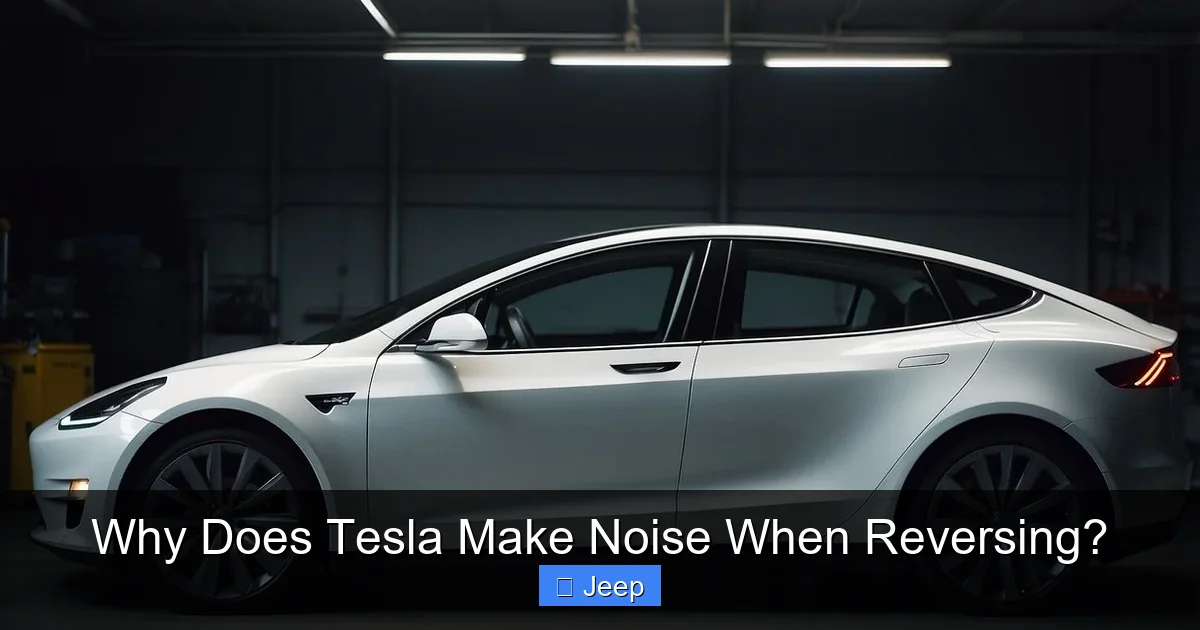
The system responsible for the reversing noise is more sophisticated than a simple chime. Tesla’s VPSS is an active safety feature with multiple components working in concert.
Visual guide about Why Does Tesla Make Noise When Reversing?
Image source: koala.sh
The Hardware: A Dedicated Speaker
Tesla vehicles are equipped with a specific, weatherproof speaker mounted on the front of the car, typically behind the grille or in the lower bumper area. This is not your standard audio system speaker; it’s engineered for clarity and external projection. There is also a corresponding speaker for the reversing sound, often located near the rear of the vehicle. The system’s control module manages these speakers independently.
The Software: Sound Generation and Activation
The vehicle’s central computer constantly monitors data from the drive selector and speed sensors. The moment the driver selects Reverse and the vehicle’s speed is below a certain threshold (usually around 19 mph or 30 km/h), the software triggers the reversing sound file. The tone is typically a continuous, pulsating hum that increases in pitch or volume slightly with vehicle speed, providing an intuitive cue that the car is accelerating backward. The sound ceases automatically when you shift into Park (P), Drive (D), or Neutral (N), or when you exceed the low-speed threshold in Reverse.
This system is always on. You cannot disable it via the touchscreen or vehicle settings. This is by design—it’s a non-negotiable safety feature, much like seat belt reminders. Attempting to disable it would require hacking the vehicle’s firmware, which voids warranties and is illegal in many regions due to safety regulations.
Comparing Tesla’s Reversing Sound to Traditional Cars
Owners often ask, “Why don’t my other cars make this noise?” The answer lies in the fundamental difference between electric and internal combustion engine (ICE) propulsion.
Visual guide about Why Does Tesla Make Noise When Reversing?
Image source: goodfellasautotn.com
The Natural Soundscape of an ICE Vehicle
When you put a gasoline car in reverse, you hear a combination of sounds: the engine note changing pitch as the transmission’s reverse gear engages, the whir of the differential and axles, and sometimes a mechanical clunk. These sounds are a byproduct of the complex mechanical dance of an engine, transmission, and drivetrain. They are not intentionally designed for pedestrian alertness; they are simply a side effect of how the machine operates. The engine is rarely silent, providing a constant auditory backdrop.
The Engineered Silence of an EV
An electric motor is inherently quiet. It produces a faint, high-frequency whine under load, but at low speeds and standstill, it’s virtually silent. The reduction gear is also very quiet. Therefore, without an artificial sound, a reversing Tesla would be inaudible to someone standing nearby, especially in a noisy environment like a parking lot. The VPSS sound fills this acoustic void deliberately.
This contrast highlights a fascinating shift in automotive design. Carmakers must now consider the auditory signature of their vehicles as a design and safety element. For Tesla, the reversing sound is functional and minimalist. Other EV manufacturers have experimented with more melodic or futuristic sounds for their low-speed alerts, but the reversing function generally remains a straightforward alert tone.
Is the Noise a Sign of a Problem? Troubleshooting
While the reversing noise is normal, it’s understandable for new owners to be concerned. How can you tell if the sound is the standard VPSS or something else?
Visual guide about Why Does Tesla Make Noise When Reversing?
Image source: chargingoption.com
Characteristics of the Normal VPSS Sound
The legitimate reversing alert is:
- Consistent: It activates every single time you select Reverse, without fail.
- External: The sound is primarily audible outside the vehicle. Inside the cabin, you might hear a faint提示音 from the speakers, but it’s much quieter than the external projection.
- Specific Tone: It’s a steady, electronic hum or beeping pattern, not a grinding, whining, or clunking noise.
- Speed-Related: The pitch or volume may subtly change as you accelerate or decelerate in reverse.
When to Be Concerned: Unusual Noises
If you hear a new, irregular, or mechanical-sounding noise when reversing, it could indicate an issue unrelated to the VPSS. These might include:
- Brake Squeal or Grind: A high-pitched squeal or grinding sound when moving backward could indicate worn brake pads or debris on the rotor. This is common in many cars, including Teslas, especially after exposure to moisture.
- Drivetrain Whine: An abnormal, loud, or changing whine from the rear of the car (where the motor is) could point to a motor bearing or gear reduction unit issue. This would likely be present in Drive as well, not just Reverse.
- Clunks or Thuds: A heavy clunk when engaging Reverse might relate to the drive unit mounts or half-shafts. This warrants inspection.
- VPSS Speaker Failure: Rarely, the external speaker itself could fail. You might notice the sound is much quieter on one side (if equipped with dual speakers) or absent entirely, but the vehicle will likely log a fault code.
What to do: If the noise is the standard, consistent electronic hum, relax—your car is working as intended. If you hear any of the concerning mechanical sounds above, schedule a service appointment through the Tesla app. A technician can run a diagnostic to identify any potential issues. For context on how different vehicles handle unusual noises, you might read about why a Subaru might make noise when turned off, which is a completely different, engine-related phenomenon.
The Ownership Experience: Living With the Sound
For most Tesla owners, the reversing noise becomes background information after a few days. It’s a simple auditory confirmation that the car is in the correct gear. However, there are a few practical aspects to consider.
Volume and Perception
The volume is preset to meet regulatory minimums. In very quiet environments (like a secluded driveway at night), it can seem surprisingly loud from outside the car. Conversely, in a bustling supermarket parking lot, it might be barely noticeable amidst the din. Don’t try to judge the system’s function by how loud it seems to you inside the cabin; its primary audience is outside.
Parking Lot Dynamics
The sound is most valuable in tight, pedestrian-heavy spaces. It provides a clear audio cue to people walking behind you that the vehicle is about to move. It can prevent “back-up” accidents. Some owners report that after a while, they start to associate the sound with the act of reversing itself, creating a conditioned response that enhances spatial awareness while driving.
No Customization, But…
While you cannot change the reversing alert sound, Tesla has occasionally updated the overall VPSS sound profile via over-the-air (OTA) software updates. These updates might slightly alter the tone or pattern to improve effectiveness or comply with new regional regulations. This means the sound could evolve over the life of your car without any action on your part.
Looking Ahead: The Future of EV Auditory Signatures
The reversing noise is just the beginning. As cities become quieter with EV adoption, the concept of “vehicle sound design” is evolving.
Beyond the Beep: Acoustic Vehicle Alerting Systems (AVAS)
The reversing sound is part of a broader Acoustic Vehicle Alerting System (AVAS) required in many markets. This system generates sounds not just for reverse but also for forward movement at low speeds (typically below 19 mph). The goal is to provide a continuous sound profile that communicates the vehicle’s speed and direction. Some manufacturers are exploring sounds that change pitch with speed, mimicking the natural sound of an engine, to give pedestrians a more intuitive sense of the vehicle’s motion.
Design as Brand Identity
Some EV makers are treating these low-speed sounds as an opportunity for brand expression. Imagine a luxury brand using a smooth, synthesized tone, while a performance brand might opt for something more aggressive. However, regulatory bodies impose strict guidelines to ensure sounds are recognizable as vehicle alerts and are not confusing (e.g., they can’t sound like sirens or musical melodies that might distract). Tesla’s approach remains firmly functional and safety-first, prioritizing clarity over character. As EV infrastructure grows, understanding the nuances of ownership, from these audible cues to home charging setup costs, becomes part of the modern EV owner’s knowledge base.
Conclusion: A Necessary Sound for a Silent Revolution
The noise your Tesla makes when reversing is not a symptom of a problem; it is a solution to one. It is a direct, engineered response to the inherent quietness of electric propulsion, designed to protect vulnerable road users. It stands in stark contrast to the organic, mechanical symphony of a reversing gasoline car. This sound is a small but significant piece of the new automotive lexicon—a digital herald announcing the arrival of the electric age. Embracing it as a normal, mandatory safety feature will save you unnecessary worry. Should you ever encounter a sound that deviates from this standard electronic hum, trust your instincts and have it inspected. But for that familiar, steady tone in reverse, you can rest assured your Tesla is simply doing its job: moving silently forward and audibly backing up, all in the name of safety.
Frequently Asked Questions
Can I turn off the reversing noise in my Tesla?
No. The reversing sound is a legally mandated safety feature (part of the VPSS) and cannot be disabled through the vehicle’s settings or by a service center. It is always active when the vehicle is in Reverse and moving below the regulated speed threshold.
What does the Tesla reversing sound actually sound like?
It is a steady, electronic hum or pulsating beep that emanates from an external speaker. It is not a mechanical grinding or whining noise. The sound is designed to be distinctive and is primarily audible outside the vehicle to alert pedestrians.
Is a loud whining noise from the rear when reversing normal?
No. The normal VPSS sound is a consistent, synthetic hum. A loud, changing, or mechanical-sounding whine from the rear of the vehicle when in Reverse could indicate an issue with the drive unit, gear reduction, or half-shafts and should be inspected by Tesla service.
Why is the reversing noise louder on some days?
The sound’s volume is fixed by the system. Its perceived loudness can change based on ambient noise levels—it may seem louder on a very quiet street and quieter in a busy parking lot. Weather can also affect sound propagation. The system itself does not adjust volume based on conditions.
Do all Tesla models have the same reversing sound?
All Tesla models equipped with the VPSS (which is all post-2019 models in regions with the mandate) produce a similar type of synthetic alert sound. Minor variations in tone or pattern may exist between model years or due to software updates, but the function and regulatory compliance are identical.
Will the reversing sound wear out or need replacement?
The external speaker is a solid-state component with no moving parts and is designed for the life of the vehicle. Failure is extremely rare. If the sound becomes distorted or stops entirely, it would likely be due to a fault in the speaker or its control module, which would be covered under warranty and replaced at a service center.
