
When Did Jeep Wrangler Go to Fuel Injection?

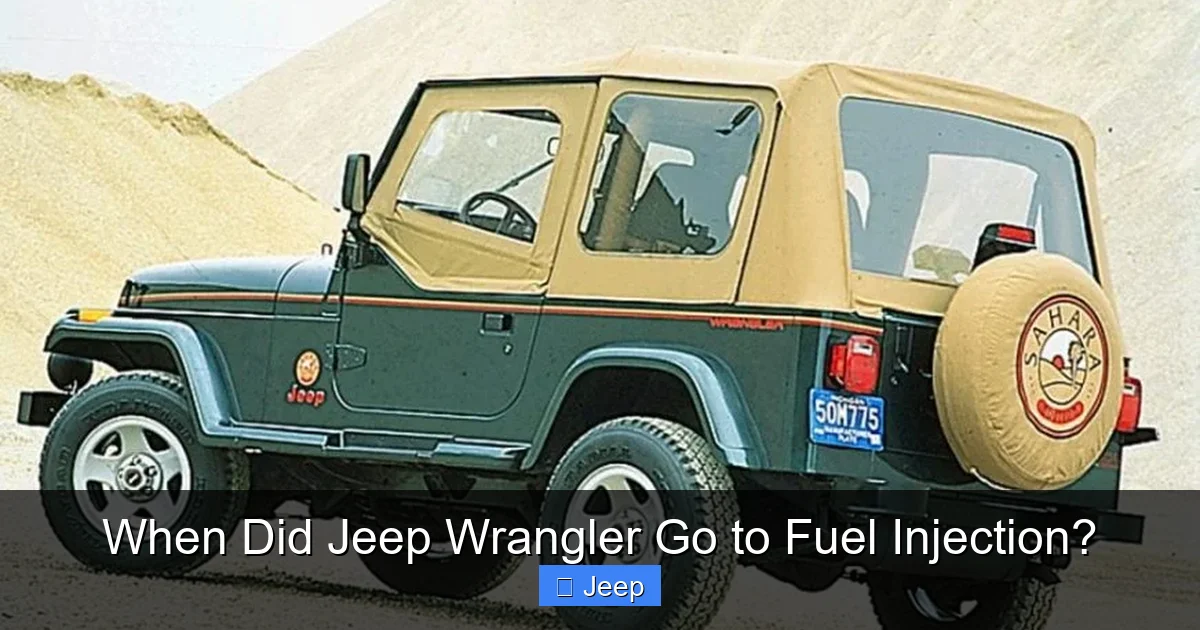
The Jeep Wrangler made the definitive switch from carburetion to fuel injection with the 1991 model year (YJ generation). This critical upgrade, using Chrysler’s Multi-Point Fuel Injection (MPFI) system, replaced the old carburetor to dramatically improve drivability, fuel efficiency, emissions, and power. While the 1987-1990 YJ Wranglers used a carburetor, every single Wrangler built from 1991 onward has been fuel-injected, marking a major evolution in the model’s engineering.
Key Takeaways
- The switch happened for the 1991 model year (YJ). All 1987-1990 Jeep Wrangler YJ models came with a carburetor. Starting in 1991, Chrysler equipped every Wrangler with a fuel injection system.
- It was driven by emissions and drivability. Stricter government emissions regulations made carburetors obsolete. Fuel injection provided precise air-fuel control, eliminating cold-start issues and hesitation.
- The system used was Chrysler’s MPFI. Multi-Point Fuel Injection means one injector per cylinder, spraying fuel directly into the intake port for superior atomization and efficiency over a single-barrel carburetor.
- It affected all subsequent generations. The 1991 transition was permanent. The TJ (1997-2006), JK (2007-2018), and JL (2018-present) Wranglers were all born with sophisticated fuel injection, which has evolved into modern systems like the Pentastar V6’s direct injection.
- Maintenance changed completely. Tuning a carburetor became obsolete. Diagnostics shifted to reading electronic sensor data (O2, MAP, TPS) with a scan tool. Common issues moved to sensors, injectors, and the PCM (engine computer).
- It enabled future power and efficiency gains. Fuel injection was the foundational technology that allowed for later upgrades like the 4.0L inline-six’s excellent reliability and the efficient, powerful turbocharged 2.0L and 2.0L hybrid four-cylinders in the JL.
- You can visually identify the change. Look under the hood of a pre-1991 YJ: you’ll see a single, mechanical carburetor with a round air filter. Post-1991 YJs and all later models have a fuel rail with individual injectors and a rectangular air intake system.
📑 Table of Contents
The Great Divide: Carbureted Simplicity vs. Fuel-Injected Complexity
If you’ve ever popped the hood of an old car and seen a big, chrome-plated contraption sitting on top of the engine with a round air filter, you’ve seen a carburetor. For decades, that’s how all gasoline engines, including the early Jeep Wrangler, got their fuel. It was a purely mechanical, elegant in its simplicity, but notoriously finicky. It relied on atmospheric pressure, vacuum, and carefully calibrated jets to mix air and fuel. For a go-anywhere workhorse like the Wrangler, this meant temperamental cold starts, altitude sickness on mountain trails, and a constant need for adjustment. The air-fuel mixture was a guess, a best-effort approximation that never quite matched the engine’s exact needs in real-time. This all changed forever with the switch to electronic fuel injection (EFI), a move that aligned the Wrangler with the modern automotive world while preserving its raw character.
Understanding this transition isn’t just about trivia; it’s about understanding the soul of the Wrangler you own or are considering buying. A carbureted YJ feels and behaves fundamentally different from an injected one. The driving experience, the maintenance routine, and even the potential for modifications diverge sharply along this 1991 model year line. It represents the moment the Wrangler truly grew up, trading some of its raw, mechanical charm for the reliability and consistency demanded by a growing legion of daily drivers and global emissions laws. Let’s pop the hood and dive deep into the why, how, and what it means for you.
The Carburetor: A Mechanical Masterpiece with Flaws
The carburetor is a marvel of analog engineering. It uses the Venturi effect—where air speeds up and pressure drops—to draw fuel from a float bowl into the airstream. Early Wrangler YJs (1987-1990) used a single-barrel Carter YFA or Weber carburetor. It had no computer, no sensors, just springs, valves, and jets. In ideal conditions, it worked fine. But ask it to perform in sub-zero mornings, at high altitude in the Rockies, or after a deep water ford, and its weaknesses showed. The mixture would run rich (too much fuel) or lean (too much air), causing rough idling, stalling, and poor throttle response. Tuning it required a skilled hand with a screwdriver and a good ear.
For the off-road purist, there’s a certain romantic appeal to this mechanical connection. You *could* tune it yourself. But for the average owner, it was a nightmare. The choke system alone—a separate set of flaps to enrich the mixture for cold starts—was a common point of failure. As emissions standards tightened in the late 1980s, adding catalytic converters and oxygen sensors to a carbureted engine was like trying to fit a square peg in a round hole. The carburetor simply couldn’t react quickly or precisely enough to keep the catalytic converter working efficiently, leading to Check Engine Lights (or “idiot lights,” as they were often called) and failed smog tests. The writing was on the wall.
The Turning Point: 1991 and the Dawn of MPFI
For the 1991 model year, Chrysler engineers made the decisive break. They replaced the carburetor with a full electronic fuel injection system. This wasn’t a half-measure. It was a complete redesign of the induction and fueling system. The heart of the new system was the Chrysler Multi-Point Fuel Injection (MPFI) setup. “Multi-point” means there is one fuel injector for each cylinder, located just upstream of the intake valve in the intake manifold. This is a critical distinction from “throttle-body injection” (TBI), which uses one or two injectors in a centralized throttle body, mimicking a carburetor’s location. MPFI is far more precise.
Visual guide about When Did Jeep Wrangler Go to Fuel Injection?
Image source: vehiclers.com
The system was controlled by the newly mandatory Engine Control Module (ECM), a simple computer by today’s standards. It gathered data from a suite of sensors: a throttle position sensor (TPS) to know how far you pressed the pedal, a manifold absolute pressure (MAP) sensor to measure engine load, an engine coolant temperature (ECT) sensor, and an oxygen (O2) sensor in the exhaust to monitor combustion efficiency. The ECM processed this data thousands of times per second and pulsed each injector with the exact amount of fuel needed for the current operating condition. The result was revolutionary for the Wrangler.
The Tangible Benefits: Why the Change Was Non-Negotiable
The switch to fuel injection wasn’t just an engineering flex; it solved real, daily problems for Wrangler owners. The benefits were immediate and profound:
- Drivability Transformed: Cold starts became a one-turn-key affair. No more pumping the gas pedal and playing with the choke. The ECM automatically enriched the mixture based on the ECT sensor. Throttle response became crisp and predictable, eliminating the hesitation and “flat spot” common with carburetors as the accelerator was pressed.
- Power and Efficiency Gains: By precisely metering fuel, the engine burned it more completely. The 1991 4.2L inline-six saw a slight but noticeable increase in horsepower and a significant improvement in fuel economy—a crucial selling point as gas prices fluctuated. The engine ran cleaner and stronger across the entire RPM range.
- Emissions Compliance: This was the primary driver. The ECM could constantly adjust fueling to keep the catalytic converter in its optimal operating temperature window, drastically reducing hydrocarbon and carbon monoxide emissions. This allowed the Wrangler to meet increasingly strict EPA and California Air Resources Board (CARB) standards, keeping it legal for sale in all 50 states.
- Altitude and Temperature Invariance: Whether you were sea level in Florida or 10,000 feet in the Rockies, the MAP sensor told the ECM the atmospheric pressure, and it automatically adjusted fuel delivery. The Wrangler no longer ran poorly at high altitude. Similarly, hot summer starts and cold winter starts were handled with equal competence.
- Elimination of Tuning: The era of the backyard carburetor tuner was over for the Wrangler. The system was designed to be “set and forget” within its factory parameters. While professional tuning is possible with aftermarket ECUs, the stock system was vastly more reliable and consistent.
Generation by Generation: The Evolution of Injection
The 1991 switch was the starting gun, but fuel injection technology has evolved dramatically throughout the Wrangler’s lifespan. Understanding each generation’s system helps diagnose issues and appreciate the engineering journey.
Visual guide about When Did Jeep Wrangler Go to Fuel Injection?
Image source: cartireinflator.com
The YJ (1991-1995): The First Fuel-Injected Wrangler
The 1991-1995 YJ Wrangler was the pioneer. It used a relatively simple, speed-density system. The MAP sensor was the primary load sensor, and the ECM used pre-programmed fuel maps based on engine speed (from the distributor) and manifold pressure. It was robust and reliable. The famous 4.0L straight-six engine arrived in 1991 for this generation, and its fuel injection system was the direct predecessor of the legendary 4.0L’s near-bulletproof reputation in the TJ. Common issues on these early systems are age-related: failing sensors (especially the O2 sensor), leaking or clogged fuel injectors, and a failing ECM (though rare). The wiring harnesses can also become brittle. For owners, a good scan tool that can read live sensor data is the most valuable diagnostic tool, replacing the old carburetor toolkit.
The TJ (1997-2006): Refinement and the 4.0L Heyday
The 1997 TJ Wrangler introduced a more sophisticated system, still using the 4.0L inline-six. While still a speed-density system, the ECM programming and sensor suite were refined. This generation solidified the fuel-injected Wrangler’s reputation for unstoppable reliability. The 4.0L, with its simple iron block and head, paired with a well-calibrated MPFI system, could run for hundreds of thousands of miles with basic maintenance. The key here was simplicity. There were fewer complex components to fail compared to modern systems. Maintenance focused on the fuel filter (often neglected), spark plugs, and the throttle body (which could get gunked up). This is the era where many Wrangler enthusiasts believe the sweet spot of reliability and capability was reached. If you’re looking at a used Wrangler, a well-maintained TJ with a 4.0L is often considered the gold standard for longevity, thanks in no small part to its robust, proven fuel injection system.
The JK (2007-2018): Modernization and New Challenges
The JK generation brought massive changes: a new 3.8L V6 (later the 3.6L Pentastar V6), independent front suspension on some models, and a much larger footprint. The fuel injection systems evolved with the engines. The 3.8L V6 used a more advanced, mass-air-flow (MAF) based system in addition to the MAP sensor, allowing for even more precise control. The Pentastar 3.6L, introduced in 2012, featured dual-VVT (variable valve timing) and a more powerful ECM. This era also saw the introduction of direct injection (DI) on the 2.0L turbo four-cylinder in the later JL, but the JK’s主流 engines remained port-injected. The complexity increased. Diagnosis now often requires a professional-grade scan tool to read specific manufacturer codes and sensor data streams. Common JK issues include oil consumption on some 3.6Ls (unrelated to injection but a known issue), throttle body failures, and injector leaks. The system is more capable but also more expensive to repair when things go wrong. For a JK owner, staying on top of routine maintenance—using high-quality fuel and oil—becomes even more critical to keep the high-pressure fuel system happy.
The JL (2018-Present): Efficiency, Power, and Hybrid Tech
The current JL Wrangler represents the pinnacle of fuel injection evolution. The standard 3.6L Pentastar V6 uses a sophisticated port injection system with excellent refinement. The headline, however, is the 2.0L turbocharged four-cylinder. This engine uses Gasoline Direct Injection (GDI), a monumental leap from the MPFI of 1991. Instead of spraying fuel into the intake port, GDI injects fuel directly into the combustion chamber under extremely high pressure. This allows for higher compression ratios, more power, and dramatically better fuel economy. It also introduces new challenges, like the potential for carbon buildup on intake valves (since fuel no longer washes over them). The JL also offers a 4xe plug-in hybrid, which integrates a complex electric motor system with the gasoline engine’s injection system, requiring even more advanced computer management. The fuel injection system in a modern JL is no longer a standalone system but a central node in a vast network of vehicle electronics.
Practical Implications for Owners: Buying, Fixing, and Modifying
This historical shift has direct, practical consequences for anyone interacting with a Wrangler, whether you’re shopping for one, wrenching in the garage, or planning upgrades.
Visual guide about When Did Jeep Wrangler Go to Fuel Injection?
Image source: moparpartsgiant.com
Buying a Used Wrangler: The 1991 Divide
When looking at used Wranglers, the fuel injection year is a major factor. A pre-1991 YJ is a classic, a rolling piece of history. It appeals to a specific enthusiast who enjoys mechanical tinkering. Expect frequent carburetor adjustments, choke issues, and poor emissions test performance. It is a project. A 1991+ YJ and all subsequent models are infinitely more user-friendly as a daily driver. They start reliably in all weather and are far less likely to leave you stranded due to a simple fueling issue. When test-driving, the difference in idle quality and throttle response between a smooth 1991+ model and a sputtering carbureted model is night and day. For a first-time Wrangler buyer or someone wanting a hassle-free companion, you should almost universally target a 1991 or newer model. The change in daily usability is that significant.
Diagnostics: From Screwdriver to Scan Tool
If you own a fuel-injected Wrangler, your diagnostic approach changed. The “check engine” light (MIL) is your friend. When it illuminates, you need a code reader or scan tool. Basic OBD-II scanners (mandatory on all 1996+ models) will give you a trouble code like P0301 (Cylinder 1 Misfire). From there, you diagnose: is it a spark plug, an injector, a vacuum leak? The key sensors to know are the O2 sensors (pre and post-cat), the MAP/MAF sensor, and the throttle position sensor. A failing sensor will give a code and cause poor running. On pre-1996 OBD-I models (1991-1995 YJs), diagnostics are simpler but still require a code reader or a clever paperclip method to flash the MIL. The era of listening to the engine and adjusting a screw is over for the mainstream Wrangler. Investing in a decent scan tool is the best $50-$100 you can spend on a fuel-injected Wrangler. For specific model advice, especially on the popular 4.0L TJ, you might want to look into the best spark plugs for Jeep Wrangler JK as a starting point for a basic tune-up that ensures optimal combustion.
Modifications: Fuel Injection Enables, But Also Constrains
Fuel injection opened the door to powerful, reliable modifications but added a layer of complexity. With a carburetor, a big intake and a re-jetted carb were the path to more power. With injection, you need to convince the ECM to deliver more fuel and advance timing. This is done through “chip” tuning (reprogramming the ECM) or using a device like a Superchips Flashcal. For the 4.0L TJ, simple bolt-ons like a cold-air intake and exhaust yield minimal gains because the stock ECM programming is already quite efficient. Significant power increases require a custom tune. For the newer Pentastar engines, tuning is even more critical. The good news is that the stock injection systems on modern Wranglers can handle a fair amount of mild modification (like larger tires and bumpers) without needing a tune, thanks to their adaptive learning. However, for serious power adders like a supercharger, you must upgrade the injectors and reprogram the ECM. The fuel pump itself, often located inside the fuel tank, is also a potential weak point when adding significant horsepower; a high-flow in-tank pump or an inline booster pump may be necessary. Always research the specific fuel system limits for your Wrangler’s engine before modifying.
Common Misconceptions and FAQs
The transition to fuel injection is sometimes misunderstood. Let’s clear up a few points.
- Myth: All 1987 Wranglers are carbureted. Mostly true. The very first 1987 models (early production) did use a carburetor. However, some late 1987 models built in 1988 might have been early 1988 models with the carburetor. The definitive rule is: 1991 and newer = fuel injection. 1990 and older = carburetor.
- Myth: Fuel injection is always better. For the vast majority of users, yes. It is more reliable, efficient, and cleaner. But for a dedicated off-roader who might submerge the vehicle in deep water, a carburetor’s simpler design can sometimes be less prone to electrical sensor failure (though modern systems are very well sealed). The trade-off is overwhelmingly in favor of injection.
- Myth: You can’t work on fuel-injected engines. False. You can. It just requires different knowledge and tools. Replacing spark plugs, fuel filters, and sensors is often easier than tuning a carburetor. The system is designed for longevity and minimal adjustment.
- What about the diesel? The 2.8L VM Motori diesel (2008-2010 JK) used common-rail direct injection from the start. It was a completely different, high-pressure diesel system, but it was also fuel-injected. The term “fuel injection” applies to both gasoline and diesel; the context of this article is the switch from carburetion to gasoline electronic fuel injection.
Frequently Asked Questions
Was there ever a fuel-injected Wrangler before 1991?
No. For the American market, all Jeep Wrangler YJ models from 1987 through the 1990 model year were equipped with a carburetor. The 1991 model year was the first and definitive year for electronic fuel injection on the Wrangler line. Some export markets may have had different regulations, but for the U.S., 1991 is the clear cutoff.
Can I convert my carbureted YJ to fuel injection?
Yes, but it’s a significant and expensive project. It requires swapping the entire intake manifold, fuel system (tank, pump, lines, rail), wiring harness, ECM, and all sensors from a fuel-injected donor YJ (1991-1995). You would also need the matching exhaust manifold with the oxygen sensor port. It’s generally more cost-effective and reliable to simply buy a fuel-injected Wrangler. For a carbureted purist, keeping it original is often the preferred route.
How can I tell if my Wrangler has fuel injection just by looking?
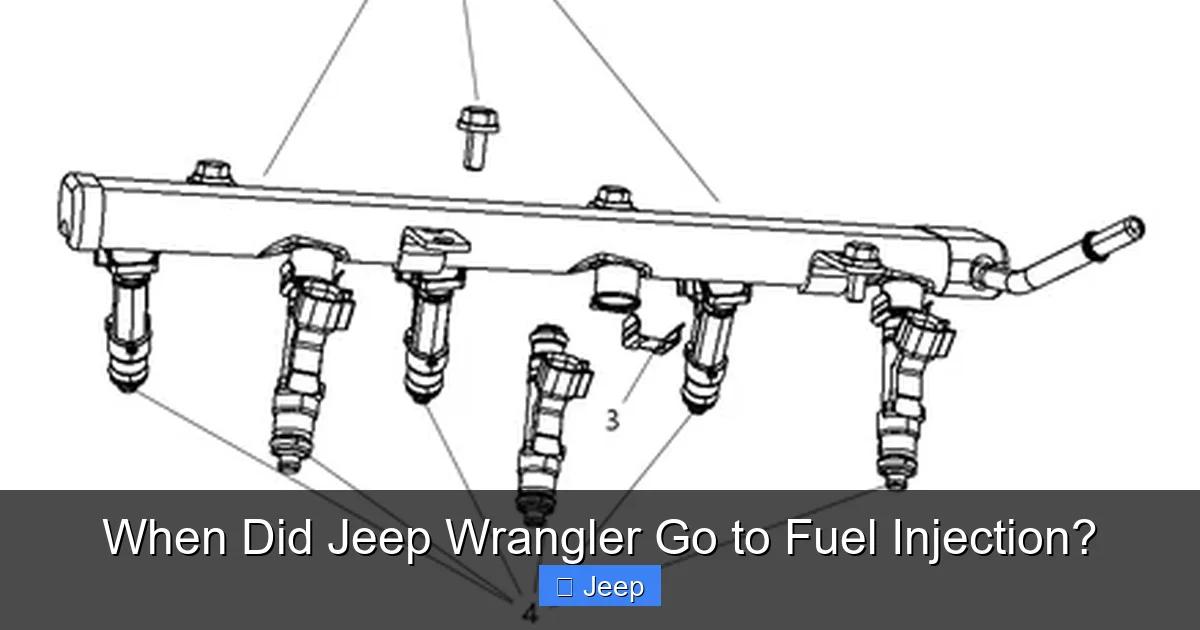
It’s very easy. Open the hood. If you see a single, round air filter housing connected to a chrome or painted metal “carburetor” with a choke knob or plate, it’s carbureted (pre-1991). If you see a rectangular air box connected to a large, black plastic intake tube that leads to a fuel rail with multiple small metal injectors screwed into the top of the intake manifold, it’s fuel-injected (1991+). The injectors are clearly visible and have an electrical connector on top.
Does fuel injection make the Wrangler less capable off-road?
Not in any meaningful way. The perception of “simplicity” is the only argument. Modern fuel-injected systems are exceptionally well-protected under the hood and are not more vulnerable to water or dust than a carburetor’s float bowl. In fact, the consistent fueling and reliability of injection are huge assets when navigating challenging terrain where a stalling carbureted engine could be a serious problem. The capabilities of the Wrangler are defined by its axles, suspension, and tires, not its fueling method.
What’s the most common problem with a fuel-injected Wrangler?
It varies by generation, but sensor failures are extremely common across all fuel-injected models. The throttle position sensor (TPS) and oxygen (O2) sensors are wear items that will eventually fail, causing rough idle, poor throttle response, and check engine lights. On higher-mileage vehicles, clogged fuel injectors can cause misfires. For the 4.0L inline-six (1991-2006), a failing crankshaft position sensor is a notorious no-start condition. Regular maintenance with quality parts is the best prevention.
Should I use premium fuel in my fuel-injected Wrangler?
Follow the manufacturer’s recommendation printed on the fuel filler door and in the owner’s manual. For the 4.0L inline-six and the 3.6L Pentastar V6, regular 87-octane unleaded fuel is perfectly acceptable and recommended. Using premium provides no benefit and is a waste of money. The ECM is tuned for 87-octane. However, if you experience engine knock (a pinging sound under load), try a tank of premium to see if it resolves it, as this could indicate a sensor or carbon issue. The high-compression 2.0L turbo *requires* premium fuel (91 octane) for optimal performance and to prevent knock.
