
How to Turn Off Manual Shift on a Jeep Grand Cherokee

Many Jeep Grand Cherokee owners accidentally engage manual shift mode (paddle shifters or Tiptronic) and struggle to return to full automatic operation. The process is simple but varies by model year and trim. Typically, you can disengage it by holding a steering wheel paddle or moving the console shifter to “D” and gently accelerating. Always consult your owner’s manual first, as the exact method differs between generations. If the mode won’t disengage, it may indicate a deeper transmission issue requiring professional diagnosis.
Key Takeaways
- Manual shift mode is a feature, not a malfunction: It allows temporary driver control over gear selection but defaults back to automatic if used correctly.
- The primary disengagement method is via the steering wheel paddles: Holding either the “+” or “-” paddle for a few seconds usually returns control to the transmission.
- Console shifter models use a “D” position with a trigger: Some models require moving the shifter to “D” while pressing a shift lock release button.
- Model year is critical: Procedures differ significantly between pre-2014 (WK1) and post-2014 (WK2/WL) Grand Cherokees.
- A persistent manual shift light may signal a problem: If the transmission won’t revert to automatic, check for fault codes or sensor issues with a mechanic.
- Safety first: Do not attempt to force the shifter. Ensure the vehicle is in “Park” or “Neutral” before making adjustments.
- Your owner’s manual is the ultimate authority: It contains the precise instructions and diagrams for your specific vehicle configuration.
📑 Table of Contents
- Understanding Manual Shift Mode in Your Jeep Grand Cherokee
- Method 1: Using the Steering Wheel Paddle Shifters (Most Common)
- Method 2: Using the Center Console Shifter
- Model Year Variations: WK1 vs. WK2 vs. WL
- Troubleshooting: What If It Won’t Turn Off?
- Why You Might Have Engaged It Accidentally (And How to Avoid It)
- When to Consult Your Owner’s Manual or a Professional
Understanding Manual Shift Mode in Your Jeep Grand Cherokee
So, you’re driving your Jeep Grand Cherokee, and you notice the engine revving higher than usual. The shift indicator on the dashboard or in the cluster shows a number (like “3” or “4”) instead of the usual “D” for Drive. You’ve accidentally activated the manual shift mode, often called Tiptronic or Sport Shift. Don’t panic! This is a built-in feature designed to give you more control, but it can be confusing when you just want the car to drive itself. This guide will walk you through exactly how to turn off manual shift on a Jeep Grand Cherokee, no matter your model year.
First, let’s clarify what this mode is. In most modern Grand Cherokees, the automatic transmission has a hidden manual control. You engage it by moving the console shifter to the left of “D” (into a gate marked with “+/-” or “M”) or by using the paddle shifters behind the steering wheel. Once active, you select gears yourself using the paddles or by nudging the shifter. The transmission will hold the gear you select until you shift again or until it reaches a redline. The system is smart—it will prevent you from stalling or damaging the engine—but it won’t automatically shift back to full automatic mode on its own. You have to tell it to.
Why Would You Want to Turn It Off?
There are a few common scenarios. You might have brushed the paddle while turning the wheel. A family member or friend might have played with the controls. Or, you intentionally used it for towing or descending a steep hill and now want to return to normal, effortless driving. Whatever the reason, the solution is straightforward once you know where to look and what button to press or hold.
Method 1: Using the Steering Wheel Paddle Shifters (Most Common)
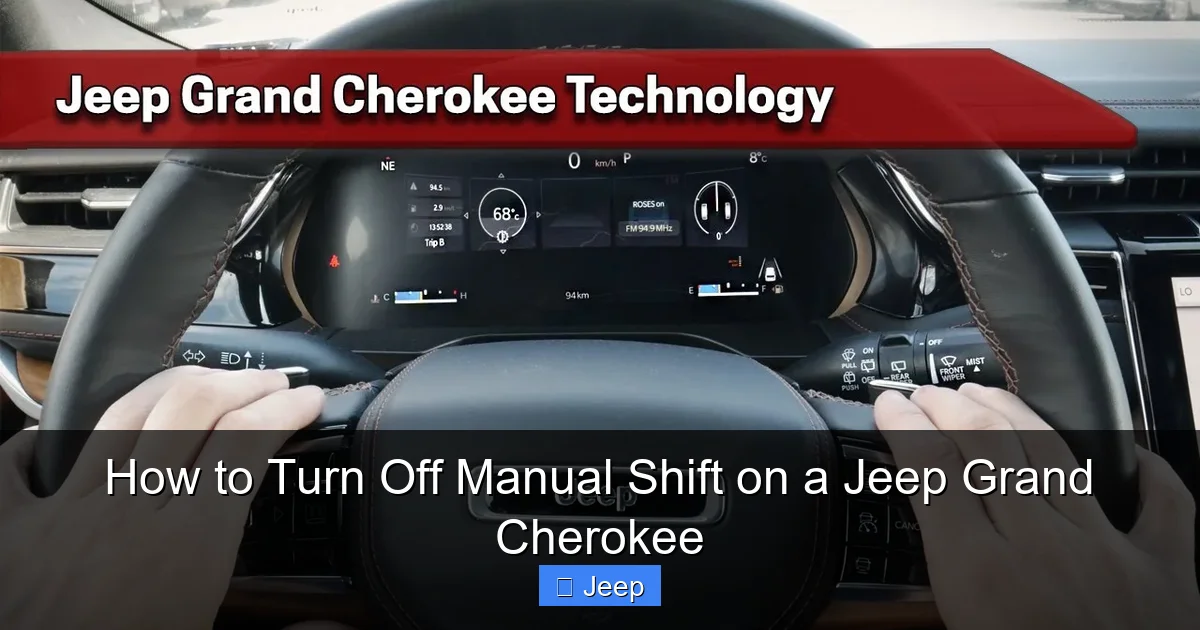
If your Grand Cherokee is equipped with paddle shifters (usually on the steering wheel column or behind the wheel), this is your primary tool. They are labeled with a “+” (for upshifts) and a “-” (for downshifts). When manual mode is active, these paddles are your gear selectors. To disengage manual mode and return to full automatic control, you need to use them in a specific way.
Visual guide about How to Turn Off Manual Shift on a Jeep Grand Cherokee
Image source: adventurejeep.com
The universal method across almost all model years is to hold either the “+” or the “-” paddle for approximately 2-3 seconds. You’ll often feel a slight click or resistance, and then the shift indicator on your dashboard should revert to displaying just “D” (or sometimes “A” for Auto). The transmission will then resume its normal, computer-controlled shifting pattern. You can do this from a complete stop or while driving at any speed. The system is designed to recognize this “hold” command as a request to exit manual mode.
- Pro Tip: Do this while the vehicle is moving at a steady speed, not during hard acceleration. It’s smoother and easier on the transmission.
- What if holding does nothing? Ensure you are holding the paddle long enough. Some models require a 4-5 second hold. Also, check that your vehicle is not in a special mode like “Snow” or “Off-Road,” which can alter shift behavior.
Method 2: Using the Center Console Shifter
Not all Grand Cherokees have paddle shifters. Many, especially base and mid-trim models, use a traditional console-mounted shifter. On these, manual mode is engaged by moving the shifter to the left out of the “D” gate into a separate gate that has a “+” and “-” position. To turn it off, you must return the shifter to the main “D” position.
Visual guide about How to Turn Off Manual Shift on a Jeep Grand Cherokee
Image source: lovelycrush.com
The process is simple: while the vehicle is in motion (or at a stop with your foot on the brake), move the shifter back to the right, into the standard “D” position. You should hear or feel a soft “clunk” as it engages. The dashboard display should immediately change from a gear number (e.g., “3”) back to just “D.” In many models, this is all that’s required. The transmission automatically resumes automatic shifting.
However, some model years—particularly some 2014-2021 WK2 models—have a slight twist. They may require you to first press the shift lock release button (the small button on the side of the shifter knob) while moving it from the manual gate back to “D”. This button prevents accidental movement out of “Park.” If your shifter feels stiff or won’t move, this is likely the reason. Depress the button and try again.
- Important Safety Note: Only attempt to move the shifter from “D” to “R” or “P” when the vehicle is at a complete stop. Moving between manual mode and “D” is generally safe at low speeds, but always keep your eyes on the road.
- Model-Specific Quirk: On some earlier models (2011-2013), the manual gate is actually a separate slot to the left of “D.” You must physically push the shifter forward into that slot to engage manual mode, and pulling it back to the right and down returns it to “D.”
Model Year Variations: WK1 vs. WK2 vs. WL
Jeep has produced three main generations of the modern Grand Cherokee. The method you use depends heavily on which one you own. Identifying your model year is the first step to success.
Visual guide about How to Turn Off Manual Shift on a Jeep Grand Cherokee
Image source: waterboostersystem.com
Pre-2014 (WK1 Generation)
These models (2005-2013) almost exclusively use the console shifter method. There are no steering wheel paddles on most trims. The shifter has a clear gate to the left of “D” marked with “+” and “-“. To exit manual mode, simply move the shifter back to the right into the “D” position. There is no separate button required; it’s a smooth motion. The dashboard display will show the selected gear number. When you move it back to “D,” that number disappears.
2014-2021 (WK2 Generation)
This is the most common generation on the road today. It introduced paddle shifters as a standard or available feature on most trims. The console shifter also gained a more electronic feel with a shift-by-wire system. For paddle-equipped models, the hold paddle method is primary. For shifter-only models, you must often press the side shift lock button while returning to “D.” The instrument cluster is digital on higher trims, clearly showing “M” or a gear number when in manual mode.
2022-Present (WL Generation)
The current generation continues with paddle shifters and an electronic console shifter. The process remains the same: hold a paddle for 2-3 seconds. However, the interface is more integrated into the digital gauge cluster. Some models may also have a dedicated “Auto” button on the steering wheel or center console that, when pressed, immediately returns the transmission to full automatic control. Check your manual for this feature.
- How to Check Your Model Year: Look at your driver’s side door jamb sticker. The “Manufacturer’s Date” or model year is listed there. You can also check your VIN (10th character indicates model year).
- Trim Level Matters: Limited, Overland, and Summit trims are more likely to have paddle shifters. Laredo and base trims typically rely on the console shifter.
Troubleshooting: What If It Won’t Turn Off?
You’ve tried holding the paddles and moving the shifter, but the transmission stubbornly stays in manual mode, holding gears or refusing to shift up automatically. This is a less common but possible issue. Before you panic, rule out the simple things.
First, ensure you are following the correct procedure for your specific model year. Re-read the relevant section above. Second, check your driving conditions. If you are in a very steep hill descent using “Hill Descent Control” or in a deep snow/off-road mode, the transmission may intentionally stay in a low gear for engine braking. Turn off those specialized off-road or traction systems first, then try the manual mode disengagement again.
If the problem persists, it could be a faulty shift lever position sensor or a problem with the Transmission Control Module (TCM). A warning light—like a transmission temperature light or a generic “check engine” light—might illuminate. In this case, the system is likely in a “limp mode” to prevent damage. Do not continue to drive in this state. You should:
- Carefully drive (if safe) to a safe location and restart the engine. Sometimes a reboot clears the fault.
- Ensure the shifter is fully clicked into the “D” position. A loose or incomplete connection can confuse the system.
- Use an OBD2 scanner to check for transmission-related fault codes (P0700 series).
If these steps don’t work, you need a professional. A dealership or qualified transmission specialist can run a deeper diagnostic on the TCM and sensor circuits. This is not typically a DIY fix for most owners.
Why You Might Have Engaged It Accidentally (And How to Avoid It)
Understanding how you got into this situation helps prevent it. The most common cause is inadvertent paddle activation. While making a tight turn, your hand or wrist can brush against the paddle on the back of the steering wheel, especially if you have a larger steering wheel or drive with your hands in an unconventional position. The paddle has a short throw and easy activation.
Another cause is fumbling with the console shifter. When reaching for the infotainment system or a cup holder, your elbow or arm might push the shifter sideways out of the “D” gate and into the manual mode gate. This is particularly easy in WK2 models where the gates are close together.
To avoid this:
- Adjust your steering wheel and seat to ensure a comfortable, neutral grip where your thumbs and fingers are clear of the paddle levers.
- Be mindful of the shifter area when reaching for objects on the center console. Consider using a console organizer to keep items from pressing against the shifter boot.
- Familiarize all drivers of your vehicle with the location and function of the manual shift controls. Show them how to turn it off.
Some drivers intentionally use manual mode for performance driving or engine braking. If this is you, practice the disengagement maneuver (holding the paddle) so it becomes second nature. You can do it safely while cruising on the highway.
When to Consult Your Owner’s Manual or a Professional
Every vehicle is unique. While this guide covers the vast majority of Grand Cherokees, your specific model year, market (U.S., Canada, Europe), and even trim package can have subtle differences. The owner’s manual is your single most reliable source. It has diagrams showing the exact location of the manual gate on your shifter and the precise instructions for your model. It’s usually in the “Driving” or “Transmission” chapter.
If you’ve consulted the manual and followed all steps correctly but the system remains unresponsive, it’s time to seek professional help. Here’s a clear decision tree:
- Step 1: Try the hold-paddle method and shifter return method multiple times, ensuring full range of motion.
- Step 2: Turn the vehicle completely off, wait 30 seconds, and restart. See if the mode resets.
- Step 3: Check for any other warning lights or messages on the dash (e.g., “Transmission Overheating,” “Service Transmission”).
- Step 4: If the problem remains, do not ignore it. Schedule an appointment with a Jeep dealer or a trusted transmission shop. Explain the symptoms: “Manual shift mode will not disengage, transmission holds gears.”
For those who enjoy DIY troubleshooting, you can also look for technical service bulletins (TSBs) related to the transmission shifter assembly for your model year. However, internal transmission issues are complex and best left to experts.
Related: If you’re dealing with other vehicle warning lights or features, understanding how to reset or disable them is key. For instance, knowing how to turn off lane departure on a Honda Civic or how to turn off the maintenance light on a Toyota follows a similar principle of consulting the manual and following precise steps. Even within Jeep, resetting the oil change light on a Jeep Grand Cherokee is a common task that requires model-specific knowledge.
Frequently Asked Questions
Will holding the paddle damage my transmission?
No. Holding the paddle to exit manual mode is a standard, manufacturer-approved function. It sends a signal to the Transmission Control Module to resume automatic shifting and will not cause any harm.
My Grand Cherokee doesn’t have paddle shifters. How do I turn it off?
If you only have a console shifter, look for a separate gate to the left of the “D” position marked with “+” and “-“. Simply move the shifter back to the right, into the standard “D” position. On some models, you may need to press the side shift lock button on the shifter knob while doing this.
What does the “M” or gear number on my dash mean?
It means your transmission is in manual shift mode. The number (e.g., 1, 2, 3) indicates the currently selected gear. “M” simply means Manual mode is active, and you can use the paddles or shifter to change gears.
Can I permanently disable the manual shift feature?
No. Manual shift mode is a permanent, built-in feature of your transmission. You can only disengage it temporarily by returning to “D.” There is no setting in the vehicle menus to remove the function entirely.
My shifter is stuck in the manual gate and won’t move to “D”. What now?
First, ensure your foot is firmly on the brake pedal. Many modern shifters require the brake to be pressed to move out of “Park” or between certain gates. If it still won’t move, check for the shift lock release button (a small button on the side of the shifter knob). Press and hold it while attempting to move the shifter. If it remains stuck, the vehicle may need to be towed to a dealer for a mechanical or electronic diagnosis.
Does turning off manual mode affect fuel economy?
No. When you return to “D,” the transmission’s computer takes over and will shift according to its optimized programming for fuel efficiency and performance. Manual mode itself, if used aggressively (holding low gears), can reduce fuel economy, but simply exiting it returns the vehicle to its normal, efficient operating parameters.
