
How to Unlock Tesla Passenger Door from Outside

Getting locked out of your Tesla can be a stressful experience, especially when you need to access the passenger door from the outside. The primary methods involve using your Tesla key fob, the smartphone app, or the hidden mechanical key as a backup. Understanding your vehicle’s specific design and having a plan can save you time and prevent damage.
Picture this: you’re standing in the rain, arms full of groceries, and your Tesla’s passenger door won’t open. The driver’s side is locked tight, and you need to get in from the outside. It’s a uniquely modern frustration. Unlike cars with traditional door handles you can pull, Teslas use flush, automatic handles that require a signal to pop out. This sleek design is great for aerodynamics and aesthetics, but it can be confusing when you’re locked out. The good news is that Tesla provides several reliable ways to unlock the passenger door from the outside, from the everyday to the emergency. This guide will walk you through every method, for every Tesla model, in simple, actionable steps. We’ll also cover what to do when things go wrong and how to prevent this situation altogether.
Key Takeaways
- Primary methods are electronic: Use your Tesla key fob/key card or the Tesla smartphone app to unlock the passenger door from outside.
- All Teslas have a hidden mechanical key: A physical key is stored inside the key fob for emergency use when electronics fail.
- Model differences matter: Handle types and backup key access vary between Model S/X and Model 3/Y.
- Prevention is key: Keep your phone charged, carry your key fob, and enable passive entry to avoid lockouts.
- Traditional tools won’t work: Slim jims and coat hangers are ineffective and can damage Tesla’s unique door mechanisms.
- Know when to call Tesla: If all electronic and mechanical methods fail, contact Tesla Service or roadside assistance.
- Extreme weather can affect electronics: Very cold temperatures may temporarily reduce key fob or phone signal effectiveness.
📑 Table of Contents
- Understanding Tesla’s Unique Door Design and Locking System
- Primary Methods to Unlock the Passenger Door from Outside
- Emergency Physical Access Options
- Model-Specific Considerations and Quirks
- Prevention and Best Practices: Never Get Locked Out
- When to Call Tesla Service or Roadside Assistance
- Conclusion
Understanding Tesla’s Unique Door Design and Locking System
Before we dive into the “how,” it helps to understand the “why.” Tesla’s approach to doors is fundamentally different from conventional cars, which is why the solutions are specific to the brand.
The Science Behind Flush Door Handles
Tesla door handles are designed to sit flush with the body until they’re needed. When you approach the car with a valid key (the fob, key card, or paired phone), the handles automatically extend. This is called “passive entry.” If the car doesn’t detect a valid key, the handles remain retracted, making it impossible to pull them open by hand from the outside. This design eliminates the old-school lever that anyone can yank. It’s a security feature, but it also means your usual “just pull the handle” instinct won’t work if the car doesn’t recognize you.
Auto-Lock Features and Security Protocols
Teslas automatically lock the doors when you shift into drive, walk away with the key, or after a set time. The system uses encrypted Bluetooth Low Energy (BLE) communication between your key device and the car. This is highly secure, but it means the car will only unlock when it receives the correct digital handshake. For the passenger door, the process is identical to the driver’s door: approach, handle extends, press to open. If the handle doesn’t extend, the car doesn’t see your key. Your first troubleshooting step is always to ensure your key device is functional and has power.
Primary Methods to Unlock the Passenger Door from Outside
These are your go-to, everyday solutions. They rely on the car’s intended electronic systems and should work smoothly if everything is in order.
Visual guide about How to Unlock Tesla Passenger Door from Outside
Image source: koala.sh
Using the Tesla Key Fob (Key Card or Key Fob)
This is the simplest and most direct method. Your Tesla came with either a key fob (for older Model S/X) or a key card (standard for Model 3/Y). Both work the same way for unlocking.
For Key Fob Users (Model S/X older than ~2021): Simply press the button on the top of the fob while standing near the passenger door. You’ll hear a click and see the handle extend. Press the handle again to open the door. The fob has a range of about 20-30 feet, but line of sight is best.
For Key Card Users (All Model 3/Y, newer S/X): Tap the key card against the door pillar on the passenger side. There’s a small, textured area (often marked with a Tesla “T” logo) specifically for this. You’ll feel a slight vibration or hear a click. The handle will then extend, and you can press it to open. Important: The card must be held flat against the sensor for a second. If it doesn’t work, try the driver’s side pillar first to wake the car up, then try the passenger side.
Pro Tip: If the key fob battery is low (the fob light will be dim or not flash), it may still work at very close range. But replace the battery (a simple CR2032 coin cell) as soon as possible. For key cards, ensure the plastic isn’t cracked, which can damage the internal chip.
Smartphone App as a Digital Key
If you have the Tesla app installed and have set up your phone as a key (which is automatic after initial setup), this is often the most convenient method.
- Ensure Bluetooth is turned ON in your phone’s settings.
- Open the Tesla app.
- On the main control screen, you’ll see a “Lock/Unlock” button. Tap “Unlock.”
- You’ll see a confirmation on the app, and the passenger door handle should extend immediately.
- Press the handle to open.
Critical Requirements: Your phone must have sufficient battery (ideally above 20%), Bluetooth must be on, and you must be within about 30 feet of the car. The app also needs to be connected to the internet to communicate with Tesla’s servers, though the actual unlock is via Bluetooth. If you have an iPhone, using the “Express Mode” feature (enabled in the Tesla app) allows you to unlock without even opening the app, just by being near the car. For Android, ensure the app is allowed to run in the background.
Troubleshooting: If the app says “Connecting…” or “No Response,” try closing and reopening the app, toggling Bluetooth off/on, or restarting your phone. If you recently changed your phone’s password or security settings, you may need to re-pair your phone as a key. This is done from the car’s touchscreen under Controls > Locks > +.
Key Card Backup (For Model 3/Y and Newer S/X)
Even if your phone is dead or lost, the key card is your ultimate backup. It’s a physical, battery-free token. The process is the same as described above: tap it on the passenger door pillar sensor. It’s a good habit to keep the key card in your wallet or purse separately from your phone. If you only rely on your phone and it dies, you’ll be locked out. The key card is your failsafe.
Emergency Physical Access Options
What happens if your key fob battery is completely dead, your key card is inside the car, and your phone is dead or broken? You need a Plan C. Tesla includes a physical, mechanical key for these exact scenarios.
Visual guide about How to Unlock Tesla Passenger Door from Outside
Image source: automotiveglory.com
Hidden Mechanical Key in the Key Fob
Every Tesla key fob (the plastic remote-style one) contains a small, metal emergency key inside. It’s not obvious at first glance.
- Locate the small button on the back of the key fob, near where the Tesla “T” logo is.
- Press this button and simultaneously pull the cover off the fob. It will separate into two parts.
- Inside, you’ll find a thin, metal key blade.
- This key is used to unlock the driver’s door manually. Important: There is no direct way to unlock the passenger door from the outside with this key. The mechanical key only works on the driver’s door.
Once you unlock the driver’s door with the metal key (insert into the small hole on the door handle and turn), you can then open the driver’s door from the inside. Inside, you can usually unlock the passenger door by pulling the interior door handle or pressing the unlock button on the door panel. From there, you can access the passenger compartment. This method requires you to first get to the driver’s side.
Note for Key Card Users: Vehicles that only came with a key card (most Model 3/Y) do not have a hidden mechanical key in a fob. For these cars, if the key card is inside and the phone/key card is unavailable, your only options are to retrieve the key card, use a second paired phone, or call for assistance. There is no external mechanical keyhole on these models.
Emergency Door Release (Inside Only)
All Teslas have a manual door release inside the vehicle. It’s a small, colored lever (usually red or orange) located near the door sill or under the interior door handle panel. This is for exiting the vehicle if power is lost and is not an external entry method. It’s crucial to know it exists for safety, but it doesn’t help you get in from the outside.
What NOT to Do: Avoid Damage
In a panic, you might think of using a slim jim, coat hanger, or trying to pry the handle. Do not do this. Tesla door mechanisms are complex and sealed. These tools will not work on the flush handles and will almost certainly scratch the paint, bend the handle, or damage the internal wiring and sensors. Repairing this damage is extremely expensive. The methods in this guide are the only safe, manufacturer-approved ways. If you’re considering such methods, stop and call for professional help instead. Unlike older cars where you might find guides on how to unlock a car door without a key using simple tools, Tesla’s design makes those techniques obsolete and risky.
Model-Specific Considerations and Quirks
While the core principles are the same, your specific Tesla model has nuances that affect the unlocking process.
Visual guide about How to Unlock Tesla Passenger Door from Outside
Image source: koala.sh
Model S and Model X: The Evolution of Handles
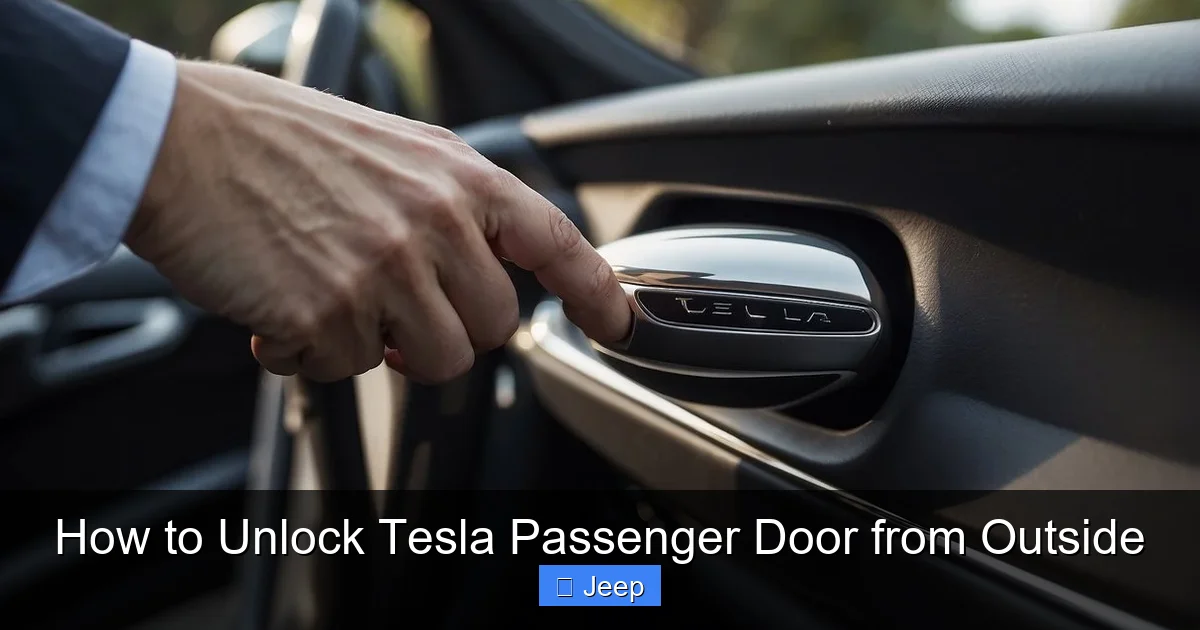
Older Model S and X (pre-2021 refresh) have what Tesla calls “original” door handles. They are rectangular and pop out when approached. They work reliably with the key fob. Newer Model S and X (2021+) have “new” flush handles that are more like Model 3/Y—they are a continuous line across the door. The unlocking method is identical: approach with key, handle extends, press. The emergency mechanical key works on the driver’s door handle of both versions. For these newer models, the key fob itself is more streamlined and also contains the mechanical key blade as described above.
A unique feature on some older Model S/X is the ability to manually pop the handle by pressing the end of it firmly with your finger, even without a key present. This is meant as a convenience if the automatic function fails. Give it a try: press the very tip of the handle (the part farthest from the door) with moderate pressure. It might pop out. If it does, you can then pull it to open. This is not a guaranteed method but can be a useful trick in a pinch.
Model 3 and Model Y: Key Card Reliance and App Nuances
Model 3 and Y are designed around the key card and phone key. There is no traditional key fob with buttons (unless purchased separately). This means your primary tools are the card and the app. The passenger door pillar sensor is very sensitive. Ensure the card is clean and undamaged. Sometimes, if the car’s 12V battery is very low (the small auxiliary battery that powers the locks and computers), the Bluetooth system may not wake up properly, and even the key card might not be recognized. In this case, you might need to jump-start the 12V battery using the front trunk’s jump posts. This is a more advanced procedure. If you suspect a dead 12V battery, the car’s touchscreen will be black or show a very low battery warning.
Another quirk: the passenger door on Model 3/Y sometimes requires the driver’s door to be unlocked first to “wake up” the entire vehicle’s system, especially if the car has been asleep for a long time. Try tapping your key card on the driver’s door pillar first, wait for the handle to extend, then immediately try the passenger door. This sequence often solves the problem.
Prevention and Best Practices: Never Get Locked Out
An ounce of prevention is worth a pound of cure. Here’s how to make a lockout extremely unlikely.
Keep Your Phone Charged and the Tesla App Updated
Your phone is your most convenient key. Make a habit of keeping it above 20% battery. Enable low power mode only when necessary, as it can sometimes restrict background app activity. Regularly update the Tesla app, as updates improve connectivity and reliability. If you have an iPhone, ensure “Express Mode” is turned on in the app’s settings. This allows the car to recognize your phone without you needing to open the app, even if your phone is locked.
Always Carry the Physical Key Fob or Key Card
Do not leave the key fob or key card inside the car. That’s the #1 cause of lockouts. Make it a ritual: when you exit the car, do a quick pat-down for your keys/phone before you close the door. Keep the key card in a dedicated pocket or wallet compartment. For key fob users, consider getting a lanyard or keychain to make it more present. The mechanical key blade inside the fob should also be known and accessible, but don’t carry it separately unless you’re extra cautious.
Enable and Understand Passive Entry
Passive entry is what makes the handles extend automatically. Ensure it’s enabled: Controls > Locks > Passive Entry. It should be on by default. Be aware of its limitations: if your key device battery is critically low, or if there’s strong electromagnetic interference (rare), passive entry may fail. In these cases, you’ll need to use the active method (pressing the fob button or tapping the card).
Also, be mindful of the car’s lock behavior. You can set it to lock automatically when you walk away, or to require you to manually lock via the app or fob. If you prefer the manual option, it gives you one last chance to check for your keys before you walk off. However, the auto-lock feature is generally safer to prevent accidentally leaving the car unlocked.
When to Call Tesla Service or Roadside Assistance
If you’ve tried every method above—key fob, key card, phone app, and even the mechanical key (for driver’s door access)—and nothing works, it’s time to call for help.
Signs of a System Malfunction
If your key devices work on one door but not the other, it could indicate a faulty door handle actuator or sensor on the passenger side. If none of the handles extend and the car doesn’t respond to any key, the issue might be with the car’s Body Controller Module (BCM) or a completely dead 12V battery. A completely black touchscreen is a classic sign of a dead 12V battery. In this state, the car’s locks won’t function electronically at all. You’ll need a jump start or a new 12V battery. If the touchscreen is on but the locks are unresponsive, it could be a software glitch. Try rebooting the car: press and hold both scroll wheels on the steering wheel until the screen goes black and the Tesla logo reappears. This often resolves temporary software bugs.
Roadside Assistance Options
Tesla offers roadside assistance for owners with an active warranty or a paid subscription. They can send a technician to help unlock your car using their proprietary tools. If you’re not covered, you’ll need a local locksmith or auto mechanic who is experienced with Teslas. Do not hire a traditional locksmith who suggests using a slim jim; they will likely fail and cause damage. Specifically ask if they have experience with Tesla’s electronic door systems. You can also use a service like AAA, but again, specify it’s a Tesla to ensure they send the right person. In an absolute emergency (e.g., a pet or child is inside), call 911. They have methods to gain entry safely.
For context, gaining entry to a traditional car without a key is a common issue, which is why there are many guides on how to unlock a Dodge Charger without keys or how to unlock a Nissan Sentra without a key. Those methods often involve manipulating the door lock rod. Tesla’s sealed, electronic system makes such techniques impossible, reinforcing why you must rely on the manufacturer’s methods or professional help.
Conclusion
Unlocking your Tesla passenger door from the outside is straightforward once you know the tools at your disposal. The electronic key fob, key card, and smartphone app are your first, best options. The hidden mechanical key in the fob provides a critical backup for driver’s door access. Remember that your specific model—whether it’s a Model S, X, 3, or Y—has slight variations in handle design and backup key availability. The most important takeaway is prevention: always be aware of your key device, keep it powered, and never leave it inside the car. If you do find yourself stranded, stay calm, work through the methods in this guide, and know that Tesla Service is there to help when all else fails. Your Tesla’s advanced security is a double-edged sword—it keeps thieves out, but it also means you need to be prepared with the correct key.
Frequently Asked Questions
Can I unlock the Tesla passenger door if my phone is dead and the key card is inside the car?
Unfortunately, if both your phone (set as a key) and the key card are inside the locked car, you have no way to unlock from the outside. You will need to call Tesla Roadside Assistance or a locksmith experienced with Teslas. The mechanical key only works on the driver’s door and requires the key fob, which you also wouldn’t have.
What if my Tesla key fob battery is completely dead?
A completely dead key fob won’t send a signal. You must replace its CR2032 battery. As a temporary measure, hold the fob directly against the door pillar when tapping (for key card models) or very close to the car when pressing the unlock button, as this can sometimes work with a very weak battery. If it still doesn’t work, use your phone or key card as the primary method.
Is there a way to manually open the passenger door handle if it’s stuck retracted?
On some older Model S and X, you can manually pop the original-style handle by pressing the very tip firmly. On Model 3, Y, and newer S/X, there is no manual external override. The handle is electronically controlled. Forcing it will cause damage. You must restore power or signal to the car.
Will extreme cold prevent my key fob or phone from unlocking the door?
Very cold temperatures can temporarily reduce the performance of batteries in key fobs and phones. If it’s extremely cold, try warming your key fob or phone in your hand or pocket for a few minutes. Hold the device closer to the car. The key card is not affected by cold as it has no battery.
Can I use a spare key fob or key card if I have one?
Yes. Tesla allows you to pair up to 19 keys (phones or key cards) to a single vehicle. If you have a spare key card, simply tap it on the passenger door pillar. If you have a spare key fob, press its unlock button. Spares are an excellent investment for preventing lockouts.
My Tesla unlocks the driver’s door but not the passenger’s door. Why?
This is unusual but can happen. First, ensure you’re standing close to the passenger door. Sometimes the signal is weaker on the far side. Try unlocking the driver’s door first to fully wake the car, then immediately try the passenger door. If it persists, the passenger door handle actuator or sensor may be faulty. This requires a service appointment with Tesla.
