
How to Flat Tow a Jeep Wrangler with Manual Transmission

Yes, you can flat tow a Jeep Wrangler with a manual transmission, but only specific models and years. The process requires meticulous preparation, including confirming your vehicle’s compatibility, using the correct equipment, and strictly adhering to speed and distance limits. Failing to follow the manufacturer’s exact guidelines can cause severe transmission damage. This guide provides the essential, step-by-step instructions to do it correctly and safely.
Key Takeaways
- Not All Manual Wranglers Can Be Flat Towed: Only certain model years (primarily TJ, JK, JL, and JT with specific manual transmissions) are approved for flat towing from the factory. Always check your owner’s manual first.
- Transmission Must Be in Neutral: The absolute most critical step is ensuring the manual transmission is in true neutral gear. Any gear engagement will destroy the transmission while towing.
- Speed and Distance Are Strictly Limited: Factory guidelines typically cap towing speeds at 50-65 mph and impose distance limits (often 30-50 miles). Exceeding these can lead to overheating and damage.
- You Need the Right Tow Bar: A proper, removable tow bar system designed for your specific Wrangler model year is non-negotiable for a safe and secure connection to the tow vehicle.
- 4WD Models Require Specific Transfer Case Settings: For 4×4 Wranglers, the transfer case must be placed in a specific neutral position (often 2H or N, depending on the model), which disengages the drivetrain.
- Pre-Tow Inspection is Mandatory: A thorough check of tire pressure, fluid levels, and all connection points before and during the tow prevents accidents and vehicle damage.
- Post-Tow Procedures Matter: After unhooking, you must restart the Jeep and shift through all gears to lubricate the transmission before driving normally.
📑 Table of Contents
- Why Manual Transmissions Are Ideal for Flat Towing
- Pre-Tow Checklist: Everything You Need to Know
- Step-by-Step: How to Flat Tow Your Jeep Wrangler
- Driving While Towing: Safe Practices and Speed Limits
- Post-Tow Procedures: Unhooking and Inspection
- Common Mistakes and How to Avoid Them
- Conclusion: Tow with Confidence, Not Complacency
Why Manual Transmissions Are Ideal for Flat Towing
Flat towing, also called “dinghy towing,” is the practice of pulling a vehicle with all four wheels on the ground. It’s a popular method for RVers, military personnel, and anyone moving a vehicle without a trailer. For Jeep Wrangler owners, the manual transmission model is the gold standard for this task. Unlike most automatic transmissions, which require a lubrication pump driven by the engine to circulate fluid, a manual transmission’s gears and bearings are bathed in fluid simply by the input shaft turning.
When a manual transmission is in neutral and the vehicle is being towed, the output shaft (connected to the driveshaft and wheels) spins freely. This spins the internal components just enough to maintain adequate lubrication without causing the gears to engage. It’s a beautifully simple mechanical solution. However, this doesn’t mean it’s a “set it and forget it” process. Factory approval is everything. You must verify your specific Jeep Wrangler model and year is authorized for flat towing in its owner’s manual. This approval is based on the specific transmission and transfer case design.
The Mechanical Advantage of Manual Gearboxes
Think of it like this: in an automatic, the transmission’s oil pump is like a heart that only beats when the engine runs. Towing without the engine running means no circulation, leading to hot spots and rapid wear. A manual transmission is more like a bath—as long as the parts are submerged and moving slightly, they get coated. The rotation from the wheels provides that minimal movement. This fundamental difference is why, for decades, the Jeep Wrangler with a manual transmission has been the go-to choice for enthusiasts who want to tow their rig behind an RV or large truck.
Which Jeep Wrangler Models Qualify?
Eligibility varies by generation. Generally:
- TJ (1997-2006): Most models with the NV3550 or AX-15 manual transmission are approved. The key is the transfer case; the NP231 is the common, towable unit.
- JK (2007-2018): Look for the NSG370 manual transmission paired with the NP231 or NP242 transfer case. Not all JK manuals were approved; 2012-2018 models with the NSG370 are typically good, but always verify.
- JL (2018-Present) & JT Gladiator (2020-Present): The current E258 manual transmission (paired with the NP242 transfer case) is factory-approved for flat towing. Again, your VIN and manual are the final arbiters.
If you own a Wrangler with an automatic transmission, the rules are completely different and usually involve a transmission lubrication pump or severe distance/speed restrictions. For the purpose of this guide, we are focusing strictly on factory-approved manual transmission models. If you’re unsure, contact a Jeep dealer with your VIN before proceeding.
Pre-Tow Checklist: Everything You Need to Know
Preparation is 90% of the battle. Rushing into a tow without a complete check is the fastest way to cause expensive damage. This checklist should become second nature every single time you prepare to flat tow your Wrangler.
Visual guide about How to Flat Tow a Jeep Wrangler with Manual Transmission
Image source: athensforeveryone.org
Vehicle Compatibility and Manufacturer Guidelines
This is Step Zero. Find your owner’s manual. In the “Recreational Towing” or “Towing” section, it will explicitly state if your vehicle can be flat towed and under what conditions. It will specify:
- Maximum towing speed (e.g., 65 mph).
- Maximum towing distance (e.g., 50 miles).
- Exact transfer case lever position (e.g., “2H” or “N”).
- Any special procedures for the steering wheel or ignition.
If your manual is missing, you can often find a PDF online by searching “[Your Year] Jeep Wrangler Owner’s Manual.” Ignoring this document is not an option. It is your legal and mechanical safety net.
Essential Towing Equipment
You need three core components:
- The Tow Bar: This is the rigid or collapsible bar that connects the front of your Wrangler to the tow vehicle’s hitch. Brands like Roadmaster, Blue Ox, and Demco are industry standards. You must purchase a system specifically engineered for your Wrangler’s year and model. It will include the bar, base plates (that bolt to your Wrangler’s frame), and all necessary hardware. Some systems are removable, leaving minimal hardware on the Wrangler when not in use.
- The Tow Vehicle: This must have a sufficiently heavy-duty hitch and a brake controller (if your Wrangler exceeds the tow vehicle’s unbraked towing capacity, which it likely will). The hitch on the tow vehicle must be rated for the Wrangler’s weight plus a safety margin. You can find the Wrangler’s curb weight in your manual or by researching online—it’s typically between 3,500 and 4,500 lbs.
- Safety Cables/Chains: These are a legal requirement and a critical safety backup. They must be crossed under the tow bar tongue to create a “cradle” that catches the tow bar if it fails, preventing the Wrangler from becoming a projectile.
Additional helpful items include a towed vehicle braking system (like a ReadyBrake or Blue Ox Patriot), which activates the Wrangler’s brakes in sync with the tow vehicle, and a breakaway switch that applies the Wrangler’s brakes if it becomes accidentally disconnected.
Pre-Tow Vehicle Inspection
With your Wrangler hooked up and ready, perform this walk-around:
- Tires: Inflate to the manufacturer’s recommended highway pressure (often found on the driver’s door jamb sticker). Check for damage, uneven wear, and adequate tread.
- Fluids: Check engine oil, coolant, and brake fluid. While not directly involved in towing, you need the Jeep road-legal after you unhook.
- Lights: Connect the electrical harness from the tow vehicle. Have an assistant verify that all Wrangler lights (taillights, brake lights, turn signals) function correctly. A wiring harness adapter is usually required.
- Base Plates & Tow Bar: Visually confirm all pins, clips, and bolts are fully engaged and locked. Give the tow bar a firm shake to ensure no movement.
- Safety Cables: Ensure they are crossed, securely attached to the tow vehicle’s hitch, and have proper slack (not dragging, not taut).
- Steering Wheel: For some models, you may need to turn the wheel to full lock in one direction and secure it with a strap to prevent movement during towing. Check your manual.
Step-by-Step: How to Flat Tow Your Jeep Wrangler
Now, let’s get connected. This process should be methodical and calm.
Visual guide about How to Flat Tow a Jeep Wrangler with Manual Transmission
Image source: adventurejeep.com
Preparing the Jeep for Connection
1. Park on Level Ground: Engage the parking brake.
2. Start the Engine: Let it idle for a minute.
3. Shift the Transfer Case: For 4×4 models, follow the manual’s exact procedure. This usually involves: coming to a complete stop, placing the transmission in Neutral (N), then moving the transfer case lever to the specified position (often “2H” or a marked “N” for neutral). You will feel a soft “clunk” as the transfer case disengages. Do not force it.
4. Shift the Transmission: With the transfer case in its neutral position, shift the manual transmission into true Neutral. Press the clutch, move the shifter to the center position between gears. Gently rock the Jeep back and forth; the shifter should move freely side-to-side.
5. Turn Off the Engine: Once in neutral, turn off the engine. Do not turn the key to the “ACC” or “LOCK” position yet. On many Jeeps, you must leave the ignition in the “ON” or “RUN” position to unlock the steering wheel for turning. Consult your manual.
6. Steering Wheel (If Required): If your model requires strapping the wheel, do so now to full lock in one direction.
Connecting the Tow Bar
1. Align the Wrangler with the tow vehicle’s hitch. Have a spotter help.
2. Back the tow vehicle up slowly until the tow bar’s receiver socket is perfectly aligned with the base plate lugs on the Wrangler.
3. Insert the tow bar into the base plates. This is often a two-person job—one person guides, the other pushes.
4. Insert the locking pins through the tow bar and base plates. Secure them with their retaining clips or bolts. Tap them in fully with a hammer. A half-inserted pin is a major failure point.
5. Lower the tow bar’s tongue onto the tow vehicle’s hitch ball. Ensure the ball is fully seated in the coupler.
6. Secure the coupler with its latch and lock.
7. Connect the Safety Cables: Cross them under the tongue of the tow bar and attach them to the designated loops on the tow vehicle’s hitch. They should be short enough to not drag but long enough to allow for turning.
8. Connect the Electrical Harness: Plug the Wrangler’s harness into the tow vehicle’s socket. Test all lights again.
Final Safety Check Before Moving
Do this with the Wrangler still in park (with parking brake on) and the tow vehicle in park:
- Verify transfer case is in correct neutral position.
- Verify manual transmission is in neutral.
- Give the tow bar a vigorous side-to-side shake. There should be no play at the connection points to the Wrangler.
- Ensure the parking brake on the Wrangler is DISENGAGED. This is critical. The wheels must spin freely.
- Check that the steering wheel (if strapped) is secure.
Once all checks pass, the driver of the Wrangler should sit in the vehicle, ready to steer if needed during initial movement. The tow vehicle driver should pull forward a few feet slowly. The Wrangler driver confirms the front wheels turn freely and there is no dragging. Then, the Wrangler driver can exit the vehicle and secure the door.
Driving While Towing: Safe Practices and Speed Limits
You’re on the road. Your driving style must change. The added mass and length of the tow combination affect acceleration, braking, and handling.
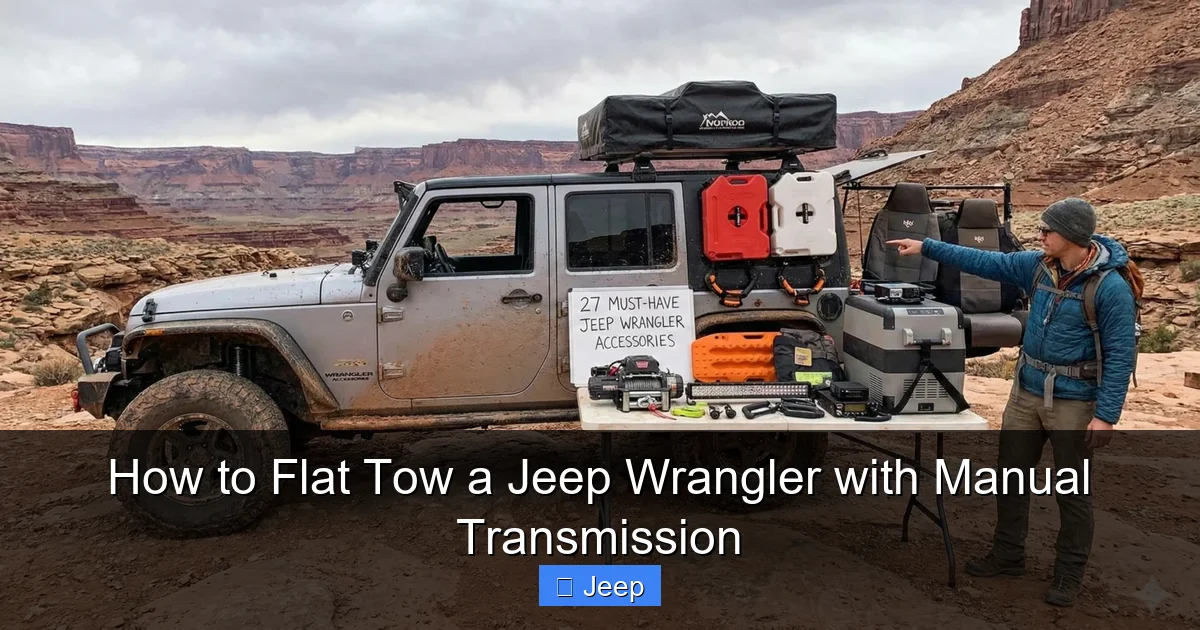
Visual guide about How to Flat Tow a Jeep Wrangler with Manual Transmission
Image source: adventurejeep.com
Understanding and Respecting Speed Limits
This is the single most common area of failure. The factory limit exists for a reason: to prevent transmission overheating. At highway speeds, the output shaft of your Wrangler’s transmission will be spinning at a very high RPM. While lubricated, this generates heat. Prolonged high-speed operation without the engine’s cooling system (the transmission isn’t connected to the Wrangler’s radiator) can cause fluid to break down and components to wear. Never exceed the speed limit stated in your owner’s manual. If no limit is given, a safe maximum is 55-60 mph. Use the right lane. Let faster traffic pass. Your journey is about safe arrival, not speed.
Driving Techniques for Towing
Allow for vastly increased stopping distances. The tow vehicle is now pulling several thousand pounds. Brake earlier and more gently. Avoid sudden maneuvers. Make wider turns to prevent the Wrangler from “cutting the corner” and jumping curbs or obstacles. Be mindful of your new, longer overall length at intersections and when merging. Use your mirrors constantly to monitor the Wrangler’s position. A extended-side mirror on the tow vehicle is highly recommended.
Monitoring Your Jeep During Transit
Every 50-100 miles, find a safe spot to pull over. Perform a quick check:
- Visually inspect the tow bar and safety cables.
- Check that the Wrangler’s tires are rolling freely and not hot to the touch (a slight warmth is normal).
- Listen for any unusual clunks or noises.
- Re-check all electrical connections if you notice light issues.
If you smell something burning or see smoke from the Wrangler’s wheel wells, stop immediately. This could indicate a brake issue (dragging brakes) or severe transmission overheating from exceeding speed limits. Do not continue.
Post-Tow Procedures: Unhooking and Inspection
The tow is over. How you unhook is just as important as how you hooked up.
Safely Disconnecting the Tow Bar
1. Park on a level surface. Engage the tow vehicle’s parking brake and the Wrangler’s parking brake.
2. Do not release the Wrangler’s parking brake yet.
3. Disconnect the safety cables and electrical harness.
4. Lower the tow bar from the hitch ball. You may need to back the tow vehicle up slightly to relieve pressure.
5. With the tow bar separated from the hitch, you can now carefully drive the Wrangler forward a few feet to free it from the base plates. An assistant should guide you.
6. Remove the locking pins and slide the tow bar out of the base plates. Store it safely on the tow vehicle.
7. Now, and only now, release the Wrangler’s parking brake.
The Critical Post-Tow Transmission Ritual
This step is absolutely essential and often forgotten. You must now lubricate the transmission and transfer case before driving normally.
- Start the Wrangler’s engine.
- With your foot on the brake, shift the transmission into gear (1st), then back to neutral. Repeat this for all forward and reverse gears (1st, 2nd, 3rd, 4th, 5th, R). Hold each gear for a second or two. This forces the fluid to circulate and coat all the synchros and bearings that may have been sitting idle.
- For the transfer case: With the transmission in Neutral, shift the transfer case lever through its full range (4L, 4H, 2H, N). Again, pause briefly in each position. This lubricates the transfer case gears.
- Finally, shift the transmission into Drive (or 1st) and carefully drive the Wrangler a short distance (a few hundred feet) at low speed, making gentle turns. This ensures everything is working smoothly before you merge into traffic.
Skipping this ritual can cause gear clash and premature wear because the first few shifts after towing will be dry or poorly lubricated.
Common Mistakes and How to Avoid Them
Even experienced towers make errors. Here are the top pitfalls and how to sidestep them.
Forgetting to Put the Transmission in True Neutral
This is the #1 cause of catastrophic, instant failure. You might think it’s in neutral because the shifter is in the middle, but it could be slightly engaged. After setting the transfer case, always rock the vehicle back and forth with the brake. If the shifter doesn’t wiggle freely, it’s not in neutral. Re-seat it. This simple check saves a $5,000 transmission.
Ignoring Speed and Distance Limits
It’s easy to think, “It’s just 70 mph for another 100 miles, what’s the harm?” The harm is thermal stress. Transmission fluid breaks down under heat. Bearings wear without proper cooling. The limit is a hard ceiling, not a suggestion. If your trip exceeds the factory distance limit, you must stop, let everything cool, start the Wrangler, run it for a few minutes to circulate fluid, and then continue. Better yet, plan a route with regular stops or use a trailer for long hauls.
Skipping the Pre-Tow and Post-Tow Inspections
Rushing leads to missed details. A missing safety cable clip, a slightly low tire, or a loose base plate pin can lead to a tow bar failure at speed. The post-tow gear-shifting ritual is not optional; it’s mandatory maintenance. Build these checks into your routine as non-negotiable steps, like buckling a seatbelt.
Assuming All Manuals Are the Same
Never assume your friend’s 2015 Wrangler JK towing procedure is identical to your 2008 JK. Transfer case designs changed. The location of the neutral position might be different. The 2008 might require a specific key position to unlock the steering. Always, always defer to your own vehicle’s manual.
Conclusion: Tow with Confidence, Not Complacency
Flat towing a Jeep Wrangler with a manual transmission is one of the most rewarding and practical skills a Wrangler owner can have. It unlocks a world of adventure, allowing you to bring your rig to remote trailheads or across the country with your home on wheels. The process is straightforward, but its simplicity is deceptive. The margin for error is zero. Success hinges on three pillars: knowledge (knowing your exact vehicle’s requirements), equipment (using the correct, high-quality tow bar and safety gear), and discipline (following every step of the pre-tow, during-tow, and post-tow procedures without exception).
Respect the machine. That iconic Jeep Wrangler is built for toughness, but its transmission is a precision instrument that has no tolerance for being towed in gear. By treating the process with the seriousness it deserves, you’ll protect your investment, ensure the safety of everyone on the road, and enjoy countless miles of trouble-free towing. Remember: when in doubt, consult the manual, consult a professional, and don’t tow. It’s better to trailer it once than to rebuild a transmission once.
Frequently Asked Questions
Can I flat tow any Jeep Wrangler with a manual transmission?
No. Only specific model years and transmissions are factory-approved for flat towing. You must check your owner’s manual for the definitive “Recreational Towing” section. Most TJ, JK, JL, and JT models with the correct manual transmission and transfer case (like the NP231 or NP242) are approved, but this is not universal.
What happens if I forget to put the transmission in neutral while flat towing?
This causes immediate and catastrophic damage. The transmission gears will be forced to turn while engaged, leading to a rapid destruction of synchronizers, bearings, and gears. The transmission will lock up, potentially causing a severe accident, and will require a complete, expensive rebuild or replacement.
Do I need a separate braking system for the towed Jeep Wrangler?
While not always legally required for every state, a supplemental braking system is highly recommended and often necessary to comply with brake laws for towed vehicles over a certain weight. It activates the Wrangler’s brakes in proportion to the tow vehicle’s braking, reduces stopping distance, and prevents the Wrangler from pushing the tow vehicle on downgrades. A breakaway switch is also a critical safety device.
How fast can I tow my Jeep Wrangler?
Strictly adhere to the speed limit in your owner’s manual. This is typically 50-65 mph. Exceeding this limit risks overheating the transmission, as it relies on minimal splash lubrication from the spinning output shaft without the cooling benefit of the engine’s systems. High speeds dramatically increase heat generation.
Can I flat tow a 4×4 Jeep Wrangler?
Yes, but only if your specific model is approved. For 4×4 models, you must place the transfer case in its designated neutral position (often “2H” or a marked “N”), which physically disconnects the front driveshaft and front axle from the transmission. This is a separate step from putting the manual transmission in neutral. Failing to do this will bind the drivetrain and cause damage.
What is the most important step after I finish flat towing?
Performing the post-tow transmission and transfer case lubrication ritual. After unhooking and restarting the Jeep, you must shift the manual transmission through all forward and reverse gears, and cycle the transfer case through all its positions. This forces lubricant to coat all the internal components that may have been dry during the tow, preventing premature wear and gear clash on your first drive.
