
What Is the Difference Between Jeep Grand Cherokee Models?

The Jeep Grand Cherokee lineup is a spectrum, not a single vehicle. Choosing between models means deciding what matters most: value and comfort (Laredo/Limited), premium features (Overland/Summit), or brute power (Trackhawk). The core differences lie in trim level, engine options, interior tech, and 4×4 capability. Your ideal Grand Cherokee depends entirely on whether you prioritize daily family hauls, off-road adventures, or track-ready speed.
Key Takeaways
- Trims Define Your Experience: From basic Laredo to ultra-luxury Summit and monstrous Trackhawk, each trim adds significant features, materials, and performance.
- Engine Choice is Key: The standard V6 is capable, but the available V8 and supercharged V8 in the Trackhawk offer vastly different power and towing profiles.
- 4×4 Systems Vary: Not all Grand Cherokees are equal off-road. The Quadra-Trac I system is for light duty, while Quadra-Trac II and Quadra-Drive II offer serious traction for challenging terrain.
- Interior Tech Scales Up: Base models have solid tech, but higher trims feature larger screens, premium audio (like McIntosh), and advanced safety suites.
- Price Gaps Are Significant: The difference between a base Laredo and a Summit can exceed $20,000, so setting a budget is crucial before comparing models.
- Model Year Matters: A 2024 Grand Cherokee is a different animal than a 2018 model, with updates to styling, tech, and even available powertrains. Always compare same-year models.
- Your Use Case is the Ultimate Decider: A family-focused driver needs a different model than someone towing a boat or seeking weekend track days. Match the model to your primary need.
📑 Table of Contents
- Understanding the Grand Cherokee Lineup: It’s Not Just One SUV
- Trim Level Deep Dive: Laredo, Limited, Overland, Summit & Trackhawk
- Engine & Performance Spectrum: V6, V8, and Supercharged V8
- 4×4 Systems: From All-Wheel Drive to Trail Conquering
- Interior & Technology: Where Luxury Meets Function
- Pricing, Value, and How to Choose Your Model
- Conclusion: The Grand Cherokee is a Chameleon – Choose Your Color
Understanding the Grand Cherokee Lineup: It’s Not Just One SUV
Let’s be honest: walking onto a Jeep dealership lot and seeing a row of Grand Cherokees can be overwhelming. They all look similar from a distance, but the difference between Jeep Grand Cherokee models is profound. It’s like comparing a well-equipped family sedan to a luxury sports sedan and a rally car—they share a basic shape and nameplate, but their souls are entirely different. The modern Grand Cherokee lineup (focusing on the current generation) is strategically segmented to appeal to a wide range of buyers, from budget-conscious families to off-road enthusiasts to speed demons.
The primary differentiators are trim level, powertrain, drivetrain, and interior technology. Think of the trim ladder as a feature checklist that gets more exhaustive as you climb. At the same time, you often pair specific trims with specific engines and drivetrains, creating distinct model personas. To make the best choice, you must first understand what each rung on this ladder offers and, more importantly, which rung aligns with your lifestyle and wallet. We’re going to break it down piece by piece, from the accessible Laredo to the awe-inspiring Trackhawk.
The Trim Level Hierarchy: From Foundation to Fortress
Jeep organizes the Grand Cherokee into a clear trim hierarchy. Each step up adds a bundle of features, often improving materials (from cloth to leather), wheels (from steel to large alloy), and technology (from a basic screen to a massive dual-screen setup). The core trims for the current model year typically include Laredo, Limited, Overland, Summit, and the high-performance SRT Trackhawk. Some years may include special editions like the Altitude or Trailhawk, but the core lineup remains consistent.
It’s crucial to understand that you don’t just buy a “Grand Cherokee.” You buy a Grand Cherokee Laredo or a Grand Cherokee Summit. The name on the window sticker tells you the vast majority of what you’re getting. For example, a Laredo is about accessible capability and value. A Limited adds significant comfort and convenience. An Overland introduces premium luxury touches. A Summit is the pinnacle of road-going refinement. And the Trackhawk throws the rulebook out the window for pure, unadulterated power. We’ll dive deep into each in a moment.
Trim Level Deep Dive: Laredo, Limited, Overland, Summit & Trackhawk
Let’s walk up the trim ladder. Remember, prices are approximate MSRP and can vary with options, incentives, and destination fees.

Visual guide about What Is the Difference Between Jeep Grand Cherokee Models?
Image source: jeepmodified.com
Jeep Grand Cherokee Laredo: The Capable Foundation
The Laredo is the entry point, but “entry” doesn’t mean “basic” in a negative sense. It’s designed to be the most accessible way into the Grand Cherokee family, offering a robust set of standards. You get the capable 3.6L V6 engine (293 hp, 260 lb-ft of torque), the essential Jeep styling, and a respectable 7,200 lbs of towing capacity when properly equipped. Inside, you’ll find cloth seats, a 7-inch driver info display, an 8.4-inch touchscreen with Uconnect 5, and a solid suite of safety features including blind-spot monitoring and rear cross-path detection. Wheels are typically 18-inch alloys. The Laredo is for the buyer who wants the genuine Grand Cherokee experience—the space, the look, the brand—without paying for luxury appointments they may not use. It’s a smart, no-fuss choice.
Jeep Grand Cherokee Limited: Stepping into Comfort & Convenience
The Limited is where the Grand Cherokee transforms from a capable utility vehicle into a comfortable, family-friendly SUV. This trim adds a significant layer of refinement. Key upgrades include leather-trimmed seats (often heated/ventilated front), a power liftgate, dual-zone automatic climate control, and a 9-speaker Alpine audio system. Exterior upgrades often include 20-inch wheels and more chrome accents. The Limited often comes standard with the more advanced Quadra-Trac II 4×4 system (on most models), which adds a low-range transfer case for more serious off-road use compared to the Laredo’s Quadra-Trac I. If you want a Grand Cherokee for daily school runs and weekend trips with a touch of elegance, the Limited is the sweet spot for many. For more on how model years affect value, you might look at resources discussing specific years like the 2017 Jeep Grand Cherokee Limited, which is often cited as a benchmark for reliability and value in the used market.
Jeep Grand Cherokee Overland: The Premium Road Warrior
Overland signals a shift towards premium luxury and road-focused sophistication, while still maintaining serious off-pavement credibility. This trim is all about high-end materials and subtle, sophisticated styling. Expect premium Nappa leather seats with unique stitching, open-pore wood interior accents, a heated steering wheel, and a powerful 9-speaker Harman Kardon premium audio system. A major visual and functional upgrade is the available Quadra-Drive II system with the Selec-Speed Control and rear electronic limited-slip differential (eLSD), which is the top non-SRT 4×4 system for tackling tough trails. Overland models frequently feature larger 21-inch wheels and a more pronounced grille design. The Overland is for the driver who wants a luxurious cabin, a smooth ride, and the peace of mind that their SUV can handle a muddy backroad or snowy mountain pass without breaking a sweat.
Jeep Grand Cherokee Summit: The Pinnacle of Luxury
The Summit is the flagship, the top of the line for the standard Grand Cherokee range. It’s less about hardcore off-road stats (though it can still go places) and more about creating a serene, opulent, and technologically advanced environment. The Summit boasts the best materials: premium leather with semi-aniline dye, real wood and metal trim, and a suede headliner. Technology peaks with the massive 10.1-inch touchscreen, a 19-speaker McIntosh premium audio system (a Benchmark feature), and a full suite of advanced driver aids like adaptive cruise control and lane centering. The Summit also often includes unique exterior styling like a black roof and more chrome. It’s the Grand Cherokee for the executive or luxury seeker who demands the quietest cabin, the best sound, and the most advanced tech, wrapped in a prestigious, understated package.
Jeep Grand Cherokee Trackhawk: The Supercharged Beast
And then there’s the Trackhawk. This isn’t just another trim; it’s a completely different animal, built by the high-performance SRT division. The Trackhawk swaps the V6 and V8 for a monstrous 6.2L supercharged V8 engine—the same one found in the Dodge Challenger Hellcat—churning out 707 horsepower and 645 lb-ft of torque. It’s the most powerful SUV ever from Jeep. Every aspect is upgraded for speed: a more robust all-wheel-drive system, high-performance Brembo brakes, a sport-tuned suspension, and aggressive styling with functional hood vents and quad exhaust tips. The interior blends premium Summit-like materials with sport-focused seats and a unique gauge cluster. This is the Grand Cherokee for the enthusiast who wants a family hauler that can also run a 0-60 mph sprint in 3.5 seconds and dominate a track day. If you’re curious about the visceral experience of this machine, reading a dedicated 2024 Jeep Grand Cherokee Trackhawk experience review will give you a real-world feel for its capabilities.
Engine & Performance Spectrum: V6, V8, and Supercharged V8
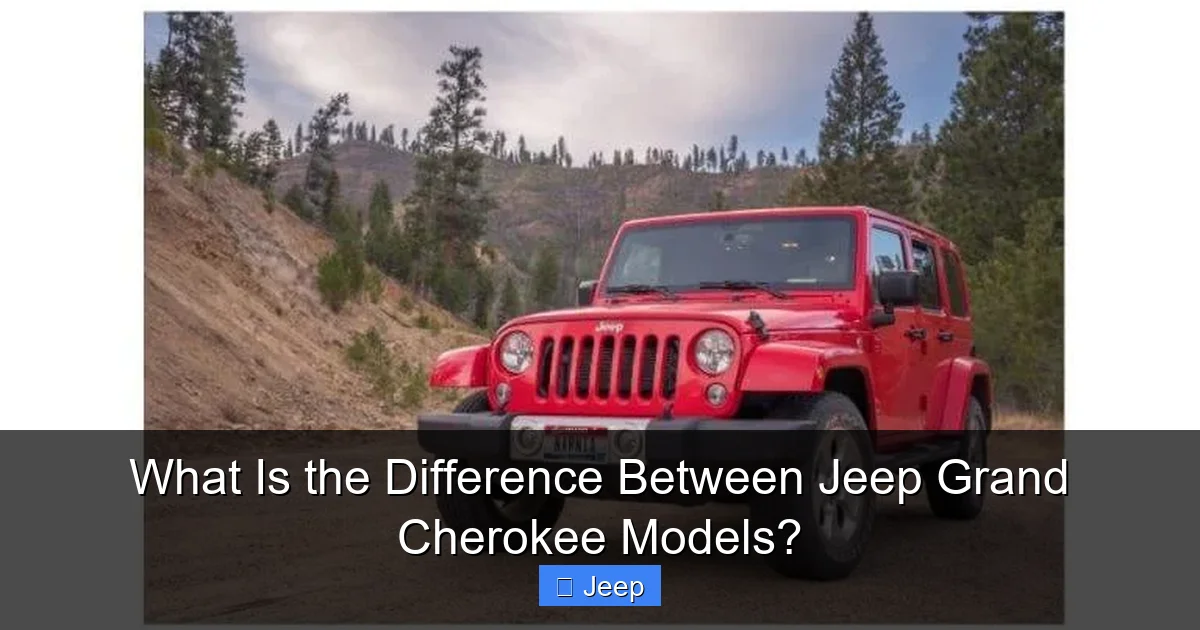
The powertrain is a primary separator between Grand Cherokee models. You don’t get to choose any engine for any trim; Jeep pairs them strategically.
Visual guide about What Is the Difference Between Jeep Grand Cherokee Models?
Image source: jeepmodified.com
The Workhorse: 3.6L Pentastar V6
This is the standard engine for Laredo, Limited, and available on Overland/Summit. It’s a proven, smooth, and reasonably powerful V6. With 293 hp, it provides adequate acceleration for merging and passing, and its 260 lb-ft of torque gives it decent pulling power for towing. Its biggest advantage is fuel economy compared to the V8s, making it the sensible choice for most daily drivers. It’s paired with a smooth 8-speed automatic transmission.
The Torque King: 5.7L HEMI V8
This legendary V8 is available on Limited (with specific packages), Overland, and Summit. It jumps to 360 hp and a substantial 390 lb-ft of torque. The difference in feel is immediate—more low-end grunt for confident passing and a higher towing capacity (up to 7,200 lbs, same as V6 but with more ease). The trade-off is significantly worse fuel economy. The HEMI’s deep rumble and effortless power are a core part of the Grand Cherokee’s character for many buyers. If you tow regularly or just enjoy the visceral feel of a V8, this is the engine to seek.
The Nuclear Option: 6.2L Supercharged HEMI V8 (Trackhawk Only)
As mentioned, this is the exclusive powerplant of the Trackhawk. The supercharger forces air into the engine, creating that insane 707 hp figure. The acceleration is violent and immediate, transforming the heavy SUV into a rocket. This engine demands premium fuel and sacrifices all pretense of fuel efficiency. It’s not for the faint of heart or light of wallet at the pump, but it’s the defining feature of the most extreme Grand Cherokee ever built.
4×4 Systems: From All-Wheel Drive to Trail Conquering
Not all “4×4” Grand Cherokees are created equal. The system you get is tied to your trim and engine choice.
Visual guide about What Is the Difference Between Jeep Grand Cherokee Models?
Image source: jeepmodified.com
Quadra-Trac I: The Full-Time All-Wheel Drive System
Found standard on many V6 Laredo models, this is essentially a sophisticated all-wheel-drive system. It’s always active, sending power to the wheels with the most traction. It’s excellent for rain, snow, and light unpaved roads. However, it has no low-range gearing, making it unsuitable for serious rock crawling or deep mud/sand where slow, controlled torque is needed.
Quadra-Trac II: The Off-Road Ready System
This is the system you’ll find on most Limited, Overland, and Summit models with the V6 or V8. It adds a two-speed transfer case with a true low-range gear (4LO). This allows for slow, controlled creeping over obstacles. It also includes the Selec-Terrain system with modes (Auto, Snow, Sport, Mud/Sand, Rock) that optimize throttle, transmission, and traction control. This is the system for the adventurous owner who might tackle forest service roads, rocky trails, or deep snow.
Quadra-Drive II: The Ultimate Trail System
This is Jeep’s pinnacle 4×4 system for the non-SRT Grand Cherokee, typically standard on Overland and Summit. It builds on Quadra-Trac II by adding an electronic limited-slip differential (eLSD) for the rear axle. This actively sends power between the left and right rear wheels, which is incredibly effective when one wheel is off the ground or on ice. For the most dedicated off-roader in a standard Grand Cherokee, this is the system to get. It’s often paired with the available air suspension that can raise the ride height for more clearance.
Interior & Technology: Where Luxury Meets Function
The cabin experience scales dramatically from base to summit.
Seats & Materials: Cloth to Semi-Aniline Leather
Laredo: Cloth seats.
Limited: Leather-trimmed seats.
Overland: Premium Nappa leather with unique perforations and stitching.
Summit: Top-tier semi-aniline leather, which is softer and more breathable, with elaborate designs.
Trackhawk: Performance-focused leather and suede sport seats with aggressive bolsters.
Infotainment: Screen Size and Audio Systems
The system evolves from a very good 8.4-inch screen to a massive 10.1-inch portrait-oriented screen in the Summit/Trackhawk. The audio system is a key differentiator: Alpine (9 speakers) in Limited/Overland, Harman Kardon (9 speakers) in Summit, and the legendary McIntosh (19 speakers) in the Summit Reserve package and Trackhawk. The McIntosh system is an audiophile’s dream and a huge reason many choose the Summit. For a deeper dive into how these tech features hold up over time, especially in models like the 2023 Jeep Grand Cherokee Limited, you can find detailed ownership reviews.
Driver-Assistance & Safety
All modern Grand Cherokees come with a good baseline of safety tech (blind-spot monitoring, rear cross-path alert). However, higher trims (Overland, Summit, Trackhawk) offer the Full-Speed Forward Collision Warning with Active Braking, Adaptive Cruise Control, and Lane Centering as part of an advanced package. These features transform highway driving from a chore to a more relaxed experience. If this is important to you, you must look at Overland or above.
Pricing, Value, and How to Choose Your Model
With all these differences, how do you pick? Start with your non-negotiables.
Define Your Primary Use Case
Family Hauler / Daily Driver: Laredo or Limited. You get space, safety, and comfort without paying for power you won’t use. The Limited is the value king for comfort.
Aspirational Luxury Buyer: Overland or Summit. You want the best materials, quietest ride, and best tech. The Summit is the ultimate expression of this.
Serious Off-Road Enthusiast: Look for an Overland or Summit with the Quadra-Drive II system, the available air suspension, and all-terrain tires. Avoid the Trackhawk for this purpose—its low-profile street tires and lowered suspension are liabilities on rocks.
Towing Enthusiast: The V8 (5.7L HEMI) is your friend. Found in Limited (with package), Overland, and Summit. The extra torque makes towing heavy trailers much easier.
Performance Junkie: There is only one choice: the Trackhawk. Nothing else in the lineup comes close.
Consider Total Cost of Ownership
The sticker price is just the start. A V8 or Trackhawk will cost thousands more to buy and will guzzle premium fuel. Insurance for a Trackhawk is notably higher. Maintenance on complex systems like air suspension or the supercharger can be costly down the road. A base Laredo or V6 Limited will be the cheapest to own long-term. Researching specific model year reliability is also smart. Some model years, like the 2016 Jeep Grand Cherokee, are renowned for their balance of features and proven reliability, making them excellent used car buys.
The Lease vs. Buy Question
Given the steep price jumps between trims, leasing can be a smart way to get into a higher trim (like a Summit or even a Trackhawk) for a lower monthly payment than financing. You always have the option to buy out the lease later. Understanding the terms is key. You can get a clear picture of current financials by checking resources on how much a Jeep Grand Cherokee lease costs, which breaks down monthly payments based on trim, term, and mileage.
Conclusion: The Grand Cherokee is a Chameleon – Choose Your Color
The difference between Jeep Grand Cherokee models is the story of a single platform engineered for wildly different missions. The lineup is a masterclass in market segmentation. The Laredo is the practical, value-packed workhorse. The Limited is the comfortable, capable family cruiser. The Overland is the luxurious, adventure-ready gentleman. The Summit is the opulent, tech-laden flagship. And the Trackhawk is the tire-shredding, headline-grabbing performance icon.
There is no single “best” Grand Cherokee. The best one is the one that aligns with your 80% of daily driving needs. Be honest with yourself. Do you need 707 horsepower, or will 290 hp suffice? Will you use the low-range transfer case, or is all-wheel drive enough? Is a McIntosh sound system a dream, or will the standard audio system do? Answer these questions, and the correct trim will reveal itself. Test drive back-to-back models if you can—the difference between a Laredo and a Summit in comfort and refinement is staggering, and the difference between a V6 and a Trackhawk in acceleration is life-changing. Your perfect Grand Cherokee is out there. It’s just a matter of finding the right model that matches your definition of “perfect.”
Frequently Asked Questions
Which Jeep Grand Cherokee model is the best value?
For most buyers, the Jeep Grand Cherokee Limited offers the best overall value. It provides a fantastic balance of comfortable leather seating, a powerful V8 option, the capable Quadra-Trac II 4×4 system, and premium features like a power liftgate and Alpine audio, without the significant price jump of the Overland or Summit.
What is the difference between Quadra-Trac I and Quadra-Trac II?
Quadra-Trac I is a full-time all-wheel-drive system best for on-road and light conditions. Quadra-Trac II adds a two-speed transfer case with a low-range gear (4LO) and the Selec-Terrain system, making it vastly more capable for serious off-road driving like rock crawling, deep mud, or sand.
Is the Jeep Grand Cherokee Trackhawk good for off-roading?
No, the Trackhawk is a terrible choice for off-roading. It’s designed for on-road and track performance, with low-profile performance tires, a lowered sport suspension, and no low-range gearing. Its 4×4 system is tuned for acceleration and cornering, not for crawling over rocks. For off-roading, choose an Overland or Summit with Quadra-Drive II.
Which Grand Cherokee model has the McIntosh stereo?
The McIntosh premium audio system with 19 speakers is a signature feature of the Grand Cherokee Summit (usually in the Summit Reserve package) and is also standard in the Grand Cherokee Trackhawk. It is not available in lower trims like Laredo, Limited, or Overland.
What Grand Cherokee model gets the supercharged V8 engine?
The supercharged 6.2L HEMI V8 engine, producing 707 horsepower, is exclusive to the Jeep Grand Cherokee SRT Trackhawk. No other trim in the standard Grand Cherokee lineup offers this engine.
How much more does a Summit cost over a Limited?
The price difference varies by model year and options, but the Grand Cherokee Summit typically starts around $10,000 to $15,000 more than the base price of a Grand Cherokee Limited. This premium buys the highest-grade interior materials, the largest touchscreen, the McIntosh audio system, and nearly every available feature as standard.
