
How to Turn Off Paddle Shifters in a 2023 Jeep Grand Cherokee

You cannot completely disable the steering wheel-mounted paddle shifters in a 2023 Jeep Grand Cherokee through any factory setting or fuse. They are an integrated, always-active part of the transmission control system. However, you can effectively “ignore” them by consistently using the standard automatic “D” (Drive) mode and avoiding manual gear selection. The system will automatically revert to fully automatic shifting after a few seconds of no paddle input, providing a seamless experience that mimics a traditional automatic transmission.
So, you’ve got a brand-new 2023 Jeep Grand Cherokee. It’s a fantastic SUV—capable, comfortable, and packed with tech. But maybe you’ve found yourself accidentally brushing against those steering wheel paddle shifters during a tight turn, causing an unwanted downshift. Or perhaps you simply prefer the pure, untethered experience of a traditional automatic transmission and see the paddles as an unnecessary distraction. You’re not alone. A common question we see from Grand Cherokee owners is, “How do I turn off the paddle shifters?” It’s a straightforward desire for a simpler interface. Unfortunately, the answer is more complex than a simple button press. Let’s dive deep into the why, the what-if, and the practical reality of living with paddle shifters in your Jeep.
Key Takeaways
- Factory Disable is Impossible: There is no menu, button sequence, or software setting in the 2023 Grand Cherokee’s Uconnect system or vehicle settings to permanently deactivate the paddle shifters.
- They Are Always Powered: The paddle shifter circuits are live whenever the ignition is on, meaning they will always send a signal to the transmission control module if pressed.
- Automatic Reversion is Key: The transmission is designed to automatically return to fully automatic shifting after 2-3 seconds of no paddle or manual lever use, making active “turning off” unnecessary for normal driving.
- Driving in “D” is Your Best Strategy: Simply place the gear selector in “D” and drive. Do not touch the paddles. The vehicle will manage all shifts on its own, and the paddles become inert for all practical purposes.
- No Fuse Pull Will Work: Pulling fuses related to the transmission or Uconnect system will likely cause error codes, disable other critical features, and is not a recommended solution.
- Purpose is Driver Engagement: Jeep includes paddle shifters to offer a sportier, more engaging driving experience and to meet consumer expectations for modern SUVs, even on non-performance models.
- Aftermarket Solutions Are Risky: Some aftermarket modules claim to disable paddle shifters, but they can void warranties, cause unpredictable transmission behavior, and create safety system conflicts.
📑 Table of Contents
- Understanding Your Grand Cherokee’s Paddle Shifters
- The Direct Answer: Why You Can’t “Turn Them Off”
- Why Would Someone Want to Disable Them? Common Scenarios
- The Practical Workaround: How to “Live With” and Effectively Ignore Them
- What Doesn’t Work: Debunking Myths and Risky “Solutions”
- When to Consider Professional Help (And What They Can’t Do)
- The Bottom Line: Embracing the Design
Understanding Your Grand Cherokee’s Paddle Shifters
Before we talk about turning them off, we need to understand exactly what they are and how they work. The 2023 Jeep Grand Cherokee, across most trims (from the base Laredo to the top-tier Summit), comes equipped with steering wheel-mounted paddle shifters. These are not mere decorative trim pieces; they are electronic switches hardwired into the vehicle’s controller area network (CAN bus).
How the System Operates
When you press the right paddle (usually marked with a “+” or an up arrow), you’re sending a digital command to the Transmission Control Module (TCM). This command tells the TCM, “Shift up one gear.” Press the left paddle (“-” or down arrow), and it says, “Shift down one gear.” This bypasses the TCM’s normal programming for a brief moment, allowing you to manually select the next gear ratio. It’s a feature borrowed from performance cars and sports sedans, designed to give the driver more control and a sportier feel.
Here’s the critical part: this system is always listening. As long as the ignition is in the “ON” or “START” position and the vehicle is in gear, the paddles are active. There is no “standby” or “off” state for this specific circuit within the factory software. Jeep’s engineers designed it this way for immediate responsiveness—the moment you decide to take control, the car is ready to obey.
The Direct Answer: Why You Can’t “Turn Them Off”
Let’s rip the bandage off right now. There is no official, factory-approved method to permanently disable or turn off the paddle shifters in a 2023 Jeep Grand Cherokee. You will not find an option buried in the Uconnect infotainment system under Settings > Vehicle. You will not find a physical switch on the steering column or dash. You will not find a secret button sequence to hold while starting the car. They are a permanent, always-on feature of the vehicle’s design.
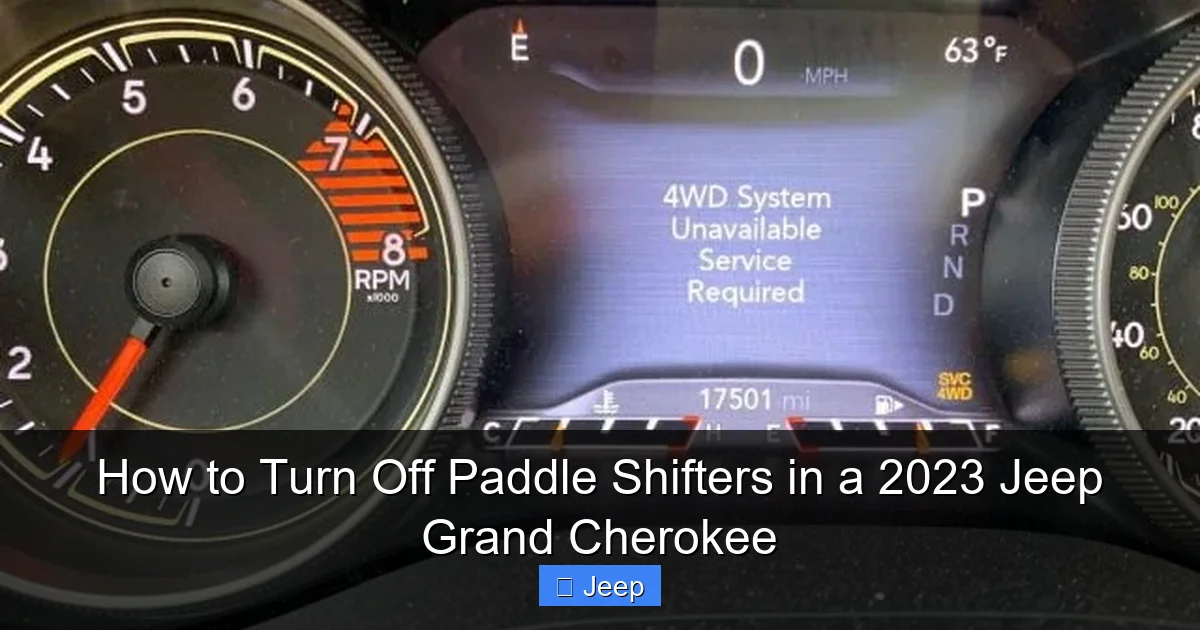
Visual guide about How to Turn Off Paddle Shifters in a 2023 Jeep Grand Cherokee
Image source: vehiclers.com
Software and Safety Integration
Modern vehicles like the Grand Cherokee are complex computers on wheels. Features are not standalone; they are integrated layers of software. The paddle shifter function is deeply embedded within the transmission control software, which also communicates with the engine control module, stability control systems (like ESC), and even the instrument cluster. Creating a software “kill switch” for just the paddles would require a fundamental rewrite of the TCM’s code—something only Fiat Chrysler Automobiles (FCA), now Stellantis, could do in a factory update. They have no incentive to do so, as the feature is marketed as a benefit.
Furthermore, the system has built-in safeguards. For instance, if you try to downshift into a gear that would over-rev the engine or exceed the vehicle’s speed for that gear, the TCM will simply ignore your paddle input. This integration is another reason a simple fuse pull won’t work—you’d be cutting power to other essential systems that share the same circuit, potentially triggering multiple dashboard warning lights and limp-mode operation.
Why Would Someone Want to Disable Them? Common Scenarios
It’s helpful to understand the user’s pain point. The desire to disable paddle shifters usually stems from a few specific, very relatable situations.

Visual guide about How to Turn Off Paddle Shifters in a 2023 Jeep Grand Cherokee
Image source: vehiclers.com
Accidental Activation During Cruising
This is the most common complaint. On a long highway drive or in city traffic, a driver might rest their hands at the “10 and 2” or “9 and 3” positions on the wheel. During a gentle steering correction, a thumb or finger can easily brush against a paddle, especially the right (upshift) paddle. The car then abruptly shifts up, lugging the engine, or down, causing a jarring surge. This is annoying, disrupts smoothness, and can be startling. Drivers want to eliminate this possibility entirely.
Preference for Pure Automatic Operation
Some buyers, particularly those coming from older, true automatic transmissions or who primarily use their Grand Cherokee as a family hauler, simply don’t want the option to manually shift. They see the paddles as clutter—buttons that serve no purpose in their driving style and could be accidentally pressed by a passenger or child. They want the car to *only* be an automatic, with zero manual override capability.
Concerns About Unintended Gear Selection
In situations like towing a trailer or driving on steep mountain roads, some drivers worry about accidentally selecting a gear that’s too low, causing excessive engine braking or strain. While the TCM’s rev-matching and safeguards prevent damage, the sudden engine braking effect can be unsettling. They’d prefer the system to have no manual input path at all.
The Practical Workaround: How to “Live With” and Effectively Ignore Them
Since you can’t turn them off, the goal shifts to making them irrelevant to your driving experience. The good news is that the Grand Cherokee’s transmission logic is designed to make this incredibly easy. You don’t have to fight the system; you just have to understand its default behavior.

Visual guide about How to Turn Off Paddle Shifters in a 2023 Jeep Grand Cherokee
Image source: jeepfixes.com
The Golden Rule: Use “D” and Don’t Touch the Paddles
This is the single most important piece of advice. When you want a completely automatic driving experience:
- Place the electronic gear selector into “D” (Drive).
- Drive the vehicle normally using the accelerator and brake pedals.
- Do not touch the paddle shifters.
That’s it. By following these steps, the Transmission Control Module will operate entirely on its own pre-programmed shift maps, considering vehicle speed, throttle position, engine load, and other parameters to select the optimal gear for efficiency and smoothness. The paddles are physically present but functionally inert because you are not engaging them.
The Automatic Reversion Feature: Your Silent Friend
Here’s the magic that makes the “don’t touch them” strategy foolproof. The 2023 Grand Cherokee’s transmission has an automatic reversion timer. If you do press a paddle to manually select a gear, the system will hold that gear for a few seconds. However, if you then make no further paddle inputs for approximately 2 to 4 seconds, the TCM will automatically revert back to full automatic control. It will seamlessly shift back into the gear it determines is appropriate for your current speed and driving conditions. You don’t have to press anything to “cancel” manual mode; you simply stop interacting with it, and the car takes back over. This feature exists precisely so drivers can enjoy a brief manual downshift for passing or engine braking without being “stuck” in a high-revving gear. For our purposes, it means any accidental, fleeting brush against a paddle is likely to be forgotten by the system almost immediately.
Driving Mode Selection Matters
Your Grand Cherokee likely has multiple drive modes (e.g., Auto, Sport, Snow, Tow/Haul). The behavior of the automatic shifting—and the responsiveness of the paddles if you do use them—changes with these modes.
- Auto Mode: This is the most relaxed, fuel-efficient setting. Shift points are higher, and the transmission prioritizes smoothness. If you accidentally tap a paddle here, the reversion will feel most natural.
- Sport Mode: This holds gears longer, provides quicker throttle response, and makes the paddle shifters feel more aggressive and immediate. If you dislike the potential for accidental activation, you might consider leaving the vehicle in Auto mode permanently, as Sport mode’s shift logic can make any unintended downshift more pronounced.
- Other Modes (Snow, Tow): These are specialized for conditions and will alter shift points for traction or engine braking. The paddle response will adapt accordingly.
For the driver seeking to ignore the paddles, sticking to Auto mode will provide the most forgiving and conventional automatic transmission feel, minimizing the impact of any accidental input.
What Doesn’t Work: Debunking Myths and Risky “Solutions”
In your search for a disable method, you might encounter forums or videos suggesting certain tricks. It’s crucial to understand why these are ineffective or dangerous.
Fuse Removal: A Bad Idea
Some might suggest locating and removing a fuse related to the “Shift by Wire” system, the TCM, or the Uconnect system. This is a terrible idea for several reasons. First, identifying the correct fuse is a nightmare, as fuse box diagrams are not always precise about which module controls which circuit. Second, pulling a transmission-related fuse will almost certainly trigger a Diagnostic Trouble Code (DTC), illuminate your check engine light, and likely put the transmission into a fail-safe “limp mode” with severely limited gear functionality. Third, you may also disable critical safety systems like Electronic Stability Control (ESC) that share the same power source, creating a dangerous driving situation. This is not a solution; it’s creating a major problem.
Aftermarket “Kill Switches” or Modules
The aftermarket world sometimes produces modules that plug into your vehicle’s OBD-II port or wiring harness, claiming to disable paddle shifters, start-stop systems, or other features. Proceed with extreme caution. These devices are not sanctioned by Jeep. They can cause:
- Unpredictable Transmission Behavior: They may interfere with the TCM’s normal communication, leading to harsh shifts, delayed shifts, or unexpected gear changes.
- Voided Warranty: If a dealer can trace a transmission issue back to an aftermarket module, your warranty on powertrain components could be denied.
- Safety System Conflicts: They might disrupt the integration between the transmission and stability control, potentially affecting handling in emergency maneuvers.
- Constant Warning Lights: They often trigger persistent fault codes and dashboard warnings that are difficult to clear.
For a feature that is merely an annoyance rather than a malfunction, introducing these significant risks is not worthwhile.
When to Consider Professional Help (And What They Can’t Do)
You might think a trip to the dealer or a trusted independent mechanic could yield a software update or hidden setting to disable the paddles. We need to manage expectations here.
The Dealer’s Perspective
If you take your 2023 Grand Cherokee to a Jeep dealership service department and ask a technician to turn off the paddle shifters, they will almost certainly tell you it’s not possible. Their factory diagnostic computers (wiTECH) have no option to disable this feature. Their technicians are trained on the vehicle’s capabilities, and this is not one of them. They might humor you by checking for any technical service bulletins (TSBs) related to the feature, but none exist for simple deactivation. Their primary role is to fix faults, not remove functional design elements.
What a Specialist *Might* Be Able To Do (And Why You Probably Shouldn’t)
There is a very small subset of performance tuners and transmission specialists who can, through deep software modification (often called “TCU tuning”), alter shift points, shift speeds, and sometimes even remap paddle response logic. However:
- This is expensive, often costing $500-$1000+.
- It involves uploading a modified firmware to your Transmission Control Module. This process carries a non-zero risk of “bricking” the module, rendering your vehicle inoperable until a new TCM is programmed.
- It will almost certainly void any remaining transmission warranty.
- The goal of these tunes is usually to make shifts *faster and more aggressive* for performance driving, not to simply disable the paddles. The paddles themselves would likely remain active, just with different shift logic.
- You are fundamentally altering a core safety and drivability system for a cosmetic preference.
For the average owner wanting to avoid accidental shifts, this nuclear option is massive overkill with unacceptable risks and costs.
The Bottom Line: Embracing the Design
So, after all that, what’s the real answer? The 2023 Jeep Grand Cherokee’s paddle shifters are a permanent, always-available feature. You cannot turn them off. But for the vast majority of drivers who find them an occasional nuisance, the solution is beautifully simple: do not use them.
Place your vehicle in “D” (Drive), select your preferred drive mode (Auto is best for this), and drive. The transmission will operate perfectly as a conventional automatic. Any accidental brush will be ignored within seconds as the system reverts. The paddles are there for the enthusiast who wants to manually control gear selection on a winding road or for a quick downshift to pass. For everyone else, they are harmless buttons that can be completely forgotten about once you adopt the “set it and forget it” mindset of using Drive mode.
Attempting to physically or electronically disable them introduces far more problems—risk, cost, and complexity—than the minor annoyance they sometimes present. Accepting that they are a non-issue when ignored is the safest, cheapest, and most practical approach to enjoying your Grand Cherokee.
If you’re fascinated by the various driver-assist and vehicle customization features across different brands, you might enjoy reading about how to turn off lane assist in a Subaru, or how to disable auto high beam assist in a Toyota. It’s interesting to see how different manufacturers implement and allow customization of their technology suites.
Frequently Asked Questions
Will putting the gear selector in “D” and not touching the paddles really make them do nothing?
Yes. As long as you do not press the paddles, they send no signal. The transmission will operate entirely automatically. The system’s automatic reversion feature means even if you accidentally tap one, it will forget the command after a few seconds.
Can I disable the paddle shifters by taking a fuse out?
No. This is strongly discouraged. Pulling a fuse for the transmission or related systems will likely cause the transmission to go into a fail-safe “limp mode,” illuminate multiple warning lights, and could disable critical safety features like electronic stability control.
Is there a secret menu in the Uconnect system to turn them off?
There is not. After extensive research and consultation of owner’s manuals and factory resources, no such hidden setting exists in the 2023 Jeep Grand Cherokee’s Uconnect software.
Will disabling the paddle shifters (if it were possible) affect my warranty?
Any unauthorized modification to the vehicle’s factory software or wiring, such as installing an aftermarket module to disable features, would likely be considered a tampering event and could void related components of your warranty, especially the powertrain warranty.
Do all 2023 Grand Cherokee models have paddle shifters?
Nearly all trims of the 2023 Grand Cherokee (including Laredo, Limited, Overland, Summit, and Summit Reserve) come standard with paddle shifters. It is a very rare configuration for this model year to not include them. The high-performance Grand Cherokee SRT and Trackhawk models also have them, often with a more aggressive calibration.
What if I accidentally downshift on the highway? Is that bad for the engine or transmission?
Modern engines and transmissions have robust rev-limiting and safeguards. Accidentally downshifting at high speed will usually result in the Transmission Control Module (TCM) rejecting the command if it would over-rev the engine, or it will perform a rev-matched downshift that is firm but not damaging. It’s jarring and not ideal, but it won’t cause immediate harm. The real risk is the sudden deceleration effect, which could surprise you or drivers behind you.
