
What Is the Tesla Wall Connector and Mobile Connector?

The Tesla Wall Connector is a high-power, permanent home charging station offering the fastest speeds for daily use, while the Mobile Connector is a portable, flexible cable for travel and occasional charging. The Wall Connector requires professional installation and hardwiring, providing up to 48 amps for rapid overnight charging. The Mobile Connector plugs into standard outlets or dedicated circuits and comes with adapters for various power sources, making it ideal for trips or as a backup. Your choice depends on your primary charging location, electrical setup, and how often you travel with your Tesla.
So, you’ve got a Tesla. Congratulations on joining the electric revolution! You’re likely buzzing about the instant torque, the tech-filled cabin, and the fact you’ll never visit a gas station again. But then reality hits: how do you actually charge this thing? Tesla makes it relatively simple with two primary solutions: the Tesla Wall Connector and the Tesla Mobile Connector. They sound similar, but they serve very different purposes. Understanding the difference is crucial for setting up a convenient, efficient, and cost-effective charging routine. This guide will break down everything you need to know about both connectors, helping you decide which is right for your lifestyle, or if you need both.
Think of it this way: the Wall Connector is like installing a personal gas pump in your garage. It’s there, ready to go, every single day, filling your “tank” quickly while you sleep. The Mobile Connector, on the other hand, is like carrying a universal fuel nozzle in your trunk. It can hook up to many different types of “fuel stations” (outlets) you find at a friend’s house, a campground, or a hotel, but it’s slower. Most new Tesla owners get the Mobile Connector in the trunk. The Wall Connector is an additional purchase you make if you want a dedicated, fast home charging solution. Let’s dive deep into each one.
Key Takeaways
- Core Purpose: Wall Connector is for fixed, high-speed home charging; Mobile Connector is for portable, versatile charging on the go.
- Charging Speed: Wall Connector delivers significantly faster charging (up to 48A) than the Mobile Connector (max 32A with 240V adapter).
- Installation: Wall Connector requires professional hardwiring; Mobile Connector simply plugs into existing outlets or a dedicated 14-50 or 10-30 receptacle.
- Cost & Value: Wall Connector has higher upfront cost (device + installation) but is more efficient; Mobile Connector is cheaper and included with new Teslas.
- Portability: Mobile Connector is designed to travel in your trunk; Wall Connector is a stationary home fixture.
- Best For: Wall Connector for primary home charging; Mobile Connector for travel, destinations, or as a secondary/backup charger.
- Smart Features: Wall Connector offers Wi-Fi connectivity, energy monitoring, and scheduling; Mobile Connector has no connectivity.
📑 Table of Contents
- Introduction to EV Charging: The Home is Where the Charge Is
- Deep Dive: The Tesla Wall Connector – Your Home Powerhouse
- Deep Dive: The Tesla Mobile Connector – Your Portable Power Solution
- Head-to-Head: Wall Connector vs. Mobile Connector
- Installation, Costs, and Practical Considerations
- Real-World Use Cases and Recommendations
- Future-Proofing Your Charging Setup
- Conclusion: Which One Should You Buy?
Introduction to EV Charging: The Home is Where the Charge Is
Before we compare the two connectors, it’s helpful to understand the landscape of electric vehicle charging. Charging an EV is measured in kilowatts (kW), which is a unit of power. The higher the kW, the faster the energy flows into your car’s battery. Your charging speed is limited by three things: the capacity of your car’s onboard charger, the capacity of the charging equipment (the connector), and the capacity of your home’s electrical circuit.
For context, a standard 120V household outlet (what you use for a lamp) provides about 1.4 kW. That’s painfully slow, adding maybe 3-5 miles of range per hour—fine for a top-up overnight but useless for daily driving. A 240V outlet, like the one your dryer uses, can provide anywhere from 3.3 kW to over 10 kW, depending on the circuit’s amperage. This is the sweet spot for home charging. Both the Wall Connector and Mobile Connector are designed to use 240V power, but they access it in different ways and with different maximum power outputs.
This is where the two Tesla connectors diverge. The Mobile Connector is essentially a smart, heavy-duty extension cord with a Tesla plug on one end and a standard 120V or 240V plug on the other. The Wall Connector is a piece of permanent hardware that gets mounted to your wall and hardwired directly into your home’s electrical panel, allowing for a much higher, dedicated current draw. Choosing between them isn’t about good vs. bad; it’s about matching the tool to the job. For the vast majority of Tesla owners, the ideal setup involves using the Wall Connector as their primary, daily charger at home, while keeping the Mobile Connector in the trunk for road trips and unexpected needs.
The Charging Ecosystem: More Than Just a Plug
It’s also worth noting that Tesla’s charging ecosystem extends beyond these two devices. On the road, you’ll use Tesla’s vast Supercharger network, which provides the fastest possible charging (up to 250 kW) and is integrated seamlessly into your car’s navigation. The Wall Connector and Mobile Connector are for the 80-90% of charging that happens at home or at destinations. They are your workhorses for daily fueling. Understanding their roles helps you avoid range anxiety and makes EV ownership feel utterly seamless.
Deep Dive: The Tesla Wall Connector – Your Home Powerhouse
The Tesla Wall Connector is the premium, permanent solution for home charging. It’s a sleek, minimalist unit that mounts to your wall (or a pole in your driveway) and is hardwired by a licensed electrician directly to a dedicated circuit in your home’s main electrical panel. This direct connection is the key to its power and reliability.
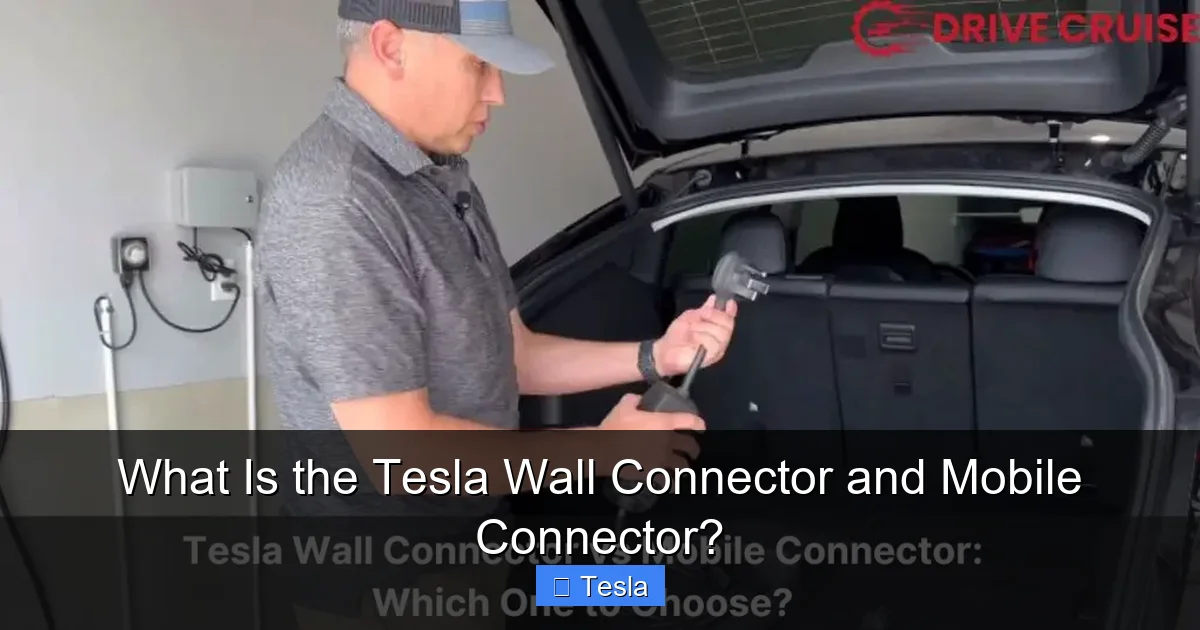
Visual guide about What Is the Tesla Wall Connector and Mobile Connector?
Image source: drivecruise.com
Design, Build, and Aesthetics
Let’s start with the look. Tesla is known for clean design, and the Wall Connector doesn’t disappoint. It’s a compact, rectangular pod with a smooth, matte finish (usually white or black). The charging cable coils neatly around the unit or can be managed with a separate hook. The connector itself is the same robust, glowing Tesla plug that fits your car. The build quality feels substantial—it’s designed to live outdoors in all weather, from scorching sun to driving rain and snow. It has a small LED status light that communicates charging status at a glance (green for ready, pulsing for charging, etc.). Its design is intentionally unobtrusive, blending into your home’s exterior like a modern light fixture.
Charging Speeds and Power Delivery: The 48A Advantage
This is the Wall Connector’s superpower. It can be configured to deliver up to 48 amps (A) of current on a 240V circuit. Let’s translate that into real-world range. A typical Tesla Model 3 Long Range has a battery capacity of about 82 kWh. Charging it from 10% to 80% on a 48A Wall Connector takes roughly 6-7 hours. That’s a full night’s sleep. On a 60A circuit (which the Wall Connector can also support with the right electrical setup), speeds can approach 11.5 kW.
Why does this matter? Speed equals convenience. The faster your home charger, the more you can top up overnight after a day of errands or a commute. If you have a long daily drive or multiple EVs, the Wall Connector’s high amperage ensures you start each day with a full battery, no matter what. It’s also more efficient at higher power levels, meaning less energy loss as heat compared to slower charging methods. For households with high electricity demand, scheduling charging via the Tesla app to happen during off-peak hours is easy with the Wall Connector’s Wi-Fi connectivity, saving money on utility bills.
Smart Features and Connectivity
The Wall Connector is a “smart” device. It connects to your home Wi-Fi network (2.4 GHz) and integrates with the Tesla mobile app. Through the app, you can:
- Monitor Energy Usage: See exactly how much power your car is drawing, useful for tracking electricity costs.
- Schedule Charging: Set specific start and stop times to charge only when electricity is cheapest or when your home’s solar system is producing excess power.
- Receive Notifications: Get alerts if charging is interrupted, if the connector goes offline, or when a session is complete.
- Control Access: You can enable or disable charging for specific vehicles (great if you have a guest or a family member with an EV that uses a different adapter).
- Firmware Updates: Tesla can push updates over Wi-Fi to improve functionality or add features, keeping your hardware current.
This connectivity transforms a simple charger into a managed energy asset. It’s a step towards a smarter home energy system, especially if you pair it with a Powerwall or solar.
Installation: A Job for the Pros
Here’s the critical part: the Tesla Wall Connector must be installed by a qualified electrician. It’s not a DIY project. The electrician will:
- Assess Your Electrical Panel: Determine if you have capacity for a new, high-amperage dedicated circuit (often 60A, 50A, or 40A). Older panels may need an upgrade.
- Run Conduit and Wire: Install the appropriate gauge wire (e.g., 6 AWG for 60A) from your panel to the mounting location.
- Mount and Connect: Securely mount the Wall Connector and hardwire it to the new circuit breaker.
- Permits and Inspection: In most areas, this work requires an electrical permit and a final inspection to ensure it meets local code.
Installation costs vary wildly based on your home’s setup, panel location, and local electrician rates. A simple, short run might cost $500-$1,000. A complex installation requiring a panel upgrade or long cable runs could easily reach $2,000-$3,000 or more. Always get multiple quotes from licensed electricians. Tesla provides excellent installation guides and specs for professionals on their website. Never skip the permit process—it’s for your safety and insurance.
Deep Dive: The Tesla Mobile Connector – Your Portable Power Solution
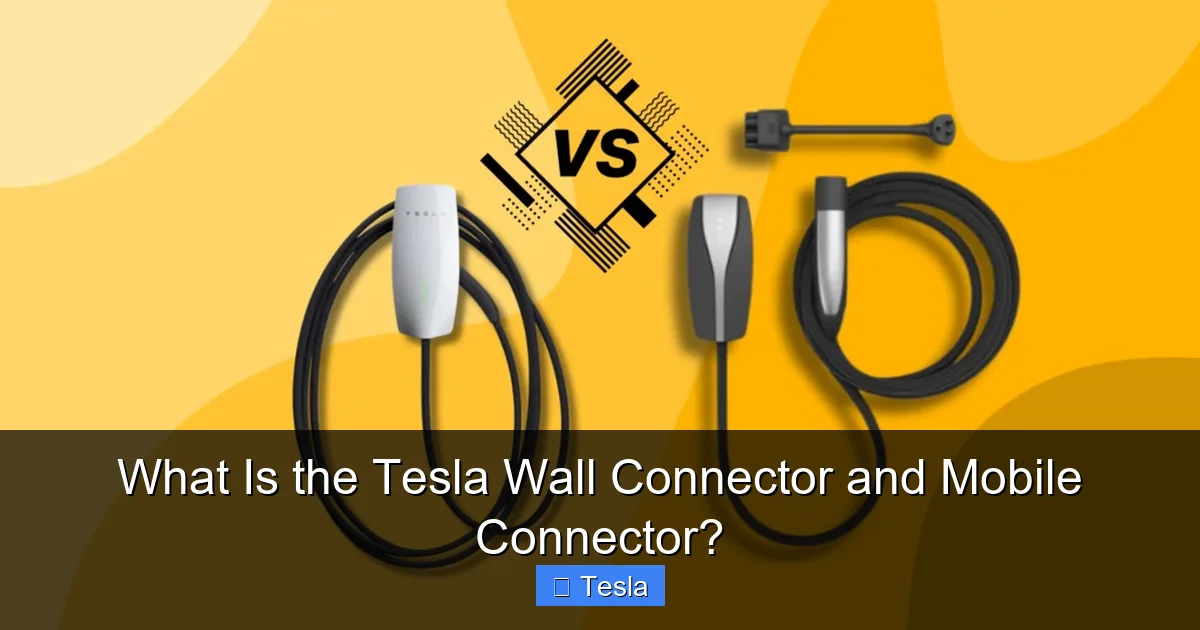
The Tesla Mobile Connector is the Swiss Army knife of charging. It’s a flexible, portable cable set that comes standard with every new Tesla. Its genius is in its adaptability. Instead of being hardwired, it has a Tesla vehicle connector on one end and a interchangeable plug on the other that can accept different adapter “pucks” for various outlet types.
Visual guide about What Is the Tesla Wall Connector and Mobile Connector?
Image source: bybriefly.com
Portability and Flexibility: Charge Anywhere
The Mobile Connector is designed to live in your trunk. It’s a coiled cable with a control box in the middle (which houses the safety electronics) and a male plug that accepts the adapters. In the base kit, you get two adapters:
- NEMA 5-15: The standard 120V household plug. This provides the slowest charge (about 3-5 miles of range per hour), but it works anywhere there’s a standard outlet. It’s your ultimate emergency backup.
- NEMA 14-50: A common 240V, 50A plug found at many RV parks, campgrounds, and some older home dryer outlets. This is the travel superstar. With a 14-50 adapter and a compatible 50A circuit, you can get up to ~32A of charge, adding 20-30 miles of range per hour. Many public destination chargers (at hotels, wineries) use this type of outlet.
You can purchase additional adapters from Tesla (like NEMA 10-30 for older dryers, NEMA 6-50 for welders, or even a 5-20 for 20A 120V circuits). This modularity means you can charge at a friend’s house (if they have a 240V outlet), at a vacation rental, or at a growing number of public 240V outlets. It turns any compatible socket into a Tesla charger. For road trips, this is invaluable. You’re not solely reliant on Superchargers; you have options at hotels, parks, and rural locations.
Charging Speeds: Good, But Not Lightning
The Mobile Connector’s maximum output is limited to 32 amps (with the 14-50 adapter on a 50A circuit). On a 240V/50A circuit, that’s about 7.7 kW. Compare that to the Wall Connector’s potential 11.5 kW on a 60A circuit. That’s a 50% difference in power. In practice, this means charging from 10% to 80% on a 14-50 might take 8-9 hours, versus 6-7 hours on a 48A Wall Connector. The 120V adapter is, as mentioned, very slow—best for overnight top-ups if you’ve driven very little.
So, the Mobile Connector is perfectly adequate for overnight charging if you have a 14-50 or similar outlet at home. But for households with two EVs or drivers with very long daily commutes, the Wall Connector’s extra speed becomes a significant quality-of-life improvement. The Mobile Connector’s strength is its flexibility, not its peak speed.
Who Is the Mobile Connector For? Everyone, Initially.
Every new Tesla owner gets a Mobile Connector. It’s your first charger. It’s perfect for:
- New Tesla owners who haven’t installed a home charger yet and are using public or 120V charging temporarily.
- Apartment or condo dwellers who may not have a dedicated parking spot with electrical access, but can occasionally plug into a shared 240V outlet.
- Road trippers who rely on a mix of Superchargers and destination charging (hotels, campgrounds). The Mobile Connector is essential gear.
- As a backup. Even if you have a Wall Connector, keeping the Mobile Connector in your trunk is wise. If your Wall Connector ever fails or you’re visiting someone, you have a fallback.
- Those with simpler electrical setups. If you have an existing 14-50 outlet in your garage or driveway (common in homes built for electric dryers or RVs), you can just buy the adapter and start charging immediately without any electrical work.
Its plug-and-play nature (once the outlet exists) makes it the most accessible charging solution.
Head-to-Head: Wall Connector vs. Mobile Connector
Now, let’s line them up and compare the key factors side-by-side to make the decision crystal clear.
Visual guide about What Is the Tesla Wall Connector and Mobile Connector?
Image source: bybriefly.com
Speed and Power
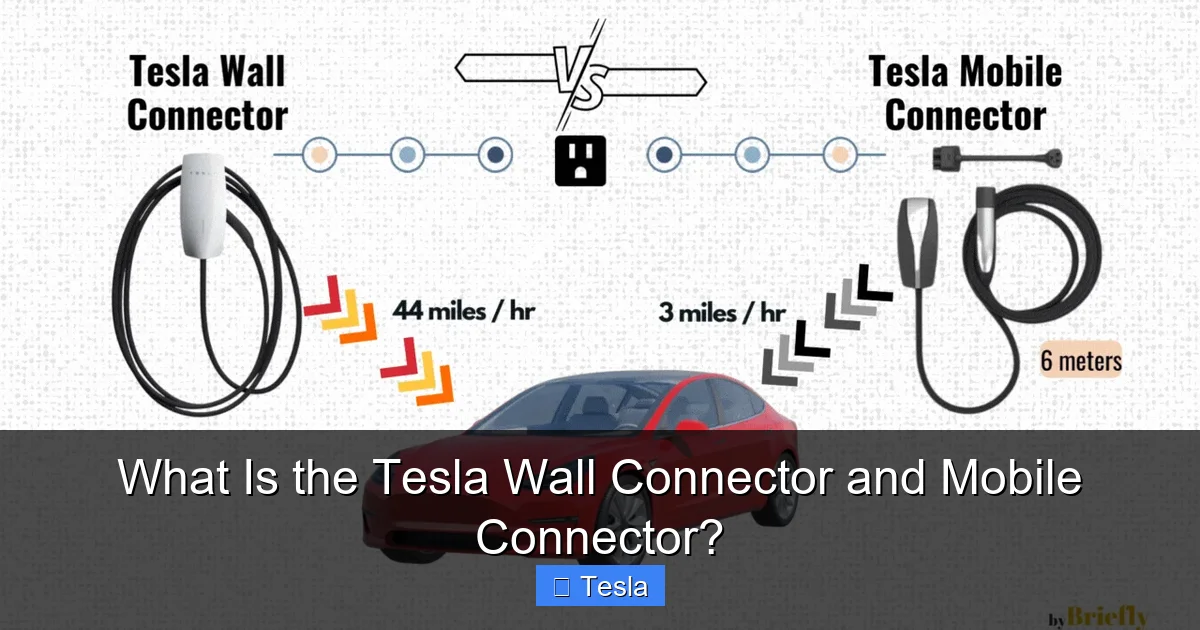
The Wall Connector wins decisively. With a proper circuit (60A), it can charge up to 48A. The Mobile Connector maxes out at 32A with a 14-50 adapter. For a full battery, the Wall Connector can save 1-2 hours of charging time. If you drive 100+ miles daily and need a full refill every night, that time savings adds up. The Mobile Connector on 120V is not suitable as a primary daily charger for most people.
Installation and Cost
This is the biggest differentiator. The Wall Connector costs $550 for the device itself, plus installation (typically $500-$3,000). It’s a project. The Mobile Connector is included with your car ($650 value if bought separately) and requires no installation—just an existing compatible outlet. If you already have a 14-50 outlet, the Mobile Connector is essentially free to start using. If you need to install a 14-50 outlet for the Mobile Connector, that’s a smaller electrical job (usually a 50A circuit) than the dedicated circuit for a Wall Connector, and often cheaper.
Convenience and Daily Use
The Wall Connector offers “plug and forget” convenience. You pull into your driveway or garage, press the connector handle to open the charge port, plug in, and walk away. Every day. No cable to unplug from an outlet, no adapter to swap. It’s always ready. The Mobile Connector requires you to have the cable with you (if charging away from home) and to plug it into an outlet each time. At home, if you’re using a 14-50 adapter, you still need to manage the cable and adapter. It’s slightly less seamless.
Portability and Travel
The Mobile Connector is the undisputed champion here. It’s made to travel. You coil it up, toss it in the trunk with its adapters, and you’re prepared for any 240V outlet you encounter. The Wall Connector is a permanent installation. You don’t move it. If you move houses, you (or the new owners) will likely leave it behind and buy a new one. For frequent travelers, the Mobile Connector is non-negotiable.
Smart Features
The Wall Connector has Wi-Fi and app integration. The Mobile Connector has no connectivity at all. You cannot schedule it or monitor its energy use remotely. You simply plug it in, and it charges. For basic home charging, this doesn’t matter. For energy management and cost savings, the Wall Connector’s smarts are a major plus.
Installation, Costs, and Practical Considerations
Let’s get practical. How do you actually get one of these set up, and what’s the real total cost?
Professional Installation for Wall Connector: A Step-by-Step
1. Purchase the Wall Connector: Buy it from Tesla’s website or a Tesla store.
2. Find a Qualified Electrician: Seek electricians with EV charging experience. Tesla has a network of recommended installers.
3. Site Survey: The electrician will visit your home to assess your electrical panel’s capacity, decide on mounting location (garage wall, exterior wall, pole), and determine wire run length.
4. Quote and Permits: Get a detailed quote including permit fees. The electrician will pull the necessary permits from your city/county.
5. Installation Day: Power is shut off. The electrician installs the dedicated breaker, runs conduit and wire, mounts the connector, makes final connections, and tests everything.
6. Inspection: A city inspector will verify the work meets code.
7. Setup: You connect the Wall Connector to your Wi-Fi via the Tesla app and configure settings.
Total Cost of Ownership
Wall Connector Path: $550 (device) + $800-$2,500 (typical install) = $1,350 – $3,050+. This is a home improvement investment.
Mobile Connector Path (at home with existing 14-50): $0 (included) + $0 (no work) = $0.
Mobile Connector Path (with new 14-50 outlet): $0 (included) + $300-$800 (install 50A circuit) = $300 – $800.
If you don’t have a suitable 240V outlet, the cost difference narrows significantly. But the Wall Connector still offers faster charging and smart features.
Safety and Compliance: Non-Negotiable
Both connectors are UL-listed and packed with safety features: ground fault protection, overcurrent protection, and temperature monitoring. However, the hardwired Wall Connector installation, when done to code, is generally considered a more robust and permanent solution with fewer connection points (like a plug) that could wear out or be exposed to the elements. The Mobile Connector’s plug-and-socket connection (to the wall outlet) is a potential point of failure if the outlet or adapter is loose or corroded—regular inspection is wise. Always use adapters rated for the amperage and environment. Never use a “cheater” plug or adapter that isn’t designed for high-current continuous use.
Real-World Use Cases and Recommendations
Theory is nice, but how do people actually use these? Here are common scenarios.
The Single-Car, Single-Home Owner
This is the classic Wall Connector customer. You have a dedicated parking spot, you own your home, and you drive your Tesla daily. Installing a Wall Connector is a no-brainer. The convenience of fast, nightly charging outweighs the cost. You’ll still keep the Mobile Connector in the trunk for the rare occasion you need it. If your panel is old and needs a $2,000 upgrade, you might opt for the Mobile Connector on a 14-50 first, and add the Wall Connector later.
The Apartment Dweller or Street Parker
The Wall Connector is likely impossible here unless you have a dedicated, powered parking spot that your landlord will allow modifications to. The Mobile Connector is your only realistic option. You’ll rely on public Superchargers, workplace charging, or perhaps a 120V outlet at home (if you can run an extension cord safely and it’s allowed by building rules). Some newer apartments are installing shared 240V outlets in parking structures—if yours has one, the Mobile Connector with a 14-50 adapter is perfect. For those with limited options, planning charging around Supercharger locations becomes part of the routine.
The Two-EV Household
If you have two Teslas (or an EV and a PHEV), the Wall Connector becomes even more valuable. You can install a single 60A circuit and use a dual charger cable (sold separately) to charge two cars from one Wall Connector, though they will share the power (e.g., 30A each). Alternatively, you can install two Wall Connectors on separate circuits for simultaneous full-speed charging. With the Mobile Connector, you’d need two adapters and two available 240V outlets, which is less common. The Wall Connector’s power management and scheduling features shine in multi-car homes.
The Road Trip Warrior
If you cross the country multiple times a year, the Mobile Connector is essential gear. While the Supercharger network is extensive, there are still vast areas where Superchargers are sparse but destination chargers (with 14-50 outlets) exist at hotels or parks. The Mobile Connector fills this gap. Pair it with a Nissan Rogue or similar SUV for your family road trips, and you have ample cargo space for the Mobile Connector and its adapter bag. For the ultimate travel setup, some owners carry both: Wall Connector for home base, Mobile Connector for the road.
The Tech Enthusiast and Smart Home Integrator
If you have solar panels and a Powerwall, the Wall Connector’s Wi-Fi and scheduling allow you to charge your car directly from your solar excess, maximizing clean energy use and minimizing grid draw. You can integrate it into home energy management systems. The Mobile Connector offers none of this. For those pursuing total energy independence, the Wall Connector is the clear choice.
Future-Proofing Your Charging Setup
EV technology evolves. What if you buy a new Tesla in five years with a bigger battery or faster onboard charger?
Software Updates and Compatibility
Both connectors are compatible with all current and past Tesla vehicles. Tesla’s vehicles and charging equipment are designed to communicate and negotiate the safest, fastest possible charging rate. A 48A Wall Connector today will still charge a future Tesla, but the car’s onboard charger will be the limiting factor if it can’t accept that much power. The good news is that Tesla’s vehicle architecture is relatively stable. The connector itself (the J1772 to Tesla adapter for non-Tesla charging is a separate accessory) is unlikely to change physically anytime soon. Your investment in a Wall Connector is safe for the foreseeable future. Regular software updates from Tesla ensure ongoing compatibility and feature enhancements for the Wall Connector.
Adapting to New Models and Higher Speeds
The next generation of Teslas may support even faster AC charging (potentially 48A or higher becoming standard). The Wall Connector, with its 48A capacity, is already positioned to handle this. The Mobile Connector’s 32A limit might become a bottleneck for future vehicles if they support higher AC rates. If you plan to keep your Tesla for a decade and want the most future-proof home setup, the Wall Connector’s higher amperage ceiling gives it an edge. The Mobile Connector’s value is in its portability, not its cutting-edge speed.
Conclusion: Which One Should You Buy?
Let’s cut to the chase. For most Tesla owners who own or rent a home with a dedicated parking spot, the answer is: get the Wall Connector as your primary home charger, and keep the Mobile Connector in your trunk as your portable travel companion. This gives you the best of both worlds: blistering-fast, convenient, smart home charging and the flexibility to charge anywhere a compatible 240V outlet exists.
If you’re on a tight budget, live in an apartment without dedicated outlets, or simply want to try EV ownership before committing to a home installation, start with the Mobile Connector. Use it with a 14-50 adapter if you can install one (or find one), or rely on 120V and public charging. You can always add a Wall Connector later.
Think of it as building your charging ecosystem. The Mobile Connector is your foundation—it comes with the car and gets you started. The Wall Connector is the upgrade that makes daily life smoother, cheaper (with time-of-use rates), and more integrated with a modern home. They aren’t mutually exclusive; they’re complementary tools for the complete EV owner. Evaluate your home’s electrical capacity, your daily mileage, your travel habits, and your budget. With that information, the right choice—or combination of choices—will become perfectly clear. Welcome to the future of driving.
Frequently Asked Questions
Can I use the Mobile Connector as my primary home charger?
Yes, if you have a dedicated 240V outlet like a NEMA 14-50 installed. It will charge at a respectable speed (~7.7 kW). However, it’s slower than a Wall Connector and lacks scheduling and monitoring features, making the Wall Connector a better daily driver for most.
Do I absolutely need a licensed electrician to install the Wall Connector?
Absolutely, yes. The Wall Connector must be hardwired to a dedicated circuit in your electrical panel. This work requires a permit, must follow local electrical codes, and poses serious risks if done incorrectly. Always hire a licensed professional.
Are all the adapters for the Mobile Connector included?
No. The Mobile Connector comes standard with two adapters: NEMA 5-15 (120V) and NEMA 14-50 (240V). Additional adapters (like NEMA 10-30, 6-50, 5-20) must be purchased separately from Tesla or third-party suppliers (ensure they are UL-listed).
Which connector should I buy first?
If you’re buying a new Tesla, you already get the Mobile Connector. Start with that. Use it to see if your daily charging needs are met with an existing 240V outlet or if you need the speed and convenience of a Wall Connector. Many owners add the Wall Connector after living with the Mobile Connector for a few months.
Can the Wall Connector charge non-Tesla electric vehicles?
No, not without a separate adapter. The Wall Connector has a native Tesla connector. To charge a non-Tesla EV (which typically uses a J1772 plug), you would need a Tesla-to-J1772 adapter, which is sold separately and not included with the Wall Connector.
Is the Wall Connector worth the extra cost over just using the Mobile Connector with a 14-50 outlet?
For many, yes. The Wall Connector offers faster charging (48A vs 32A), a cleaner permanent installation, Wi-Fi/smart features for energy management, and a more robust, weatherproof design. The $1,000-$2,000 premium buys significant daily convenience and long-term value, especially for households with high electricity demand or multiple EVs.
