
How to Check Codes on a 2016 Dodge Ram

Checking diagnostic trouble codes (DTCs) on a 2016 Dodge Ram is essential for identifying engine, transmission, and system issues early. Whether you use the truck’s built-in key cycle method or an OBD2 scanner, understanding how to read and interpret these codes helps prevent costly repairs and keeps your Ram running smoothly.
So, you’re behind the wheel of a 2016 Dodge Ram—maybe it’s your daily driver, your workhorse, or your weekend warrior. It’s powerful, rugged, and built to handle just about anything you throw at it. But like any vehicle, even the mighty Ram can run into trouble. And when something’s off, your truck has a clever way of telling you: through diagnostic trouble codes, or DTCs.
These codes are your truck’s way of speaking up. Whether it’s a misfiring engine, a faulty sensor, or a transmission hiccup, the 2016 Dodge Ram’s onboard computer—called the Powertrain Control Module (PCM)—monitors hundreds of systems in real time. When it detects an anomaly, it logs a code and often triggers the infamous “Check Engine” light on your dashboard. Ignoring that light is like ignoring a smoke alarm—it might not be an emergency, but it’s definitely a sign something needs attention.
The good news? You don’t need to be a mechanic to understand what your Ram is trying to tell you. With a few simple tools and a bit of know-how, you can check these codes yourself, save money on diagnostics, and even tackle some repairs at home. In this guide, we’ll walk you through everything you need to know about how to check codes on a 2016 Dodge Ram—from free methods using just your key, to advanced scanning with professional tools. Whether you’re a DIY enthusiast or just want to be more informed before visiting a shop, this guide has you covered.
Key Takeaways
- Use the key cycle method: Turn the ignition on and off three times to trigger the check engine light flash sequence for basic code reading without tools.
- Invest in an OBD2 scanner: A reliable scanner provides accurate, detailed codes and live data for comprehensive diagnostics.
- Locate the OBD2 port: Found under the dashboard near the driver’s side, usually below the steering column.
- Understand code formats: Codes like P0300 (random misfire) follow a standard structure—first letter indicates system, numbers specify the issue.
- Clear codes after repair: Use your scanner to reset the system and verify the fix worked before the check engine light returns.
- Consult repair manuals: Factory service manuals or trusted online resources help interpret complex codes and recommend solutions.
- Regular maintenance prevents codes: Routine oil changes, air filter replacements, and spark plug checks reduce the likelihood of triggering DTCs.
📑 Table of Contents
Understanding Diagnostic Trouble Codes (DTCs)
Before diving into the “how,” let’s talk about the “what.” What exactly are these codes, and why should you care?
Diagnostic Trouble Codes are standardized alphanumeric sequences generated by your vehicle’s onboard computer when it detects a problem. These codes follow a universal format set by the Society of Automotive Engineers (SAE), which means they’re consistent across most vehicles—including your 2016 Dodge Ram. Each code gives you a clue about where the issue might be and what system is affected.
For example, a code starting with “P” refers to the powertrain—engine and transmission. “B” codes relate to the body (like airbags or power windows), “C” codes are for chassis systems (like ABS), and “U” codes involve network or communication issues between modules. The numbers that follow narrow it down further. A P0300, for instance, means a random or multiple cylinder misfire has been detected. A P0420 suggests the catalytic converter isn’t operating efficiently.
These codes aren’t guesses—they’re based on real data from sensors throughout your truck. The PCM constantly monitors things like engine temperature, oxygen levels in the exhaust, fuel pressure, and crankshaft position. When a sensor reports a value outside the expected range, or when two sensors disagree, the PCM logs a code and may illuminate the Check Engine light.
But here’s the thing: a code tells you *what* is wrong, not necessarily *why*. A P0300 could be caused by bad spark plugs, a failing ignition coil, a vacuum leak, or even low fuel pressure. That’s why interpreting codes correctly is just the first step. The real value comes in using that information to guide your troubleshooting.
Why Checking Codes Matters
You might be thinking, “Can’t I just wait and see if the problem goes away?” In some cases, maybe. But ignoring a Check Engine light is risky. Some issues, like a failing oxygen sensor, might not seem urgent—but over time, they can reduce fuel efficiency, increase emissions, and even damage other components like the catalytic converter, which can cost over $1,000 to replace.
Other problems, like a misfire or transmission slip, can lead to poor performance, stalling, or even safety hazards if they worsen. By checking codes early, you can catch small issues before they become big, expensive ones. Plus, many auto parts stores offer free code reading—so there’s really no reason not to take a peek when that light comes on.
Common Codes in the 2016 Dodge Ram
While every truck is different, some codes appear more frequently in the 2016 Ram due to common wear items or design characteristics. Here are a few you might encounter:
– P0300 – Random/Multiple Cylinder Misfire: Often caused by worn spark plugs, bad coils, or dirty fuel injectors. The 5.7L Hemi engine in many 2016 Rams is prone to coil failures over time.
– P0420 – Catalyst System Efficiency Below Threshold: Usually points to a failing catalytic converter, but can also be triggered by a bad oxygen sensor or exhaust leak.
– P0171/P0174 – System Too Lean: Indicates the engine is running with too much air and not enough fuel. Common causes include vacuum leaks, dirty mass airflow (MAF) sensors, or weak fuel pumps.
– P0700 – Transmission Control System Malfunction: A general code that means the transmission computer has detected an issue. Often followed by more specific transmission codes.
– P0455 – Large Evaporative Emission System Leak: Typically caused by a loose gas cap, cracked hose, or faulty purge valve. Easy to fix, but easy to overlook.
Knowing these common codes can help you prioritize repairs and understand what your mechanic is talking about when you bring your truck in.
Method 1: Using the Key Cycle Method (No Tools Required)
Visual guide about How to Check Codes on a 2016 Dodge Ram
Image source: imgv2-1-f.scribdassets.com
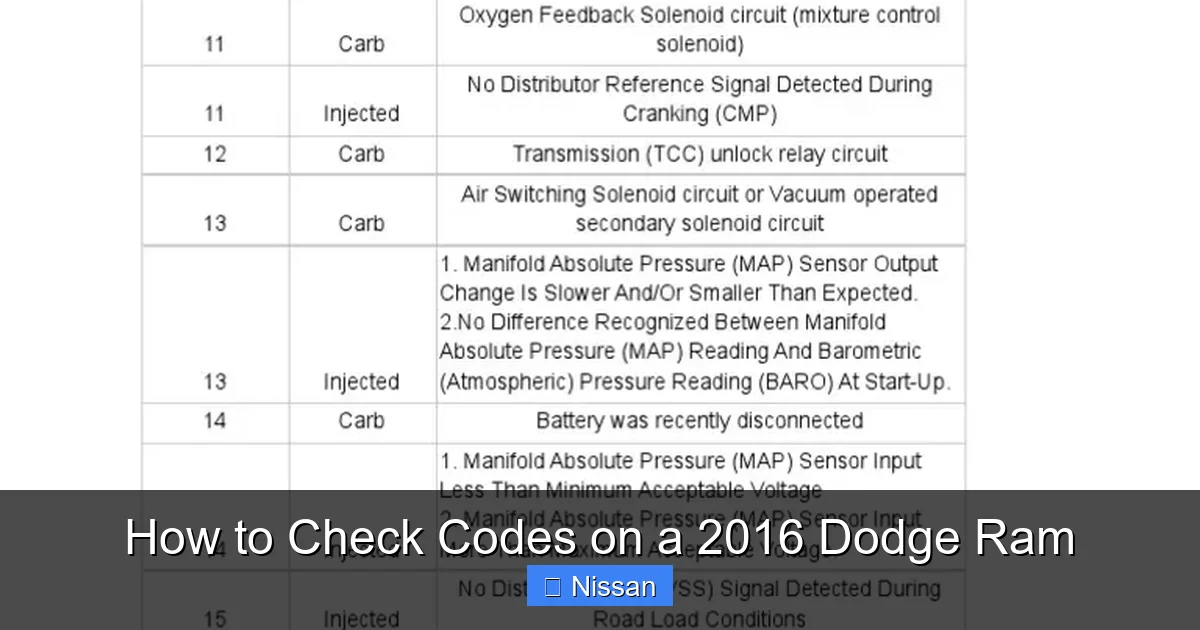
If you don’t have a scanner handy, don’t worry—your 2016 Dodge Ram has a built-in way to read basic codes using just your ignition key. This method, often called the “key dance” or “key cycle method,” triggers the Check Engine light to flash in a pattern that corresponds to the stored trouble code. It’s a clever trick that’s been around for decades, and it still works on many Chrysler, Dodge, and Ram vehicles.
Step-by-Step Guide to the Key Cycle Method
Here’s how to do it:
1. Turn the ignition to “ON” (but don’t start the engine): Insert your key and turn it to the “ON” position. You should see all the dashboard lights illuminate, including the Check Engine light.
2. Turn the key back to “OFF”: Wait about 2–3 seconds.
3. Repeat the ON-OFF cycle three times: Turn the key to ON, then OFF, then ON, then OFF, then ON again. Do this within about 5–10 seconds total. The final position should be ON (engine still off).
4. Watch the Check Engine light: After the third ON position, the Check Engine light will begin to flash. The pattern of flashes corresponds to the trouble code.
5. Count the flashes: The first digit is shown by long flashes (each representing 10), followed by short flashes for the second digit. For example, one long flash and three short flashes means code 13. A pause, then two long and four short flashes would be code 24.
6. Record the code(s): Some vehicles may display multiple codes. Wait for a longer pause between sequences to distinguish them.
7. Turn the key to “OFF” to end the sequence.
Limitations of the Key Cycle Method
While this method is handy in a pinch, it has some drawbacks. First, it only reads codes from the engine control module (ECM)—not the transmission, ABS, or other systems. Second, it only shows the primary code; it won’t give you live data, freeze frame information, or the ability to clear codes. Third, interpreting flash patterns can be tricky if you’re not familiar with the timing.
Also, not all 2016 Rams respond the same way. Some models, especially those with advanced infotainment systems or updated software, may not support this method. If the light doesn’t flash after the key cycle, it’s likely your truck requires an OBD2 scanner.
Still, for a quick check when you’re away from tools, the key cycle method is a valuable skill to have. Just remember: it’s a starting point, not a complete diagnostic.
Method 2: Using an OBD2 Scanner (Recommended)

Visual guide about How to Check Codes on a 2016 Dodge Ram
Image source: dodgecheckenginelight.com
For the most accurate and comprehensive code reading, an OBD2 scanner is the way to go. These devices plug directly into your truck’s diagnostic port and communicate with the PCM to retrieve detailed information about stored codes, pending codes, live sensor data, and more. They’re affordable, easy to use, and essential for anyone serious about DIY maintenance.
Locating the OBD2 Port
The OBD2 port on a 2016 Dodge Ram is typically located under the dashboard on the driver’s side, just below the steering column. It’s a 16-pin connector, usually black or gray, and may be tucked behind a small panel or covered by a plastic trim piece. You don’t need tools to access it—just reach under the dash and feel for the connector. It’s often within arm’s reach when you’re seated in the driver’s seat.
If you can’t find it, check near the fuse box or behind the knee airbag panel (on some models). The owner’s manual also has a diagram showing the exact location.
Choosing the Right OBD2 Scanner
Not all scanners are created equal. Here’s what to look for:
– Basic Code Readers: These are the cheapest (around $20–$40) and can read and clear codes. They’re great for beginners but offer limited functionality.
– Mid-Range Scanners: Priced between $50–$150, these often include live data, freeze frame info, and compatibility with multiple vehicle systems. Brands like BlueDriver, Autel, and Innova are reliable.
– Professional-Grade Scanners: For advanced users or mechanics, tools like the Autel MaxiCOM or Snap-on scanners offer full system diagnostics, bi-directional controls, and software updates. These can cost $300+.
For most Ram owners, a mid-range scanner is the sweet spot—it gives you detailed info without breaking the bank.
How to Use an OBD2 Scanner
Using a scanner is straightforward:
1. Turn off the engine.
2. Plug the scanner into the OBD2 port. Make sure it’s fully seated.
3. Turn the ignition to “ON” (or start the engine, depending on the scanner). Most scanners will power up automatically.
4. Follow the on-screen prompts. Select your vehicle make, model, and year if required.
5. Choose “Read Codes” or “Scan for DTCs.” The scanner will communicate with the PCM and display any stored or pending codes.
6. Review the results. The scanner will show the code (e.g., P0300) and often a brief description (e.g., “Random/Multiple Cylinder Misfire Detected”).
7. Check live data (if available). This shows real-time sensor readings like engine RPM, coolant temperature, oxygen sensor voltage, and fuel trim. It’s incredibly useful for diagnosing intermittent issues.
8. Clear codes (after repair). Once you’ve fixed the problem, use the scanner to clear the codes. This turns off the Check Engine light and resets the system.
Tips for Effective Scanning
– Always clear codes *after* making a repair, not before. Clearing codes without fixing the issue will just make the light come back on.
– Take screenshots or write down live data if you’re troubleshooting a complex problem.
– Some scanners allow you to save diagnostic reports—great for sharing with a mechanic.
– Keep your scanner’s software updated for the best compatibility.
Interpreting and Acting on the Codes

Visual guide about How to Check Codes on a 2016 Dodge Ram
Image source: dodgecheckenginelight.com
So you’ve retrieved a code—now what? Understanding what it means and how to respond is the real challenge.
Decoding the Alphanumeric Sequence
Let’s break down a typical code: P0302.
– P: Powertrain (engine/transmission)
– 0: Generic code (SAE standard)
– 3: Indicates the subsystem (in this case, ignition system or misfire)
– 02: Specific cylinder (cylinder 2)
So P0302 means “Cylinder 2 Misfire Detected.” That’s much more specific than a generic P0300.
Other examples:
– P0171: System Too Lean (Bank 1) – likely a vacuum leak or MAF sensor issue.
– P0441: Evaporative Emission Control System Incorrect Purge Flow – could be a stuck purge valve.
– P0715: Input/Turbine Speed Sensor Circuit Malfunction – points to a transmission sensor problem.
Using Repair Manuals and Online Resources
Once you know the code, the next step is figuring out the cause. Factory service manuals for the 2016 Dodge Ram are the gold standard—they include wiring diagrams, torque specs, and step-by-step repair procedures. You can find them online or at auto parts stores.
Websites like AllData, Mitchell1, and even forums like RamForumz.com or DodgeForum.com are also invaluable. Many experienced Ram owners share their repair stories, photos, and tips. Just be cautious—always cross-reference information and avoid relying on a single source.
When to DIY vs. When to See a Mechanic
Some repairs are perfect for DIYers:
– Replacing spark plugs or ignition coils
– Cleaning the MAF sensor
– Tightening or replacing the gas cap
– Swapping out an oxygen sensor
Others require specialized tools or expertise:
– Transmission repairs
– Catalytic converter replacement
– Internal engine work
If you’re unsure, start with simple checks. For example, if you get a P0300, inspect your spark plugs and coils before assuming it’s a major issue. But if you see a transmission code like P0715, it’s wise to consult a professional—transmission work is complex and easy to mess up.
Preventing Future Codes
The best way to deal with trouble codes is to avoid them altogether. Regular maintenance is your first line of defense.
Routine Maintenance Tips
– Change the oil every 5,000–7,500 miles: Use the recommended oil type (usually 5W-20 or 0W-20) and high-quality filters.
– Replace spark plugs every 30,000–100,000 miles: The 5.7L Hemi uses coil-on-plug ignition, so inspect both plugs and coils.
– Clean the MAF sensor every 15,000 miles: Use MAF cleaner spray—never touch the delicate wires.
– Check the air filter regularly: A dirty filter restricts airflow and can cause lean codes.
– Inspect vacuum hoses: Look for cracks, leaks, or loose connections—common causes of P0171/P0174.
– Use quality fuel: Top-tier gasoline with detergents helps keep injectors clean.
Monitoring Your Truck’s Health
Consider using a Bluetooth OBD2 adapter (like the BlueDriver or FIXD) that pairs with your smartphone. These apps provide real-time alerts, maintenance reminders, and code monitoring—so you’re always in the loop.
Conclusion
Checking codes on a 2016 Dodge Ram doesn’t have to be intimidating. Whether you use the simple key cycle method or invest in an OBD2 scanner, you now have the tools to understand what your truck is telling you. These codes are more than just warning lights—they’re diagnostic clues that can save you time, money, and stress.
By learning how to read, interpret, and act on these codes, you take control of your vehicle’s health. You’ll catch problems early, make informed repair decisions, and keep your Ram running strong for years to come. And remember: regular maintenance is the best way to prevent codes from appearing in the first place.
So the next time that Check Engine light flickers on, don’t panic. Grab your scanner, take a deep breath, and dive in. Your 2016 Dodge Ram will thank you.
Frequently Asked Questions
Can I check codes on a 2016 Dodge Ram without a scanner?
Yes, you can use the key cycle method—turn the ignition on and off three times to make the Check Engine light flash the code. However, this only reads basic engine codes and doesn’t provide detailed data like a scanner would.
Where is the OBD2 port located on a 2016 Dodge Ram?
The OBD2 port is typically found under the dashboard on the driver’s side, below the steering column. It’s a 16-pin connector, often tucked behind a plastic panel or near the fuse box.
What does a P0300 code mean on a 2016 Ram?
A P0300 code indicates a random or multiple cylinder misfire. Common causes include worn spark plugs, faulty ignition coils, dirty fuel injectors, or vacuum leaks.
Can I clear codes myself after a repair?
Yes, most OBD2 scanners allow you to clear diagnostic trouble codes after fixing the issue. This turns off the Check Engine light and resets the system for monitoring.
Why does my Check Engine light keep coming back after clearing codes?
If the light returns, the underlying problem hasn’t been fixed. The PCM detects the same issue again and reactivates the code. Diagnose and repair the root cause instead of just clearing codes.
Is it safe to drive with a Check Engine light on?
It depends on the code. A minor issue like a loose gas cap may be safe for a short drive, but serious problems like a misfire or transmission fault can cause damage. Always check the code and assess the severity.