
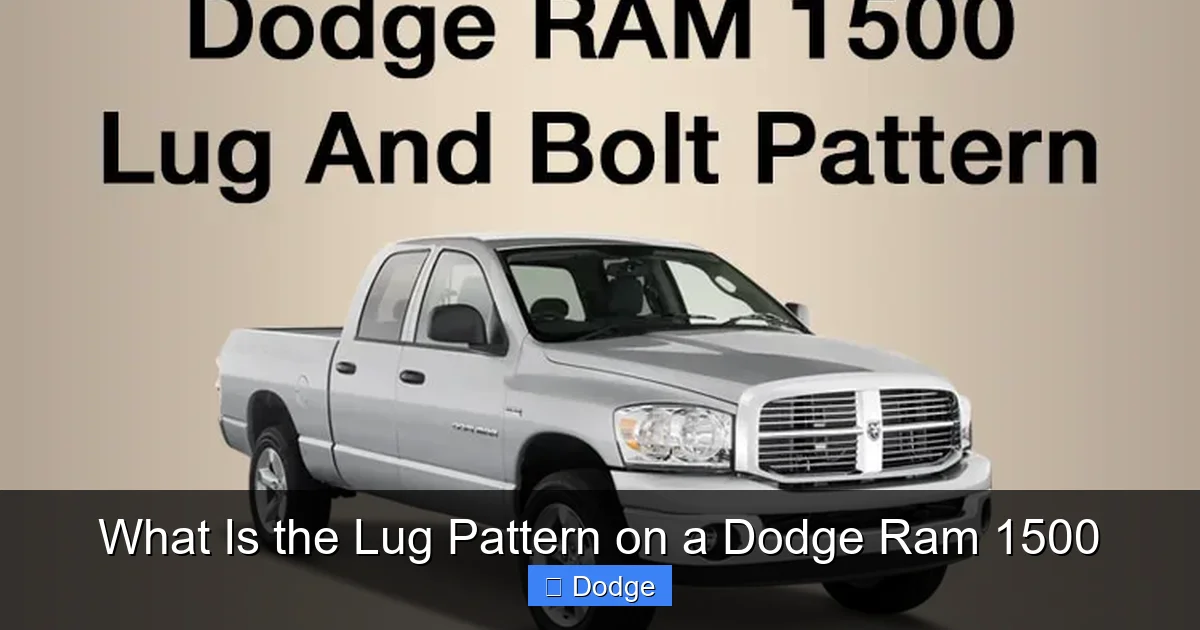
What Is the Lug Pattern on a Dodge Ram 1500

The lug pattern on a Dodge Ram 1500 is a critical specification for wheel compatibility, safety, and performance. Most models from 1994 to present use a 5×5.5-inch (5×139.7mm) bolt pattern, but older and heavy-duty variants may differ. Knowing your exact lug pattern ensures proper fitment when upgrading wheels or replacing damaged rims.
If you’ve ever looked at the wheels on your Dodge Ram 1500 and wondered, “What exactly is that bolt arrangement called?”—you’re not alone. Whether you’re planning to upgrade to stylish aftermarket rims, replace a damaged wheel, or just curious about your truck’s specs, understanding the lug pattern is one of the most important things you can know. It’s not just a technical detail—it’s the key to safe, smooth, and reliable driving.
The lug pattern, also known as the bolt pattern or PCD (Pitch Circle Diameter), defines how the wheel attaches to the hub. It includes two key numbers: the number of lug nuts (or bolts) and the diameter of the imaginary circle they form. For the Dodge Ram 1500, this specification has remained remarkably consistent over the years—but there are exceptions. Getting it right means your wheels will seat properly, your tires will wear evenly, and you’ll avoid dangerous situations like wheel wobble or detachment. In this guide, we’ll break down everything you need to know about the lug pattern on a Dodge Ram 1500, from how to identify it to why it matters for your next upgrade.
Key Takeaways
- Standard Lug Pattern: The majority of Dodge Ram 1500 trucks from 1994 onward use a 5×5.5-inch (5×139.7mm) lug pattern, meaning five lug nuts spaced evenly around a 5.5-inch circle.
- Year and Trim Variations: While most Ram 1500s share the same pattern, early models (pre-1994) and certain heavy-duty versions may have different configurations—always verify your specific model year.
- Importance for Wheel Swaps: Matching the correct lug pattern is essential when installing aftermarket wheels, adapters, or used rims to avoid vibration, unsafe driving conditions, or damage to hub components.
- Measuring the Lug Pattern: You can measure it yourself using a ruler or caliper: count the number of lugs and measure the distance between two opposite bolts (for even-numbered patterns) or use a bolt pattern gauge for accuracy.
- Aftermarket Compatibility: Many popular off-road and performance wheels are designed for the 5×5.5 pattern, making the Ram 1500 a favorite among customizers—but always double-check offset and backspacing too.
- Safety First: Incorrect lug patterns can lead to loose wheels, warped rotors, or catastrophic failure—never force a wheel that doesn’t fit snugly over the studs.
- Professional Help Recommended: If you’re unsure about your truck’s specs, consult your owner’s manual, a dealership, or a trusted mechanic before purchasing new wheels.
📑 Table of Contents
Understanding Lug Patterns: The Basics
Before diving into the specifics of the Dodge Ram 1500, let’s clarify what a lug pattern actually is. Think of it as the “fingerprint” of your wheel hub—a unique combination that determines which wheels will fit your vehicle. The lug pattern is expressed in a format like “5×5.5” or “6×139.7.” The first number tells you how many lug nuts or bolts are on the wheel (in this case, five), and the second number is the diameter (in inches or millimeters) of the circle that passes through the center of each bolt hole.
For example, a 5×5.5-inch pattern means there are five lug nuts, and if you drew a circle connecting the centers of each bolt, that circle would be 5.5 inches in diameter. This measurement is crucial because even a small mismatch—say, 5×5.0 instead of 5×5.5—can prevent a wheel from fitting properly. Wheels are precision-engineered components, and the hub, rotor, and wheel must all align perfectly for safe operation.
Why does this matter so much? Because your wheels are literally what keep your truck connected to the road. If the lug pattern doesn’t match, the wheel won’t seat flush against the hub. This can lead to vibrations at high speeds, uneven tire wear, loosening of lug nuts, and in extreme cases, the wheel could come off while driving. That’s not just inconvenient—it’s extremely dangerous.
The Standard Lug Pattern on a Dodge Ram 1500

Visual guide about What Is the Lug Pattern on a Dodge Ram 1500
Image source: vehiclerides.com
Now, let’s get to the heart of the matter: what is the lug pattern on a Dodge Ram 1500? For the vast majority of models produced from 1994 to the present day, the answer is a 5×5.5-inch bolt pattern. That’s five lug nuts arranged in a circle with a 5.5-inch diameter. In metric terms, this is equivalent to 5×139.7mm (since 5.5 inches × 25.4 mm/inch = 139.7 mm). This pattern has been used consistently across nearly all Ram 1500 trims, including the SLT, Laramie, Rebel, Limited, and TRX models.
This consistency is one of the reasons the Ram 1500 is so popular among enthusiasts and customizers. Because the 5×5.5 pattern is widely used across many American trucks and SUVs—including Ford F-150s (post-2015), Chevrolet Silverados, and GMC Sierras—there’s a huge selection of aftermarket wheels available. Whether you’re looking for aggressive off-road rims, sleek chrome finishes, or lightweight performance wheels, chances are you’ll find something that fits your Ram 1500 without needing adapters or modifications.
It’s worth noting that the 5×5.5 pattern applies to both two-wheel-drive (2WD) and four-wheel-drive (4WD) Ram 1500 models. The drivetrain doesn’t affect the lug pattern—only the hub design and suspension components change. So whether you’re driving a base model work truck or a high-performance TRX with supercharged V8 power, the bolt pattern remains the same.
Exceptions and Historical Variations

Visual guide about What Is the Lug Pattern on a Dodge Ram 1500
Image source: vehiclerides.com
While the 5×5.5-inch pattern dominates the Ram 1500 lineup, it’s not universal across all years and configurations. If you own a very early model or a specialized variant, you might encounter a different lug pattern. Understanding these exceptions is important, especially if you’re buying used wheels or restoring an older truck.
Pre-1994 Dodge Ram Trucks
Before the Ram 1500 was officially introduced in 1994, Dodge produced full-size pickups under names like the D150, W150, and Ram pickup (first generation). These earlier models often used a 5×4.5-inch (5×114.3mm) lug pattern. For example, the 1981–1993 Dodge Ram D150 typically had a 5×4.5 pattern. This is a common source of confusion for owners restoring classic trucks or swapping wheels between generations.
If you’re working with a pre-1994 Dodge pickup, always verify the lug pattern before purchasing wheels. A 5×4.5 wheel will not fit a 5×5.5 hub, and vice versa. The difference might seem small, but even a 1-inch variance in bolt circle diameter can make installation impossible without adapters—and adapters introduce their own risks and complications.
Heavy-Duty and Commercial Variants
While the Ram 1500 is a half-ton pickup, Dodge also produced heavier-duty models like the Ram 2500 and 3500. These trucks often use a 8×6.5-inch (8×165.1mm) lug pattern due to their larger axles and higher load capacities. Although not technically Ram 1500s, some owners confuse these models or attempt to swap parts between them. It’s important to remember that the Ram 1500 is distinct from its heavier siblings, and their lug patterns are not interchangeable.
Additionally, some commercial or fleet versions of the Ram 1500—particularly those built for specific industries or government use—may have unique configurations. However, these are rare, and the standard 5×5.5 pattern still applies in nearly all cases.
International and Export Models
Dodge has sold Ram trucks in various global markets, and in some regions, local regulations or manufacturing practices led to slight variations. For example, certain export models may have used metric-only specifications or different hub designs. If you’re driving a Ram 1500 imported from outside North America, it’s wise to double-check the lug pattern with a professional or consult the vehicle’s documentation.
How to Confirm Your Ram 1500’s Lug Pattern
Visual guide about What Is the Lug Pattern on a Dodge Ram 1500
Image source: tiresglobe.com
Even though the 5×5.5 pattern is standard, it’s always smart to verify your specific truck’s configuration. Here’s how you can do it yourself—no mechanic required.
Check the Owner’s Manual
The easiest and most reliable method is to consult your owner’s manual. Dodge includes detailed specifications for wheel and tire information, including the lug pattern, in the vehicle’s documentation. Look for sections labeled “Wheels and Tires,” “Technical Specifications,” or “Vehicle Identification.” This is especially helpful if you’ve lost track of your truck’s exact model year or trim.
Measure It Yourself
If you don’t have the manual, you can measure the lug pattern at home with basic tools. Here’s how:
– For a 5-lug pattern (like the Ram 1500), measure the distance from the center of one lug hole to the center of the lug hole directly across from it (skipping one hole in between). This gives you the bolt circle diameter.
– Use a ruler, tape measure, or digital caliper for accuracy. Measure in inches or millimeters.
– For a 5×5.5 pattern, this measurement should be approximately 5.5 inches (139.7 mm).
Alternatively, you can use a bolt pattern gauge—a specialized tool designed for this purpose. These are inexpensive and available at most auto parts stores. Simply place the gauge over the lug holes and match it to the correct template.
Look at the Wheel Itself
Sometimes, the wheel manufacturer stamps the lug pattern directly on the back of the rim. Remove the wheel (safely, with the truck on jack stands and the parking brake engaged) and inspect the inner barrel. You might find markings like “5×139.7” or “5×5.5.” This is a quick way to confirm, especially if you’re evaluating used wheels.
Use Online VIN Decoders
Many websites offer free VIN (Vehicle Identification Number) decoding services. By entering your Ram 1500’s 17-digit VIN, you can access detailed specs, including wheel and tire information. This is particularly useful if you’re buying a used truck and want to verify its original configuration.
Why the Lug Pattern Matters for Wheel Upgrades
Now that you know how to identify your Ram 1500’s lug pattern, let’s talk about why it’s so important—especially if you’re thinking about upgrading your wheels.
Aftermarket Wheel Compatibility
The 5×5.5-inch pattern is one of the most common bolt patterns in the truck world. As a result, there’s an enormous selection of aftermarket wheels designed specifically for this configuration. Whether you want blacked-out off-road rims, polished aluminum classics, or forged performance wheels, you’ll have no trouble finding options that fit your Ram 1500.
Popular brands like Fuel Off-Road, Method Race Wheels, MotoMetal, and Raceline all offer wheels in the 5×5.5 pattern. Many of these are engineered with the Ram 1500 in mind, featuring correct center bore sizes (typically 77.8mm) and appropriate offsets for proper clearance and handling.
Avoiding Fitment Issues
Even with the correct lug pattern, other factors like offset, backspacing, and center bore diameter can affect fitment. Offset refers to how far the wheel’s mounting surface is from the centerline—too much positive offset can cause rubbing on suspension components, while too much negative offset can stress wheel bearings.
Backspacing is the distance from the wheel’s mounting surface to the inner edge. It affects how the wheel sits in the wheel well and can influence steering and stability. Always check these specs when selecting new wheels, especially if you’re lifting your truck or installing larger tires.
Using Wheel Adapters (and Why You Should Avoid Them)
Some people consider using wheel adapters to fit wheels with a different lug pattern. For example, you might find a great deal on a set of 5×4.5 wheels and think an adapter will make them work. While adapters exist, they’re generally not recommended for daily driving.
Adapters add extra components between the hub and wheel, increasing the risk of loosening, vibration, or failure. They also change the effective offset and can place additional stress on suspension parts. In most cases, it’s safer and more reliable to stick with wheels that match your truck’s native lug pattern.
Safety Considerations and Best Practices
Getting the lug pattern right isn’t just about aesthetics—it’s a matter of safety. Here are some best practices to keep in mind.
Never Force a Wheel
If a wheel doesn’t slide smoothly over the lug studs, don’t force it. This is a clear sign of a mismatch. Forcing it can damage the studs, warp the rotor, or crack the wheel. Always test-fit wheels before tightening lug nuts.
Use Proper Torque Specifications
Once you have the correct wheels, tighten the lug nuts to the manufacturer’s recommended torque—usually around 110–130 ft-lbs for a Ram 1500. Use a torque wrench, not an impact gun alone, to ensure even clamping force. Over-tightening can stretch studs; under-tightening can lead to loosening over time.
Re-Torque After Installation
After driving 50–100 miles, recheck the lug nut torque. New wheels can settle, and lug nuts may loosen slightly. This simple step can prevent serious issues down the road.
Inspect Regularly
Make it a habit to inspect your wheels and lug nuts during routine maintenance. Look for signs of corrosion, cracking, or looseness. Replace damaged lug nuts or studs immediately.
Conclusion
The lug pattern on a Dodge Ram 1500 is a foundational specification that affects everything from wheel compatibility to driving safety. For most models from 1994 onward, that pattern is a reliable 5×5.5-inch (5×139.7mm) configuration—five lug nuts spaced evenly around a 5.5-inch circle. This consistency has made the Ram 1500 a favorite among truck enthusiasts, offering access to a vast array of aftermarket wheels and customization options.
However, it’s important to remember that not all Ram trucks are created equal. Older models, heavy-duty variants, and international versions may have different patterns, so always verify your specific vehicle’s specs before making any changes. Whether you’re upgrading for style, performance, or functionality, taking the time to confirm your lug pattern ensures a safe, smooth, and satisfying experience.
When in doubt, consult your owner’s manual, measure the pattern yourself, or seek advice from a trusted mechanic. Your wheels are your connection to the road—treat them with care, and they’ll serve you well for miles to come.
Frequently Asked Questions
What is the lug pattern on a 2023 Dodge Ram 1500?
The 2023 Dodge Ram 1500 uses a 5×5.5-inch (5×139.7mm) lug pattern, consistent with most modern Ram 1500 models. This applies to all trims, including the TRX, Limited, and Big Horn.
Can I use Ford F-150 wheels on my Ram 1500?
Yes, but only if the Ford wheels have a 5×5.5-inch bolt pattern. Post-2015 Ford F-150s use this same pattern, so many wheels are interchangeable—but always check offset, center bore, and backspacing for proper fit.
How do I measure a 5-lug bolt pattern?
For a 5-lug pattern, measure from the center of one lug hole to the center of the hole directly across (skipping one hole). This distance should be 5.5 inches (139.7 mm) for a Ram 1500.
Are all Dodge Ram 1500 lug patterns the same?
Almost all Ram 1500s from 1994 to today use the 5×5.5 pattern. However, pre-1994 Dodge pickups and heavy-duty Ram 2500/3500 models have different patterns—always verify your specific model.
Can I change my Ram 1500’s lug pattern?
Technically yes, using wheel adapters or hub-centric conversion kits, but this is not recommended for daily driving due to safety and reliability concerns. It’s better to use wheels that match your native pattern.
What happens if I install wheels with the wrong lug pattern?
Incorrect lug patterns can cause wheels to not seat properly, leading to vibration, uneven tire wear, loosened lug nuts, or even wheel detachment. Always ensure compatibility before installation.
