
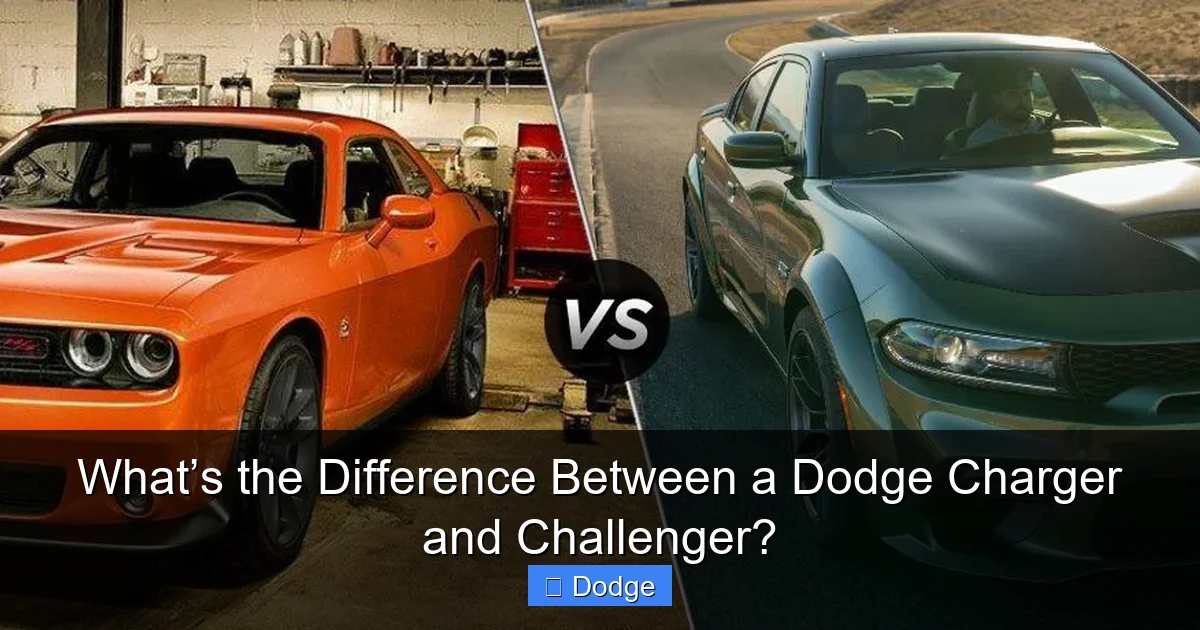
What’s the Difference Between a Dodge Charger and Challenger?

The Dodge Charger and Challenger are both iconic American muscle cars, but they serve different purposes. The Charger is a four-door sedan built for daily driving with family-friendly space, while the Challenger is a two-door coupe focused on raw performance and retro style. Choosing between them depends on your lifestyle, space needs, and driving preferences.
If you’ve ever stood in a car dealership or scrolled through muscle car forums, you’ve probably asked yourself: “What’s the difference between a Dodge Charger and Challenger?” At first glance, they look like siblings—same brand, similar aggressive styling, and that unmistakable rumble under the hood. But dig a little deeper, and you’ll find they’re built for very different kinds of drivers.
The Dodge Charger and Challenger are two of the most recognizable names in American performance. Both carry the Dodge badge, both roar with V8 power, and both turn heads on the highway. But while they share DNA, their DNA expresses itself in different ways. One is a four-door powerhouse that doubles as a family hauler. The other is a two-door tribute to classic muscle, built for speed and style. Understanding the differences between them isn’t just about specs—it’s about matching the right car to your life.
Whether you’re a daily commuter who still wants to feel the thrill of acceleration, or a weekend warrior who lives for track days and burnouts, one of these cars is likely calling your name. In this guide, we’ll break down everything from design and performance to practicality and tech, so you can make an informed decision. Let’s dive in.
Key Takeaways
- Body Style: The Charger is a four-door sedan; the Challenger is a two-door coupe, offering a more classic muscle car look.
- Seating and Space: The Charger seats up to five comfortably with a usable back seat; the Challenger seats four, with limited rear legroom.
- Performance Options: Both offer powerful V8 engines, including the legendary Hellcat and SRT variants, but the Challenger often feels more track-focused.
- Daily Usability: The Charger wins for everyday driving with better visibility, easier access, and more trunk space.
- Design and Styling: The Challenger has a bold, retro-inspired design; the Charger blends muscle with modern sedan practicality.
- Technology and Features: Both come well-equipped, but the Charger often includes more family-oriented tech like rear-seat entertainment options.
- Target Audience: The Charger suits drivers who want power with practicality; the Challenger appeals to enthusiasts seeking pure muscle car thrills.
📑 Table of Contents
Body Style and Design: Sedan vs. Coupe
The most obvious difference between the Dodge Charger and Challenger is their body style. The Charger is a four-door sedan, while the Challenger is a two-door coupe. This fundamental distinction shapes nearly every other aspect of their design, usability, and driving experience.
The Charger’s sedan layout gives it a more modern, versatile appearance. It looks aggressive, yes—especially with its wide grille, sculpted hood, and LED lighting—but it still blends into everyday traffic. You can drive it to work, pick up the kids from school, or take a road trip without drawing too much attention (unless you opt for the bright colors or SRT badging). The four doors make entry and exit easy, and the roofline is high enough for adults to sit comfortably in the back.
In contrast, the Challenger leans hard into its retro roots. Its long hood, short deck, and muscular fenders echo the classic muscle cars of the 1970s. The two-door design gives it a sleek, low-slung profile that screams performance. It’s not trying to be subtle. From the iconic shaker hood to the available racing stripes, the Challenger is a rolling piece of automotive art. But that style comes with trade-offs: the rear doors are absent, and the back seat is more of a “nice-to-have” than a functional space.
Visually, the Charger feels more balanced—like a sports sedan that happens to have a supercharged heart. The Challenger, on the other hand, looks like it’s ready to launch at a moment’s notice. If you want a car that turns heads at car shows and makes a statement at stoplights, the Challenger wins on pure style. But if you need something that looks sharp without sacrificing everyday usability, the Charger strikes a better balance.
Interior Space and Practicality
Visual guide about What’s the Difference Between a Dodge Charger and Challenger?
Image source: cdn-ds.com
When it comes to interior space, the Charger and Challenger diverge significantly. The Charger is built with practicality in mind, offering a spacious cabin that can comfortably seat five adults. The rear seats have decent legroom and headroom, making it a viable option for families or frequent carpoolers. The trunk is also generous, with around 16 cubic feet of cargo space—enough for groceries, luggage, or even a set of golf clubs.
The Challenger, by contrast, is more of a 2+2 coupe. The front seats are roomy and supportive, especially in higher trims with performance buckets, but the back seat is best suited for small children or occasional use. Adults will find the rear cramped, with limited legroom and a low roofline that can cause headroom issues. The trunk is smaller, too—around 11–12 cubic feet—which is still decent for a coupe but falls short of the Charger’s utility.
Storage inside the cabin also differs. The Charger includes more thoughtful touches like rear air vents, USB ports for backseat passengers, and larger door pockets. The Challenger focuses more on the driver experience, with a cockpit-style layout and fewer rear-seat amenities. If you regularly carry passengers or need to haul gear, the Charger is the clear winner. But if you’re mostly driving solo or with one passenger, the Challenger’s tighter cabin can actually enhance the sense of connection to the road.
Another practical consideration is visibility. The Charger’s sedan design offers better sightlines, with a higher seating position and larger windows. The Challenger’s low roof and thick pillars can create blind spots, especially when merging or parking. That said, both cars come with modern driver aids like blind-spot monitoring and rear cross-traffic alert to help compensate.
Performance and Engine Options

Visual guide about What’s the Difference Between a Dodge Charger and Challenger?
Image source: i.ytimg.com
Now for the fun part—performance. Both the Dodge Charger and Challenger offer an impressive range of engines, from efficient V6s to earth-shaking supercharged V8s. But while their powertrains overlap, the driving experience differs due to weight, aerodynamics, and tuning.
The base engine for both models is a 3.6-liter Pentastar V6, producing around 300 horsepower. It’s smooth, reliable, and fuel-efficient for a muscle car, making it a great choice for daily driving. Step up to the 5.7-liter HEMI V8, and you’re looking at 370 horsepower—enough to deliver thrilling acceleration and that classic V8 rumble.
But the real magic happens when you go big. Both cars offer the 6.4-liter HEMI V8, found in the R/T Scat Pack and SRT 392 trims. This engine delivers 485 horsepower and 475 lb-ft of torque, launching either car from 0 to 60 mph in under 4.5 seconds. It’s a sweet spot for drivers who want serious power without stepping into extreme territory.
Then there’s the Hellcat. Available in both the Charger and Challenger, the supercharged 6.2-liter HEMI V8 produces a staggering 717 horsepower (or 797 in the Redeye version). This isn’t just fast—it’s borderline ridiculous. The Hellcat can hit 60 mph in under 3.5 seconds and has a top speed of over 200 mph. It’s the kind of power that makes you grin from ear to ear, but also demands respect.
The Challenger often feels more focused in its performance tuning. It’s slightly lighter than the Charger (especially in widebody form), and its shorter wheelbase gives it a more agile feel on twisty roads. The Charger, being a heavier sedan, feels more planted and stable at high speeds, but it doesn’t corner with the same sharpness.
For track enthusiasts, the Challenger SRT Super Stock and Charger SRT Super Stock offer drag-focused setups with drag radial tires, launch control, and suspension tuned for straight-line speed. The Challenger also offers the SRT Demon and Demon 170 (though these are limited-production models), which are essentially street-legal dragsters.
In short: if you want raw, unfiltered performance in a coupe, the Challenger is the purist’s choice. If you want that same power in a more stable, four-door package, the Charger delivers.
Driving Experience and Handling

Visual guide about What’s the Difference Between a Dodge Charger and Challenger?
Image source: whatisthedifferencebetween.org
The driving experience is where the Charger and Challenger truly diverge. While both are built on the same platform and share many components, their tuning and layout create distinct personalities behind the wheel.
The Charger feels like a grand tourer with muscle car DNA. It’s comfortable on long highway drives, with a smooth ride and quiet cabin at cruising speeds. The steering is responsive but not overly aggressive, making it easy to drive in traffic. Even in SRT trim, the Charger remains surprisingly composed, with adaptive suspension options that can soften the ride for daily use.
The Challenger, on the other hand, feels more like a sports car in disguise. Its lower center of gravity, stiffer suspension, and rear-wheel-drive setup give it a more connected, driver-focused feel. The steering is heavier and more precise, especially in SRT models with performance steering. It’s the kind of car that rewards skilled driving and feels alive on back roads or the track.
But that focus comes at a cost. The Challenger’s ride can be firmer, especially on rough pavement, and the lower profile means less ground clearance. The Charger, with its taller stance, handles speed bumps and potholes with more grace.
Braking is another area of difference. Both cars offer Brembo brakes in higher trims, but the Challenger’s lighter weight gives it a slight edge in stopping power. The Charger’s larger size means it takes a bit more effort to slow down from high speeds, though it’s still more than capable.
For daily driving, the Charger is the more comfortable and versatile option. For weekend fun or spirited driving, the Challenger offers a more engaging, visceral experience. It’s the difference between a performance sedan and a true muscle coupe.
Technology and Features
Both the Dodge Charger and Challenger come well-equipped with modern technology, but their feature sets reflect their different roles.
The Charger often includes more family-friendly tech. Higher trims offer rear-seat entertainment systems, multiple USB ports, and even available Wi-Fi hotspots. The Uconnect infotainment system is user-friendly, with an 8.4-inch or 10.1-inch touchscreen, Apple CarPlay, Android Auto, and navigation. Available features include a premium sound system, wireless charging, and a digital instrument cluster.
The Challenger focuses more on the driver. While it has the same Uconnect system, the layout is more performance-oriented, with customizable drive modes, launch control, and performance pages that display horsepower, torque, and G-forces. The available Laguna leather seats and carbon-fiber trim add a sporty luxury feel.
Safety features are similar across both models. Standard equipment includes forward collision warning, adaptive cruise control, lane departure warning, and automatic emergency braking. The Charger, with its better visibility and four-door design, may feel safer in everyday driving, but both cars earn solid safety ratings.
One area where the Charger pulls ahead is in available all-wheel drive. The Charger GT and R/T models offer AWD, which improves traction in rain or snow—something the Challenger doesn’t offer. If you live in a region with harsh weather, the Charger’s AWD option could be a deciding factor.
Fuel Economy and Ownership Costs
Let’s be honest—neither the Charger nor the Challenger is known for fuel efficiency. But there are differences worth noting.
The base V6 models are the most economical. The Charger V6 with AWD gets around 19 mpg city and 30 mpg highway. The Challenger V6 is slightly less efficient, at 19/27 mpg, due to its rear-wheel-drive setup and weight distribution.
Step up to the V8, and fuel economy drops significantly. The 5.7-liter HEMI gets around 16/25 mpg in the Charger and 15/24 in the Challenger. The 6.4-liter Scat Pack models are even thirstier, averaging 15/24 mpg. The Hellcat variants? Expect single-digit city mileage—around 12–13 mpg—and mid-teens on the highway.
Insurance and maintenance costs are also higher for these high-performance machines. The Challenger, with its coupe design and track-ready image, may carry slightly higher insurance premiums. Both cars require premium fuel, and routine maintenance (especially for supercharged models) can be pricey.
That said, both offer strong resale value, especially in SRT or Hellcat trims. Enthusiasts hold onto these cars, and limited-edition models like the Demon or Redeye can appreciate over time.
Which One Should You Choose?
So, which is better—the Dodge Charger or Challenger?
It depends on your lifestyle.
Choose the **Dodge Charger** if:
– You need a daily driver that can also deliver thrilling performance.
– You regularly carry passengers or need trunk space.
– You want the option of all-wheel drive for better traction.
– You prefer a more comfortable, stable ride for long trips.
Choose the **Dodge Challenger** if:
– You want a pure muscle car experience with retro styling.
– You prioritize performance and handling over practicality.
– You mostly drive solo or with one passenger.
– You’re drawn to the coupe’s aggressive, head-turning design.
Both cars are icons in their own right. The Charger proves that muscle cars can be practical. The Challenger proves that they don’t have to be. Whichever you choose, you’re getting a piece of American automotive history—with a modern twist.
Frequently Asked Questions
Which is faster, the Dodge Charger or Challenger?
With the same engine, both cars have nearly identical acceleration times. However, the Challenger is slightly lighter and more aerodynamic, giving it a small edge in handling and track performance. The Charger feels more stable at high speeds due to its longer wheelbase.
Can you fit adults in the back seat of a Challenger?
Technically yes, but it’s not ideal. The Challenger’s rear seat is best suited for children or short trips. Adults will find legroom and headroom limited, especially with the low roofline. The Charger is far more comfortable for rear passengers.
Does the Dodge Charger have all-wheel drive?
Yes, the Charger GT and R/T models offer all-wheel drive, which improves traction in wet or snowy conditions. The Challenger is only available with rear-wheel drive, making the Charger a better choice for harsh weather.
Are the Charger and Challenger reliable?
Both have solid reliability records, especially with the V6 and 5.7-liter V8 engines. The supercharged Hellcat models require more maintenance and premium fuel, but overall, they’re dependable when properly cared for.
Which has better fuel economy, the Charger or Challenger?
The Charger is slightly more fuel-efficient, especially in V6 and AWD configurations. The Challenger’s rear-wheel-drive setup and weight distribution result in marginally lower mileage, particularly in city driving.
Can you daily drive a Dodge Challenger?
Yes, but it’s less practical than the Charger. The Challenger’s stiff suspension, limited rear seat, and poor visibility make it better suited for weekend fun or short commutes. The Charger is the better choice for daily driving.