
What Is the Avh Button on a Subaru Forester?

The AVH button on a Subaru Forester stands for Auto Vehicle Hold, a smart safety feature that keeps your vehicle stationary without using the brake pedal. It’s especially helpful on hills or in stop-and-go traffic, giving drivers more control and reducing fatigue.
If you’ve ever driven a Subaru Forester—especially a newer model—you might have noticed a small button near the gear shifter labeled “AVH.” At first glance, it might seem like just another mysterious automotive acronym, but this little button packs a big punch when it comes to convenience and safety. Whether you’re navigating steep mountain roads, stuck in city traffic, or simply want a smoother driving experience, understanding what the AVH button does can make a real difference.
The AVH button stands for Auto Vehicle Hold, and it’s one of those features that feels like magic the first time you use it. Instead of constantly pressing the brake pedal to keep your Forester from rolling—especially on hills—you can activate AVH and let the car do the work for you. It’s not a parking brake, and it’s not cruise control. Instead, it’s a smart, temporary hold system that keeps your vehicle stationary without any input from your foot. This means less leg fatigue, fewer accidental rollbacks, and a more relaxed drive, particularly in challenging conditions.
In this guide, we’ll dive deep into what the AVH button is, how it works, when to use it, and why it’s such a valuable feature in the Subaru Forester. Whether you’re a new Forester owner or just curious about modern car tech, this article will give you everything you need to know about this often-overlooked but incredibly useful function.
Key Takeaways
- AVH stands for Auto Vehicle Hold: It’s an electronic parking assist that keeps the Forester stationary without pressing the brake.
- Activated via a dashboard button: Located near the gear shifter, the AVH button is easy to reach and use.
- Works on inclines and flat surfaces: Ideal for hills, traffic jams, or long stops at traffic lights.
- Automatically disengages when accelerating: The system releases when you press the gas pedal, ensuring smooth takeoffs.
- Enhances safety and comfort: Reduces driver fatigue and prevents rollback on steep hills.
- Compatible with most Forester trims: Available on models from 2019 onward, especially in higher trims like Limited and Touring.
- Not a parking brake replacement: Always use the electronic parking brake (EPB) when parked for long periods.
📑 Table of Contents
What Does AVH Stand For?
The letters “AVH” stand for Auto Vehicle Hold. It’s a driver-assist technology designed to keep your vehicle stationary without requiring you to keep your foot on the brake pedal. Think of it as a temporary electronic handbrake that activates automatically when certain conditions are met.
Unlike traditional parking brakes—which are mechanical and meant for long-term use—AVH is an electronic system that works in real time. It uses sensors and the vehicle’s braking system to detect when the car is stopped and then applies light pressure to the brakes to prevent movement. This is especially helpful in situations where you’re stopped for more than a few seconds, such as at a red light, in heavy traffic, or on a steep incline.
It’s important to note that AVH is not the same as the electronic parking brake (EPB), which is a separate system used when the vehicle is parked. The EPB is engaged manually (usually with a button labeled “P” or “EPB”) and is designed to hold the car in place for extended periods. AVH, on the other hand, is temporary and automatically disengages when you’re ready to move.
How AVH Differs from Other Braking Systems
To truly understand AVH, it helps to compare it to other common braking features in modern vehicles:
– **Foot Brake:** This is the standard brake pedal you press with your foot. It requires constant pressure to keep the car stationary.
– **Electronic Parking Brake (EPB):** A manual system used when parking. It locks the rear wheels and must be disengaged manually or automatically when driving.
– **Hill Start Assist (HSA):** A feature that briefly holds the brakes after you release the pedal on a hill, giving you time to accelerate without rolling backward. However, HSA only works for a few seconds.
– **Auto Vehicle Hold (AVH):** Unlike HSA, AVH continues to hold the vehicle as long as the conditions are met—no time limit. It’s like having HSA on steroids.
What sets AVH apart is its ability to maintain brake pressure indefinitely (within reason) without driver input. This makes it ideal for long stops, traffic jams, or steep hills where you might otherwise have to ride the brake or use the parking brake repeatedly.
How Does the AVH Button Work?
Visual guide about What Is the Avh Button on a Subaru Forester?
Image source: images.carexpert.com.au
The AVH system in the Subaru Forester is a seamless blend of sensors, software, and the vehicle’s braking system. Here’s a step-by-step breakdown of how it operates:
When you come to a complete stop—whether on a flat road or an incline—the Forester’s onboard computers detect that the vehicle is stationary. If the AVH system is activated (via the button), it automatically applies a small amount of pressure to the brakes to keep the car from moving. You’ll notice this as a slight sensation in the brake pedal or a quiet hum from the braking system.
The system remains active as long as:
– The driver’s door is closed.
– The driver is seated and the seatbelt is fastened.
– The engine is running.
– The vehicle is in Drive (D) or Reverse (R).
Once you press the accelerator pedal to move forward or backward, the AVH system instantly releases the brakes, allowing for a smooth and controlled takeoff. There’s no delay or jerk—just a seamless transition from stop to go.
Activation and Deactivation
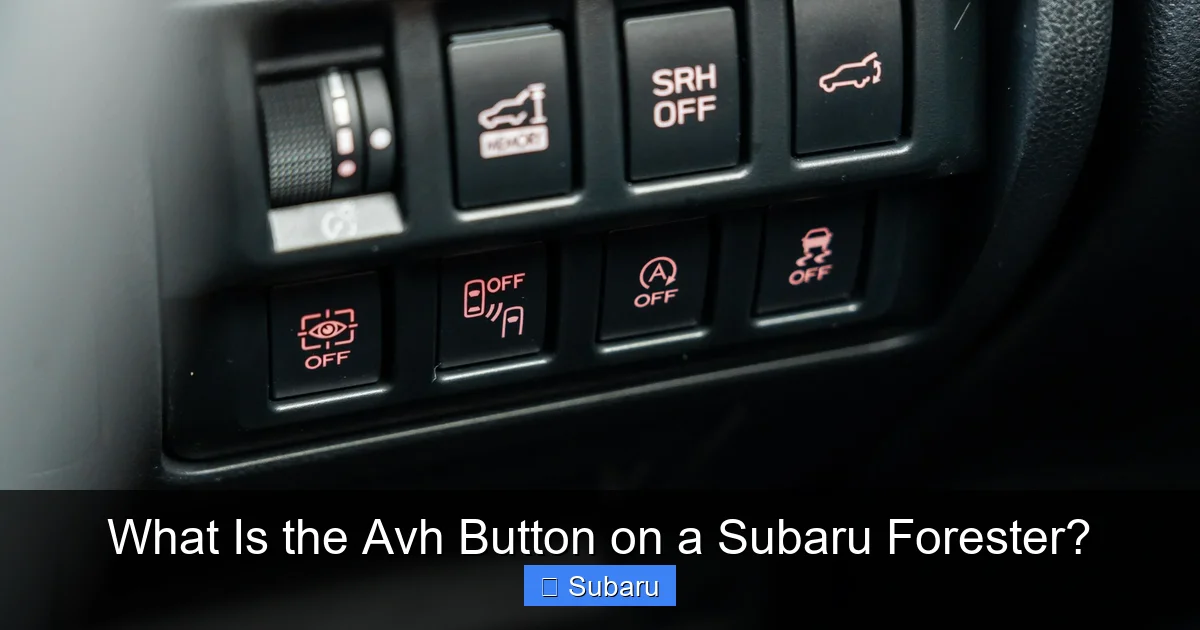
Activating AVH is simple. Look for the AVH button near the gear shifter—usually on the center console. It’s often labeled with the letters “AVH” and may have an icon resembling a car with a brake symbol. Press the button once to turn it on. A green indicator light will appear on the dashboard to confirm activation.
To turn it off, simply press the button again. The light will go out, and the system will no longer engage automatically.
It’s worth noting that AVH can also be temporarily overridden. For example, if you press the brake pedal firmly while AVH is active, the system may disengage until you release the pedal and come to a stop again.
Conditions That Affect AVH Performance
While AVH is highly reliable, there are a few conditions that can affect how well it works:
– **Driver Presence:** If the driver’s seat is unoccupied or the seatbelt is unbuckled, AVH will not activate.
– **Door Status:** If any door (including the trunk) is open, the system may not engage.
– **Gear Position:** AVH only works when the vehicle is in Drive or Reverse. It won’t activate in Park or Neutral.
– **Battery Voltage:** Extremely low battery voltage can disable the system temporarily.
– **Extreme Temperatures:** In very cold or hot conditions, the system may take longer to respond or behave slightly differently.
Despite these limitations, AVH is designed to work reliably in everyday driving conditions. Most drivers will find it activates smoothly and consistently.
When Should You Use the AVH Button?
Visual guide about What Is the Avh Button on a Subaru Forester?
Image source: ahparts.com
The AVH button is most useful in specific driving scenarios where keeping the vehicle stationary without constant brake pressure is beneficial. Here are some common situations where AVH shines:
1. Stopping on Hills
One of the biggest advantages of AVH is its ability to prevent rollback on steep inclines. If you’re driving in hilly areas—like the Pacific Northwest, mountainous regions, or even urban neighborhoods with steep driveways—AVH can be a lifesaver.
Imagine you’re stopped at a red light on a 15% grade. Without AVH, you’d need to either keep your foot on the brake (which can be tiring) or use the parking brake (which requires manual disengagement). With AVH activated, the car holds itself in place. When the light turns green, you simply press the accelerator, and the car moves forward smoothly—no rollback, no stress.
2. Heavy Traffic and Stop-and-Go Driving
In congested city traffic, you’re constantly stopping and starting. This can be exhausting, especially if you’re driving a manual transmission (though the Forester is CVT-only). Even with an automatic, keeping your foot on the brake for long periods can lead to fatigue.
With AVH, you can come to a stop, and the car will hold itself. This gives your right leg a break and reduces the risk of accidentally creeping forward if you accidentally bump the accelerator.
3. Long Traffic Lights or Railroad Crossings
Some traffic lights last over a minute, and railroad crossings can have long wait times. Instead of holding the brake the entire time, you can activate AVH and relax. The system will keep the car stationary until you’re ready to go.
4. Loading or Unloading Passengers or Cargo
If you’re picking up kids from school or loading groceries, AVH can help keep the car steady while you’re in and out of the vehicle. Just make sure the driver’s door is closed and the seatbelt is fastened for the system to work.
5. Driving with Passengers Who Get Motion Sickness
Frequent braking and releasing can cause motion sickness in sensitive passengers. AVH helps create a smoother ride by eliminating the constant “jerk” of pressing and releasing the brake.
Tips for Using AVH Effectively
Visual guide about What Is the Avh Button on a Subaru Forester?
Image source: cars101.com
To get the most out of the AVH system in your Subaru Forester, keep these practical tips in mind:
Always Check the Dashboard Light
Before relying on AVH, make sure the green indicator light is on. If it’s not, the system may not be active. This light confirms that AVH is ready to engage when you stop.
Don’t Rely on AVH for Long-Term Parking
Remember, AVH is not a parking brake. It’s designed for temporary holds. Always use the electronic parking brake (EPB) when you’re parked for more than a few minutes. The EPB is engaged by pulling up the button near the gear shifter and is essential for safety when the car is unattended.
Use AVH in Combination with Hill Start Assist
The Forester also comes with Hill Start Assist (HSA), which works alongside AVH. HSA gives you a few seconds of brake hold when you release the pedal on a hill. AVH takes over after that, providing continuous hold. Together, they offer excellent hill-driving support.
Be Mindful in Wet or Icy Conditions
While AVH works in most weather conditions, icy or wet roads can affect traction. The system holds the brakes, but if the tires lose grip, the car could still slide. Always drive cautiously in winter weather and consider using winter tires.
Practice in a Safe Area
If you’re new to AVH, try it out in a quiet parking lot or on a gentle hill. Get a feel for how the system engages and releases. This will build your confidence and help you use it effectively in real-world situations.
Keep the System Maintained
Like all electronic systems, AVH relies on sensors and software. Keep your Forester’s software up to date through Subaru’s STARLINK system or dealer updates. Also, ensure your brake system is in good condition—worn brake pads or low brake fluid can affect performance.
Which Subaru Forester Models Have AVH?
The AVH feature is available on most Subaru Forester models from 2019 onward. It’s typically included in higher trims such as the Premium, Limited, and Touring. However, availability can vary by region and model year, so it’s best to check your owner’s manual or consult your dealer.
Here’s a quick breakdown:
– **2019–2024 Subaru Forester:** AVH is standard on Limited and Touring trims. It may be optional or included in packages on Premium and Sport trims, depending on the market.
– **Base (L and Base) Trims:** These often do not include AVH, as they come with fewer driver-assist features.
– **Hybrid Models:** The Forester Hybrid (available in some regions) also includes AVH as part of its advanced safety suite.
If you’re unsure whether your Forester has AVH, look for the button near the gear shifter or check the dashboard for the AVH indicator light. You can also refer to your owner’s manual under “Driver-Assist Technologies” or “Braking Systems.”
How to Confirm AVH Is Installed
If you can’t find the button, don’t panic. Some Foresters may have the feature but not the physical button—especially in earlier model years. In such cases, AVH might be integrated into the electronic parking brake system and activated automatically under certain conditions.
To confirm, try this test:
1. Come to a complete stop on a flat surface.
2. Release the brake pedal.
3. If the car remains stationary without rolling, AVH may be active (even without the button).
However, for full control and visibility, having the AVH button is ideal.
Common Misconceptions About AVH
Despite its usefulness, there are several myths and misunderstandings about the AVH system. Let’s clear them up:
Myth 1: AVH Is the Same as Cruise Control
No. Cruise control maintains a set speed while driving. AVH only works when the vehicle is stopped. They serve completely different purposes.
Myth 2: AVH Can Replace the Parking Brake
Absolutely not. AVH is for temporary holds. Always use the electronic parking brake (EPB) when parked. Relying on AVH alone can lead to accidents if the system disengages unexpectedly.
Myth 3: AVH Works in All Gears
AVH only activates in Drive (D) and Reverse (R). It does not work in Park (P) or Neutral (N). This is a safety feature to prevent accidental engagement when the car is not in motion.
Myth 4: AVH Drains the Battery
While AVH does use electrical power, it’s minimal and designed to work within the vehicle’s normal power budget. It won’t drain your battery under normal conditions.
Myth 5: AVH Is Only for Hills
While hills are a major use case, AVH is equally useful on flat roads—especially in traffic. It reduces fatigue and improves comfort in any stop-and-go situation.
Conclusion
The AVH button on a Subaru Forester is a small but powerful feature that enhances both safety and driving comfort. By automatically holding the vehicle stationary without requiring constant brake pressure, it reduces driver fatigue, prevents rollback on hills, and makes stop-and-go driving much more pleasant.
Whether you’re navigating steep mountain passes, stuck in city traffic, or simply want a smoother ride, AVH is a tool worth mastering. It’s not a replacement for the parking brake, but rather a smart assistant that works alongside other safety systems like Hill Start Assist and the electronic parking brake.
If your Forester has the AVH button, take the time to learn how it works. Practice in a safe environment, understand its limitations, and use it regularly. You’ll quickly wonder how you ever drove without it.
In a world where driving can be stressful and tiring, features like AVH remind us that modern cars are designed not just for performance, but for peace of mind. So the next time you see that little AVH button, don’t ignore it—press it, trust it, and enjoy the ride.
Frequently Asked Questions
What does AVH stand for on a Subaru Forester?
AVH stands for Auto Vehicle Hold. It’s a driver-assist feature that keeps the vehicle stationary without requiring you to press the brake pedal.
Is AVH the same as the parking brake?
No, AVH is not the same as the parking brake. AVH is for temporary holds while driving, while the parking brake is for long-term use when the car is parked.
Can I use AVH on flat roads?
Yes, AVH works on both flat roads and inclines. It’s useful in traffic, at long red lights, or any situation where you’re stopped for more than a few seconds.
Does AVH work in reverse?
Yes, AVH activates in both Drive (D) and Reverse (R). It can help prevent rollback when backing up a hill.
Why isn’t the AVH light turning on?
The light may not turn on if the driver’s door is open, the seatbelt is unbuckled, or the vehicle is in Park or Neutral. Make sure all conditions are met for activation.
Do all Subaru Foresters have AVH?
No, AVH is typically available on higher trims like Limited and Touring from 2019 onward. Base models may not include it.
