
Honda Cr-v Vs Toyota Highlander: Which Is Better?

Choosing between the Honda CR-V and Toyota Highlander depends on your needs. The CR-V excels in fuel efficiency and daily driving comfort, while the Highlander offers more space and power for families. We break down every detail to help you decide.
Key Takeaways
- Size Matters: The Toyota Highlander is a midsize three-row SUV, while the Honda CR-V is a compact two-row crossover—ideal for different family sizes.
- Fuel Efficiency Winner: The CR-V delivers up to 30 mpg combined, making it one of the most fuel-efficient SUVs in its class.
- Power and Towing: The Highlander offers a V6 engine and higher towing capacity (up to 5,000 lbs), perfect for hauling trailers or boats.
- Interior Space and Seating: Highlander seats up to eight; CR-V seats five comfortably with generous cargo room for its size.
- Safety Ratings: Both earn top marks from IIHS and NHTSA, but the Highlander includes standard rear-seat reminder and available blind-spot monitoring on all trims.
- Technology and Infotainment: CR-V features a user-friendly 7-inch touchscreen; Highlander offers a larger 12.3-inch display on higher trims with wireless Apple CarPlay and Android Auto.
- Long-Term Value: Both hold resale value well, but Toyota’s reputation for reliability gives the Highlander a slight edge for long-term ownership.
📑 Table of Contents
- Honda CR-V vs Toyota Highlander: Which Is Better?
- Size and Seating: Compact Crossover vs. Family Hauler
- Performance and Power: Efficiency vs. Muscle
- Fuel Economy: Saving at the Pump
- Interior and Technology: Comfort and Connectivity
- Safety Features and Ratings: Peace of Mind on the Road
- Price and Value: What You Get for Your Money
- Which One Should You Choose?
Honda CR-V vs Toyota Highlander: Which Is Better?
So, you’re in the market for a reliable, practical SUV—but which one? The Honda CR-V and Toyota Highlander are two of the most popular choices in their respective categories, and for good reason. Both brands are known for durability, safety, and strong resale value. But they serve different needs. The CR-V is a compact crossover perfect for city driving and small families, while the Highlander is a midsize three-row SUV built for larger households and longer road trips.
This head-to-head comparison will help you cut through the noise. We’ll dive into performance, fuel economy, interior space, tech features, safety, and overall value. Whether you’re commuting daily, shuttling kids to soccer practice, or planning a cross-country family vacation, one of these SUVs will likely fit your lifestyle better. Let’s find out which one that is.
Size and Seating: Compact Crossover vs. Family Hauler
Honda CR-V: The Smart Choice for Smaller Families
The Honda CR-V is a compact SUV that seats five passengers comfortably. It’s designed for urban and suburban drivers who want agility without sacrificing cargo space. With 39.2 cubic feet behind the rear seats and up to 75.8 cubic feet with the seats folded, the CR-V offers impressive storage for its size. That’s enough room for groceries, luggage, camping gear, or even a small mattress for weekend adventures.
Visual guide about Honda Cr-v Vs Toyota Highlander: Which Is Better?
Image source: earnhardthonda.com
Inside, the cabin feels airy and modern. High-quality materials, soft-touch surfaces, and a minimalist dashboard design give it a premium feel. The front seats are supportive, and rear passengers enjoy ample legroom—about 40.4 inches, which is generous for a compact SUV. The CR-V’s lower ride height also makes it easier to get in and out of, especially for older passengers or those with mobility concerns.
Toyota Highlander: Room for Everyone and Everything
If you need to carry six or eight people regularly, the Toyota Highlander is the clear winner. As a midsize SUV, it offers three rows of seating—standard on most trims—with room for up to eight passengers. The third row is best suited for kids or shorter adults, but it’s usable in a pinch. The second row can be configured as a bench (for three) or captain’s chairs (for two), depending on your preference.
Cargo space is where the Highlander really shines. With all seats up, you still get 16 cubic feet behind the third row—enough for a few suitcases or backpacks. Fold the third row, and you gain 48.4 cubic feet. Drop both rear rows, and you’re looking at a massive 84.3 cubic feet. That’s more than enough for moving furniture, hauling sports equipment, or packing for a week-long trip.
The Highlander’s cabin is spacious and well-appointed. Higher trims feature leather upholstery, wood trim, and ambient lighting. The ride height is higher than the CR-V’s, which some drivers prefer for better visibility, though it can make entry and exit a bit more of a climb.
Performance and Power: Efficiency vs. Muscle
Honda CR-V: Smooth and Efficient
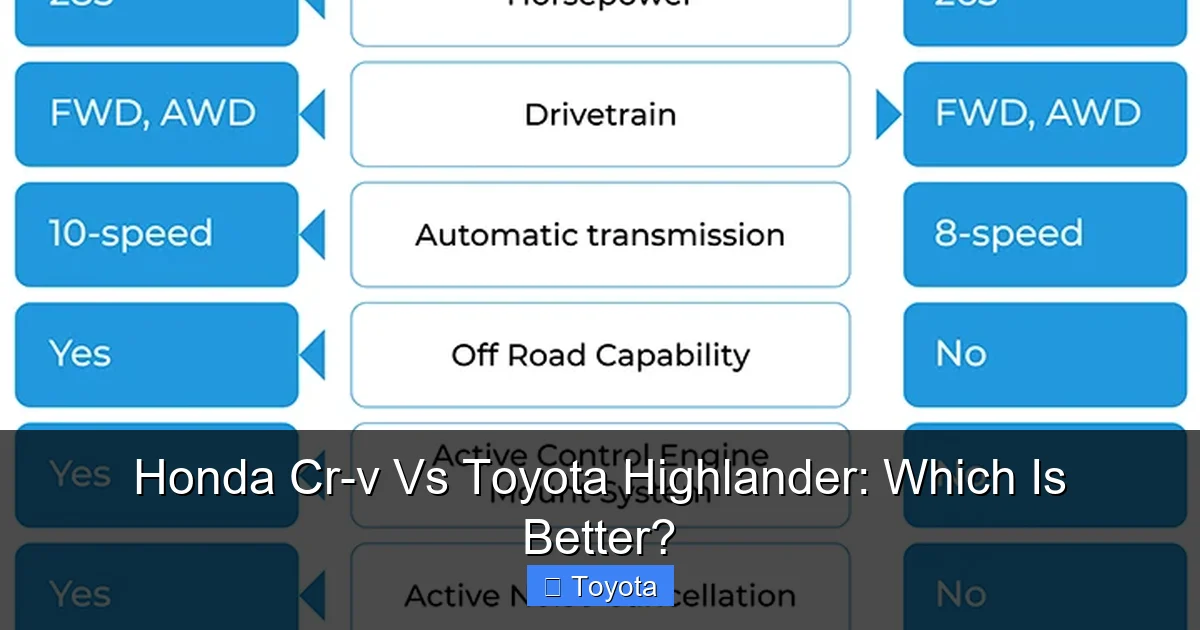
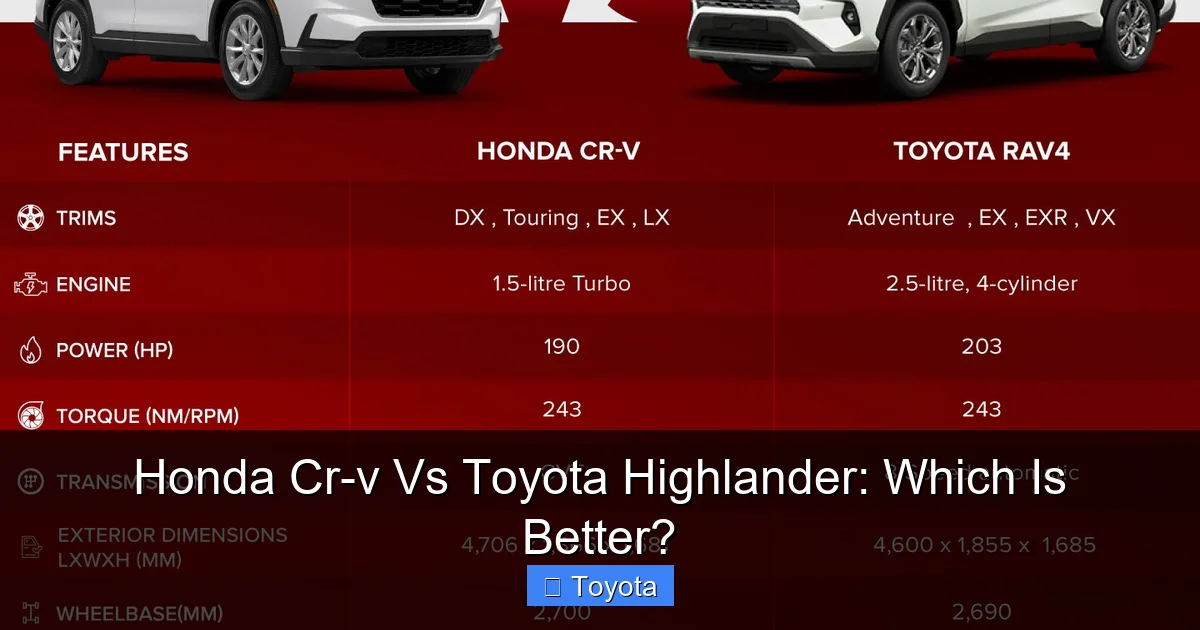
The 2024 Honda CR-V comes with a single engine option: a 1.5-liter turbocharged four-cylinder that produces 190 horsepower and 179 lb-ft of torque. It’s paired with a continuously variable transmission (CVT) that delivers smooth acceleration and excellent fuel economy. Front-wheel drive is standard, with all-wheel drive available as an option.
Visual guide about Honda Cr-v Vs Toyota Highlander: Which Is Better?
Image source: d2hucwwplm5rxi.cloudfront.net
This engine is more than adequate for daily driving. It’s quick off the line, handles highway merges with ease, and remains quiet at cruising speeds. The CR-V isn’t built for towing heavy loads—its maximum towing capacity is just 1,500 pounds—but that’s typical for compact SUVs. If you’re not planning to haul a boat or trailer, this won’t be an issue.
One standout feature is Honda’s Earth Dreams technology, which optimizes fuel efficiency without sacrificing performance. The CR-V also includes an Eco Mode that adjusts throttle response and climate control to maximize mileage.
Toyota Highlander: Stronger and More Capable
The Toyota Highlander offers two powertrains: a standard 3.5-liter V6 engine and an available hybrid option. The V6 delivers 295 horsepower and 263 lb-ft of torque, paired with an eight-speed automatic transmission. This engine provides confident acceleration, especially when merging or climbing hills. It also enables a much higher towing capacity—up to 5,000 pounds when properly equipped. That’s enough to tow a small camper, jet skis, or a utility trailer.
The hybrid version combines a 2.5-liter four-cylinder engine with electric motors for a total of 243 horsepower. While not as powerful as the V6, the hybrid delivers better fuel economy and a smoother, quieter ride. It’s ideal for drivers who want efficiency without giving up space and capability.
Both Highlander powertrains come with standard front-wheel drive, with all-wheel drive available. The AWD system is more robust than the CR-V’s, offering better traction in snow, rain, or light off-road conditions.
Fuel Economy: Saving at the Pump
Honda CR-V: The Efficiency Champion
When it comes to fuel economy, the Honda CR-V is hard to beat. The front-wheel-drive model achieves an EPA-estimated 28 mpg in the city and 34 mpg on the highway, for a combined 30 mpg. Even with all-wheel drive, it still manages 27/32 mpg (city/highway), which is excellent for an SUV.

Visual guide about Honda Cr-v Vs Toyota Highlander: Which Is Better?
Image source: i.ytimg.com
This efficiency translates to real savings. If you drive 15,000 miles per year and gas costs $3.50 per gallon, the CR-V will cost you about $1,750 annually in fuel. That’s significantly less than many competitors, especially larger SUVs.
The CR-V’s lightweight design, aerodynamic shape, and efficient engine all contribute to its impressive mileage. It’s a great choice for commuters, weekend travelers, or anyone looking to reduce their carbon footprint.
Toyota Highlander: Balanced Efficiency for a Larger SUV
The Highlander’s fuel economy depends on the powertrain. The V6 model gets an EPA-estimated 21 mpg city and 29 mpg highway, for a combined 24 mpg. That’s respectable for a three-row SUV, but noticeably lower than the CR-V.
The hybrid version is much more efficient: 36 mpg city, 35 mpg highway, and 36 mpg combined. That’s a huge improvement and makes the Highlander Hybrid competitive with smaller SUVs. In fact, it’s one of the most fuel-efficient three-row SUVs on the market.
While the standard Highlander won’t save you as much at the pump, the hybrid offers a compelling balance of space, power, and efficiency. If you’re set on a larger SUV but still care about fuel costs, the hybrid is the way to go.
Interior and Technology: Comfort and Connectivity
Honda CR-V: User-Friendly and Modern
The CR-V’s interior is a standout in the compact SUV segment. The dashboard is clean and intuitive, with physical buttons for climate and audio controls—something many rivals have replaced with touchscreens. This makes it easier to use while driving.
The standard infotainment system includes a 7-inch touchscreen with Apple CarPlay and Android Auto integration. Higher trims add wireless connectivity, a premium Bose audio system, and a 9-inch display. The system is responsive and easy to navigate, even for tech newcomers.
Other tech features include a digital instrument cluster, wireless phone charging, and multiple USB ports. The CR-V also offers Honda’s CabinTalk system, which lets the driver broadcast their voice to rear passengers—handy for long trips with kids.
Toyota Highlander: Premium Feel with Advanced Tech
The Highlander’s interior leans more upscale, especially on higher trims like the Limited and Platinum. Soft leather, real wood accents, and ambient lighting create a luxurious atmosphere. The dashboard is well-organized, with a mix of physical and touch controls.
The base model comes with an 8-inch touchscreen, but higher trims upgrade to a stunning 12.3-inch display. This larger screen supports wireless Apple CarPlay and Android Auto, plus built-in navigation and a premium JBL audio system. The interface is smooth and intuitive, with crisp graphics and quick response times.
The Highlander also includes Toyota’s latest connectivity features, such as remote start via smartphone app, Wi-Fi hotspot capability, and over-the-air software updates. The available digital rearview mirror uses a camera to eliminate blind spots, especially useful when the cargo area is full.
Safety Features and Ratings: Peace of Mind on the Road
Honda CR-V: Top Safety Pick
The Honda CR-V has earned a Top Safety Pick+ award from the Insurance Institute for Highway Safety (IIHS) and a 5-star overall safety rating from the National Highway Traffic Safety Administration (NHTSA). It comes standard with Honda Sensing, a suite of advanced driver-assistance features.
This includes forward collision warning, automatic emergency braking, lane departure warning, lane keeping assist, adaptive cruise control, and traffic sign recognition. Higher trims add blind-spot monitoring, rear cross-traffic alert, and a driver attention monitor.
The CR-V’s structure is designed to absorb impact energy, and it includes eight airbags for comprehensive protection. Its lower center of gravity also reduces the risk of rollover.
Toyota Highlander: Safety First
The Highlander also earns top safety honors, with a Top Safety Pick+ from IIHS and a 5-star NHTSA rating. It comes standard with Toyota Safety Sense 2.5+, which includes pre-collision warning with pedestrian detection, lane departure alert with steering assist, automatic high beams, and dynamic radar cruise control.
Unique to the Highlander is the standard Rear Seat Reminder, which alerts you to check the back seat before exiting the vehicle—a simple but potentially life-saving feature. Higher trims add blind-spot monitoring, rear cross-traffic braking, and a 360-degree camera system.
The Highlander’s larger size and higher ride height can improve visibility, but its longer hood may require more attention when parking in tight spaces. Still, its safety tech and build quality make it one of the safest family SUVs available.
Price and Value: What You Get for Your Money
Honda CR-V: Affordable and Practical
The 2024 Honda CR-V starts at around $29,500 for the base LX trim. That’s competitive for a well-equipped compact SUV. Even the top-tier Touring trim, which includes leather seats, a sunroof, and premium audio, tops out at about $37,000.
With strong resale value and low maintenance costs, the CR-V offers excellent long-term value. Honda’s reputation for reliability means fewer trips to the mechanic and lower repair bills over time.
Toyota Highlander: More Features, Higher Price
The Highlander starts at approximately $38,500 for the base L trim. That’s significantly more than the CR-V, but you’re getting a larger vehicle with more power and space. The hybrid version starts around $42,000, and the top Platinum trim can exceed $52,000.
Like the CR-V, the Highlander holds its value well. Toyota’s legendary durability and low cost of ownership make it a smart investment, especially for families who plan to keep their vehicle for 10+ years.
When comparing price to features, the Highlander offers more standard tech and safety on higher trims, but the CR-V delivers better value for budget-conscious buyers.
Which One Should You Choose?
So, which is better: the Honda CR-V or the Toyota Highlander? The answer depends on your lifestyle, family size, and driving needs.
If you’re a single professional, couple, or small family who values fuel efficiency, easy maneuverability, and a lower price tag, the Honda CR-V is the better choice. It’s perfect for city driving, daily commutes, and weekend getaways. Its compact size makes parking a breeze, and its fuel economy will save you money over time.
On the other hand, if you have a larger family, frequently transport passengers, or need to tow gear, the Toyota Highlander is the way to go. Its three rows, powerful engine, and generous cargo space make it ideal for road trips, carpools, and outdoor adventures. The hybrid version adds efficiency without sacrificing capability.
Both SUVs are reliable, safe, and packed with modern features. But they serve different purposes. The CR-V is a smart, efficient daily driver. The Highlander is a capable, spacious family hauler.
Ultimately, the best SUV is the one that fits your life. Test drive both, compare your priorities, and choose the one that feels right. Whether you go with Honda’s compact champion or Toyota’s family favorite, you’re getting a vehicle built to last.
Frequently Asked Questions
Is the Honda CR-V or Toyota Highlander more reliable?
Both are highly reliable, but Toyota has a slight edge in long-term dependability. The Highlander’s simpler V6 engine and proven hybrid system contribute to its strong reputation. The CR-V is also very reliable, with few major issues reported.
Can the Honda CR-V seat seven people?
No, the CR-V only seats five passengers. It does not offer a third row. If you need seating for six or more, the Toyota Highlander is the better option.
Which SUV has better fuel economy?
The Honda CR-V wins in fuel efficiency, with up to 30 mpg combined. The Highlander Hybrid comes close at 36 mpg combined, but the standard V6 model gets only 24 mpg combined.
Can the Toyota Highlander tow more than the CR-V?
Yes, by a significant margin. The Highlander can tow up to 5,000 pounds with the V6 engine, while the CR-V is limited to 1,500 pounds. This makes the Highlander better for trailers, boats, or campers.
Which SUV has more cargo space?
The Toyota Highlander offers more total cargo space—up to 84.3 cubic feet with all seats folded—compared to the CR-V’s 75.8 cubic feet. However, the CR-V has more space behind the rear seats.
Are both SUVs available with all-wheel drive?
Yes, both the Honda CR-V and Toyota Highlander offer all-wheel drive as an option. It’s recommended for drivers in snowy or wet climates for better traction and stability.