
What Does the Snow Button Do in a Toyota Highlander?

The snow button in a Toyota Highlander adjusts the vehicle’s throttle response and transmission shift points to improve traction and control in slippery conditions like snow, ice, or mud. It’s a simple but powerful feature designed to help drivers maintain stability and reduce wheel spin when road conditions get tough.
If you’ve ever driven a Toyota Highlander in the winter—especially in snowy or icy conditions—you’ve probably noticed a small button labeled “SNOW” on the center console. It might look unassuming, but this little button plays a big role in how your SUV handles when the roads turn treacherous. Whether you’re navigating a snow-covered driveway, driving through a blizzard, or simply dealing with slushy morning commutes, understanding what the snow button does can make a real difference in your safety and confidence behind the wheel.
The Toyota Highlander is known for its reliability, comfort, and family-friendly design. But it’s also built with practical features that help drivers tackle challenging weather. The snow button is one of those often-overlooked tools that can significantly improve your vehicle’s performance in low-traction environments. It’s not magic—it won’t make your Highlander float over ice—but it does give you more control when you need it most.
In this article, we’ll dive deep into what the snow button actually does, how it works, when to use it, and why it’s such a valuable feature for Highlander owners. Whether you’re a new owner or have been driving your Highlander for years, this guide will help you get the most out of this helpful winter driving aid.
Key Takeaways
- Improves Traction in Slippery Conditions: The snow button reduces engine power delivery to prevent wheel spin on snow, ice, or wet roads.
- Adjusts Throttle Response: It softens throttle input, making acceleration smoother and more controlled.
- Modifies Transmission Shift Patterns: The transmission shifts earlier to keep engine RPMs lower, enhancing stability.
- Works with AWD and FWD Models: Available on both front-wheel drive and all-wheel drive Highlander trims.
- Not a Replacement for Winter Tires: While helpful, the snow button doesn’t replace the need for proper winter tires or safe driving habits.
- Easy to Use and Toggle On/Off: Simply press the button on the center console to activate or deactivate the mode.
- Part of Toyota’s Safety and Comfort Features: Designed to support drivers in adverse weather without compromising everyday driving performance.
📑 Table of Contents
What Is the Snow Button in a Toyota Highlander?
The snow button in a Toyota Highlander is a driver-selectable mode that modifies the vehicle’s engine and transmission behavior to improve traction and stability in slippery conditions. When activated, it adjusts how the throttle responds to your foot on the accelerator and changes the way the automatic transmission shifts gears. The goal is to reduce the likelihood of wheel spin and help the vehicle maintain better control on snow, ice, mud, or wet pavement.
This feature is available on most modern Toyota Highlander models, including both front-wheel drive (FWD) and all-wheel drive (AWD) versions. It’s typically located on the center console, near other driving mode buttons like “ECO” or “SPORT.” The button is usually marked with a snowflake icon or the word “SNOW,” making it easy to identify.
When you press the snow button, a light or indicator may appear on your dashboard, confirming that the mode is active. You can turn it off at any time by pressing the button again. The system is designed to be intuitive—no complicated menus or settings to navigate. Just press and go.
It’s important to note that the snow button is not a standalone safety system like traction control or stability control. Instead, it works alongside those systems to give you an extra layer of control. Think of it as a “gentler” driving mode that helps prevent sudden movements that could lead to skidding or loss of control.
How Does the Snow Button Work?
The snow button works by making two key adjustments to your Highlander’s performance: throttle response and transmission shift logic.
First, it softens the throttle response. Normally, when you press the accelerator, the engine responds quickly, especially in sportier driving modes. But in snow or ice, that quick response can cause the wheels to spin before they gain traction. The snow button reduces this sensitivity, so even if you press the gas pedal firmly, the engine delivers power more gradually. This helps prevent wheel slip and gives you smoother, more predictable acceleration.
Second, it changes the transmission shift pattern. In normal driving, the transmission shifts at higher RPMs to deliver more power and responsiveness. But in snow mode, the transmission shifts earlier—usually at lower RPMs. This keeps the engine in a lower power range, reducing the chance of sudden bursts of torque that could break traction. It also helps maintain a steady speed, which is especially useful when climbing hills or driving on uneven surfaces.
For example, imagine you’re trying to pull out of a snowy driveway. Without the snow button, your wheels might spin as you try to accelerate. But with the snow button on, the engine delivers power more gently, and the transmission shifts sooner, helping your tires grip the snow instead of spinning uselessly.
These adjustments are subtle but effective. They don’t make your Highlander slower—they make it smarter in low-traction conditions.
Is the Snow Button the Same as Traction Control?
No, the snow button is not the same as traction control, although they work together to improve safety.
Traction control is an automatic safety system that constantly monitors wheel speed. If it detects that one or more wheels are spinning faster than the others (a sign of loss of traction), it applies the brakes to that wheel or reduces engine power to regain grip. It’s always active when the vehicle is running, unless manually turned off.
The snow button, on the other hand, is a proactive driver-controlled mode. It doesn’t wait for wheel spin to happen—it prevents it from occurring in the first place by adjusting throttle and transmission behavior. Think of traction control as the “emergency responder” and the snow button as the “preventive measure.”
Using both together gives you the best of both worlds: the snow button helps you avoid slipping, and traction control steps in if you do start to lose grip. They complement each other perfectly, especially in challenging winter conditions.
When Should You Use the Snow Button?
Visual guide about What Does the Snow Button Do in a Toyota Highlander?
Image source: bryansgarage.com
Knowing when to use the snow button is just as important as understanding how it works. It’s not meant for everyday driving—only for specific situations where traction is compromised.
Ideal Conditions for Using the Snow Button
The snow button is most effective in the following scenarios:
– **Fresh Snow or Deep Slush:** When roads are covered in snow or slush, tire grip is significantly reduced. The snow button helps prevent wheel spin during acceleration.
– **Icy Roads:** Black ice or frost-covered surfaces offer little traction. Gentle throttle input from snow mode can help you maintain control.
– **Muddy or Gravel Roads:** Loose surfaces like mud or gravel can cause wheels to slip. The snow button’s smoother power delivery helps maintain forward momentum.
– **Steep Driveways or Hills:** Starting from a stop on an incline in snowy conditions can be tricky. The snow button helps you accelerate gradually without spinning your wheels.
– **Wet or Rain-Slicked Roads:** While not as extreme as snow, heavy rain can reduce traction. Some drivers find snow mode helpful in very wet conditions, especially if hydroplaning is a concern.
When NOT to Use the Snow Button
While the snow button is helpful in low-traction situations, it’s not always the best choice. Avoid using it in these cases:
– **Dry, Clear Roads:** On normal pavement, the snow button can make your Highlander feel sluggish and less responsive. It’s designed for slippery conditions, not everyday driving.
– **Highway Speeds:** At higher speeds, you want full throttle response and normal transmission behavior. Using snow mode on the highway can reduce performance and fuel efficiency.
– **Performance Driving:** If you’re driving aggressively or need quick acceleration (like merging onto a highway), snow mode will limit your vehicle’s responsiveness.
In short, use the snow button when you need extra control in slippery conditions, and turn it off when roads are clear and dry.
Practical Example: Driving in a Snowstorm
Let’s say you’re driving your Highlander home during a winter storm. The roads are covered in snow, and visibility is low. You approach a stop sign, and as you try to accelerate, your front wheels start to spin. This is a common issue—especially in FWD models—when traction is poor.
Now, imagine you had pressed the snow button before starting your drive. As you press the accelerator, the engine responds more gently. The transmission shifts early, keeping RPMs low. Instead of spinning, your tires grip the snow and you move forward smoothly. You feel more in control, and the risk of getting stuck or sliding is reduced.
This is the real benefit of the snow button: it gives you a better chance of maintaining forward momentum without losing control.
Does the Snow Button Work on All Highlander Models?
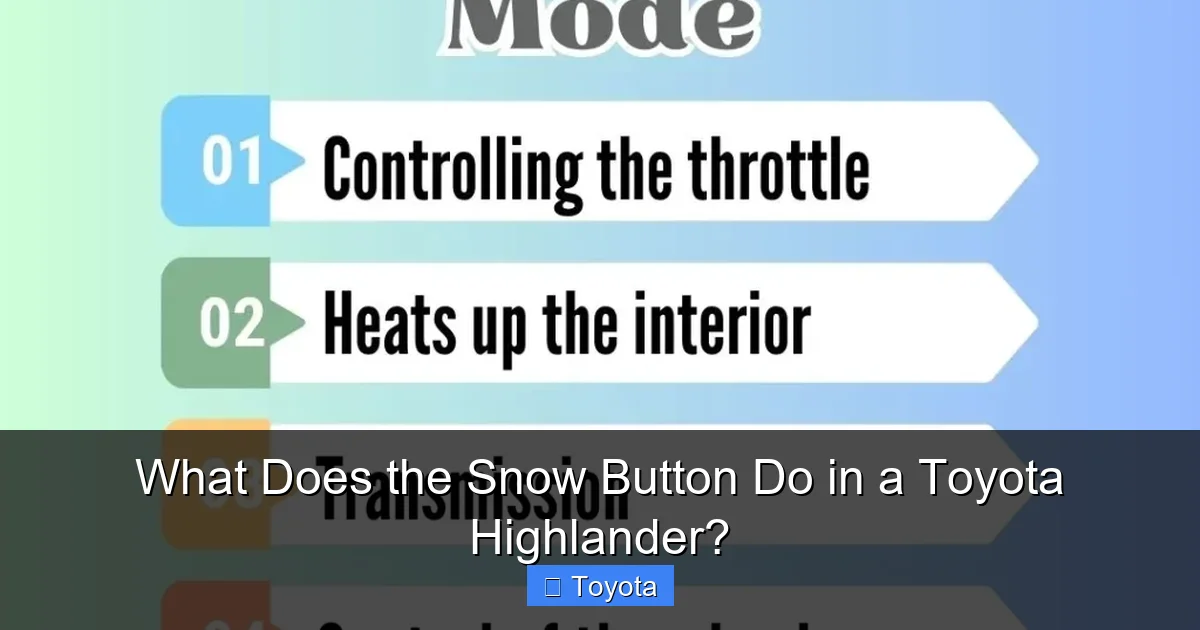
Visual guide about What Does the Snow Button Do in a Toyota Highlander?
Image source: gearfixup.com
Yes, the snow button is available on most Toyota Highlander models from the early 2000s onward, though its exact functionality may vary slightly depending on the year and trim level.
Availability by Model Year and Trim
– **2001–2007 Highlander (First Generation):** Early models may have a basic snow mode that primarily affects throttle response.
– **2008–2013 Highlander (Second Generation):** Improved integration with the transmission and throttle systems. Available on most trims, including V6 models.
– **2014–2019 Highlander (Third Generation):** Enhanced snow mode with better coordination between engine, transmission, and traction control. Standard on most trims.
– **2020–Present Highlander (Fourth Generation):** The snow button is standard across all trims, including the hybrid models. It works seamlessly with Toyota’s advanced safety suite (Toyota Safety Sense).
Both front-wheel drive (FWD) and all-wheel drive (AWD) Highlanders come equipped with the snow button. While AWD provides better overall traction, the snow button adds an extra layer of control by managing how power is delivered to the wheels.
Hybrid Highlander and the Snow Button
The Toyota Highlander Hybrid also includes the snow button, and it works similarly to the gas-only version. However, because hybrids use electric motors and regenerative braking, the system may feel slightly different. The snow mode still softens throttle response and adjusts shift patterns, but the electric motor’s instant torque can be managed more precisely.
In fact, some drivers find that the hybrid’s electric motor provides even smoother low-speed control in snow mode, making it especially useful for city driving in winter.
How the Snow Button Compares to Other Driving Modes
Visual guide about What Does the Snow Button Do in a Toyota Highlander?
Image source: gearfixup.com
The Toyota Highlander offers several driving modes, each designed for different conditions. Understanding how the snow button compares to others can help you choose the right one for the situation.
Snow Mode vs. ECO Mode
ECO mode is designed to improve fuel efficiency by reducing engine power, softening throttle response, and optimizing climate control. It’s great for everyday driving when you want to save gas.
Snow mode, on the other hand, prioritizes traction and control over fuel economy. While both modes soften throttle response, snow mode also adjusts transmission shift points specifically for low-traction conditions. ECO mode doesn’t make these adjustments, so it’s not ideal for snow or ice.
Snow Mode vs. SPORT Mode
SPORT mode does the opposite of snow mode. It makes the throttle more responsive, delays transmission shifts for higher RPMs, and improves handling for more dynamic driving. It’s perfect for winding roads or when you want a more engaging drive.
But in snow or ice, SPORT mode can be dangerous. The increased throttle sensitivity and higher power delivery can easily cause wheel spin. Always use snow mode in slippery conditions—never SPORT.
Snow Mode vs. AWD Lock (if equipped)
Some AWD Highlander models include an “AWD Lock” button, which locks the front and rear axles together for better traction off-road or in deep snow. This is different from snow mode.
AWD Lock sends power evenly to all four wheels, while snow mode manages how that power is delivered. You can—and often should—use both together in severe conditions. For example, use AWD Lock for climbing a snowy hill, and snow mode to prevent wheel spin during acceleration.
Tips for Getting the Most Out of the Snow Button
To maximize the effectiveness of the snow button, follow these practical tips:
1. Use It Before You Need It
Don’t wait until you’re already slipping to press the snow button. Activate it as soon as you encounter snow, ice, or slush. This gives you the best chance of maintaining control from the start.
2. Combine It with Winter Tires
The snow button is helpful, but it’s not a substitute for proper winter tires. Winter tires are made with softer rubber and deeper treads that grip snow and ice far better than all-season tires. Use the snow button in combination with winter tires for the best performance.
3. Drive Smoothly
Even with the snow button on, avoid sudden movements. Accelerate, brake, and steer gently. The snow button helps, but your driving habits matter most.
4. Turn It Off When Roads Clear
Once you’re back on dry pavement, turn off the snow button. It’s not designed for normal driving and can reduce fuel efficiency and responsiveness.
5. Practice in a Safe Area
If you’re new to the snow button, practice using it in an empty parking lot during light snow. Get a feel for how your Highlander responds. This builds confidence for real-world winter driving.
6. Check Your Owner’s Manual
Every Highlander model is slightly different. Your owner’s manual will have specific details about how the snow button works in your vehicle, including any limitations or recommendations.
Myths and Misconceptions About the Snow Button
There are several myths about the snow button that can lead to confusion or misuse. Let’s clear them up.
Myth 1: The Snow Button Makes Your Car “Snow-Proof”
False. The snow button improves traction and control, but it doesn’t make your Highlander immune to skidding or getting stuck. It’s a helpful tool, not a magic solution.
Myth 2: You Should Always Use It in Winter
Not true. Only use it when roads are slippery. On dry winter days, normal driving mode is better for performance and fuel economy.
Myth 3: It Only Works with AWD
Incorrect. The snow button works on both FWD and AWD Highlanders. While AWD helps with overall traction, the snow button improves how power is delivered in any configuration.
Myth 4: It Slows Down Your Car Too Much
Not necessarily. The snow button makes acceleration smoother, but it doesn’t drastically reduce speed. You’ll still be able to drive normally—just with more control.
Myth 5: It’s the Same as 4WD
No. The Highlander is not a 4WD vehicle. It uses AWD, which is different. The snow button works with AWD but doesn’t convert it into a 4WD system.
Conclusion
The snow button in a Toyota Highlander is a simple yet powerful feature that can make winter driving safer and more manageable. By adjusting throttle response and transmission shift patterns, it helps prevent wheel spin and improves traction on snow, ice, and other slippery surfaces. It’s easy to use, available on most models, and works alongside other safety systems like traction control and AWD.
While it’s not a replacement for winter tires or cautious driving, the snow button is a valuable tool in your winter driving toolkit. Use it wisely—activate it in low-traction conditions, combine it with good driving habits, and turn it off when roads are clear.
Whether you’re navigating a snowy school pickup route or driving through a mountain pass, the snow button gives you one more reason to trust your Highlander in any weather. It’s just one of the many ways Toyota designs its vehicles to keep you safe, confident, and in control—no matter what the forecast says.
Frequently Asked Questions
What does the snow button do in a Toyota Highlander?
The snow button adjusts the vehicle’s throttle response and transmission shift points to improve traction and control in slippery conditions like snow, ice, or mud. It helps prevent wheel spin by delivering power more gradually.
Can I use the snow button on dry roads?
It’s not recommended. The snow button is designed for low-traction conditions. Using it on dry roads can make your Highlander feel sluggish and reduce fuel efficiency.
Does the snow button work on all Highlander models?
Yes, the snow button is available on most Toyota Highlander models from the early 2000s onward, including both gas and hybrid versions, and on FWD and AWD trims.
Is the snow button the same as traction control?
No. Traction control is an automatic system that reacts to wheel spin, while the snow button is a driver-activated mode that prevents wheel spin by adjusting throttle and transmission behavior.
Should I use the snow button with winter tires?
Yes, absolutely. Winter tires provide the best grip in cold weather, and using them with the snow button gives you the safest and most controlled driving experience in winter conditions.
Can I use the snow button and AWD Lock at the same time?
Yes, and it’s often recommended in severe conditions. AWD Lock sends power to all four wheels, while the snow button manages how that power is delivered to prevent slipping.