
How Many Catalytic Converters Are in a Toyota Tundra?

The number of catalytic converters in a Toyota Tundra varies by model year, engine type, and drivetrain configuration—typically ranging from two to four. Understanding your Tundra’s setup helps with maintenance, emissions compliance, and diagnosing performance issues.
If you’re a Toyota Tundra owner—or thinking about becoming one—you’ve probably heard the term “catalytic converter” thrown around, especially when talking about emissions, performance, or that dreaded check engine light. But how many catalytic converters are actually in a Toyota Tundra? The answer isn’t as simple as you might think. It depends on several factors: the year your Tundra was made, the engine under the hood, whether it’s two-wheel or four-wheel drive, and even where it was originally sold.
The catalytic converter is a critical part of your vehicle’s exhaust system. It works like a mini chemical factory, converting harmful gases like carbon monoxide, nitrogen oxides, and unburned hydrocarbons into less harmful substances like carbon dioxide, nitrogen, and water vapor. Because of increasingly strict environmental regulations, modern vehicles—especially full-size trucks like the Tundra—are equipped with multiple catalytic converters to ensure they meet emissions standards.
So, let’s break it down. Most Toyota Tundras built from the early 2000s onward have between two and four catalytic converters. But why the variation? And what does that mean for you as a driver? In this guide, we’ll walk you through everything you need to know about catalytic converters in the Toyota Tundra—how many you have, where they’re located, why they matter, and what to do if one fails.
Whether you’re troubleshooting a performance issue, planning a repair, or just curious about your truck’s emissions system, this article will give you the clear, practical information you need. We’ll cover model-specific details, explain the differences between engine types, and even offer tips on maintenance and replacement. By the end, you’ll know exactly how many catalytic converters are in your Tundra—and why that number matters.
Key Takeaways
- Most Toyota Tundras have two to four catalytic converters: The exact number depends on the engine (V6 or V8), model year, and whether it’s a 2WD or 4WD model.
- V8 engines usually require more catalytic converters: Due to higher emissions output, V8-powered Tundras often have dual exhaust systems with two or more catalytic converters.
- Pre-2005 models may have fewer converters: Older Tundras, especially early V6 versions, sometimes came with only one or two catalytic converters before stricter emissions standards.
- Federal vs. California emissions standards matter: Tundras sold in California or other CARB-compliant states often have additional catalytic converters to meet stricter regulations.
- Replacing catalytic converters can be expensive: OEM units cost $1,000–$3,000+ each, so knowing how many you have helps budget for repairs.
- Signs of a failing catalytic converter include reduced fuel economy, check engine lights, and rattling noises: Early diagnosis can prevent further engine damage.
- Aftermarket options exist but may affect warranty or emissions compliance: Always verify compatibility and local laws before replacing.
📑 Table of Contents
- Understanding Catalytic Converters: Why They Matter in the Toyota Tundra
- How Many Catalytic Converters Are in a Toyota Tundra? A Model-by-Model Breakdown
- Where Are the Catalytic Converters Located in a Toyota Tundra?
- Why Does the Number of Catalytic Converters Vary?
- Signs of a Failing Catalytic Converter in Your Toyota Tundra
- Replacing Catalytic Converters in a Toyota Tundra: What You Need to Know
- Conclusion: Know Your Tundra’s Catalytic Converter Setup
Understanding Catalytic Converters: Why They Matter in the Toyota Tundra
Before we dive into the specifics of how many catalytic converters are in a Toyota Tundra, it helps to understand what these components do—and why they’re so important. The catalytic converter is essentially your vehicle’s environmental gatekeeper. It sits in the exhaust system, usually between the engine and the muffler, and uses precious metals like platinum, palladium, and rhodium to trigger chemical reactions that neutralize toxic emissions.
In the U.S., the Clean Air Act and regulations from the Environmental Protection Agency (EPA) require all vehicles to meet strict emissions standards. The Toyota Tundra, as a full-size pickup truck with powerful engines, must comply with these rules—especially since trucks often produce more emissions than smaller vehicles. That’s where catalytic converters come in. They reduce the amount of pollution your truck releases into the atmosphere, helping protect air quality and public health.
But here’s the thing: not all catalytic converters are created equal. Some are more efficient than others, and some are designed to handle higher exhaust volumes. That’s why the number and placement of catalytic converters in your Tundra depend on its engine size and configuration. For example, a V6 engine might need fewer converters than a V8, simply because it produces less exhaust gas. Similarly, trucks sold in states with stricter emissions laws—like California—often have additional converters to meet those requirements.
Understanding how many catalytic converters your Tundra has isn’t just about satisfying curiosity. It’s also practical. If your check engine light comes on and a mechanic says you need a new catalytic converter, knowing how many you have can help you estimate the cost and scope of the repair. It can also help you spot potential issues early, like reduced fuel efficiency or unusual exhaust smells, which are common signs of a failing converter.
In short, catalytic converters are a vital part of your Tundra’s emissions system. They keep your truck running clean, compliant, and efficient. And knowing how many you have—and where they’re located—can save you time, money, and headaches down the road.
How Many Catalytic Converters Are in a Toyota Tundra? A Model-by-Model Breakdown
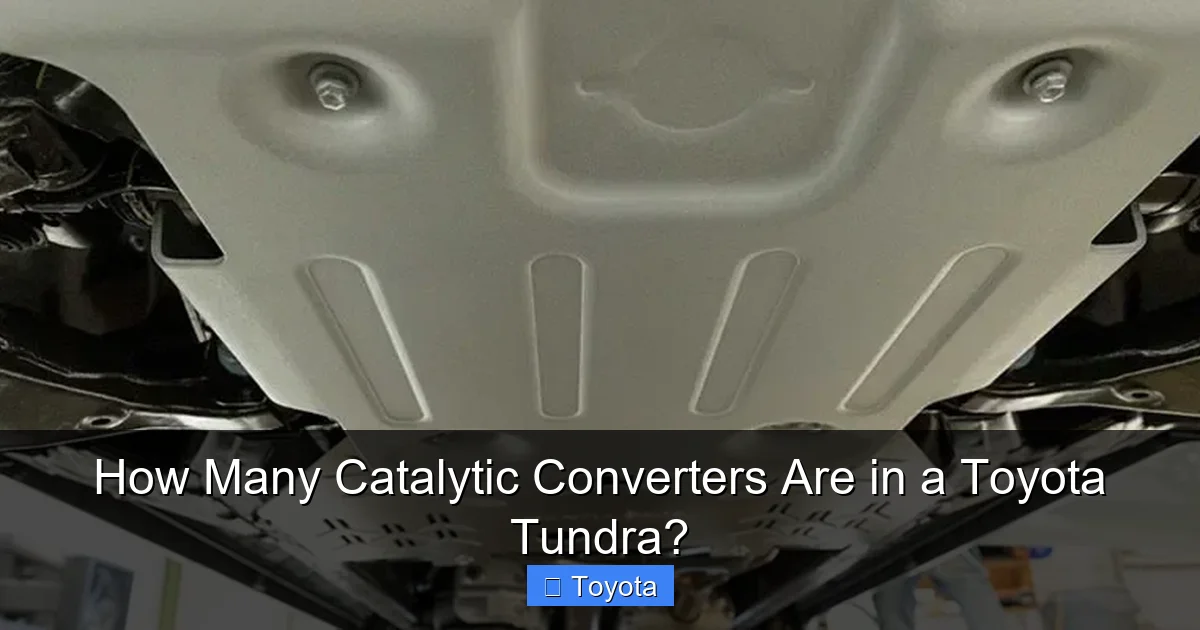
Visual guide about How Many Catalytic Converters Are in a Toyota Tundra?
Image source: moparmax.com
Now let’s get to the heart of the matter: how many catalytic converters are actually in a Toyota Tundra? The answer varies depending on the year, engine, and drivetrain. Let’s break it down by generation and engine type to give you a clear picture.
First Generation (2000–2006)
The original Toyota Tundra, introduced in 2000, came with two engine options: a 3.4L V6 and a 4.7L V8. The V6 models typically had two catalytic converters—one for each bank of cylinders—since they used a dual exhaust system. The V8 models, especially those with 4WD, often had three or even four catalytic converters. This was due to the higher emissions output and the need to meet both federal and California Air Resources Board (CARB) standards.
For example, a 2004 Tundra with the 4.7L V8 and 4WD might have:
– One catalytic converter per exhaust manifold (two total)
– One or two additional “underfloor” converters further down the exhaust system
This setup ensured that the truck met emissions requirements in all 50 states, including stricter CARB states.
Second Generation (2007–2013)
The second-generation Tundra introduced a more powerful 5.7L V8 engine, which significantly increased emissions output. As a result, Toyota equipped most V8 models with four catalytic converters. The 4.7L V8 and 4.0L V6 models typically had two or three, depending on the drivetrain and emissions package.
For instance, a 2010 Tundra with the 5.7L V8 and 4WD would usually have:
– Two “pre-cats” (one per cylinder bank, mounted close to the engine)
– Two “main cats” (located under the truck, near the transmission)
This four-converter setup was standard for V8 models, especially those sold in California or other emissions-restricted states.
Third Generation (2014–Present)
The current-generation Tundra, starting in 2014, continues to use the 5.7L V8 as its primary engine (until the 2022 refresh, which introduced a twin-turbo V6). Most of these trucks still have four catalytic converters, especially the V8 models. However, the 2022 and newer Tundras with the new 3.5L twin-turbo V6 (i-FORCE) also use multiple converters—typically two or three—due to the engine’s high output and strict emissions standards.
Even with the new engine, Toyota maintains a robust emissions system. The 2023 Tundra, for example, uses a close-coupled catalytic converter near the engine and additional underfloor converters to ensure compliance with EPA and CARB regulations.
Two-Wheel Drive vs. Four-Wheel Drive
Another factor that affects the number of catalytic converters is drivetrain. 4WD models often have more complex exhaust systems to accommodate the transfer case and driveshaft tunnel. This can require additional catalytic converters or different placement to ensure proper exhaust flow and emissions control.
In general, 4WD Tundras—especially V8 models—are more likely to have three or four catalytic converters, while 2WD models might get by with two or three, depending on the engine and emissions package.
Federal vs. California Emissions
If your Tundra was originally sold in California, New York, Vermont, or other CARB-compliant states, it likely has more catalytic converters than a federal-emissions model. These “CARB-spec” trucks are built to meet stricter standards and often include extra converters or more advanced catalytic technology.
You can usually tell if your Tundra is a CARB model by checking the emissions label under the hood or looking at the Vehicle Emissions Control Information (VECI) sticker. It will specify whether the vehicle meets federal or California standards.
Where Are the Catalytic Converters Located in a Toyota Tundra?
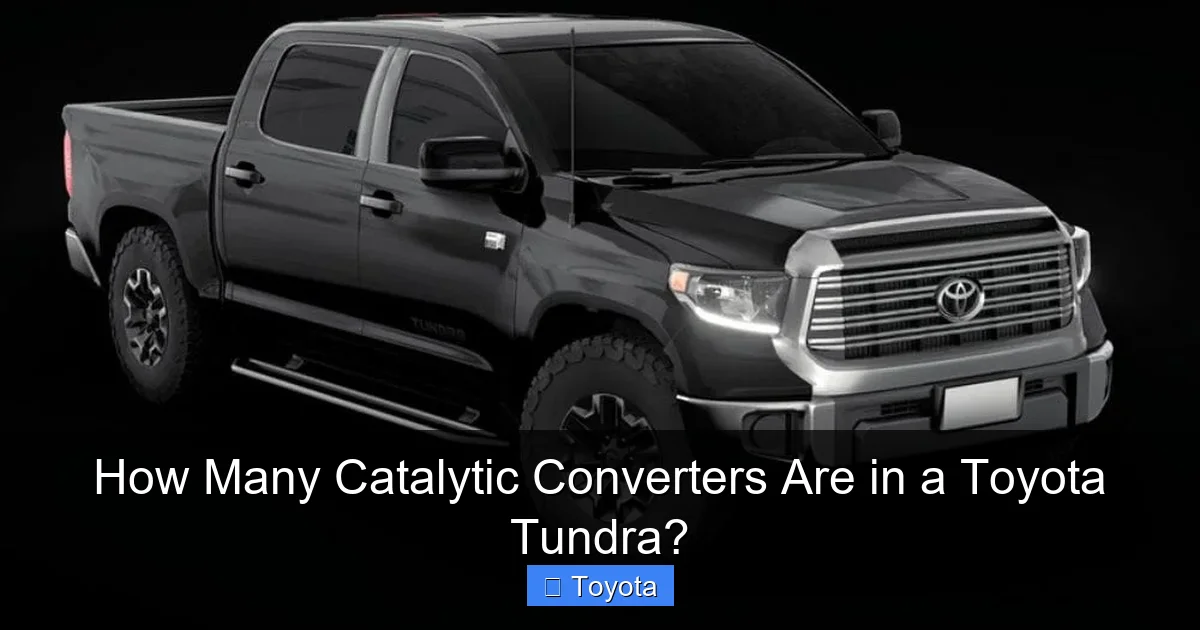
Visual guide about How Many Catalytic Converters Are in a Toyota Tundra?
Image source: vehiclefreak.com
Knowing how many catalytic converters your Tundra has is one thing—knowing where they’re located is another. The placement of these components can affect everything from maintenance to theft risk (yes, catalytic converter theft is a real problem).
Pre-Catalytic Converters (Pre-Cats)
These are the converters mounted closest to the engine, usually bolted directly to the exhaust manifolds. They’re often called “pre-cats” because they handle the hottest, most toxic exhaust gases right after they leave the combustion chamber. In a V8 Tundra, you’ll typically find one pre-cat on each side of the engine—so two total.
Pre-cats are critical for reducing emissions quickly, while the engine is still warming up. They’re also more prone to damage from overheating or engine misfires, which is why they’re often the first to fail.
Main Catalytic Converters (Underfloor Cats)
These are the larger converters located under the truck, usually near the transmission or rear axle. They handle the bulk of emissions cleanup after the exhaust has cooled slightly. In a four-converter setup, you’ll typically have two main cats—one on each side of the exhaust system.
Because they’re farther from the engine, underfloor cats are less likely to overheat but can still fail due to contamination (like oil or coolant leaks) or physical damage from road debris.
Secondary or Mid-Pipe Converters
Some Tundra models, especially older V8s, include an additional converter in the mid-pipe section of the exhaust. This “third cat” helps further reduce emissions and is often found in 4WD models or CARB-spec trucks.
These mid-pipe converters are less common in newer models, as advances in catalytic technology have made them less necessary. However, they’re still present in certain configurations.
Visual Identification Tips
If you’re under your Tundra with a flashlight, look for cylindrical or oval-shaped components with heat shields. They’re usually made of stainless steel and have oxygen sensor ports nearby. Pre-cats are smaller and closer to the engine, while main cats are larger and located further back.
You can also use an OBD2 scanner to check for trouble codes related to catalytic converter efficiency (like P0420 or P0430). These codes often indicate a problem with the main catalytic converter on the driver or passenger side.
Why Does the Number of Catalytic Converters Vary?
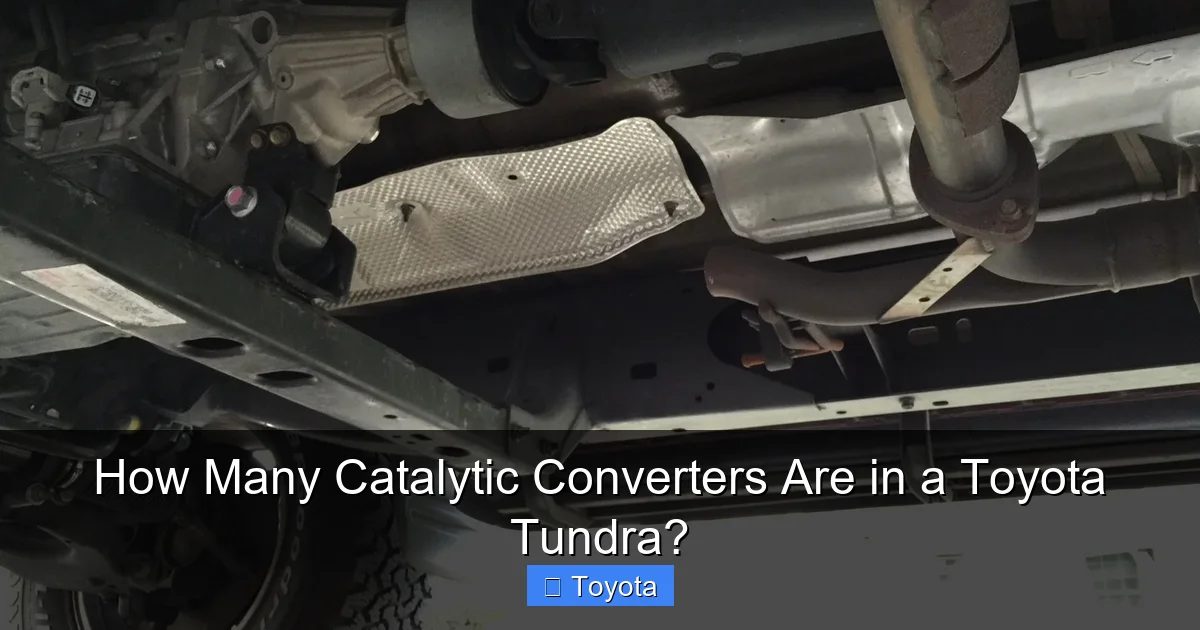
Visual guide about How Many Catalytic Converters Are in a Toyota Tundra?
Image source: auto-domain.com
So why do some Tundras have two catalytic converters while others have four? It all comes down to emissions regulations, engine design, and vehicle configuration.
Emissions Standards and Regulations
The U.S. has some of the strictest vehicle emissions standards in the world. Over the past two decades, the EPA and CARB have continually tightened these rules, requiring automakers to reduce pollutants like nitrogen oxides (NOx), carbon monoxide (CO), and hydrocarbons (HC).
Full-size trucks like the Tundra, with their large engines and high torque output, naturally produce more emissions than smaller vehicles. To meet these standards, Toyota had to install more catalytic converters—especially on V8 models.
For example, in the early 2000s, a V6 Tundra might have been able to meet emissions standards with just two converters. But by the late 2000s, even V6 models often required three or more to keep up with evolving regulations.
Engine Size and Configuration
Larger engines produce more exhaust gas, which means more pollutants to clean. The 5.7L V8 in the second- and third-generation Tundra generates significantly more emissions than the 3.4L V6, so it needs a more robust catalytic system.
Additionally, V8 engines typically have a 90-degree V configuration with two cylinder banks. This allows Toyota to use a dual exhaust system—one for each bank—which means each side can have its own catalytic converter. That’s why V8 Tundras often have two pre-cats and two main cats.
Drivetrain and Exhaust Layout
4WD models have more components under the truck—like the transfer case and driveshaft—which can interfere with exhaust routing. To maintain proper exhaust flow and emissions control, Toyota sometimes adds extra catalytic converters or repositions them to avoid obstructions.
For example, a 4WD Tundra might have a longer exhaust system with an additional converter to ensure all gases are treated before exiting the tailpipe.
Model Year and Technological Advances
As catalytic converter technology has improved, Toyota has been able to achieve better emissions control with fewer or more efficient converters. However, because regulations have also gotten stricter, the net result is often more converters—not fewer.
For instance, the 2022 Tundra with the new 3.5L twin-turbo V6 uses advanced catalysts with higher precious metal content, allowing it to meet emissions standards with fewer converters than older V8s. But because the engine is so powerful, it still requires multiple converters to handle the exhaust volume.
Signs of a Failing Catalytic Converter in Your Toyota Tundra
Even the best catalytic converters don’t last forever. Over time, they can become clogged, contaminated, or damaged—leading to performance issues and emissions problems. Here are the most common signs that one of your Tundra’s catalytic converters might be failing.
Check Engine Light
The most obvious sign is the check engine light. Modern Tundras use oxygen sensors before and after the catalytic converter to monitor its efficiency. If the converter isn’t working properly, the downstream sensor will detect higher levels of pollutants, triggering a trouble code like P0420 (Catalyst System Efficiency Below Threshold).
Don’t ignore this light. While it could be a faulty sensor, it’s often a sign of a failing converter—especially if the code persists after clearing it.
Reduced Fuel Economy
A clogged catalytic converter restricts exhaust flow, which can cause the engine to work harder and burn more fuel. If you notice your Tundra’s gas mileage dropping suddenly—say, from 15 mpg to 12 mpg—it could be a sign of a blocked converter.
This happens because the engine can’t expel exhaust gases efficiently, leading to backpressure and reduced performance.
Rattling Noise from Under the Truck
Catalytic converters contain a honeycomb-like ceramic substrate coated with precious metals. Over time, this substrate can break apart due to heat or physical damage, creating a rattling sound when you drive—especially over bumps or when idling.
If you hear a loose, metallic rattle from under your Tundra, it’s a strong indicator that the internal structure of the converter has failed.
Loss of Power or Poor Acceleration
A severely clogged converter can act like a choke, limiting the engine’s ability to breathe. This results in sluggish acceleration, reduced towing capacity, and a general feeling of weakness—especially when climbing hills or carrying a heavy load.
If your Tundra feels sluggish even with a full tank of gas and no other obvious issues, the catalytic converter could be the culprit.
Excessive Heat Under the Vehicle
A failing catalytic converter can overheat due to unburned fuel entering the exhaust system. This can cause the converter to glow red-hot under the truck—a dangerous condition that poses a fire risk.
If you notice unusual heat or see smoke coming from under your Tundra, pull over immediately and have it inspected.
Failed Emissions Test
If you live in a state that requires annual emissions testing, a failing catalytic converter will almost certainly cause your Tundra to fail. High levels of CO, HC, or NOx in the exhaust are clear signs that the converter isn’t doing its job.
Even if your truck passes the visual inspection, the tailpipe emissions test will reveal the problem.
Replacing Catalytic Converters in a Toyota Tundra: What You Need to Know
If one or more of your Tundra’s catalytic converters fails, replacement is usually the only solution. But it’s not cheap—and it’s not always straightforward.
Cost of Replacement
OEM (original equipment manufacturer) catalytic converters for the Toyota Tundra can cost anywhere from $1,000 to $3,000 or more per unit. That means replacing all four on a V8 model could cost $4,000–$12,000 at a dealership.
Aftermarket converters are cheaper—typically $300–$800 each—but they may not last as long or meet emissions standards. Some states, like California, require CARB-compliant aftermarket converters, which can cost nearly as much as OEM units.
Labor and Installation
Replacing a catalytic converter isn’t a DIY job for most people. It requires lifting the truck, removing exhaust components, and often welding or cutting. Labor costs can add $200–$600 or more, depending on the shop and the number of converters being replaced.
Pre-cats are especially tricky because they’re bolted to the exhaust manifolds and can be difficult to access.
Warranty and Legal Considerations
Federal law requires catalytic converters to be covered under emissions warranty for 8 years or 80,000 miles. If your Tundra is still under warranty, Toyota may cover the replacement cost.
However, tampering with or removing catalytic converters is illegal under the Clean Air Act—even if you install aftermarket units. Always use EPA- or CARB-compliant parts and have the work done by a certified technician.
Prevention Tips
To extend the life of your catalytic converters:
– Fix engine misfires promptly (they can dump unburned fuel into the exhaust)
– Avoid short trips that prevent the converter from reaching operating temperature
– Use the correct fuel and oil to prevent contamination
– Park in well-lit areas to deter theft
Conclusion: Know Your Tundra’s Catalytic Converter Setup
So, how many catalytic converters are in a Toyota Tundra? The answer depends on your truck’s year, engine, drivetrain, and emissions package—but most Tundras have between two and four. V8 models, especially 4WD and CARB-spec versions, typically have the most converters due to higher emissions output and stricter regulations.
Understanding your Tundra’s catalytic converter setup isn’t just about satisfying curiosity. It’s a practical step that can help you diagnose problems, estimate repair costs, and keep your truck running clean and compliant. Whether you’re dealing with a check engine light, planning a repair, or just want to know more about your vehicle, this knowledge puts you in control.
Remember: catalytic converters are essential for reducing pollution and protecting the environment. They’re also expensive to replace, so taking care of them—and knowing how many you have—can save you time, money, and stress in the long run.
If you’re ever unsure about your Tundra’s emissions system, consult your owner’s manual, check the VECI sticker under the hood, or talk to a trusted mechanic. With the right information, you can keep your Tundra running strong—and clean—for years to come.
Frequently Asked Questions
How many catalytic converters does a 2005 Toyota Tundra have?
A 2005 Toyota Tundra typically has two to four catalytic converters, depending on the engine and drivetrain. V6 models usually have two, while V8 4WD models often have three or four, especially if they meet California emissions standards.
Can I drive my Tundra with a bad catalytic converter?
You can drive short distances with a failing catalytic converter, but it’s not recommended. A clogged converter can cause engine damage, reduced performance, and increased emissions. Have it inspected and replaced as soon as possible.
Are catalytic converters covered under warranty?
Yes, catalytic converters are covered under the federal emissions warranty for 8 years or 80,000 miles, whichever comes first. If your Tundra is still under warranty, Toyota may cover the replacement cost.
Why are catalytic converters stolen from trucks like the Tundra?
Catalytic converters contain precious metals like platinum, palladium, and rhodium, which can be sold for scrap. Full-size trucks like the Tundra have higher ground clearance, making it easier for thieves to slide underneath and remove the converters quickly.
Can I replace my Tundra’s catalytic converter myself?
Replacing a catalytic converter is complex and usually requires professional tools and welding. It’s not recommended for most DIYers. Always use EPA- or CARB-compliant parts and have the work done by a certified technician.
How long do catalytic converters last in a Toyota Tundra?
Most catalytic converters last 100,000 to 150,000 miles, but they can fail earlier due to engine problems, contamination, or physical damage. Regular maintenance and prompt repairs can help extend their lifespan.
