
How to Reset Check Engine Light on a Toyota Highlander

Resetting the check engine light on your Toyota Highlander doesn’t have to be intimidating. Whether you’ve fixed the underlying issue or just want to clear the warning, this guide walks you through safe, proven methods—from using an OBD2 scanner to disconnecting the battery—so you can drive with confidence again.
Key Takeaways
- Understand why the light came on first: Never reset the light without diagnosing the root cause—common issues include loose gas caps, faulty oxygen sensors, or spark plug problems.
- Use an OBD2 scanner for accuracy: This tool reads error codes and safely clears the light after repairs, giving you peace of mind and preventing future surprises.
- Disconnecting the battery is a last resort: While it may reset the light, it also erases radio settings, trip data, and adaptive learning in your engine control unit (ECU).
- Drive cycles matter: After resetting, your Highlander needs to complete a drive cycle so the onboard computer can recheck systems and confirm the fix.
- Not all resets are permanent: If the problem isn’t truly resolved, the light will return—don’t ignore recurring warnings.
- Regular maintenance prevents flare-ups: Simple habits like tightening your gas cap and using quality fuel reduce the chances of false triggers.
- When to see a mechanic: Persistent or flashing lights indicate serious issues like catalytic converter failure or engine misfires—seek professional help immediately.
📑 Table of Contents
Why Is Your Toyota Highlander’s Check Engine Light On?
So, you’re driving along in your trusty Toyota Highlander—maybe heading to soccer practice, running errands, or cruising down the highway—and suddenly, that little orange engine icon pops up on your dashboard. Your heart skips a beat. Is it serious? Should you pull over? Can you even drive home?
First, take a breath. The check engine light (CEL) isn’t always a sign of doom. In fact, in many cases, it’s your vehicle’s way of saying, “Hey, something’s not quite right—let’s talk.” But ignoring it? That’s like ignoring a smoke alarm because you don’t smell smoke yet. It could save you from a much bigger headache down the road.
The check engine light is part of your Highlander’s onboard diagnostics system (OBD2), which monitors everything from emissions to fuel efficiency and engine performance. When a sensor detects an anomaly—like a drop in oxygen levels, a misfire, or a loose gas cap—it sends a signal to the engine control unit (ECU), which then triggers the light.
Now, here’s the thing: the light can mean anything from a minor glitch to a major mechanical failure. A flashing light usually indicates a severe issue, like an engine misfire that could damage the catalytic converter. A steady light? That’s more likely a moderate problem, such as a faulty sensor or emissions issue.
But before you panic or rush to reset it, ask yourself: *What changed recently?* Did you just fill up with gas? Maybe the gas cap wasn’t tightened properly—a surprisingly common cause. Did you notice rough idling, reduced fuel economy, or a strange noise? These clues can help pinpoint the issue.
Understanding why the light came on is the first and most important step. Resetting it without fixing the root cause is like putting a bandage on a broken bone—it might look better temporarily, but the problem’s still there, and it could get worse.
Common Causes of the Check Engine Light in a Toyota Highlander
Let’s break down some of the most frequent culprits behind that glowing engine icon in your Highlander:
– **Loose or faulty gas cap:** This is the #1 reason for a check engine light in many vehicles, including the Highlander. If the cap isn’t sealed tightly, fuel vapors can escape, triggering an evaporative emissions system (EVAP) fault. It’s an easy fix—just tighten it or replace it if cracked.
– **Oxygen (O2) sensor failure:** These sensors monitor the amount of unburned oxygen in your exhaust. If one goes bad, your engine might run rich (too much fuel) or lean (too little fuel), hurting performance and fuel economy.
– **Catalytic converter issues:** Over time, this emissions component can clog or fail, especially if you’ve ignored other problems like misfires. A failing converter often causes reduced power and increased emissions.
– **Spark plugs or ignition coils:** Worn spark plugs or faulty coils can cause engine misfires, leading to rough running and that dreaded CEL.
– **Mass airflow (MAF) sensor problems:** This sensor measures how much air enters the engine. If it’s dirty or malfunctioning, your Highlander might hesitate during acceleration or stall at idle.
– **Evaporative emissions system leaks:** Small leaks in the EVAP system—like cracked hoses or a faulty purge valve—can trigger the light even if there’s no visible damage.
– **Exhaust gas recirculation (EGR) valve issues:** A clogged or stuck EGR valve can cause rough idling and increased emissions.
Knowing these common causes helps you narrow down the issue. But how do you find out exactly what’s going on? That’s where diagnostics come in.
Diagnosing the Problem: Don’t Guess—Know for Sure
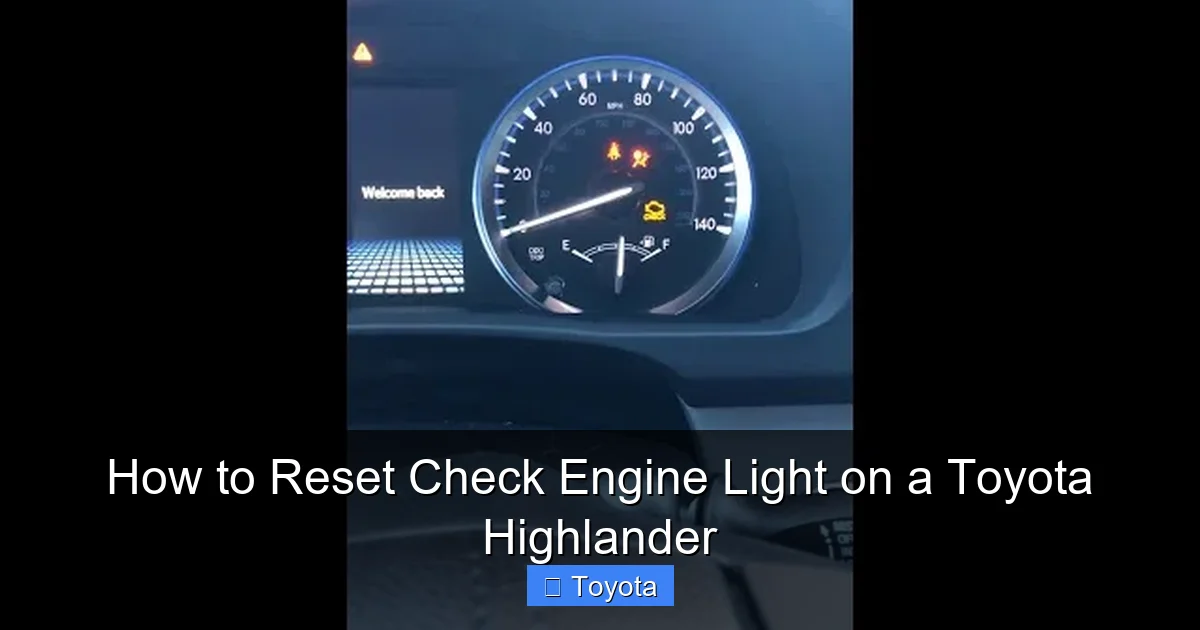
Visual guide about How to Reset Check Engine Light on a Toyota Highlander
Image source: i.ytimg.com
You wouldn’t treat a fever without checking your temperature, right? The same logic applies to your Highlander. Before you reset the check engine light, you need to know *why* it came on. Guessing could cost you time, money, and even your safety.
The best way to diagnose the issue is by reading the diagnostic trouble codes (DTCs) stored in your vehicle’s computer. These codes are like a secret language your car uses to tell you what’s wrong. For example, a P0420 code means “Catalyst System Efficiency Below Threshold,” while a P0455 indicates a large EVAP leak.
Using an OBD2 Scanner: Your Best Friend for Diagnostics
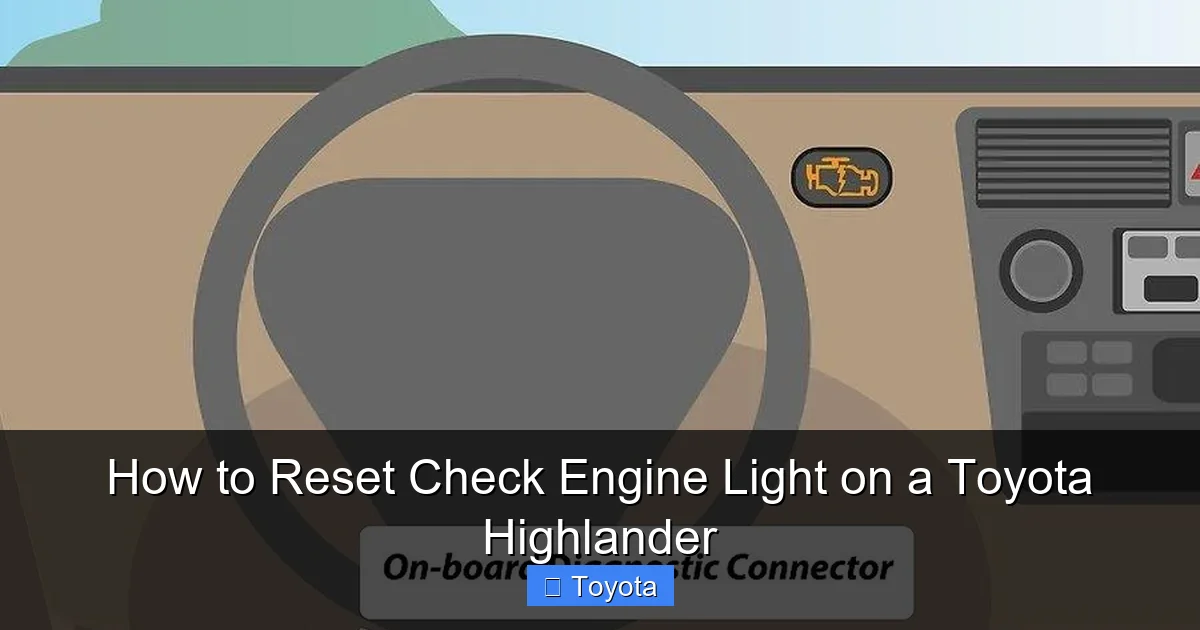
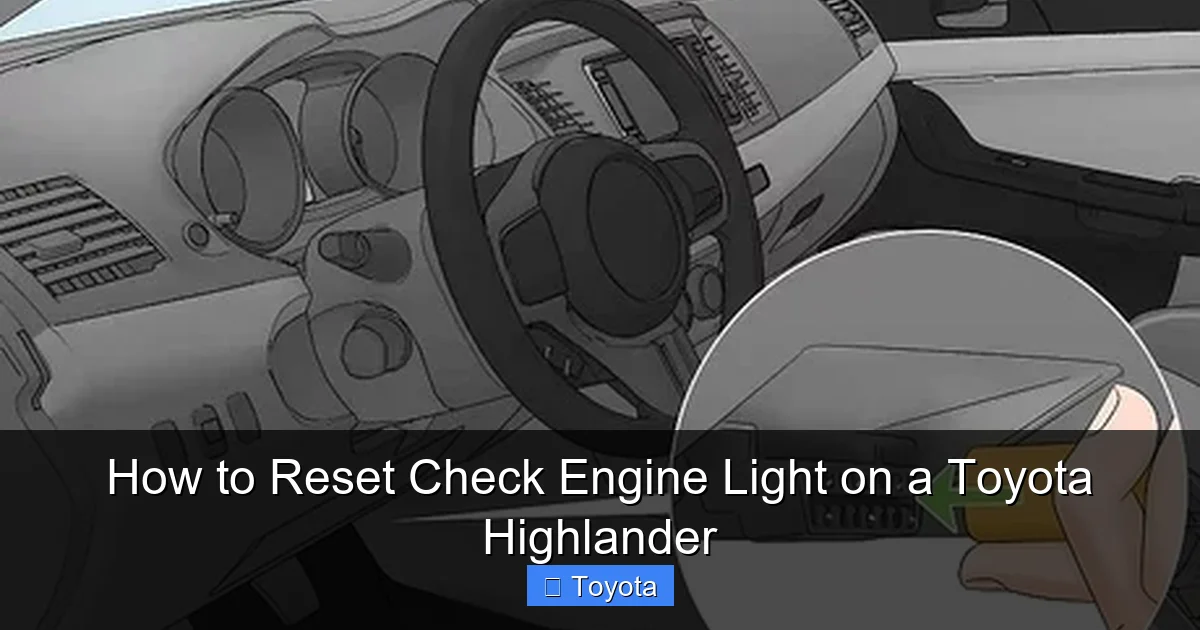
An OBD2 (On-Board Diagnostics II) scanner is a small, handheld device that plugs into your Highlander’s diagnostic port—usually located under the dashboard, near the steering column. Once connected, it communicates with the ECU and retrieves the trouble codes.
Here’s how to use one:
1. **Turn off the ignition.** Make sure your Highlander is off and the key is removed.
2. **Locate the OBD2 port.** It’s typically under the dashboard, on the driver’s side. It’s a 16-pin connector, often black or gray.
3. **Plug in the scanner.** Insert the scanner’s connector firmly into the port.
4. **Turn the ignition to “ON” (but don’t start the engine).** This powers up the scanner and allows it to communicate with the ECU.
5. **Follow the scanner’s prompts.** Most modern scanners will display the codes on a screen. Write them down or take a photo.
6. **Look up the codes.** Use the scanner’s built-in database, a free app, or a site like OBD-Codes.com to interpret what each code means.
For example, if you get a P0442 code, it likely means a small EVAP leak—possibly a loose gas cap or a cracked hose. A P0301 code? That’s a misfire in cylinder 1, often due to a bad spark plug or ignition coil.
Free Code Reading at Auto Parts Stores
Don’t have an OBD2 scanner? No problem. Most auto parts stores—like AutoZone, O’Reilly, or Advance Auto Parts—offer free code reading. Just drive in, and a technician will plug in their scanner and tell you the codes. They might even give you a printout.
But here’s a tip: don’t let them sell you a part right away. Ask for the code and do a little research. Sometimes, the fix is simpler (and cheaper) than they suggest.
What If the Light Comes Back After Reset?
This is a red flag. If you reset the light and it returns within a few days or after a short drive, the underlying issue hasn’t been resolved. The ECU is simply detecting the same problem again.
For instance, if you reset a P0420 code (catalytic converter) but don’t replace the converter, the light will come back—because the converter is still failing. In this case, resetting the light is just hiding the symptom, not fixing the disease.
That’s why diagnosis is crucial. It saves you from wasting money on unnecessary parts and ensures your Highlander runs safely and efficiently.
How to Reset the Check Engine Light on a Toyota Highlander
Visual guide about How to Reset Check Engine Light on a Toyota Highlander
Image source: carfromjapan.com
Alright, so you’ve diagnosed the issue, made the repair (or confirmed it’s safe to drive), and now you’re ready to reset that pesky check engine light. Great! There are a few ways to do this, but not all methods are created equal.
Let’s walk through the most effective and safe ways to reset the light on your Toyota Highlander.
Method 1: Use an OBD2 Scanner (Recommended)
This is the gold standard for resetting the check engine light. It’s quick, accurate, and doesn’t disrupt other vehicle systems.
Here’s how:
1. **Ensure the repair is complete.** Whether you tightened the gas cap, replaced a sensor, or fixed a leak, make sure the issue is truly resolved.
2. **Plug in the OBD2 scanner.** Connect it to the diagnostic port under the dashboard.
3. **Turn the ignition to “ON.”** Don’t start the engine—just power up the electronics.
4. **Navigate to the “Clear Codes” or “Erase DTCs” option.** This is usually found in the main menu.
5. **Confirm the reset.** The scanner will ask if you’re sure—select “Yes.”
6. **Wait for confirmation.** The scanner should display a message like “Codes Cleared” or “Reset Successful.”
7. **Turn off the ignition and unplug the scanner.**
That’s it! The check engine light should be off. If it was the only warning light, your dashboard should look normal again.
Method 2: Disconnect the Battery (Use with Caution)
This is a classic DIY trick, but it comes with risks. Disconnecting the battery resets the ECU by cutting power, which clears stored codes—including the check engine light. However, it also resets other systems.
Here’s how to do it safely:
1. **Turn off the ignition and remove the key.**
2. **Open the hood and locate the battery.** In most Highlanders, it’s on the right side of the engine bay.
3. **Disconnect the negative terminal first.** Use a wrench to loosen the nut on the negative (-) cable. Pull the cable off and secure it away from the battery terminal.
4. **Wait 10–15 minutes.** This allows the ECU to fully discharge and reset.
5. **Reconnect the negative terminal.** Tighten it securely.
6. **Turn the ignition to “ON” (don’t start the engine).** Wait a few seconds, then turn it off.
7. **Start the engine.** The check engine light should be off.
⚠️ **Important Notes:**
– You may lose radio presets, clock settings, and seat/mirror memory.
– Some Highlanders require a “relearn” procedure for the idle air control system—your engine might idle roughly for a few minutes.
– This method doesn’t always work on newer models with advanced electronics.
Method 3: Drive Cycle Reset (Natural Clearing)
Sometimes, the check engine light will turn off on its own—after you’ve fixed the issue and driven the vehicle through a specific pattern called a “drive cycle.”
A drive cycle is a series of driving conditions that allow the ECU to retest all monitored systems. For example:
– Start the engine when cold (below 160°F).
– Drive at varying speeds (city and highway).
– Accelerate and decelerate smoothly.
– Let the engine idle for a few minutes.
After completing a full drive cycle (usually 30–100 miles, depending on the issue), the ECU may automatically clear the code and turn off the light—if no faults are detected.
This method is completely safe and doesn’t require tools, but it’s slower and less reliable than using a scanner.
Method 4: Use a Smartphone App with Bluetooth OBD2 Adapter
If you’re tech-savvy, you can use a Bluetooth OBD2 adapter (like the FIXD or BlueDriver) paired with a smartphone app. These devices plug into the OBD2 port and connect to your phone via Bluetooth.
Popular apps include:
– **Torque Pro (Android)**
– **OBD Fusion (iOS/Android)**
– **FIXD Sensor App**
Once connected, you can read codes, monitor live data, and clear the check engine light—all from your phone. It’s convenient, especially if you want to track your Highlander’s performance over time.
What to Do After Resetting the Light
Visual guide about How to Reset Check Engine Light on a Toyota Highlander
Image source: wikihow.com
Resetting the check engine light is just the beginning. To ensure your Highlander stays in top shape, follow these post-reset steps:
Complete a Drive Cycle
As mentioned earlier, your Highlander’s ECU needs to recheck all systems after a reset. A proper drive cycle helps it do that.
A typical drive cycle for a Toyota Highlander might include:
– Cold start (engine below 160°F).
– Idle for 2–3 minutes.
– Drive at 25–35 mph for 3–5 minutes.
– Accelerate to 55 mph and cruise for 5–10 minutes.
– Decelerate without braking (let the engine slow the car).
– Stop and idle for 2–3 minutes.
This sequence allows the ECU to test oxygen sensors, catalytic converter efficiency, EVAP system, and more.
Monitor for Recurrence
Keep an eye on your dashboard. If the check engine light comes back within a few days, the problem wasn’t fully resolved. Revisit your diagnosis and consider professional help.
Reset Other Systems (If Needed)
After disconnecting the battery, you might need to reset:
– **Radio presets:** Re-enter your favorite stations.
– **Clock:** Adjust the time.
– **Power windows:** On some models, you may need to “relearn” the auto-up/down function by holding the window switch after closing.
Keep Records
Save your repair receipts and note the date, mileage, and issue. This helps with future diagnostics and can increase resale value.
When to See a Mechanic
While many check engine light issues are DIY-friendly, some require professional attention. Here’s when to call in the experts:
– **Flashing check engine light:** This indicates a severe misfire that could damage the catalytic converter. Pull over safely and have the vehicle towed if necessary.
– **Persistent light after repair:** If the light returns after a proper fix, there may be a deeper issue.
– **Loss of power or strange noises:** These symptoms suggest serious mechanical problems.
– **You’re unsure of the diagnosis:** If you can’t interpret the codes or don’t have the tools to fix the issue, a certified Toyota technician can help.
Toyota dealerships and trusted independent shops have advanced diagnostic tools and access to technical service bulletins (TSBs) specific to your Highlander model.
Preventing Future Check Engine Light Issues
An ounce of prevention is worth a pound of cure. Here’s how to keep that light off for good:
– **Tighten your gas cap after every fill-up.** Make sure it clicks 3–5 times.
– **Use quality fuel.** Stick to Top Tier gasoline to reduce carbon buildup.
– **Follow your maintenance schedule.** Replace spark plugs, air filters, and oxygen sensors as recommended.
– **Address warning signs early.** Rough idling, poor fuel economy, or hesitation? Get it checked.
– **Avoid short trips.** Frequent cold starts can lead to sensor and emissions issues.
– **Keep the engine clean.** Use fuel system cleaners periodically to prevent carbon deposits.
Conclusion
Resetting the check engine light on your Toyota Highlander doesn’t have to be a mystery. With the right tools and knowledge, you can diagnose the issue, make the repair, and clear the light safely and effectively.
Remember: the light is there to help you. Ignoring it or resetting it without fixing the problem is like silencing a smoke alarm while the fire still burns. Take the time to understand what your Highlander is telling you.
Whether you use an OBD2 scanner, disconnect the battery, or complete a drive cycle, always prioritize safety and accuracy. And when in doubt, don’t hesitate to consult a professional.
Your Highlander is built to last—treat it well, and it’ll keep you moving smoothly for years to come.
Frequently Asked Questions
Can I reset the check engine light without a scanner?
Yes, you can disconnect the battery for 10–15 minutes to reset the light, but this method may erase other settings and isn’t always reliable on newer models. An OBD2 scanner is the safest and most effective option.
Will the check engine light reset itself?
Sometimes. If the issue is fixed and you complete a proper drive cycle, the ECU may automatically clear the code and turn off the light. However, this isn’t guaranteed and can take days or weeks.
Is it safe to drive with the check engine light on?
It depends. A steady light usually means a moderate issue—you can drive short distances but should get it checked soon. A flashing light indicates a serious problem—stop driving and seek help immediately.
How much does it cost to reset a check engine light?
Using an OBD2 scanner costs nothing if you own one. Auto parts stores often offer free code reading. Professional diagnostics at a shop may cost $50–$150, but that includes identifying the root cause.
Why did my check engine light come back after resetting?
The underlying issue wasn’t fixed. The ECU detected the same problem again. Revisit your diagnosis and ensure the repair was complete before resetting.
Does resetting the check engine light improve gas mileage?
Only if the original issue (like a faulty oxygen sensor) was affecting fuel efficiency. Resetting the light itself doesn’t improve performance—fixing the problem does.