
If I Sell My Car to Carmax Do I Pay Taxes

If you sell your car to CarMax outright, you typically do not pay taxes on the sale. However, if you’re trading it in toward a new vehicle purchase, tax implications depend on your state’s laws and how the transaction is structured.
So, you’ve decided it’s time to part ways with your trusty old ride. Maybe it’s racking up repair bills, or perhaps you just want something newer, safer, or more fuel-efficient. Whatever the reason, you’re considering CarMax—the big-box used car retailer known for its no-haggle pricing and nationwide presence. It’s a popular choice because it’s fast, transparent, and hassle-free compared to private sales or dealership negotiations.
But before you hand over the keys, there’s one big question on your mind: *Do I have to pay taxes when I sell my car to CarMax?* It’s a smart question—and the answer isn’t always straightforward. While selling your car outright to CarMax usually means no immediate tax bill, the full picture depends on whether you’re doing a straight sale or trading in toward a new vehicle. And even then, your state’s tax laws play a huge role.
In this guide, we’ll break down exactly how taxes work when selling or trading in your car at CarMax. We’ll cover everything from basic definitions to real-world examples, so you walk away confident about your financial obligations—and maybe even save a few bucks in the process.
Key Takeaways
- No tax on private sales: When you sell your car directly to CarMax (not trading in), it’s treated like a private sale—no sales tax is charged.
- Trade-in tax benefits vary by state: Some states allow you to deduct the trade-in value from the taxable amount of your new car purchase, reducing your overall tax bill.
- CarMax handles paperwork: The company manages title transfers and reporting, but you’re still responsible for understanding your tax obligations.
- Keep records for IRS purposes: Even if no tax is due, retain all sale documents in case of an audit or future questions about capital gains.
- Loan payoff affects net proceeds: If you owe money on your car, CarMax will pay off the lender first—your take-home amount may be reduced, but this doesn’t trigger taxes.
- Consult a tax pro if unsure: Complex situations (like selling a business vehicle) may have different rules—always seek personalized advice.
📑 Table of Contents
- Understanding How Car Sales Are Taxed in the U.S.
- Selling Your Car to CarMax: The Tax-Free Option
- Trading In at CarMax: When Taxes Might Apply
- CarMax Handles the Paperwork—But You’re Still Responsible
- Real-Life Scenarios: What Actually Happens
- Tips to Maximize Your Return and Minimize Tax Hassles
- Final Thoughts: Peace of Mind Matters Most
Understanding How Car Sales Are Taxed in the U.S.
To answer whether you’ll pay taxes when selling your car to CarMax, it helps to first understand how vehicle transactions are taxed in the United States. Unlike buying a new phone or clothes—where sales tax is added at checkout—selling a personal vehicle operates under different rules.
When you sell a car you own outright (meaning no loan or lease), the transaction is generally treated as a private sale. In most cases, **you do not pay sales tax on the money you receive**. That’s because sales tax applies to purchases, not sales. Think of it this way: the buyer pays tax when they buy something; the seller doesn’t get taxed on their income from the sale—unless specific conditions apply.
However, things get trickier when you’re trading in your car as part of a new vehicle purchase. In that scenario, your trade-in value can affect how much sales tax you owe on the new car—but only if your state allows it. Some states let you subtract the trade-in value from the purchase price before calculating tax, which can result in significant savings. Others tax the full price of the new vehicle regardless of trade-in value.
It’s also important to note that the IRS doesn’t typically treat personal vehicle sales as taxable income—especially if you’re selling for less than you paid. You only need to report a gain (and potentially pay capital gains tax) if you sell a car for more than its original purchase price *and* it’s considered a collectible or investment asset—which is rare for everyday drivers.
Private Sale vs. Trade-In: What’s the Difference?
The key distinction here is between a **private sale** and a **trade-in**.
In a private sale to CarMax, you’re simply selling your car for cash (or check). CarMax becomes the new owner, and you walk away with the money. No new vehicle is involved. This type of transaction is clean, simple, and—importantly—free of sales tax for you as the seller.
A trade-in, on the other hand, happens when you use your current car as partial payment toward a new or used vehicle purchase—either at CarMax or another dealership. Here, the value of your old car is applied as a credit against the price of the new one. Because a purchase is involved, sales tax comes into play—but how it’s calculated depends entirely on your state.
For example, if you buy a $25,000 car and trade in your old vehicle for $8,000, your out-of-pocket cost might be $17,000. But in states that allow trade-in deductions, you’d only pay sales tax on that $17,000—not the full $25,000. That could mean hundreds of dollars in savings.
Why State Laws Matter So Much
There’s no federal law governing how trade-ins are taxed—it’s left up to individual states. As of 2024, about 30 states allow you to deduct your trade-in value from the taxable amount of your new car purchase. These include large states like California, Texas, Florida, and New York.
But in states like Arizona, Nevada, and Wyoming, you pay sales tax on the full purchase price—even if you traded in a car worth thousands. That means a $30,000 car with a $10,000 trade-in still gets taxed on $30,000, costing you an extra $800 (at an 8% tax rate) compared to a state that allows deductions.
Always check your state’s Department of Motor Vehicles (DMV) or Department of Revenue website for the latest rules. CarMax will apply the correct tax calculation at the time of sale, but it’s wise to know what to expect beforehand.
Selling Your Car to CarMax: The Tax-Free Option

Visual guide about If I Sell My Car to Carmax Do I Pay Taxes
Image source: miramarspeedcircuit.com
If you’re looking to avoid taxes altogether, selling your car directly to CarMax—without buying another vehicle—is usually your best bet. This is considered a private-party sale, and in nearly all cases, **no sales tax is due from you**.
Here’s how it works: You bring your car to a CarMax location (or get an online offer), they inspect it, make you a no-haggle offer, and if you accept, they pay you—either by check, bank transfer, or even a same-day deposit. The transaction is completed in under an hour in many cases.
Because you’re not purchasing anything, there’s no sales tax involved. CarMax handles the title transfer and notifies your state’s DMV that you’ve sold the vehicle. You’ll receive a bill of sale and a release of liability form, which you should file with your local DMV to protect yourself from future parking tickets or tolls linked to the car.
It’s worth noting that while you won’t pay sales tax, you also won’t receive any tax benefit—unlike with a trade-in in a deductible state. So if you’re planning to buy a new car soon, compare both options to see which saves you more money overall.
What If I Owe Money on My Car?
Many people sell their cars to CarMax even when they still have an outstanding auto loan. CarMax can handle this too—they’ll pay off your lender directly and send you the remaining equity (if any).
For example, say your car is worth $12,000 according to CarMax, but you still owe $9,000 on your loan. CarMax will send $9,000 to your lender and give you $3,000. If your loan balance is higher than the car’s value (you’re “upside-down”), you’ll need to pay the difference out of pocket—or roll it into a new loan if you’re trading in.
Importantly, **this payoff process does not trigger any taxes**. You’re not earning income; you’re simply settling a debt. The IRS doesn’t tax loan repayments or equity payouts from vehicle sales.
Document Everything
Even though you likely won’t owe taxes, keep all paperwork from your CarMax sale:
– The bill of sale
– Title transfer documents
– Loan payoff confirmation (if applicable)
– CarMax’s offer printout
These records can help if the IRS ever questions your finances—or if you need to prove ownership history for insurance or legal reasons. Store them digitally and in a safe physical location.
Trading In at CarMax: When Taxes Might Apply
Visual guide about If I Sell My Car to Carmax Do I Pay Taxes
Image source: dollarbreak.com
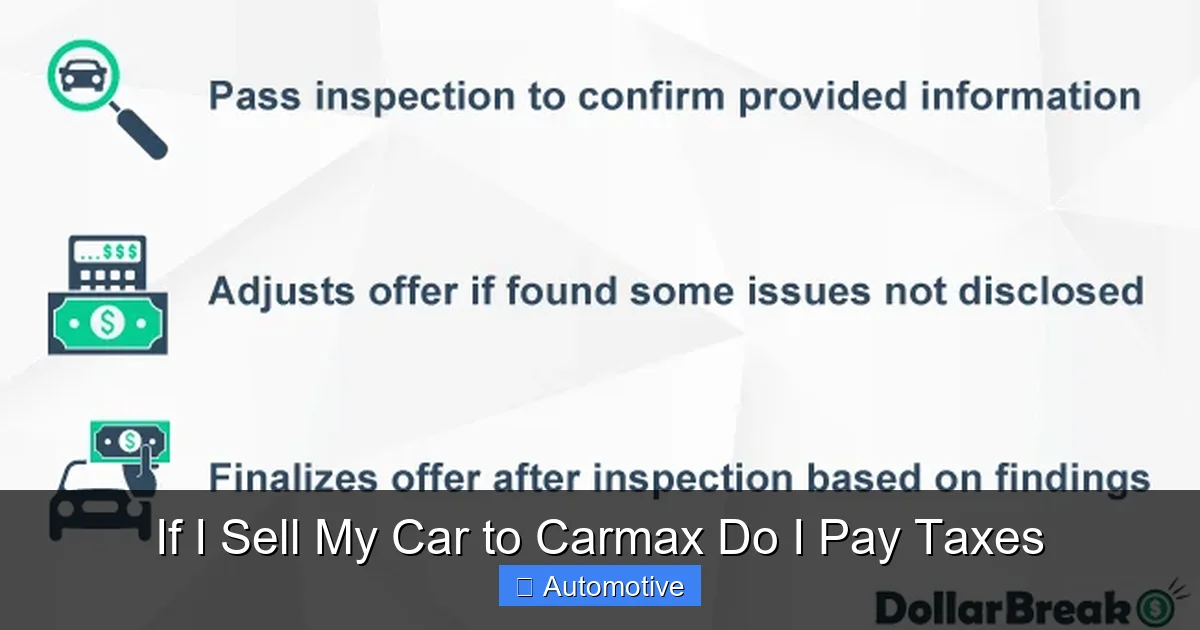
Now, let’s talk about the other common scenario: trading in your car at CarMax while buying a new one. This is where taxes *can* come into play—but only on the purchase side, not the sale.
When you trade in, CarMax applies the value of your old car as a down payment toward your new vehicle. The sales tax is then calculated based on the net price you pay—*but only if your state allows trade-in deductions*.
Let’s look at two examples:
**Example 1: California (Trade-In Deduction Allowed)**
You buy a $30,000 car and trade in your old vehicle for $10,000.
Taxable amount: $20,000
Sales tax (7.25%): $1,450
**Example 2: Arizona (No Deduction Allowed)**
Same purchase and trade-in.
Taxable amount: $30,000
Sales tax (8.5%): $2,550
That’s a difference of $1,100—just because of state law!
CarMax’s system automatically applies your state’s tax rules during the transaction, so you don’t have to calculate it yourself. But knowing your state’s policy helps you budget accurately and avoid surprises at the signing table.
Can I Avoid Tax by Selling Privately Instead?
Some buyers consider selling their car privately to avoid trade-in taxes—but this isn’t always smarter. Private sales often take longer, require more effort (listing, meeting buyers, handling paperwork), and may net less money due to lower offers or safety concerns.
Plus, if you’re buying a new car anyway, you’ll still pay sales tax on the full purchase price in non-deductible states—whether you trade in or sell privately. In deductible states, trading in is usually more convenient and just as tax-efficient.
Only consider a private sale if you’re not buying a replacement vehicle—or if you can get significantly more money than CarMax’s offer.
What About Luxury or High-Value Cars?
If your car is worth more than you originally paid (say, a classic or limited-edition model), you might wonder about capital gains tax. For most personal vehicles, the IRS doesn’t require reporting unless you sell for a substantial profit and the car is deemed a collectible.
However, if you use your car for business (e.g., rideshare or delivery), different rules may apply. Depreciation and business use can affect your tax situation. In these cases, consult a tax professional before selling.
CarMax Handles the Paperwork—But You’re Still Responsible
Visual guide about If I Sell My Car to Carmax Do I Pay Taxes
Image source: junkthatcar.com
One of the biggest perks of selling or trading in at CarMax is their streamlined process. They handle title transfers, lien releases, and DMV notifications—saving you hours of bureaucratic hassle.
But remember: **they don’t file your taxes**. While CarMax ensures the transaction complies with state motor vehicle laws, tax reporting (if needed) falls on you.
For instance, if you sell a business-owned vehicle, you may need to report the sale on your business tax return. Or if you receive a 1099 form from CarMax (which is rare for personal sales under $600), you should include that information in your tax filing.
CarMax may issue a 1099-K if you sell multiple vehicles or if the transaction meets IRS reporting thresholds—but for a single personal car sale, this is uncommon.
When Might You Get a 1099?
The IRS requires payment processors (including businesses like CarMax) to issue Form 1099-K if you receive more than $20,000 in gross payments *and* have more than 200 transactions in a year. Since most individuals sell one car occasionally, this threshold is rarely met.
However, if you’re a dealer or frequently flip cars, CarMax may report your sales. Keep records and consult a CPA to ensure proper reporting.
Real-Life Scenarios: What Actually Happens
Let’s walk through a few common situations to make this concrete.
**Scenario 1: Maria sells her 2018 Honda Accord to CarMax for $14,000.**
She owns the car outright and isn’t buying a new one.
→ Result: No taxes due. She receives $14,000. CarMax handles the title transfer.
**Scenario 2: James trades in his 2016 Toyota Camry (valued at $9,000) for a new $28,000 Ford Escape in Texas.**
Texas allows trade-in deductions.
→ Taxable amount: $19,000
→ Sales tax (6.25%): $1,187.50
→ James pays tax only on the net price.
**Scenario 3: Linda sells her leased BMW to CarMax.**
She’s not the owner—the leasing company is.
→ CarMax works with the lessor to complete the buyout.
→ Linda may receive excess equity or owe a deficit, but no taxes are triggered by the transfer.
These examples show how context matters. Always clarify whether you’re selling or trading in—and know your state’s rules.
Tips to Maximize Your Return and Minimize Tax Hassles
Selling your car doesn’t have to be stressful. Follow these practical tips to get the best deal and stay tax-compliant:
1. **Check your state’s trade-in tax policy first.** Use your DMV website or call them directly.
2. **Get multiple offers.** Compare CarMax’s appraisal with values from Kelley Blue Book, Edmunds, and local dealers.
3. **Clean your car inside and out.** A well-maintained vehicle can increase its value by hundreds of dollars.
4. **Gather all documents ahead of time.** Title, registration, maintenance records, and loan info (if applicable) speed up the process.
5. **Negotiate only if you’re trading in elsewhere.** CarMax’s offers are fixed, but other dealers may match or beat them.
6. **Keep digital copies of all paperwork.** Store them in cloud storage or email them to yourself.
7. **Ask CarMax for a detailed breakdown.** Understand how they arrived at your offer and how taxes were calculated (if trading in).
Final Thoughts: Peace of Mind Matters Most
At the end of the day, selling your car to CarMax is designed to be simple, fast, and transparent. For most people, **you will not pay taxes when selling your car outright**—and even when trading in, the tax impact is often favorable thanks to state-level deductions.
The key is understanding your specific situation: Are you selling or trading? What state do you live in? Do you owe money on the car? Answering these questions upfront saves time, money, and stress.
And while CarMax takes care of the logistics, staying informed empowers you to make the best financial decision. Whether you walk away with a check or drive off in a new ride, knowing your tax obligations gives you confidence—and that’s priceless.
Frequently Asked Questions
Do I pay sales tax if I sell my car to CarMax?
No, you typically do not pay sales tax when selling your car directly to CarMax. Since it’s treated as a private sale, sales tax applies only to purchases—not sales.
Will I owe taxes if I trade in my car at CarMax?
You may pay sales tax on the new vehicle purchase, but only on the net amount after your trade-in value—if your state allows deductions. Check your state’s rules to know for sure.
Does CarMax report my car sale to the IRS?
Generally, no. CarMax only issues a 1099 form if you meet specific IRS thresholds (over $20,000 and 200+ transactions), which is rare for individual sellers.
What if I still owe money on my car when selling to CarMax?
CarMax will pay off your lender first. Any remaining equity goes to you, and any deficit must be covered by you. This process does not trigger taxes.
Can I avoid paying tax by selling privately instead of trading in?
In states that don’t allow trade-in deductions, selling privately won’t reduce your new car tax bill. In deductible states, trading in is often just as tax-efficient and more convenient.
Do I need to keep records after selling my car to CarMax?
Yes. Keep the bill of sale, title transfer docs, and loan payoff confirmation (if applicable) for at least three years in case of audits or disputes.
