
How Many Watts Does a Car Battery Have

Most car batteries deliver between 400 and 1,000 watts of power, depending on voltage and cold cranking amps (CCA). Understanding your battery’s wattage helps ensure reliable starts and safe use of electronics while driving.
Key Takeaways
- Car batteries typically provide 400–1,000 watts: This range covers most standard 12-volt automotive batteries used in passenger vehicles.
- Wattage depends on voltage and current: Power (watts) = Voltage (volts) × Current (amps). Most car batteries are 12V, so amperage determines wattage.
- Cold Cranking Amps (CCA) affect real-world performance: A higher CCA rating means more starting power in cold weather, directly influencing usable wattage during engine start.
- Accessories draw power from the battery: Lights, radios, phone chargers, and dash cams all consume watts—knowing your battery’s capacity helps avoid draining it.
- Battery age and condition reduce output: An old or weak battery may deliver far less than its rated wattage, even if it still starts the car.
- Upgrading accessories? Check wattage compatibility: High-draw devices like inverters or sound systems need sufficient battery support to prevent damage or failure.
- Alternator recharges the battery while driving: The battery supplies short bursts of high wattage; the alternator maintains charge during operation.
📑 Table of Contents
- Understanding Car Battery Wattage: Why It Matters
- What Determines a Car Battery’s Wattage?
- How Many Watts Does a Typical Car Battery Deliver?
- Factors That Affect Car Battery Wattage
- How to Calculate Your Car Battery’s Wattage
- Tips to Maximize Your Car Battery’s Power and Lifespan
- Conclusion: Wattage Matters More Than You Think
Understanding Car Battery Wattage: Why It Matters
If you’ve ever wondered how much power your car battery actually holds, you’re not alone. Most drivers know their battery starts the engine, but few understand the actual energy it delivers—measured in watts. So, how many watts does a car battery have? The short answer: typically between 400 and 1,000 watts. But that number isn’t fixed—it changes based on battery type, age, temperature, and what you’re using it for.
Think of your car battery like a water tank. The size of the tank is its capacity (measured in amp-hours), but the pressure pushing the water out is like voltage. Together, they determine how much “work” the battery can do—that’s wattage. In simple terms, watts measure how much electrical energy the battery can deliver at any given moment. Whether you’re cranking a cold engine at 6 a.m. or running your phone charger on a road trip, wattage tells you if your battery can handle the load.
Knowing your battery’s wattage isn’t just technical trivia—it’s practical knowledge. It helps you choose the right accessories, avoid draining your battery, and understand why your car might struggle to start in winter. Whether you’re a weekend mechanic or just want to keep your ride running smoothly, understanding battery wattage gives you confidence behind the wheel.
What Determines a Car Battery’s Wattage?
Visual guide about How Many Watts Does a Car Battery Have
Image source: redway-tech.com
At its core, wattage is a measure of electrical power—how much energy is being used or supplied per second. For car batteries, this is calculated using a simple formula:
Power (Watts) = Voltage (Volts) × Current (Amps)
Most modern cars use a 12-volt electrical system, so the voltage is fairly consistent. That means the real variable is current—how many amps the battery can deliver. And that’s where things get interesting.
Voltage: The Constant Factor
Nearly all passenger vehicles run on a 12-volt battery system. Even though the battery is labeled “12V,” it actually operates between about 11.8 volts (when nearly dead) and 12.6 volts (when fully charged). When the engine is running, the alternator bumps this up to 13.7–14.7 volts to recharge the battery. But for wattage calculations, we usually use 12 volts as a baseline.
So if your battery can deliver 50 amps, its wattage would be:
12 volts × 50 amps = 600 watts
That’s enough to power a small space heater or a powerful car stereo system—but only for a short time.
Current: The Variable That Changes Everything
Current, measured in amps, is what really determines how many watts your battery can produce. And this number isn’t static. It depends on several factors:
– Cold Cranking Amps (CCA): This is the most important spec for starting power. It tells you how many amps the battery can deliver at 0°F (−18°C) for 30 seconds while maintaining at least 7.2 volts. A typical CCA rating for a standard car battery ranges from 400 to 800 amps. Using our formula, that translates to 4,800 to 9,600 watts—but only for a very short burst during engine start.
Wait—that seems way higher than the 400–1,000 watts we mentioned earlier. Why the discrepancy?
Because CCA measures peak power during cranking, not continuous output. Once the engine starts, the load drops dramatically. And the battery isn’t designed to sustain hundreds of amps for long. So while a 600 CCA battery can briefly deliver over 7,000 watts, its steady-state wattage is much lower.
Battery Capacity and Amp-Hours
Another key factor is the battery’s capacity, measured in amp-hours (Ah). This tells you how long the battery can deliver a certain amount of current. For example, a 50 Ah battery can theoretically supply 5 amps for 10 hours, or 50 amps for 1 hour.
To find watt-hours (a measure of total energy), multiply amp-hours by voltage:
50 Ah × 12 V = 600 watt-hours
This means the battery stores 600 watt-hours of energy total. But again, it can’t deliver all that at once. Most car batteries are designed for short, high-current bursts—not long-term power delivery.
How Many Watts Does a Typical Car Battery Deliver?
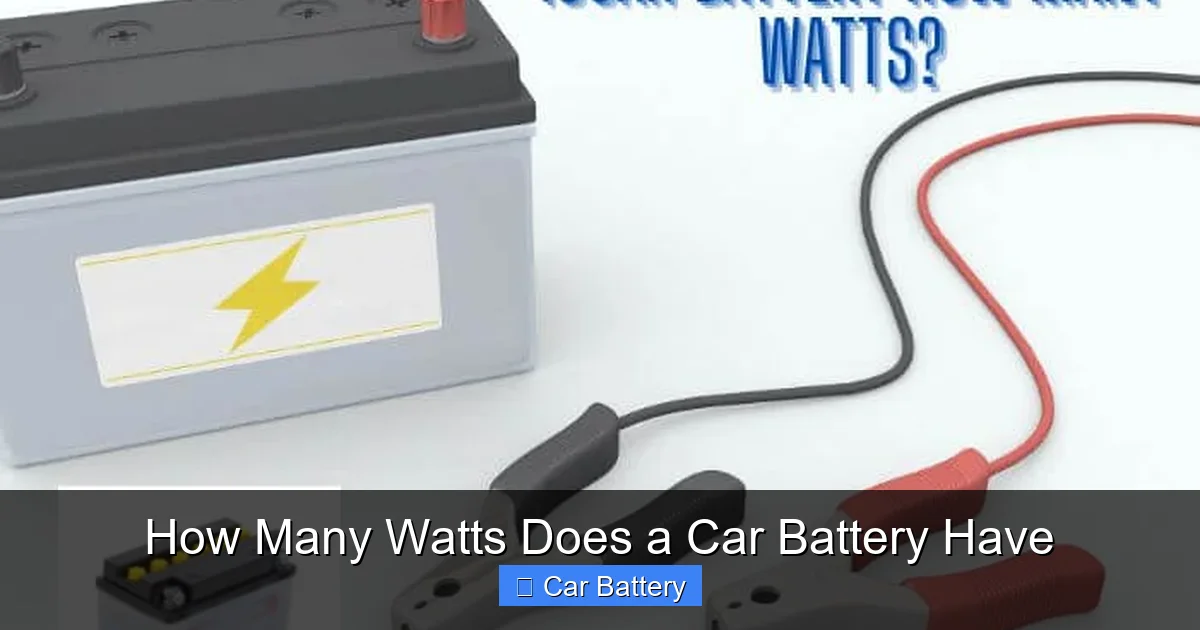
Visual guide about How Many Watts Does a Car Battery Have
Image source: thepowerfacts.com
Now that we understand the basics, let’s answer the big question: how many watts does a car battery have in real-world use?
For most standard 12-volt car batteries, the continuous wattage output ranges from 400 to 1,000 watts. This is the power available for running accessories when the engine is off, or for supplemental power when the alternator can’t keep up.
Let’s break this down with examples.
Starting the Engine: Short Bursts of High Power
When you turn the key, the starter motor draws a huge surge of current—often 200 to 600 amps, depending on engine size and temperature. At 12 volts, that’s:
12 V × 300 A = 3,600 watts (for a typical 300 CCA draw)
But this only lasts a few seconds. Once the engine fires, the load drops to near zero. So while the battery can briefly deliver thousands of watts, it’s not designed to sustain that.
Running Accessories: Steady, Lower Power
When the engine is off, the battery powers everything: lights, radio, climate control, phone chargers, and more. Here’s how much power common accessories use:
– Headlights (halogen): ~120 watts (60W each)
– Radio/stereo: ~20–50 watts
– Phone charger: ~5–10 watts
– Dash cam: ~5 watts
– Interior lights: ~10–20 watts
– Heated seats: ~100–200 watts each
If you’re parked with the engine off and running headlights, radio, and two phone chargers, you’re drawing roughly:
120 (lights) + 40 (radio) + 10 (chargers) = 170 watts
That’s well within the 400–1,000 watt range of most batteries. But if you add heated seats or a powerful sound system, you could easily exceed 500 watts.
How Long Can the Battery Last?
Let’s say your battery has a 600 watt-hour capacity (50 Ah × 12 V). If you’re drawing 200 watts continuously, how long will it last?
600 watt-hours ÷ 200 watts = 3 hours
But in reality, you shouldn’t drain a car battery below 50% to avoid damage. So you’d only get about 1.5 hours of runtime before risking a dead battery.
This is why idling with the engine off and using high-draw accessories can leave you stranded. The alternator isn’t running to recharge the battery, so it’s all coming from stored energy.
Factors That Affect Car Battery Wattage
Visual guide about How Many Watts Does a Car Battery Have
Image source: powerclues.com
Not all car batteries are created equal. Several factors influence how many watts your battery can actually deliver—especially under real-world conditions.
Battery Age and Condition
A brand-new battery will deliver close to its rated wattage. But as it ages, its internal resistance increases, and its capacity drops. A 3-year-old battery might only deliver 70–80% of its original power. By 5 years, it could be down to 50% or less.
Signs of a weak battery include:
– Slow engine crank
– Dim headlights when idling
– Electrical glitches (radio resetting, power windows slow)
– Needing jump-starts
If your battery is more than 4 years old, consider testing it at an auto parts store—they’ll check voltage, CCA, and overall health.
Temperature Effects
Cold weather is the enemy of battery performance. At 0°F (−18°C), a battery can lose up to 60% of its cranking power. That’s why cars struggle to start in winter—even if the battery is in good shape.
Why? Chemical reactions inside the battery slow down in the cold, reducing its ability to deliver high current. So a battery rated for 600 CCA at room temperature might only deliver 300 CCA in freezing weather.
Conversely, extreme heat can shorten battery life by accelerating corrosion and evaporation of electrolyte. Ideal operating temperature is around 77°F (25°C).
Battery Type and Technology
Not all car batteries are the same. The three main types are:
– Flooded Lead-Acid (FLA): The most common and affordable. Good for standard vehicles but requires maintenance (checking water levels). Typical wattage: 400–800 watts.
– Absorbent Glass Mat (AGM): More expensive but offers higher performance. Used in start-stop vehicles and luxury cars. Can deliver 600–1,000+ watts with better deep-cycle capability.
– Enhanced Flooded Battery (EFB): A step up from FLA, designed for start-stop systems. Better than standard batteries but not as robust as AGM.
AGM batteries, for example, can handle deeper discharges and recharge faster, making them better for high-wattage applications like car audio or camping setups.
Parasitic Drain and Electrical Loads
Even when your car is off, small amounts of power are used by the clock, alarm system, and onboard computers. This is called parasitic drain—usually 20–50 milliamps (0.02–0.05 amps), or about 0.25–0.6 watts.
Over time, this can drain the battery. If you leave your car unused for weeks, a parasitic drain of 50 mA could consume:
0.05 A × 12 V = 0.6 watts
0.6 W × 24 hours = 14.4 watt-hours per day
14.4 × 30 = 432 watt-hours in a month
That’s enough to kill a weak battery. If you store your car for long periods, consider a battery maintainer or trickle charger.
How to Calculate Your Car Battery’s Wattage
Want to know exactly how many watts your battery can deliver? It’s easier than you think. You just need two pieces of information: voltage and current.
Step 1: Find Your Battery’s Voltage
Almost all cars use a 12-volt system. Check your battery label—it should say “12V.” Some older vehicles (like classic cars) may use 6 volts, but this is rare today.
Step 2: Determine the Current (Amps)
This is where it gets trickier. You can’t just look at the label and find “watts.” Instead, you’ll need to use one of these specs:
– Cold Cranking Amps (CCA): For starting power. Use this for peak wattage.
– Cranking Amps (CA): Similar to CCA but measured at 32°F (0°C). Slightly higher than CCA.
– Amp-Hours (Ah): For total energy capacity.
For example, if your battery has 600 CCA:
12 V × 600 A = 7,200 watts (peak cranking power)
But remember, this is only for a few seconds.
For continuous power, look at the Ah rating. A 50 Ah battery can deliver 50 amps for 1 hour, or 5 amps for 10 hours. So:
12 V × 50 A = 600 watts (for 1 hour)
12 V × 5 A = 60 watts (for 10 hours)
Step 3: Calculate Watt-Hours for Total Energy
To find total stored energy, multiply voltage by amp-hours:
12 V × 50 Ah = 600 watt-hours
This tells you how much energy the battery holds—like the “fuel tank” size. But again, you shouldn’t use more than 50% to avoid damage.
Practical Example: Sizing a Power Inverter
Say you want to run a 300-watt coffee maker from your car battery using a power inverter. Can your battery handle it?
First, calculate the current draw:
300 watts ÷ 12 volts = 25 amps
Now, check your battery’s capacity. If it’s 50 Ah, and you only use half (25 Ah), you can run the coffee maker for:
25 Ah ÷ 25 A = 1 hour
But inverters aren’t 100% efficient—most are 85–90%. So actual draw might be 28–30 amps, reducing runtime to about 50 minutes.
Also, running high-wattage devices drains the battery fast. If the engine is off, you risk a dead battery. For best results, run such devices while driving, so the alternator helps recharge the battery.
Tips to Maximize Your Car Battery’s Power and Lifespan
Knowing how many watts your battery has is one thing—using that knowledge wisely is another. Here are some practical tips to get the most out of your car battery.
Avoid Deep Discharges
Car batteries aren’t designed for deep cycling like marine or RV batteries. Draining below 50% regularly shortens their lifespan. Try to recharge the battery before it drops too low—especially if you’re using accessories with the engine off.
Turn Off Accessories When Idling
If you’re parked for more than 10 minutes, turn off lights, radio, and chargers. Even small loads add up. A 50-watt draw for 2 hours uses 100 watt-hours—nearly 20% of a 50 Ah battery’s capacity.
Use a Battery Maintainer for Long Storage
If you won’t drive your car for weeks or months, use a trickle charger or smart maintainer. These devices keep the battery at full charge without overcharging, preventing sulfation and extending life.
Test Your Battery Annually
Most auto parts stores offer free battery testing. They’ll check voltage, CCA, and overall health. If your battery is over 3 years old or showing signs of weakness, get it tested before winter.
Upgrade for High-Draw Applications
If you’re running a powerful sound system, camping fridge, or multiple electronics, consider upgrading to an AGM battery. They handle deeper discharges and deliver more consistent wattage.
Keep Terminals Clean
Corrosion on battery terminals increases resistance, reducing power delivery. Clean terminals with a wire brush and baking soda solution every 6–12 months.
Conclusion: Wattage Matters More Than You Think
So, how many watts does a car battery have? The answer isn’t a single number—it’s a range that depends on voltage, current, temperature, age, and usage. Most car batteries deliver between 400 and 1,000 watts of continuous power, with brief bursts of over 7,000 watts during engine start.
Understanding this helps you make smarter decisions about your vehicle’s electrical system. Whether you’re choosing accessories, troubleshooting a weak start, or planning a road trip with extra gadgets, knowing your battery’s wattage gives you confidence and control.
Remember: your car battery is more than just a starter—it’s the heart of your vehicle’s electrical system. Treat it well, and it’ll keep you moving for years to come.
Frequently Asked Questions
How many watts does a typical car battery produce?
A standard 12-volt car battery typically delivers between 400 and 1,000 watts of continuous power, depending on its amp-hour rating and condition. Peak power during engine start can exceed 7,000 watts for a few seconds.
Can I run a 500-watt device from my car battery?
Yes, but only for a limited time—especially if the engine is off. A 500-watt draw uses about 42 amps (500W ÷ 12V), which could drain a 50 Ah battery in under an hour. For safety, run high-wattage devices while driving so the alternator can help recharge the battery.
Does cold weather reduce a car battery’s wattage?
Yes, significantly. At 0°F, a battery can lose up to 60% of its cranking power, reducing both amperage and wattage. This is why cars often struggle to start in winter, even with a healthy battery.
What’s the difference between watts and watt-hours?
Watts measure power (energy per second), while watt-hours measure total energy capacity. A 600 watt-hour battery can deliver 600 watts for 1 hour, or 300 watts for 2 hours.
Can I calculate my battery’s wattage at home?
Yes. Multiply the battery’s voltage (usually 12V) by its current in amps. For continuous power, use the amp-hour rating. For example, a 50 Ah battery can deliver 600 watts (12V × 50A) for one hour.
Is an AGM battery better for high-wattage applications?
Yes. AGM batteries deliver more consistent wattage, handle deeper discharges, and recharge faster than standard flooded batteries. They’re ideal for high-draw systems like car audio, inverters, or start-stop vehicles.
