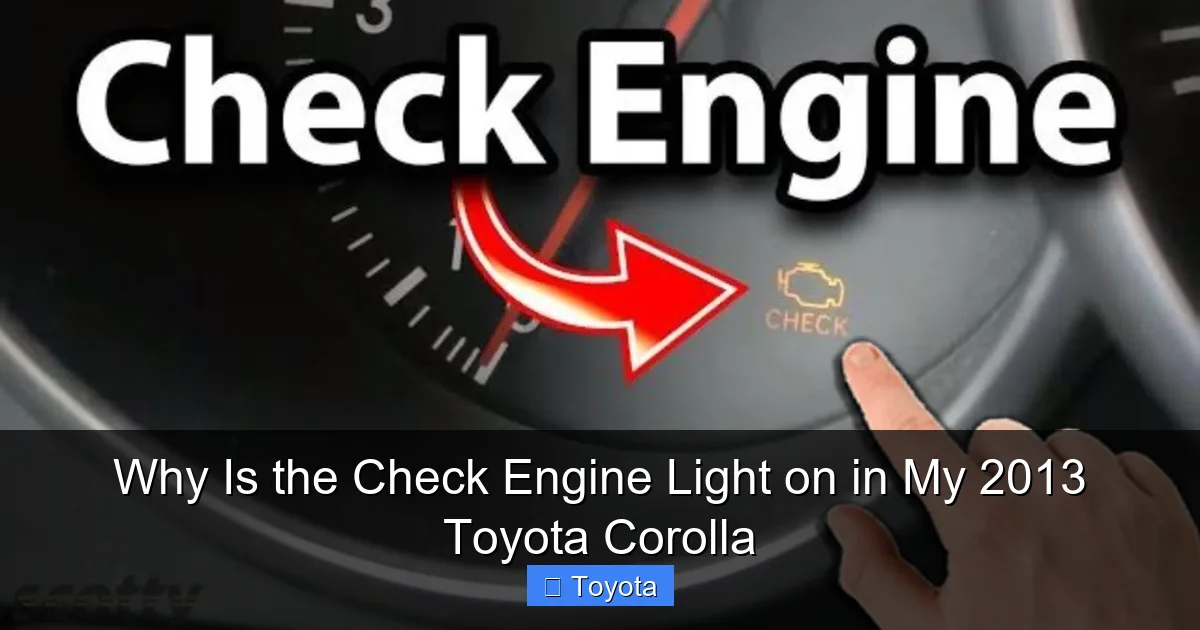
Why Is the Check Engine Light on in My 2013 Toyota Corolla

Contents
- 1 Key Takeaways
- 2 📑 Table of Contents
- 3 That Glowing Yellow Light: Your 2013 Toyota Corolla Is Trying to Tell You Something
- 4 The Usual Suspects: Top 7 Reasons Your 2013 Corolla’s Light Is On
- 5 Diagnosis: How to Find Out What the Code Means
- 6 What to Do When the Light Comes On: A Practical Action Plan
- 7 Can I Still Drive My Corolla With the Light On?
- 8 Conclusion: Knowledge Is Power (and Saves Money)
- 9 Frequently Asked Questions

Dashboard Polish

Side Mirror Rain Guard

Car Door Edge Guard

Car Windshield Wiper Blades
A lit check engine light in your 2013 Toyota Corolla means the car’s computer has detected a problem in the emissions, engine, or transmission system. It’s a warning, not an immediate death sentence, but ignoring it can lead to more damage and failed inspections. Common culprits include a loose gas cap, faulty oxygen sensor, or catalytic converter issues. The first step is to get the specific trouble code read, which tells you exactly what the computer is concerned about.
Key Takeaways
- The light is a warning, not a diagnosis: It tells you something is wrong, but you need a code scan to know what. Don’t guess—get the code.
- Some issues are simple and cheap: A loose or damaged gas cap is the #1 cause and can be fixed in minutes at almost no cost.
- Other issues can be serious and expensive: Problems with the catalytic converter, spark plugs, or major sensors can cause poor performance and costly repairs if delayed.
- You can often drive short distances: If the car runs normally, you can drive to a mechanic, but avoid long trips or heavy loads until diagnosed.
- Never ignore a flashing light: A flashing check engine light indicates a severe problem, like a misfire that can damage the catalytic converter. Stop driving immediately.
- Resetting the light doesn’t fix the problem: Clearing the code without repair will cause the light to return. Fix the underlying issue first.
- Your 2013 Corolla has specific common issues: Be aware of known problems for this model year, such as certain EVAP system leaks or intake manifold gasket concerns.
📑 Table of Contents
- That Glowing Yellow Light: Your 2013 Toyota Corolla Is Trying to Tell You Something
- The Usual Suspects: Top 7 Reasons Your 2013 Corolla’s Light Is On
- Diagnosis: How to Find Out What the Code Means
- What to Do When the Light Comes On: A Practical Action Plan
- Can I Still Drive My Corolla With the Light On?
- Conclusion: Knowledge Is Power (and Saves Money)
That Glowing Yellow Light: Your 2013 Toyota Corolla Is Trying to Tell You Something
You’re driving along, everything feels fine, and then you see it—that small, glowing icon on your dashboard that looks like an engine. Your heart sinks a little. The check engine light. In your trusty 2013 Toyota Corolla. It’s a moment every driver dreads. But before you panic or ignore it, take a breath. This light is actually one of your car’s most important communication tools. It’s your Corolla’s way of saying, “Hey, something under the hood needs your attention.” Understanding what it means and what to do next can save you from a small issue becoming a big, expensive headache.
The check engine light, technically called the Malfunction Indicator Lamp (MIL), is part of your car’s On-Board Diagnostics II (OBD-II) system. Since 1996, all cars sold in the U.S. have had this standardized system. It constantly monitors dozens of sensors and components related to emissions and engine performance. When a sensor sends a reading outside the expected parameters, the computer stores a diagnostic trouble code (DTC) and illuminates the light to get your attention. Your 2013 Corolla’s computer is incredibly sophisticated, but it can’t tell you “the oxygen sensor in bank 1 is running lean.” It can only say “something’s wrong here” and give a mechanic a starting point with that code. So, the light is the first clue, not the full story.
The Usual Suspects: Top 7 Reasons Your 2013 Corolla’s Light Is On
While hundreds of codes can trigger the light, a handful of common issues plague the 2013 Toyota Corolla specifically and small cars in general. Let’s break down the most likely offenders, from the embarrassingly simple to the seriously complex.
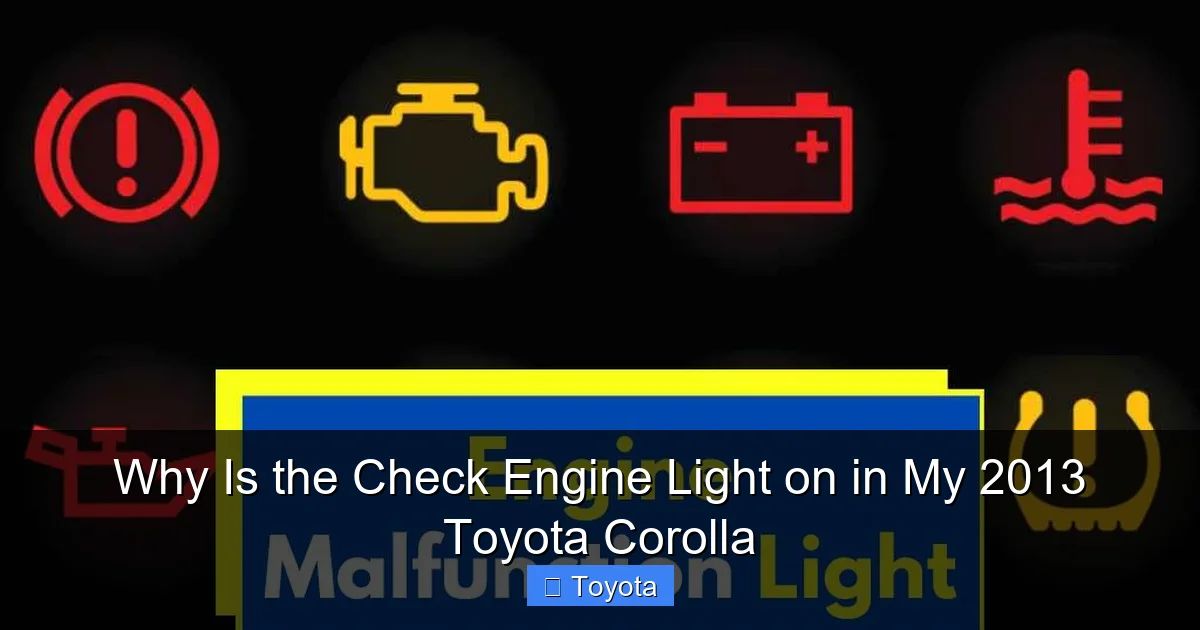
Visual guide about Why Is the Check Engine Light on in My 2013 Toyota Corolla
Image source: weldingtroop.com
1. The Loose or Faulty Gas Cap
Yes, really. The number one cause of a check engine light across all makes and models is a gas cap that isn’t tightened properly. Your fuel system is a sealed environment. If the cap is loose, cracked, or missing, vapors can escape, which the EVAP (Evaporative Emission Control) system detects as a leak. The computer throws a code like P0455 (large EVAP leak) or P0457 (gas cap left loose). The fix is astonishingly simple: pull over safely, remove the gas cap, listen for the clicks as you re-tighten it until it clicks at least three times. If the cap is damaged, replace it. This is often the one repair you can do yourself in under a minute. After driving a few cycles, the light may go out on its own if the system passes the self-test again. If it doesn’t, you still need the code cleared, but the problem is solved.
2. Oxygen Sensor (O2 Sensor) Failure
The Corolla’s 1.8L 2ZR-FE engine uses multiple oxygen sensors to monitor the amount of oxygen in the exhaust. This data helps the computer adjust the air-fuel mixture for optimal performance and minimal emissions. Over time, these sensors, especially the downstream (post-catalytic converter) sensor, can fail or become sluggish. A common code is P0131 (O2 Sensor Circuit Low Voltage) or P0420 (Catalyst System Efficiency Below Threshold). A failing O2 sensor will cause your fuel economy to drop noticeably and may cause a rough idle. Replacing an O2 sensor is a moderate DIY job for the mechanically inclined, but professional diagnosis is recommended to confirm it’s the sensor and not an underlying issue causing the sensor to read incorrectly.
3. Catalytic Converter Problems
This is a big one. The catalytic converter is a critical emissions component that burns off unburned hydrocarbons in your exhaust. It’s expensive to replace. The most common code associated with it is P0420, which indicates the converter isn’t cleaning the exhaust as efficiently as it should. This can be caused by the converter itself wearing out (high mileage is a factor) or by an upstream problem, like a failing O2 sensor or misfiring spark plug, that allows unburned fuel to enter and poison the converter. Symptoms might include a sulfuric (rotten egg) smell from the exhaust, poor acceleration, or a significant drop in fuel economy. Diagnosis is key here—you don’t want to replace a $1,500+ part only to have the problem persist because the root cause wasn’t fixed.
4. Mass Air Flow (MAF) Sensor Issues
The MAF sensor measures the amount of air entering your engine so the computer can calculate the correct fuel amount. It’s a delicate component that can get dirty from oil and dust, especially if your air filter is neglected. A dirty or failing MAF sensor will cause codes like P0101 (Mass Air Flow Circuit Range/Performance) and will lead to a rough idle, hesitation when accelerating, and poor fuel economy. Sometimes, cleaning the sensor with a dedicated MAF cleaner can restore function. Other times, it needs replacement. It’s a relatively inexpensive part and often a straightforward swap.
5. Spark Plugs and Ignition Coils
Worn-out spark plugs or failing ignition coils are classic causes of misfires. A misfire means fuel isn’t burning properly in one or more cylinders. This triggers codes like P0300 (random/multiple cylinder misfire detected) or P0301-P0304 (misfire on cylinder 1-4). Symptoms are very noticeable: a rough, shaking idle, loss of power, and possibly a flashing check engine light (which is an emergency—stop driving). For a 2013 Corolla with around 90,000+ miles, this is a prime suspect. Spark plugs are a routine maintenance item (typically replaced every 30,000-60,000 miles). Ignition coils can fail individually. Replacing the plugs and coils is a common and important service.
6. Evaporative Emission (EVAP) System Leaks
Beyond a loose gas cap, the EVAP system has hoses, valves, and a charcoal canister that can develop leaks over time. Small leaks trigger codes like P0440, P0441, or P0442. You might not feel any driveability issues, but the light will be on. These leaks can be tricky to find. Sometimes it’s a cracked hose, sometimes a faulty purge valve or vent solenoid. A mechanic will often perform a “smoke test” to pressurize the system and visually spot the leak. While not immediately damaging, an EVAP leak will cause your car to fail an emissions test.
7. Thermostat or Coolant Temperature Sensor
Your Corolla’s engine needs to run at a specific temperature. The thermostat regulates coolant flow, and the coolant temperature sensor tells the computer how hot the engine is. If the thermostat sticks open or closed, or if the sensor gives a bad reading (codes like P0115-P0119), the computer gets confused. This can cause the engine to run rich (using more fuel), run poorly, and struggle to reach operating temperature, especially in cold weather. You might notice the heater blowing lukewarm air or the temperature gauge behaving erratically.
Diagnosis: How to Find Out What the Code Means
Knowing the common causes is one thing, but you need the specific code to pinpoint the issue. You have a few options, ranging from free to professional.

Visual guide about Why Is the Check Engine Light on in My 2013 Toyota Corolla
Image source: i.ytimg.com
The Free Scan: Auto Parts Stores
Stores like AutoZone, Advance Auto Parts, and O’Reilly will scan your OBD-II port for free. It’s a great first step. A technician plugs a reader into the port (located under the dashboard, usually on the driver’s side), retrieves the code(s), and gives you a printout or explanation. This tells you the *area* of the problem (e.g., “P0171 – System Too Lean”), but not the exact failed part. It’s your starting point.
The DIY Scan: Buy a Code Reader
For $30-$100, you can buy a basic OBD-II scanner. This is a fantastic tool for any car owner. It lets you read and clear codes yourself. More advanced models give you live data (real-time sensor readings), which is invaluable for diagnosing intermittent problems. If you plan to keep your Corolla for a while, this is a wise investment.
The Professional Deep Dive: Mechanic or Dealer
This is the gold standard. A professional uses a high-end scanner that can access manufacturer-specific codes and live data streams. They combine the code with a test drive, visual inspection, and data analysis to accurately diagnose the root cause. For complex issues like catalytic converter efficiency codes or intermittent misfires, this professional diagnosis is worth the diagnostic fee to avoid throwing parts at the problem.
What to Do When the Light Comes On: A Practical Action Plan
Don’t just stare at it. Here’s your step-by-step guide.

Visual guide about Why Is the Check Engine Light on in My 2013 Toyota Corolla
Image source: i.ytimg.com
- Step 1: Assess the Immediate Danger. Is the light flashing? If yes, your engine is misfiring badly and sending unburned fuel into the exhaust, which can destroy the catalytic converter within minutes. Pull over safely, shut off the engine, and call for a tow. If the light is solid, proceed to step 2.
- Step 2: Check for Obvious Issues. Safely pull over and check your gas cap. Is it loose? Tighten it until it clicks. Also, check your oil level and coolant level (when the engine is cool). Low levels can trigger warnings. Look under the car for obvious leaks.
- Step 3: Listen and Feel. Does the engine run differently? Is there a rough idle, lack of power, strange noises, or smoke from the exhaust? Note any symptoms. This information is critical for the mechanic.
- Step 4: Get the Code Read. Go to an auto parts store for a free scan or use your own scanner. Write down the exact code (e.g., P0420) and its definition.
- Step 5: Research the Code for Your Corolla. Search online for “2013 Toyota Corolla P0420.” You’ll find forums, videos, and articles from other owners who had the same code. This gives you real-world context. For instance, you might learn that for this model year, P0420 often points to an aging catalytic converter or a failing rear O2 sensor.
- Step 6: Decide on Action. If the code points to something simple like a gas cap, fix it. If it’s a sensor you feel comfortable replacing, order the part. For most other codes, especially those affecting drivability or emissions (P0420, P0300, etc.), schedule an appointment with a trusted mechanic. Bring your code research with you.
- Step 7: Do NOT Just Reset the Light. You can clear the code with a scanner, but if you haven’t fixed the problem, the light will return, usually within 30-50 miles of driving as the system completes its self-tests. Resetting is only appropriate after the repair is made. For specific steps on resetting the light on your Corolla, you can refer to this guide on how to reset the check engine light on a Toyota Corolla.
Can I Still Drive My Corolla With the Light On?
This is the million-dollar question. The answer is: it depends entirely on the symptoms.
- Yes, if: The light is solid, the engine runs smoothly, there are no strange noises, smells, or smoke, and you can drive it a short distance (less than 50 miles) to get it diagnosed. Avoid high speeds, rapid acceleration, and towing. Get it checked as soon as possible.
- No, stop driving if: The light is flashing (immediate stop and tow). The engine is running very rough, shaking excessively, or has lost significant power. You see smoke (blue = burning oil, white = coolant leak) or smell raw fuel or sulfur (rotten eggs). You hear loud knocking noises. These indicate active, severe damage occurring.
Remember, driving with an unresolved problem can turn a $200 sensor fix into a $2,000 catalytic converter replacement. Your 2013 Corolla is a reliable car, but even it has its limits. When in doubt, err on the side of caution and have it towed.
Conclusion: Knowledge Is Power (and Saves Money)
A check engine light in your 2013 Toyota Corolla is not a reason to panic, but it is a reason to pay attention. It’s your car’s early warning system. The most important thing you can do is get the specific trouble code. That single alphanumeric string (like P0455) is the key that unlocks the mystery. From there, armed with knowledge about common Corolla issues—the gas cap, O2 sensors, and spark plugs—you can have an informed conversation with your mechanic. You can avoid unnecessary parts replacements and ensure the root cause is fixed. Your Corolla has likely been a faithful companion. A little proactive care when this light comes on will keep it running reliably and efficiently for many more miles. Don’t ignore the message; listen to it, diagnose it, and fix it. Your wallet and your car will thank you in the long run.
Frequently Asked Questions
Will the check engine light reset itself?
Yes, but only if the problem was temporary and the car’s computer successfully completes its self-tests after a few drive cycles (typically 30-50 miles of driving). If the fault persists, the light will come back on. If you fix the issue, you may need to manually clear the code for the light to go out immediately.
How much does it cost to diagnose a check engine light?
The cost varies. Many auto parts stores offer a free code read. A mechanic’s diagnostic fee typically ranges from $80 to $150. This fee is usually waived if you proceed with the recommended repair at their shop. The diagnosis fee covers their time, expertise, and equipment.
Can low oil cause a check engine light?
Not directly. Low oil will trigger the separate oil pressure warning light. However, if oil gets so low that it causes severe engine damage (like a spun bearing), that damage could eventually trigger a check engine code related to engine performance or misfires. They are separate systems, but both are critical warnings.
What’s the most common code for a 2013 Toyota Corolla?
While it varies by mileage and maintenance history, codes related to the EVAP system (like P0455 for a large leak) and oxygen sensor codes (like P0131 or P0420) are very common. For higher-mileage Corollas, misfire codes (P0300-P0304) related to spark plugs or ignition coils are also frequent.
My check engine light is on, but the car runs fine. Is it safe to ignore?
No, it’s not safe to ignore, even if the car runs fine. The light indicates the car is likely polluting more than allowed, which will cause it to fail an emissions test. More importantly, a small, non-drivability issue (like a failing sensor) can sometimes lead to a larger, more expensive problem (like a damaged catalytic converter) if left unchecked. Get it diagnosed.
How long can I drive with a solid check engine light before getting it checked?
If the car runs smoothly with no other symptoms, you should plan to get it diagnosed within a few days to a week. Avoid long highway trips or hauling heavy loads in the meantime. Use the time to get the code read and research the potential issue. Do not wait weeks or months, as a minor problem can escalate.