Why Is My Toyota Key Fob Not Working After Battery Change?

Contents
- 1 Key Takeaways
- 2 📑 Table of Contents
- 3 1. The Usual Suspects: Immediate Post-Replacement Checks
- 4 2. The Resynchronization Solution: Re-Pairing Your Fob
- 5 3. Programming and Immobilizer System Issues
- 6 4. Physical Damage and Environmental Factors
- 7 5. Advanced Troubleshooting and Diagnostic Steps
- 8 6. When to Seek Professional Help: Dealer vs. Locksmith
- 9 Conclusion: Patience and Precision Are Key
- 10 Frequently Asked Questions


Replacing your Toyota key fob battery should fix the problem, but sometimes it creates new issues. The most common culprits are a faulty battery installation, a need to resynchronize the fob with the car, or a dead battery in the car itself. Don’t panic—systematic troubleshooting usually resolves it without a dealer visit.
You just popped open your Toyota key fob, carefully swapped out the old CR2032 for a fresh one, snapped it back together, and… nothing. The lock/unlock buttons are dead. The panic alarm won’t sound. You even try the physical emergency key, and it won’t turn in the door or ignition. Frustration sets in. Why would a simple battery change break a perfectly good key fob? It’s a surprisingly common issue, and the good news is that it’s almost always fixable. This guide will walk you through every possible reason, from the simplest user error to more complex electronic glitches, and give you clear, step-by-step solutions to get your Toyota key working again.
Key Takeaways
- Incorrect Battery Installation: A battery placed backward, not seated properly, or with poor contact is the #1 reason for post-change failure.
- Fob Needs Resynchronization: The key fob often loses its connection with the car’s computer after battery removal and must be manually resynced.
- Car Battery Health is Key: A weak or dead car battery can prevent the key fob’s signal from being recognized, even with a fresh fob battery.
- Wrong Battery Type: Using an incorrect size or voltage battery (e.g., CR2032 vs. CR2025) can cause intermittent or no function.
- Internal Fob Damage: Moisture, physical damage, or a broken internal contact pad can be exposed during battery replacement.
- Security System Glitch: The car’s immobilizer system may need a reset, which sometimes requires a professional scan tool.
- Start with Simple Checks: Always verify the new battery’s voltage, check for physical damage, and try the resync procedure before assuming complex failure.
📑 Table of Contents
- 1. The Usual Suspects: Immediate Post-Replacement Checks
- 2. The Resynchronization Solution: Re-Pairing Your Fob
- 3. Programming and Immobilizer System Issues
- 4. Physical Damage and Environmental Factors
- 5. Advanced Troubleshooting and Diagnostic Steps
- 6. When to Seek Professional Help: Dealer vs. Locksmith
- Conclusion: Patience and Precision Are Key
1. The Usual Suspects: Immediate Post-Replacement Checks
Before you assume the worst, let’s rule out the most common and easily fixed problems. These are the first things to inspect, and they solve over half of all “key fob not working after battery change” cases.
Is the Battery Actually Good and Installed Correctly?
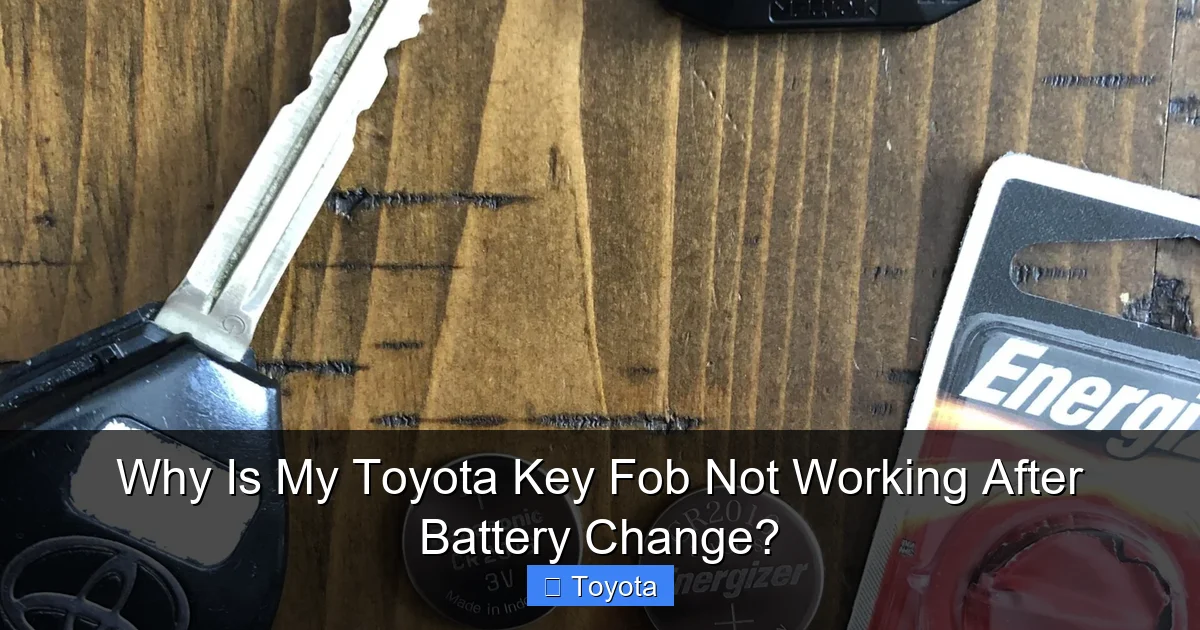
This sounds obvious, but it’s the trap many people fall into. First, did you use the correct battery? Most Toyota key fobs from the last 15 years use a CR2032 3V lithium coin cell. Some older or specific models might use a CR2025 (thinner) or even a different type. Check the old battery’s labeling or your owner’s manual. Using a weak, old, or incorrect stock battery from your drawer is a bad start.
Second, is it installed backward? The “+” side (usually with writing) must face up towards the rubber gasket/contacts. If it’s reversed, the fob gets no power. Third, is it making proper contact? Sometimes the metal spring or clip inside the fob gets bent or isn’t pressing the battery firmly against the contact points. Gently bend any metal contacts inward to ensure a snug fit. Finally, test the battery itself. Use a multimeter or a battery tester. A “fresh” battery from the store can be dead if it’s old stock. A reading below 2.8V is suspect.
Did You Damage the Internal Contacts?
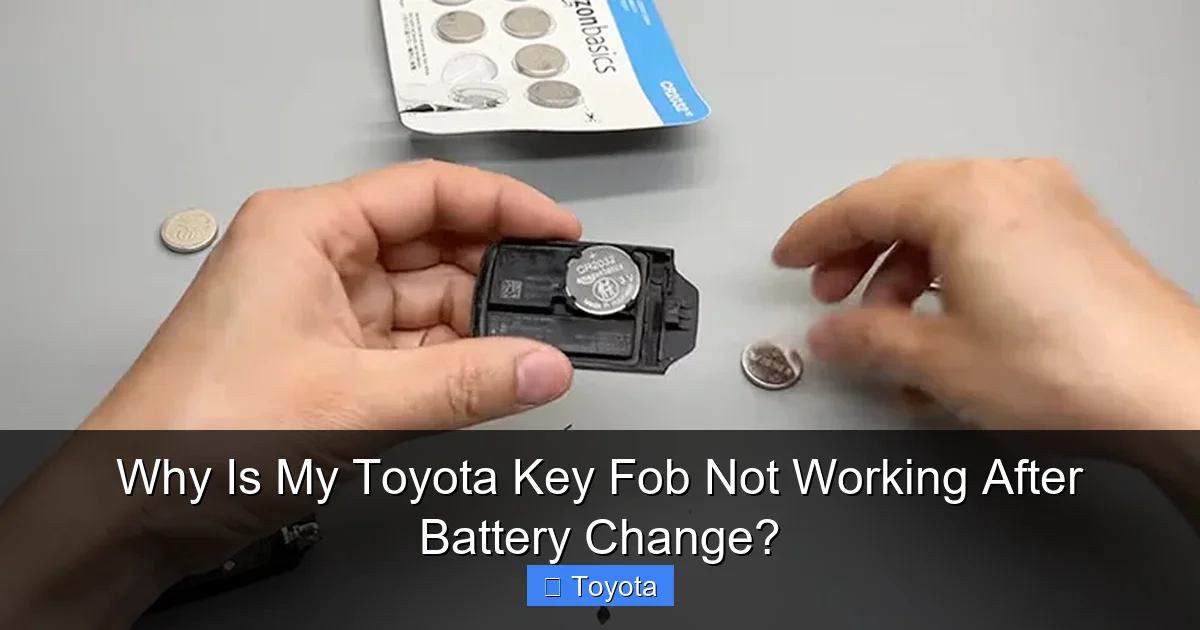
When you pry open the fob, you risk damaging the delicate gold-plated contact pads on the circuit board. Look closely at the two metal discs the battery touches. Are they bent, cracked, or pushed in? A single broken contact means the circuit is open. If you see damage, you might need a new key fob shell or a professional repair. Also, check the small rubber gasket/seal. If it’s pinched or out of place, it can prevent the fob from closing properly and making contact.
The Car’s Battery Might Be the Real Problem
This is a classic case of mistaken identity. You replace the key fob battery, but the car’s main 12V battery is weak or dead. The key fob’s radio signal is very low power. If the car’s battery voltage is too low (below ~12.4V), its own receiver and immobilizer system may not power up fully to “hear” the fob’s signal. You might think the fob is broken, but the car is simply asleep. Try jump-starting your Toyota or charging the main battery. If the fob works after a jump, you’ve found your culprit. This also explains why the physical key might not work—the steering column lock is electronically controlled and needs sufficient car battery voltage to release.
2. The Resynchronization Solution: Re-Pairing Your Fob
Modern Toyota key fobs communicate with the car via a rolling code system. Every time you press a button, it sends a unique code. When you remove the battery, the fob’s internal clock and code counter can get out of sync with the car’s computer. The car receives the signal but discards it as an “old” or “invalid” code. The fix is to manually resynchronize them. This is the most common specific fix for this exact problem.
Visual guide about Why Is My Toyota Key Fob Not Working After Battery Change?
Image source: autoowa.com
Standard Toyota Key Fob Resync Procedure
The steps are generally the same for most models (Camry, Corolla, RAV4, etc.), but always check your owner’s manual for model-specific nuances.
- Get inside the car and close all doors. Do not start the car.
- Insert the key into the ignition and turn it to the “ON” or “ACC” position (the position right before starting, where dash lights come on). Do not start the engine.
- Press and hold the “LOCK” button on the key fob for one full second.
- While still holding the LOCK button, turn the ignition key to the “OFF” position.
- Release the LOCK button.
- Remove the key from the ignition.
- Test the fob. The doors should lock and unlock. You may need to repeat the cycle (ON -> hold LOCK -> OFF -> release) 2-3 times for it to take.
For some models, you may need to press the LOCK and UNLOCK buttons simultaneously for a few seconds after step 2. The key is to perform the button press with the ignition in the ON/ACC state.
Why Resync Works and When It Fails
This procedure forces the car’s immobilizer module to accept the next code from the fob as the new “first” code, resetting the sync. It works for 90% of post-battery-change issues. If it doesn’t work after several tries, the fob may have lost its programming entirely and needs to be reprogrammed by a dealer or locksmith with a specialized diagnostic tool. A sign of this is if the fob’s lights flash when you press buttons (indicating it’s transmitting), but the car does nothing. That means the car is receiving a signal but rejecting the code.
3. Programming and Immobilizer System Issues
If resynchronization fails, the key fob’s transponder chip may have become unpaired from your Toyota’s immobilizer system. This is more serious but still often solvable without a huge cost.
Visual guide about Why Is My Toyota Key Fob Not Working After Battery Change?
Image source: hondatheotherside.com
Understanding the Immobilizer
Your Toyota has an immobilizer—an anti-theft system that prevents the engine from starting without the correctly coded key. The chip in your key fob (separate from the battery-powered remote functions) is read by a ring around the ignition when you insert the key. If the battery change coincided with you using the physical key (the metal blade) to unlock/lock the car, you might have triggered the immobilizer’s security protocol. The car might be in a “sleep” mode, refusing all key signals until reset.
How to Perform a Hard Reset on the Car
Sometimes, the car’s Body Control Module (BCM) or immobilizer module just needs a full reboot. Disconnecting the car battery is the nuclear option but often works.
- Open the hood and locate the negative (-) terminal on your car’s battery.
- Using a 10mm wrench, loosen and remove the negative cable. Secure it away from the terminal so it can’t arc back.
- Wait at least 10-15 minutes. This allows all capacitors in the car’s computers to fully discharge, clearing any temporary glitches.
- Reconnect the negative cable and tighten it securely.
- Close the hood. The car’s systems will reboot. You may need to reset your radio presets and clock.
- Now, try the resynchronization procedure from Section 2 again with the key fob.
Warning: Disconnecting the battery may also require you to enter a security code for your audio system (if equipped). Have this code ready (often in the owner’s manual or glove box).
When You Need Professional Reprogramming
If a hard reset and resync don’t work, the key fob’s transponder chip data may have been corrupted or the car’s immobilizer module has “forgotten” that key. This is common if the battery was changed while the key was out of the car for a long time, or if the fob suffered a static shock. At this point, you need a professional. A Toyota dealer can use their Techstream diagnostic system to add the key back to the car’s memory. Independent locksmiths with automotive programming capabilities can also do this, often for less money. They will need your vehicle’s VIN and proof of ownership. This is not something you can do with a simple button-press sequence at home.
4. Physical Damage and Environmental Factors
Sometimes, the battery change process itself causes the damage that leads to failure.
Visual guide about Why Is My Toyota Key Fob Not Working After Battery Change?
Image source: i.ytimg.com
Water Damage and Corrosion
Key fobs are not waterproof. If you changed the battery on a humid day, or if there was condensation inside the fob, a tiny drop of water can bridge contacts and cause a short. Look for white or green crusty residue (corrosion) on the battery contacts or circuit board. Clean it gently with a cotton swab dipped in 90% isopropyl alcohol. Let it dry completely for 30 minutes before reassembling. If corrosion is heavy, the circuit board may be permanently damaged.
Broken Button Pads or Internal Wires
When snapping the fob halves back together, it’s easy to misalign them. This can pin or crush the thin, flexible membrane that connects the physical buttons to the circuit board. Press each button firmly and listen/feel for a distinct click. If a button feels mushy or doesn’t click, the pad underneath is likely misaligned or torn. Also, check the tiny wire that connects the two halves of the fob (if your model has one). It’s very fragile and can be pinched or severed during closure.
5. Advanced Troubleshooting and Diagnostic Steps
You’ve tried the basics. Let’s get methodical.
Test the Fob with a Different Method
Does your Toyota have a hidden keyhole? Many models (like some Camrys) have a small removable cover on the driver’s door handle. Use the physical emergency key to unlock the door. If this works, the mechanical key blade is fine, and the problem is purely with the remote/immobilizer electronics. If the physical key doesn’t work, and the car battery is known good, the issue might be with the steering lock mechanism itself, which is a separate, more complex problem that can be linked to a weak main battery or a faulty lock actuator.
Listen for the “Click” and Watch for Lights
When you press any button on the fob:
- Do you hear/feel a faint click from inside the fob? If yes, the button circuit is working, and power is reaching the circuit board. The issue is likely with the radio transmitter or programming.
- Does the fob’s LED light blink? If the LED blinks but the car does nothing, the fob is transmitting, but the car isn’t accepting the signal (immobilizer/programming issue).
- Is there no click and no light? This points to a power issue: bad battery, bad installation, or broken internal connection.
Try the “Spare” Key Fob
If you have a second key fob for your Toyota, test it. If the spare works perfectly, the problem is isolated to the fob you just changed. If the spare also fails after your main battery change attempt (unlikely but possible if you triggered a system-wide event), the problem is with the car’s receiver or immobilizer. If the spare works and the main one doesn’t, the main fob likely needs reprogramming or has internal damage.
6. When to Seek Professional Help: Dealer vs. Locksmith
You’ve exhausted the homeowner fixes. The key fob doesn’t respond, the resync fails, the car battery is strong, and the physical key works. Now what?
What a Toyota Dealer Will Do
The dealer has the official Toyota Techstream diagnostic software. They will:
- Connect to your car’s OBD-II port.
- Check for any stored fault codes in the Immobilizer Control Module and Body Control Module.
- Verify the key fob’s transponder chip is being read by the ignition ring.
- If the key is “unregistered,” they will perform a “key registration” procedure, which involves a specific sequence with the key in the ignition and button presses on the fob. This re-pairs the key’s chip with the car’s computer.
- They can also test the car’s keyless entry receiver antenna (usually around the dashboard) for faults.
Cost: Typically $80-$150 for diagnosis and programming, sometimes more if a new key fob is needed.
What a Qualified Automotive Locksmith Can Do
Many reputable locksmiths invest in professional-grade key programming tools (like Autel, Foxwell, or specialized key programmers) that can perform the same immobilizer registration as a dealer, often at a 30-50% lower cost. They are mobile and can come to you. Ensure they specifically mention experience with Toyota immobilizer systems and key programming, not just key cutting. This is often the most cost-effective solution for a lost programming issue.
When to Consider a Replacement Key Fob
If the fob has visible physical damage (cracked case, water damage, broken buttons) or if the circuit board is burned out, repair is not economical. You will need a new key fob. You can buy an OEM (Toyota) fob from a dealer or a high-quality aftermarket one. Critical: A blank aftermarket fob must be programmed to your car by a professional. You cannot just swap the old circuit board into a new shell unless you are extremely skilled with micro-soldering.
Conclusion: Patience and Precision Are Key
A Toyota key fob that stops working after a battery change is almost always a simple sync issue or a minor installation error. Start with the absolute basics: confirm the new battery is good, correctly oriented, and making firm contact. Then, perform the manual resynchronization procedure—it’s your first and best line of defense. If that fails, a full car battery disconnect reset is your next logical step. Remember that the health of your car’s main 12V battery is intrinsically linked to the keyless entry system’s performance. Only after these steps should you consider the need for professional reprogramming or fob replacement. By working through this checklist methodically, you’ll solve the problem yourself in most cases, saving time and money. And if you do need to call a pro, you’ll be able to explain exactly what you’ve already tried, which speeds up the diagnosis.
Frequently Asked Questions
Can a low key fob battery cause a Toyota not to start?
No, a low key fob battery prevents the remote functions (lock/unlock) but will not stop the engine from starting if you use the physical key. The transponder chip in the key fob is passive and powered by the car’s ignition ring, not the fob’s battery. However, a completely dead car battery will prevent starting and can also make the key fob seem unresponsive.
Why is my Toyota key fob blinking red after I changed the battery?
A blinking red light typically indicates a low battery in the fob itself, even after a change. This means the new battery might be weak, installed incorrectly, or there’s a short circuit draining it. Double-check the battery type, orientation, and contact cleanliness. If it persists, the fob’s internal circuitry may be faulty.
Do I need to reprogram my Toyota key fob after changing the battery?
Usually, no. A simple battery change does not require full reprogramming. However, it often requires a manual resynchronization procedure (like holding the lock button with the ignition on) to re-establish the rolling code sync between the fob and the car. This is a user-level fix, not professional reprogramming.
My Toyota key fob works from up close but not from a distance. Is this related to the battery change?
Yes. A marginal battery (slightly weak or poor contact) will have enough power for the close-range signal but not for the longer range. Reinstall the battery, ensuring perfect contact. If the problem persists after a fresh, correct battery, the fob’s transmitter antenna inside the case may be damaged or disconnected.
Can changing the key fob battery trigger the Toyota’s security system?
It can indirectly. If you use the physical key to lock/unlock the doors after the battery change, some Toyota models interpret that as a “theft” event if the alarm was armed, and the immobilizer may stay active. A resync procedure or a full car battery disconnect reset will clear this state.
What if my Toyota’s key fob and physical key both stopped working after a battery change?
This strongly suggests the problem is not with the key fob itself. The common link is your car’s 12V battery. A severely weak or dead main battery cannot power the door lock actuators, the steering column lock, or the immobilizer receiver. Jump-start or charge your car’s battery first. If the physical key works in the door but the steering lock won’t release, it’s still likely a voltage issue with the lock actuator.