
How Long Can a Toyota Camry Go Without an Oil Change

Sticking to your Toyota Camry’s recommended oil change interval is non-negotiable for engine health. While modern synthetic oils and engine monitoring systems offer flexibility, consistently exceeding guidelines leads to accelerated wear, sludge buildup, and catastrophic failure. The “safe” window depends entirely on your driving habits, oil type, and vehicle model year, not a universal mileage. Always prioritize your owner’s manual and treat oil changes as essential preventive maintenance, not an optional service.
Let’s be honest: the “Change Oil” light on your Toyota Camry’s dashboard is one of those little nagging reminders we all wish would just… go away. You’re busy, the car seems fine, and that $60-$100 service can feel like an annoying expense. So, the big, tempting question looms: how long can a Toyota Camry actually go without an oil change before something bad happens?
The short, crucial answer is: It depends, but you should never test the limits. Your Camry’s engine is a marvel of precision engineering, but it’s a metal machine that relies on clean, properly viscous oil as its lifeblood. That oil degrades over time, losing its ability to lubricate, cool, clean, and protect. Pushing past the recommended service interval is a gamble with one of your most valuable assets. This guide will break down exactly what factors determine oil life, the real risks of delay, and how to make an informed, engine-saving decision for your specific Camry.
Key Takeaways
- Follow the Manual: Your Camry’s recommended interval (often 5,000-10,000 miles) is the primary guideline, but it’s based on ideal conditions.
- Oil Type is Critical: Full synthetic oil lasts significantly longer than conventional oil, enabling extended intervals in newer models.
- Your Driving Style Matters Most: “Severe” driving (short trips, extreme temps, towing) can cut your oil life in half, requiring more frequent changes.
- Trust, But Verify, Your Monitoring System: Toyota’s Maintenance Required light calculates oil life based on algorithms, but it’s not infallible for extreme conditions.
- Delaying Has Real Costs: Skipping oil changes causes engine sludge, increased friction, and can void warranties, leading to expensive repairs far exceeding the cost of the service.
- Check Your Oil Regularly: A monthly dipstick check is the best habit to catch low levels or degraded oil (dark, gritty, or smelling burnt) between services.
- When in Doubt, Ask a Pro: A trusted mechanic can assess your specific driving patterns and advise a truly personalized maintenance schedule.
📑 Table of Contents
- Manufacturer Recommendations: Your Starting Point
- The “Severe Driving” Trap: Why Your Real Interval Is Shorter
- Oil Type Matters: Conventional vs. Synthetic vs. Toyota Genuine
- Modern Monitoring Systems: Your Car’s Best Friend (With Caveats)
- The Real Risks: What Happens When You Go Too Long
- Practical Tips and Best Practices for Your Camry
- Conclusion: Your Camry’s Longevity is in Your Hands
Manufacturer Recommendations: Your Starting Point
Every Toyota Camry owner’s first and most important reference is the official owner’s manual. Toyota provides specific oil change intervals based on rigorous testing for each generation and engine type. For decades, the standard was a conservative 3,000 miles or 3 months. However, advances in engine technology and lubricants have dramatically extended these intervals.
Modern Conventional Wisdom
For most modern Toyota Camry models (roughly 2012 and newer), using genuine Toyota motor oil or a high-quality equivalent that meets Toyota’s specifications, the recommended interval is typically:
- 7,500 to 10,000 miles, or
- 12 months, whichever comes first.
This is for what Toyota classifies as “normal” driving conditions. But here’s the critical catch: very few drivers experience truly “normal” conditions. The manual explicitly states that if your driving falls into “severe” categories, you should reduce that interval. In fact, you might be surprised to learn that your daily commute likely qualifies as severe service. Understanding these conditions is key to answering our core question.
The “Severe Driving” Trap: Why Your Real Interval Is Shorter
Toyota defines “severe” driving not as racing or off-roading, but as common, everyday scenarios that stress your engine oil. If your Camry experiences any of the following, you must cut the recommended interval by 30-50%.

Visual guide about How Long Can a Toyota Camry Go Without an Oil Change
Image source: vehicleanswers.com
Common Severe Driving Conditions
- Frequent Short Trips: Driving less than 5-10 miles in cold weather, or under 10 miles in normal temps, doesn’t allow the oil to fully warm up and burn off contaminants. This is the #1 culprit for most drivers.
- Extreme Temperatures: Consistently driving in very hot (above 90°F/32°C) or very cold (below 0°F/-18°C) climates.
- Stop-and-Go Traffic: City commuting with constant idling and acceleration increases engine stress and contaminant buildup.
- Dusty or Sandy Environments: Abrasive particles can bypass the air filter and mix with oil.
- Towing or Heavy Loads: Using your Camry to pull a trailer or carry maximum cargo increases engine workload and heat.
- Extensive Idling: If your job involves long periods of parked engine operation (e.g., police, taxi, some sales roles).
Practical Example: If your manual says 10,000 miles for normal use, and you have a 20-mile highway commute in moderate weather, you might safely approach that limit. But if you drive 3 miles to the grocery store, sit in traffic, and repeat this pattern daily, you should be planning for an oil change around 5,000-6,000 miles. The oil is degrading faster due to condensation and fuel dilution, even if the odometer hasn’t hit the big number.
Oil Type Matters: Conventional vs. Synthetic vs. Toyota Genuine
The type of oil in your crankcase is arguably the second most important factor after your driving habits. Not all oils are created equal, and their formulation dictates their longevity.
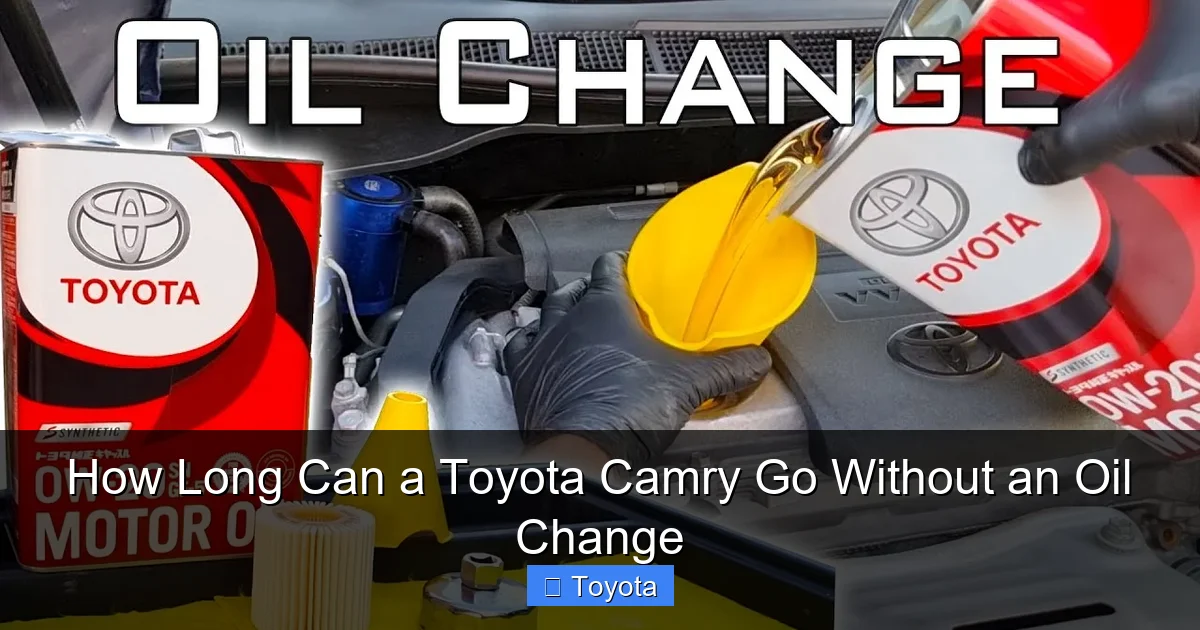
Visual guide about How Long Can a Toyota Camry Go Without an Oil Change
Image source: i.ytimg.com
Synthetic Oil: The Game-Changer
Full synthetic oils are engineered at the molecular level. They have superior thermal stability (resist breaking down at high temps), better cold-flow properties, and contain advanced additive packages that fight sludge, varnish, and wear. This is why manufacturers can recommend 7,500-10,000 mile intervals. Synthetic oil can last significantly longer than conventional oil under the right conditions. However, even synthetic oil is not invincible; its additives deplete over time, and it can become contaminated with fuel, water, and metal particles.
Conventional Oil: The Shorter Lifespan
If your older Camry (pre-2010) or a budget service uses conventional mineral oil, the standard interval drops dramatically to 3,000-5,000 miles. This oil oxidizes and thickens more quickly, especially under heat stress. Using conventional oil and trying to stretch it to a 7,500-mile interval is a direct path to sludge formation.
Toyota Genuine Motor Oil
When you get an oil change at a Toyota dealership, they use Toyota Genuine Motor Oil, which is formulated specifically for Toyota engines and meets all their specifications. It’s often a high-quality synthetic blend or full synthetic, depending on the grade. This ensures compatibility with engine seals and the variable valve timing (VVT-i) system, which is sensitive to oil quality.
Modern Monitoring Systems: Your Car’s Best Friend (With Caveats)
Gone are the days of a simple sticker on your windshield. Most Toyota Camrys from the early 2000s onward feature an intelligent Maintenance Required light or a more advanced Oil Maintenance Indicator on the multi-information display. This system is not a simple mileage counter; it’s an algorithm-based computer that calculates oil life.

Visual guide about How Long Can a Toyota Camry Go Without an Oil Change
Image source: rxmechanic.com
How It Works
The system monitors engine operating conditions: engine revolutions, coolant temperature, driving duration, and vehicle speed. It uses this data to estimate how much the oil’s lubricating properties have degraded. When it calculates that the oil life has reached a predetermined threshold (usually around 15% remaining), it illuminates the “Maintenance Required” light. After you have the oil changed, a mechanic (or you, with the right procedure) resets the system, and the countdown begins anew.
Limitations and When to Ignore It
While sophisticated, this system has a fundamental assumption: it expects you to be using the recommended oil type and that your driving, while variable, isn’t constantly severe. If you live in a consistently extreme climate, tow regularly, or make only very short trips, the algorithm may overestimate oil life. In these cases, you should manually shorten the interval regardless of what the light says. The system is a fantastic tool, but it’s a generalized tool. Knowing how to reset the maintenance light after an oil change is useful, but knowing when to ignore its initial timing is even more important for engine longevity.
The Real Risks: What Happens When You Go Too Long
Why is this such a big deal? Because oil isn’t just a lubricant; it’s a multi-functional fluid. As it degrades, it fails at all its jobs, and the consequences are progressive and expensive.
Stage 1: Reduced Protection (5,000-7,500 miles past due)
The oil’s viscosity (thickness) changes. It may become too thin to maintain a protective film between metal parts (like pistons and cylinder walls) or too thick to flow properly on cold starts. This leads to increased metal-to-metal contact and microscopic wear. Fuel economy drops slightly as the engine works harder.
Stage 2: Sludge and Varnish (7,500-10,000 miles past due)
Oxidation and contamination cause the oil to form a thick, gooey sludge. This sludge clogs oil passages, preventing oil from reaching critical components like the camshaft and valve train. It coats parts in a varnish that impedes heat dissipation. You might start to hear ticking or tapping noises from the valvetrain. The oil pan may show a black, tar-like residue when drained.
Stage 3: Catastrophic Failure (10,000+ miles past due)
This is the point of no return. Bearings (main and rod) lose their oil film and weld themselves to the crankshaft. The oil pump can become clogged with sludge, starving the engine of lubrication entirely. The result is a seized engine—a “blown” engine. The cost to replace or rebuild an engine is typically $3,000 to $6,000 or more. Compared to a $75 oil change, this is a devastating financial hit that could have been avoided.
Warranty Note: Consistently ignoring oil change intervals can be used by the manufacturer to deny warranty claims for engine-related failures, as it constitutes neglect.
Practical Tips and Best Practices for Your Camry
So, knowing all this, how do you build a bulletproof oil change strategy?
1. Start with the Manual, Then Personalize
Find the “Scheduled Maintenance” chart in your owner’s manual. Note the “Severe” schedule interval. Adopt that as your baseline, not the “Normal” one. For a 2023 Camry with synthetic oil under severe conditions, that’s likely 5,000 miles or 6 months.
2. Check Your Oil Level Monthly (Yes, Really)
This is the single most important habit you can develop. Park level, engine off for 5-10 minutes, pull the dipstick, wipe, reinsert, and check. The level should be between the MIN and MAX marks. If it’s low, top up with the correct oil type. This catches minor leaks or consumption issues early. While you’re there, look at the oil’s color and smell. Fresh synthetic oil is amber and translucent. If it’s pitch black, gritty, or smells like burnt toast, it’s degraded—get it changed immediately, even if you’re under the mileage limit.
3. Use the Correct Oil Viscosity and Specification
Using “0W-20” is common for newer Camrys (2018+), but older models may require “5W-30”. Never guess. The manual or the oil cap under your hood specifies it. Using the wrong weight can cause damage. For peak performance and longevity, choose an oil with the Toyota API (or ILSAC) “starburst” certification and the correct viscosity grade.
4. Don’t Just Change the Filter—Use a Quality One
The oil filter is your engine’s kidneys. A cheap filter allows more contaminants to circulate. Stick with OEM Toyota filters or reputable brands like Fram, Mobil 1, or Wix. A proper filter change is part of the service.
5. Consider Your Environment and Usage
If you live in a very dusty area, change the air filter more often. If you do a lot of short trips in winter, consider a 4,000-mile interval in the coldest months. If you’re storing the Camry for months, change the oil before storage and again after, as sitting oil can absorb moisture.
6. Factor in Cost vs. Risk
An independent shop oil change for a Camry typically costs $40-$80 with conventional oil and $60-$100 with synthetic. A dealership might be $10-$20 more but often includes a multi-point inspection. When viewed as insurance for a $20,000-$30,000 asset, it’s an exceptional value. Skipping it to save $80 is the ultimate false economy.
Conclusion: Your Camry’s Longevity is in Your Hands
The question “how long can a Toyota Camry go without an oil change?” doesn’t have a single mileage answer. The technical maximum under perfect, laboratory conditions with full synthetic oil might be 12,000 miles. But in the real world of commutes, errands, and varying weather, that number is dangerously high. The true answer is: as long as the recommended interval for your specific driving style and oil type.
For the vast majority of drivers, that means scheduling an oil change every 5,000 to 7,500 miles or every 6 months, whichever comes first. Treat the Maintenance Required light as a helpful reminder, not an absolute alarm. Combine it with your own monthly oil checks and an honest assessment of your driving habits. By respecting this simple, fundamental service, you’re not just changing oil; you’re investing in the smooth, reliable, and long-lived performance that makes the Toyota Camry a legendary sedan. Protect your investment—get the oil changed on time, every time.
Frequently Asked Questions
Can I drive my Camry if the oil change is overdue by a few hundred miles?
Yes, a small delay of 500 miles or a month is generally not an emergency, but you should schedule the service immediately. The risk increases exponentially with every mile beyond the recommended interval due to accelerating oil degradation.
What type of oil does a Toyota Camry require?
It depends on the model year and engine. Most 2018+ Camrys require 0W-20 full synthetic oil. Many 2012-2017 models use 0W-20 or 5W-30. Always check your owner’s manual or the oil cap for the exact specification (e.g., “Toyota Genuine Motor Oil” or “API SP”) to ensure proper engine protection and warranty compliance.
How do I reset the “Maintenance Required” light after an oil change?
Turn the ignition to “ON” (do not start). Use the trip/odometer button to display the “ODO” screen. Turn the ignition off. Press and hold the trip button while turning the ignition back to “ON”. Continue holding until the odometer displays “000000” or the light blinks and goes off (about 5-10 seconds). Release the button. The process can vary slightly by year; consult your manual for the exact steps for your Camry.
What constitutes “severe” driving for a Camry’s oil life?
Severe driving includes frequent trips under 5 miles in cold weather, extended idling, driving in very hot or very cold climates, consistent stop-and-go traffic, towing, or driving on dusty roads. If your daily routine fits any of these, you should use the “severe” maintenance schedule from your manual, which typically halves the normal oil change interval.
How often should I check my Camry’s oil level between changes?
You should check the oil level at least once a month, and before any long road trips. This is the best way to catch low oil levels (which can cause damage quickly) and visually inspect the oil’s color and clarity for signs of degradation or contamination.
Is full synthetic oil worth the extra cost for my Camry?
Absolutely, for almost all modern Camrys. Full synthetic oil provides superior protection against high-temperature breakdown, better cold-weather flow, and longer drain intervals. It also helps keep engines cleaner and can improve fuel economy slightly. For engines requiring 0W-20, synthetic oil is mandatory. The extra cost per quart is minimal compared to the protection it offers and the potential for longer intervals.
