
Why Is My Jeep Shaking When Idling?

A shaking Jeep at a stoplight is rarely normal and usually points to a specific mechanical or electronic issue. Common culprits include worn engine mounts, dirty fuel injectors, faulty spark plugs, or vacuum leaks. Diagnosing the exact cause requires a systematic check, starting with simple visual inspections and potentially using an OBD2 scanner. Ignoring the shake can lead to more expensive damage, so addressing it promptly is key to keeping your Jeep reliable and safe.
Key Takeaways
- Worn or broken engine mounts are the #1 suspect: These rubber components isolate engine vibration. When they fail, that vibration goes straight into the cabin, making your Jeep shake visibly and audibly at idle.
- Fuel and ignition problems are frequent causes: Clogged fuel injectors, a weak fuel pump, or worn spark plugs/coils can cause mis-fires, making the engine run rough and shake.
- Air and vacuum leaks disrupt the air-fuel mix: A cracked hose or leaking gasket lets in extra unmetered air, confusing the engine computer and causing a rough, shaky idle.
- The throttle body and idle air control valve (IACV) need to be clean: Carbon buildup here can restrict airflow at idle, causing the engine to hunt or stall while shaking.
- Always check for stored diagnostic trouble codes (DTCs): Even if your check engine light isn’t on, a simple OBD2 scanner can reveal pending codes that point directly to the problem area.
- Don’t ignore it—shaking causes accelerated wear: Prolonged shaking stresses other components like the exhaust system, electrical connectors, and even the transmission, leading to costlier repairs.
- Some fixes are DIY-friendly, others require a pro: Replacing spark plugs or cleaning the throttle body is often doable at home, but motor mount replacement or internal engine issues need a mechanic’s expertise.
📑 Table of Contents
- That Unsettling Rumble: Your Jeep Shouldn’t Shake at a Stop
- Understanding “Idle”: What Should Your Jeep Be Doing?
- The Usual Suspects: Top Causes of a Shaking Idle
- Your DIY Diagnostic Game Plan: Start Simple
- When to Wave the White Flag: Call a Professional Mechanic
- Prevention is Key: Keeping Your Idle Smooth
- Conclusion: Don’t Let the Shake Shake Your Confidence
That Unsettling Rumble: Your Jeep Shouldn’t Shake at a Stop
You’re sitting at a red light, foot on the brake, and you feel it. That familiar, unsettling vibration through the steering wheel, seat, and floorboard. Your Jeep is running, but it’s shaking like it’s cold on a winter morning—only it’s not cold, and it’s definitely not normal. That feeling of your trusty SUV trembling in place can be anything from a minor annoyance to a major warning sign. So, why is your Jeep shaking when idling? Let’s pop the hood, both literally and figuratively, and figure out what’s going on under there.
First, take a breath. An idle shake is one of the most common complaints we hear from Jeep owners, from Wranglers to Grand Cherokees. It’s a clear communication from your engine that something in its delicate balance is off. The engine needs to run smoothly at a specific RPM (usually around 600-800 for most Jeeps) when you’re not pressing the gas. Any significant deviation from that smoothness creates the shake you feel. Our goal here is to give you the knowledge to understand the possible causes, perform some basic checks, and know exactly when it’s time to call in the pros. Think of this as your diagnostic roadmap.
Understanding “Idle”: What Should Your Jeep Be Doing?
Before we dive into problems, let’s define normal. A healthy engine at idle should be almost serene. You might feel a faint, steady thrum—that’s the four-stroke cycle in motion—but it should be consistent. The RPM gauge (if you have one) should hold steady. There should be no violent shaking, no lurching forward as if it wants to jump out of park, and no sound like a bag of marbles being shaken in a tin can. If your Jeep’s idle is so rough that the steering wheel dances in your hands or the whole vehicle seems to shudder, something is wrong.
Visual guide about Why Is My Jeep Shaking When Idling?
Image source: offroadcare.com
Modern Jeeps rely on the Engine Control Unit (ECU) to manage idle speed. It uses inputs from dozens of sensors (like the throttle position sensor, mass airflow sensor, and oxygen sensors) and actuators (like the Idle Air Control Valve or IACV) to automatically adjust fuel and air for a smooth stop. When one of these components fails or gets dirty, or if there’s a mechanical issue like a compression problem, the ECU’s adjustments can’t compensate, and the shake becomes obvious.
The Usual Suspects: Top Causes of a Shaking Idle
Let’s break down the most common reasons your Jeep is shaking at a standstill. We’ll start with the most frequent and move to the less common but still possible.
Visual guide about Why Is My Jeep Shaking When Idling?
Image source: miro.medium.com
1. Worn or Failed Engine (Motor) Mounts
This is the classic, and often the most likely, culprit. Engine mounts are the rubber (or sometimes hydraulic) bushings that hold your engine and transmission to the vehicle’s frame. Their job is to absorb the natural vibrations and torque of the engine so you don’t feel them inside the cabin. Over time, years of heat, oil exposure, and constant stress cause this rubber to deteriorate, crack, and break.
What it feels like: A pronounced, heavy shake that is most violent right when you first start the engine and then might smooth out slightly as the engine warms. You might also feel a solid “clunk” or thud when shifting into drive or reverse from park. The shake often gets worse when you turn on the air conditioning because the AC compressor adds extra load to the engine, amplifying the vibration.
How to check: With the engine running and the parking brake set, have a friend slowly shift between Park, Neutral, Drive, and Reverse while you watch the engine from the side. If you see the engine rock excessively from side to side or front to back, the mounts are bad. A flashlight helps. You can also try “loading” the engine: with the brake firmly held, shift into Drive and then gently apply a little throttle (be careful!). If the shake intensifies dramatically, mounts are very likely.
2. Fuel Delivery Problems: Gunk and Weak Pressure
Your engine needs a precise mist of fuel mixed with air to run smoothly. If the fuel coming in is inconsistent, the engine will stutter and shake.
- Dirty Fuel Injectors: Over thousands of miles, tiny deposits can clog the microscopic holes in fuel injectors. This results in a weak or uneven spray pattern, causing some cylinders to run lean (not enough fuel) and mis-fire. The result is a rough, shaky idle. This is a very common issue, especially in Jeeps that see lots of short trips where the engine doesn’t get thoroughly hot enough to burn off deposits.
- Weak Fuel Pump or Clogged Fuel Filter: If the fuel pump can’t maintain proper pressure, or if the filter is blocked, fuel flow to the injectors becomes inconsistent, especially at the low demand of idle. The engine starves for fuel and runs rough.
What it feels like: A constant, light-to-moderate shudder. It might feel like the engine is “searching” for stability, with the RPMs fluctuating up and down slightly on the gauge. It may improve slightly when revved higher but return when back at idle.
3. Ignition System Failures: No Spark, No Smoothness
The spark plugs and ignition coils are what ignite the air-fuel mixture in each cylinder. If one or more isn’t working properly, that cylinder doesn’t fire, causing a mis-fire and a shake.
- Worn Spark Plugs: Old, gapped, or fouled plugs can’t create a strong, consistent spark. They are a routine maintenance item (typically every 30,000-100,000 miles depending on type).
- Failing Ignition Coils: Each cylinder (or pair of cylinders) has its own coil that steps up the battery’s voltage to create the spark. These can fail intermittently or completely as they age. A common Jeep issue is coil failure, especially on the 3.6L V6 engines.
What it feels like: A distinct, rhythmic shake that corresponds to the number of cylinders. A 4-cylinder engine will have a more noticeable shake than a smooth V6 or V8. You might also see a check engine light flashing (a serious warning for mis-fire) or a stored code for a specific cylinder mis-fire (like P0301 for Cylinder 1).
4. Air Intake and Vacuum Leaks: Too Much of a Good Thing
Engines need a precise amount of air. The computer measures incoming air with the Mass Airflow (MAF) sensor. If there’s a leak in the air intake system *after* the MAF sensor, the engine gets “extra” air that the computer doesn’t know about. This creates a lean condition (too much air, not enough fuel) and a rough idle.
Common leak points: Cracked or loose plastic intake tubes, disconnected or cracked vacuum hoses (these are everywhere under the hood), a leaking intake manifold gasket, or a faulty PCV valve hose.
What it feels like: Often a higher-pitched, fluttering idle where the RPMs seem to wander up and down. It might smooth out slightly when you press the throttle, as the leak becomes a smaller percentage of total airflow. A hissing sound from the engine bay at idle is a dead giveaway.
5. A Dirty Throttle Body or Faulty Idle Air Control Valve (IACV)
The throttle body controls how much air enters the engine when you press the gas pedal. At idle, a small bypass channel controlled by the IACV (or in some newer cars, the throttle plate itself is motorized) lets in just enough air to keep the engine running. Carbon deposits from engine vapors can coat the throttle blade and the inside of the bore, or the IACV passage can get gunked up, preventing smooth operation.
What it feels like: An idle that is very low and lumpy, or one that fluctuates wildly. The engine might stall when coming to a stop or when the AC turns on. It can feel like the engine is “fighting” to stay alive.
6. Low Compression: The Engine’s Worn-Out Heart
This is a more serious, internal engine problem. Compression is what makes the engine powerful and smooth. Worn piston rings, burnt valves, or a blown head gasket can cause low compression in one or more cylinders. A cylinder with low compression won’t contribute power evenly, causing a shake.
What it feels like: A deep, heavy shake that is present at all RPMs, not just idle. It will worsen under load (like when the AC is on or when driving uphill). There is often blue smoke from the exhaust (burning oil) or white sweet-smelling smoke (coolant leak) associated with this. This requires a major repair.
Your DIY Diagnostic Game Plan: Start Simple
Before you panic or hand over your keys and your wallet, there are several safe, simple checks you can do yourself. Always start with the engine cool and the parking brake firmly set.
Visual guide about Why Is My Jeep Shaking When Idling?
Image source: psychoautos.com
Step 1: The Visual and Auditory Sweep
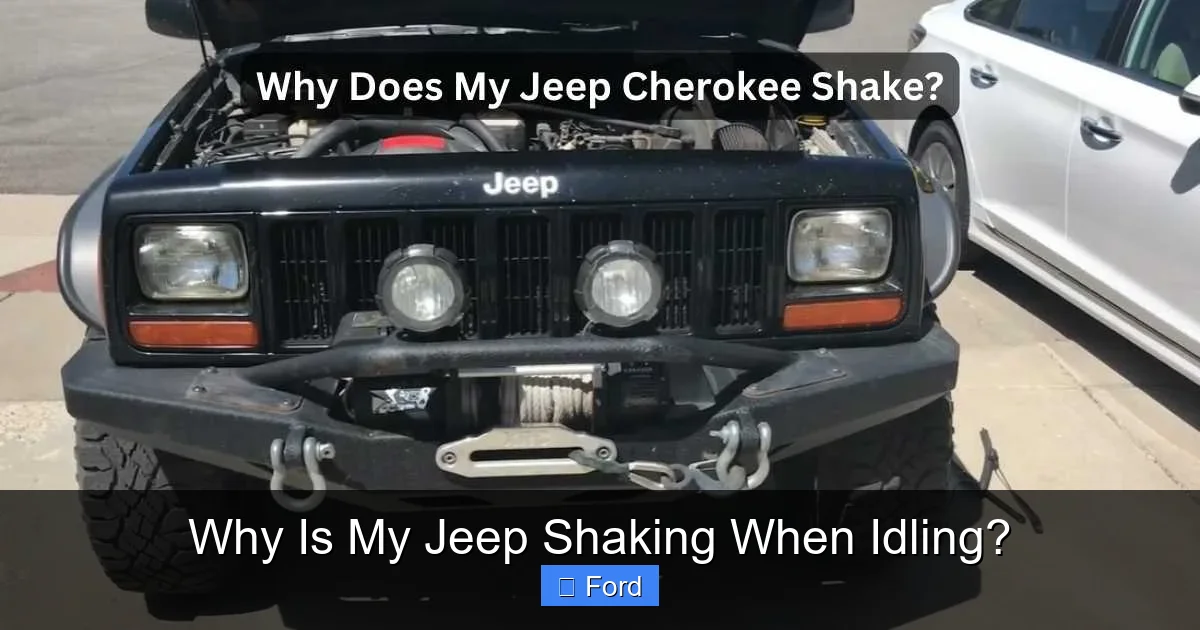
Open the hood with the engine running. Listen. Can you hear a hissing sound? That points to a vacuum leak. Look at the engine. Do you see any disconnected or cracked rubber hoses? Do the engine mounts look like they have large gaps or cracked rubber? Shine a light on the throttle body—is it coated in black soot? These are all clues.
Step 2: The “Load” Test
This helps isolate whether the problem is in the engine’s core combustion or in the mounts. With the brake held firmly, shift into Drive (or 1st gear in a manual) and very gently press the accelerator to raise the RPM to about 1500-2000. Be extremely careful not to lurch forward. Does the shake get much, much worse? If yes, it strongly points to engine or transmission mounts. If the shake stays roughly the same, the problem is likely inside the engine (fuel, spark, air).
Step 3: Check the Basics
When was the last time you had a tune-up? If your spark plugs are overdue, replace them. It’s one of the most common and inexpensive fixes. Also, check your oil level. While low oil won’t usually cause a shake at idle directly, severely low oil can cause valve train noise that might be mistaken for a shake, and it’s always good to rule out.
Step 4: Scan for Codes
This is the most important step. You don’t need an expensive scan tool. Any generic OBD2 scanner (they cost as little as $20) will plug into the port under your dash (it’s usually near your steering column). Even if your check engine light is off, scan for pending codes. A pending code for a mis-fire (P0300-P030X) or fuel trim (P0171/P0174) is a huge clue. This will tell you if a specific cylinder is mis-firing or if the engine is running lean. A code like P0506 (Idle Air Control System RPM Lower Than Expected) points directly to the throttle body/IACV. If you get a code, search it online along with your Jeep’s year and engine size for specific diagnostic help.
When to Wave the White Flag: Call a Professional Mechanic
Some issues are beyond safe DIY scope. You should definitely consult a qualified mechanic, preferably one familiar with Jeeps, if:
- Your check engine light is flashing. This indicates a severe mis-fire that can damage your catalytic converter—stop driving and get it towed.
- You’ve done the basic checks and found no obvious leaks, the plugs are new, and there are no helpful codes. The problem could be internal (low compression, bad camshaft sensor, etc.).
- You’ve confirmed bad engine mounts. While you can replace some mounts yourself with the right tools, many on modern Jeeps require lifting the engine and are very labor-intensive. A pro can do it faster and safer.
- The shake is accompanied by overheating, smoking, or strange noises (clunks, knocks).
- You’re simply uncomfortable performing any of the diagnostic steps.
A good mechanic will perform a “cylinder balance test” to isolate a mis-firing cylinder and will do a thorough smoke test for vacuum leaks, which is the most reliable way to find them.
Prevention is Key: Keeping Your Idle Smooth
Once you fix the current shake, you want it to stay fixed. Here’s how:
- Stick to your maintenance schedule. Regular oil changes, air filter replacements, and spark plug/ignition coil service as per your owner’s manual are the foundation.
- Use top-tier gasoline. Higher-quality fuels have better detergent additives that help keep fuel injectors clean. Occasionally adding a fuel system cleaner (like Seafoam or Techron) can help, but don’t overdo it.
- Let your engine warm up properly on cold starts. Drive gently for the first few minutes. This allows the engine to reach optimal operating temperature and burn off carbon deposits more effectively.
- Inspect rubber components. When you’re under the hood for other services, take a quick look at vacuum hoses and the engine mounts for signs of age or cracking.
- Don’t ignore small problems. A slight shudder that comes and goes is often the first sign of a failing mount or a slightly dirty injector. Catching it early is cheaper.
Conclusion: Don’t Let the Shake Shake Your Confidence
Your Jeep shaking when idling is its way of asking for help. It’s a symptom, not a disease. By methodically working through the most common causes—starting with the simple, free checks like listening for leaks and scanning for codes—you can often pinpoint the issue. Remember, the most common fix is a set of new spark plugs or a cleaned throttle body, but don’t overlook the physical engine mounts, which are a very typical failure point on aging Jeeps. Whether you’re a DIY enthusiast or prefer to leave it to the experts, understanding what’s happening under the hood empowers you to have an informed conversation and avoid unnecessary repairs. A smooth idle is a sign of a healthy engine, and a healthy engine means your Jeep is ready to tackle whatever adventure you have in mind next.
Frequently Asked Questions
Is it safe to drive my Jeep if it’s shaking at idle?
For a short distance to a repair shop, it may be safe if the shake is mild and there are no other warning lights. However, driving with a severe shake or a flashing check engine light can cause catastrophic damage to the catalytic converter or other components. It’s best to diagnose and fix the issue before driving long distances.
What is the most common cause of a shaking idle in a Jeep?
The most frequent culprits are worn engine mounts, dirty fuel injectors, and faulty spark plugs or ignition coils. For many Jeep models, especially those with the 3.6L V6, ignition coil failures are a very common source of rough idling and mis-fires.
Can low oil cause a Jeep to shake at idle?
Severely low oil can cause valve train noise and potentially engine damage, which might lead to a rough running condition. However, a simple low oil level typically does not cause a distinct idle shake. It’s always good to check your oil level first as part of basic diagnostics, but the shake is more likely from the issues listed above.
How much does it cost to fix a shaking idle?
The cost varies wildly. A set of spark plugs ($50-$150 in parts) and labor is relatively inexpensive. Replacing a fuel injector or cleaning the throttle body might run $200-$500. Replacing engine mounts is a bigger job, often costing $400-$1000+ depending on the mount location and labor rates. An internal engine problem like low compression can cost thousands.
Can I fix a shaking idle myself?
You can certainly try! Start with the easy stuff: check and tighten all your engine bay hose connections, clean the throttle body with a dedicated cleaner, and replace your spark plugs if they’re due. Scanning for codes is a must and is very DIY-friendly. However, diagnosing complex vacuum leaks or replacing engine mounts is often best left to professionals due to safety and complexity.
Why does my Jeep shake worse when the air conditioning is on?
Turning on the AC engages the compressor, which puts an extra load on the engine. This extra strain magnifies any existing imbalance or vibration. If the shake gets dramatically worse with the AC on, it’s a very strong indicator of worn engine mounts. The mounts are what normally dampen this added vibration, and if they’re failed, you feel the full effect. It can also highlight a slightly weak cylinder that can’t handle the extra load.
