Why Does My Ford F-150 Jerk When I Accelerate?

Contents
- 1 Key Takeaways
- 2 📑 Table of Contents
- 3 The Fuel System: The Engine’s Lifeline
- 4 The Ignition System: Creating the Spark
- 5 Transmission Troubles: Not Just an Engine Issue
- 6 Sensors and Electronics: The Truck’s Nervous System
- 7 Tires, Wheels, and Driveline: The Final Connection
- 8 Software, Battery, and the Little Things
- 9 Conclusion: A Methodical Approach to Smooth Acceleration
- 10 Frequently Asked Questions


Is your Ford F-150 jerking or shuddering when you press the gas pedal? This common but unsettling issue can stem from simple fixes like bad spark plugs or clogged fuel filters to more complex transmission or sensor failures. Ignoring the problem can lead to expensive repairs, so it’s crucial to diagnose the specific cause, which often involves checking the fuel, ignition, and electronic systems systematically. A smooth acceleration is essential for both performance and safety, so don’t delay investigating the root of the jerk.
You’re merging onto the highway, you press the gas pedal, and instead of a smooth surge of power, your Ford F-150 lurches, shudders, or feels like it’s stumbling forward. That sickening jerk isn’t just annoying—it’s your truck telling you something’s wrong. As America’s best-selling truck for decades, the F-150 is known for its robustness, but even the toughest workhorse can develop acceleration issues. The problem can range from a quick, inexpensive fix to a sign of a major repair looming. Understanding the “why” is the first step to getting your Ford F-150’s power delivery smooth and reliable again. This guide will walk you through the most common causes, from the simplest to the most complex, so you can diagnose and solve the jerk.
Key Takeaways
- Fuel delivery problems are a top suspect: A clogged fuel filter, weak fuel pump, or dirty injectors can cause uneven fuel flow, leading to stumbles and jerks during acceleration.
- Ignition system failures cause misfires: Worn spark plugs, bad ignition coils, or damaged wires prevent proper combustion, making the engine run rough and jerk under load.
- Transmission issues often feel like jerking: Low fluid, faulty solenoids, or worn clutches in automatic transmissions can cause harsh shifts or slippage that mimics engine hesitation.
- Faulty sensors trick the computer: A bad Mass Airflow (MAF) sensor, Throttle Position Sensor (TPS), or O2 sensors send incorrect data, disrupting the air-fuel mixture and throttle response.
- Tires and wheels can create vibration: Severe tire imbalance, uneven wear, or bent wheels can cause a shudder that feels like acceleration jerking, especially at higher speeds.
- Software and electrical gremlins exist: Outdated Engine Control Unit (ECU) software or corroded battery/ground connections can affect throttle response and engine smoothness.
- Always start with simple checks: Begin by scanning for trouble codes, inspecting spark plugs, and checking fluid levels before assuming major component failure.
📑 Table of Contents
- The Fuel System: The Engine’s Lifeline
- The Ignition System: Creating the Spark
- Transmission Troubles: Not Just an Engine Issue
- Sensors and Electronics: The Truck’s Nervous System
- Tires, Wheels, and Driveline: The Final Connection
- Software, Battery, and the Little Things
- Conclusion: A Methodical Approach to Smooth Acceleration
The Fuel System: The Engine’s Lifeline
Think of your engine as a giant air pump that needs a precise mist of gasoline to explode at just the right moment. If that fuel supply is inconsistent, the explosions are uneven, and you feel that as a jerk or hesitation when you ask for more power. The fuel system in your F-150 is a chain, and if any link is weak, the whole chain fails.
Clogged Fuel Filter: The Silent Blocker
Every gallon of gas carries tiny particles of dirt and rust from the tank and gas station. The fuel filter’s job is to catch this gunk before it reaches the delicate injectors. Over time, this filter gets packed with debris, creating a restriction. When you accelerate, the engine demands a huge surge of fuel. A clogged filter can’t deliver fast enough, causing the engine to starve momentarily—resulting in a distinct stumble or jerk. This is often more noticeable when trying to pass or climb a hill. Replacing the fuel filter is a routine maintenance item (often every 30,000-50,000 miles) that many owners overlook, especially on older models.
Weak Fuel Pump: Can’t Keep Up with Demand
The fuel pump lives inside the gas tank and is responsible for pushing fuel under pressure to the engine. As it ages, its pressure can drop, or its volume flow can decrease. At idle, the demand is low, and you might not notice anything. But when you slam the throttle, the engine’s computer calls for a massive amount of fuel instantly. A weak pump can’t supply it, causing a temporary lean condition (too much air, not enough fuel) that causes a misfire and a jerk. You might also hear a whining noise from the tank or experience hard starts. Testing fuel pressure with a gauge is the definitive way to check this.
Dirty or Faulty Fuel Injectors: The Spray Nozzles
Fuel injectors are精密 nozzles that spray a fine mist of fuel into the intake manifold or directly into the cylinder (on direct injection engines). They can get clogged with carbon deposits or varnish from low-quality fuel or infrequent use. A partially clogged injector sprays a weaker or uneven mist. During acceleration, the computer tries to compensate, but the cylinder with the weak injector runs lean and misfires, causing a shake or jerk that may be felt throughout the truck. Using quality fuel and occasional injector cleaner can help, but severely clogged injectors often need professional cleaning or replacement.
The Ignition System: Creating the Spark
Even with perfect fuel, you need a strong, consistent spark to ignite it. The ignition system—spark plugs, wires (if equipped), and ignition coils—is responsible for this. Any weakness here causes a misfire, which feels exactly like a jerk or stumble under acceleration. Misfires are also what trigger the dreaded “check engine” light.
Visual guide about Why Does My Ford F-150 Jerk When I Accelerate?
Image source: vehicleschool.com
Worn Spark Plugs: The Most Common Culprit
Spark plugs take a tremendous amount of abuse. They sit in a hot, high-pressure environment and erode over time. The electrode gap widens, and the ceramic insulator can crack. A worn plug might spark weakly or inconsistently, especially under the higher cylinder pressures of acceleration. This causes that cylinder to misfire. On a V8 like many F-150s, a single misfiring plug can cause a noticeable judder. Inspecting and replacing spark plugs at the manufacturer’s recommended interval is critical. If you’re due, consider upgrading to high-performance iridium or platinum plugs for better longevity and spark. For specific recommendations on the best plugs for your 5.0L or other engine, check out our guide to the best spark plugs for Ford F-150 5.0.
Bad Ignition Coils: Amplifying the Spark
Modern F-150s often use a Coil-On-Plug (COP) system, where each cylinder has its own small ignition coil sitting directly on the spark plug. These coils can fail internally, producing a weak or non-existent spark. A failing coil might work fine at low RPM but break down under the higher stress of acceleration. Diagnosing involves swapping coils between cylinders to see if the misfire moves, which is a classic mechanic trick. A bad coil will usually set a specific cylinder misfire code (like P0302 for cylinder 2).
Damaged Spark Plug Wires (If Applicable)
On older F-150 models with distributor or coil-pack systems, high-resistance spark plug wires can degrade. The insulation can crack, causing high-voltage leaks to ground. This weakens the spark at the plug. You might see a blue arcing spark at night from the wires. Resistance testing with a multimeter can identify bad wires. While less common on newer models, they are still a point of failure on trucks from the early 2000s.
Transmission Troubles: Not Just an Engine Issue
This is a critical distinction. A “jerk” during acceleration can originate from the transmission, not the engine. The feeling is different—often a sudden clunk, harsh engagement, or a shudder that feels like it’s coming from the center of the truck, especially when shifting from 1st to 2nd gear or under light throttle. Automatic transmissions are complex, and several components can cause this.
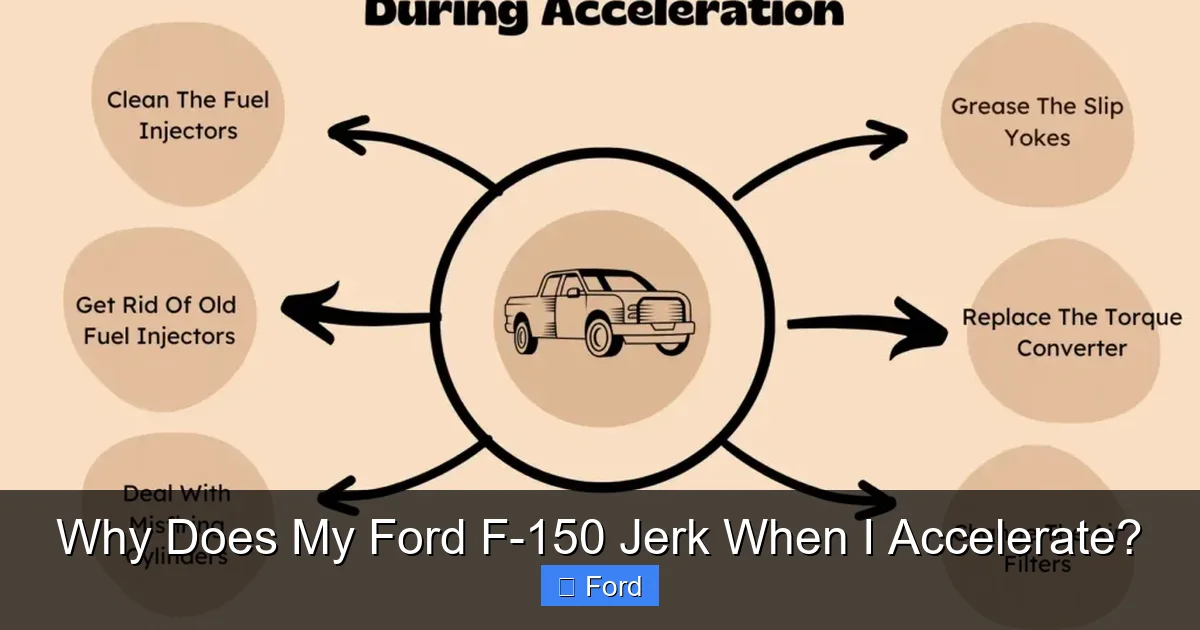
Visual guide about Why Does My Ford F-150 Jerk When I Accelerate?
Image source: vehicleschool.com
Low or Degraded Transmission Fluid
Transmission fluid does more than lubricate; it’s a hydraulic fluid that creates pressure to engage clutches and bands. Low fluid level means insufficient pressure, causing delayed or harsh engagements. Fluid that is old, burnt, or contaminated has lost its frictional properties. This prevents the transmission’s internal clutches from engaging smoothly, leading to a slip-and-grab feeling that manifests as a jerk. Checking the fluid level and condition (color and smell) is the first step. It should be bright red and smell slightly sweet, not brown and burnt.
Faulty Transmission Solenoids
Solenoids are electro-hydraulic valves controlled by the Transmission Control Module (TCM). They direct fluid to the correct clutch packs to shift gears. A solenoid that is sticking, blocked, or failing electrically won’t open or close properly. This disrupts the timing of clutch engagement, causing a harsh, abrupt shift that feels like a kick or jerk. Diagnosing this often requires a professional scan tool to monitor solenoid performance and solenoid resistance tests.
Worn Clutch Packs or Bands (High-Mileage Symptom)
Inside an automatic transmission are multiple clutch packs and bands for each gear. Over time and with hard use (towing, high mileage), the friction material on these clutches wears away. Worn clutches slip under load before finally grabbing, which causes a pronounced shudder or jerk, especially when the transmission is cold or under heavy acceleration. This is a sign of internal wear and typically requires a rebuild or replacement transmission.
Sensors and Electronics: The Truck’s Nervous System
Your F-150’s engine computer (PCM) relies on a network of sensors to know what’s happening. If these sensors send bad data, the computer makes wrong decisions about fuel, spark, and throttle, leading to poor performance and jerking.
Visual guide about Why Does My Ford F-150 Jerk When I Accelerate?
Image source: carglassadvisor.com
Mass Airflow (MAF) Sensor Failure
The MAF sensor measures the amount of air entering the engine. This is the single most important piece of data for calculating fuel delivery. A dirty or failed MAF sensor will under-report or over-report airflow. The computer then adds too much or too little fuel, causing a lean or rich condition that causes hesitation, stumbling, and jerking under acceleration. A common fix is to carefully clean the MAF sensor with dedicated electronics cleaner. If cleaning doesn’t help, replacement is needed.
Throttle Position Sensor (TPS) Issues
The TPS tells the computer how far you’re pressing the gas pedal. If it’s worn or failing, its signal might be jumpy or inaccurate. The computer might think you’ve suddenly let off the pedal or slammed it, causing abrupt changes in throttle opening and fuel delivery that feel like a jerk, especially during steady acceleration. On some models, a failing TPS can also cause idle problems.
Oxygen (O2) Sensor Problems
Downstream O2 sensors monitor exhaust gases to fine-tune fuel mixture after the catalytic converter. While a bad O2 sensor usually triggers a check engine light and hurts fuel economy, it can also cause subtle fueling issues that feel like a slight hesitation or lack of smoothness under load, particularly during the transition from cruise to acceleration.
Tires, Wheels, and Driveline: The Final Connection
Sometimes, what feels like an engine or transmission jerk is actually coming from the wheels and axles. This is especially true if the jerk is speed-related or accompanied by vibration in the steering wheel or seat.
Tire Imbalance and Uneven Wear
A severely out-of-balance tire will create a rhythmic thumping or vibration that increases with speed. When you accelerate, this vibration can intensify and feel like a shudder or jerk through the cab and floor. Similarly, tires with extreme uneven wear (cupping, feathering) can cause a similar sensation. A simple tire balance and rotation might solve the problem. If your tires are worn unevenly, it might point to an alignment issue. Investing in a quality set of tires can prevent many of these issues. For help choosing the right tires for your F-150, see our roundup of the best tires for Ford F-150.
Bent Wheels or Damaged Axles
Hitting a deep pothole or curb can bend a wheel or damage an axle shaft. A bent wheel will cause a consistent vibration at certain speeds that worsens with acceleration. A bent or damaged CV axle (on 4×4 models) or driveshaft can cause a noticeable clunk or jerk, especially when starting from a stop or during turns. Visual inspection and a “road test” on a lift by a technician can identify these.
U-Joint or Center Support Bearing Failure
The driveshaft on rear-wheel and 4×4 F-150s is connected by U-joints. A worn or failing U-joint will have excessive play and can cause a clunk or jerk when you apply power, particularly when shifting between drive and reverse. On longer wheelbase models, a failing center support bearing can cause similar symptoms. These are wear items that need replacement.
Software, Battery, and the Little Things
Before you assume a major mechanical failure, consider these electronic and maintenance-related causes that are often overlooked.
Outdated TCM/PCM Software
Ford regularly releases Technical Service Bulletins (TSBs) and software updates for the Powertrain Control Module (PCM) and Transmission Control Module (TCM). These updates can refine throttle response, shift points, and torque management to fix known drivability issues like hesitation or harsh shifts. A simple software reflash at the dealer can sometimes completely eliminate a jerking problem that has no physical cause. Always ask if there are any outstanding updates for your vehicle’s VIN.
Weak Battery or Poor Grounding
Modern trucks are electrical computers on wheels. A weak, failing battery can cause voltage drops that confuse the sensitive engine and transmission computers. This can lead to erratic throttle response, rough running, and even harsh transmission behavior as systems struggle to communicate. Similarly, a corroded or loose battery cable or a poor engine/chassis ground strap can create similar electrical gremlins. A simple load test on the battery and a visual inspection of all major ground connections (battery terminals, engine block, chassis) is a smart first step. If your battery is old, consider a replacement. You can find a suitable option in our list of the best batteries for Ford F-150 for your model year.
Dirty Throttle Body
Carbon buildup around the throttle plate can cause it to stick or not respond smoothly to pedal input. The computer tries to compensate, but you might feel a hesitation or a sudden “grab” when you press the pedal. Cleaning the throttle body with a dedicated cleaner is a relatively easy DIY job on many models.
Conclusion: A Methodical Approach to Smooth Acceleration
Your Ford F-150 jerking when accelerating is a symptom, not a diagnosis. The cause lies somewhere in the chain that converts your foot’s pressure into forward motion: fuel, spark, air, electronics, or the driveline itself. The key is a logical, step-by-step diagnosis. Always start by checking for any stored trouble codes with an OBD-II scanner, even if the check engine light isn’t on. Codes like P0300 (random misfire), P0171 (system too lean), or P0700 (transmission control system) give you a massive head start.
From there, begin with the simplest, most common, and least expensive items: inspect and replace spark plugs if due, check all fluid levels (engine oil, transmission fluid, coolant), ensure your tires are properly inflated and balanced, and give the battery a once-over. If those don’t solve it, the investigation moves to fuel pressure tests, sensor inspections (MAF, TPS), and finally, more in-depth transmission diagnostics. While some issues are perfect for a savvy DIYer, others—especially transmission and complex electronic faults—are best left to a qualified Ford technician with the proper scan tools and experience. Don’t ignore the jerk; address it methodically, and you’ll get your F-150’s confident, smooth power back.
Frequently Asked Questions
Is it safe to drive my Ford F-150 if it jerks when accelerating?
It depends on the severity. A slight, occasional stumble might be safe for a short distance to a repair shop. However, a violent jerk, especially if accompanied by noises, smoke, or a check engine light, can be dangerous and may cause further damage. It’s best to diagnose the issue promptly.
Can low transmission fluid really cause jerking?
Absolutely. Low or degraded transmission fluid is a very common cause of harsh, jerky shifts in automatics. The fluid creates hydraulic pressure; without enough clean fluid, the clutches engage abruptly instead of smoothly. Always check fluid level and condition first when diagnosing transmission-related jerks.
How much does it typically cost to fix an F-150 that jerks on acceleration?
The cost varies wildly. A new set of spark plugs might cost $200-$400 in parts and labor. A fuel filter replacement is under $200. A MAF sensor might be $300-$500. Major transmission repairs can range from $1,500 to over $4,000. Getting an accurate diagnosis is essential before quoting a price.
Can dirty fuel injectors cause my truck to jerk?
Yes. Clogged injectors spray a weak, inconsistent mist of fuel. This causes a lean condition in that cylinder, leading to a misfire that you feel as a jerk or stumble, especially under load. Injector cleaning or replacement can resolve this.
Should I immediately check the engine light if my F-150 jerks?
Yes. Even if the light isn’t on, you should scan for any stored or pending trouble codes immediately. Many issues that cause jerking (misfires, lean conditions) will log a code. Reading these codes is the fastest way to narrow down the problem area.
Can a software update fix my acceleration jerk?
Sometimes. Ford has released TSBs and PCM/TCM updates for certain model years that address known drivability issues like hesitation or harsh shifts. A dealer can check your VIN for any applicable updates, which is a non-invasive and often free fix if under warranty or a simple reflash.