
Who Makes Toyota Batteries

Toyota batteries are not made by Toyota alone—they’re produced through strategic partnerships with leading global manufacturers like Panasonic, GS Yuasa, and CATL. These collaborations ensure high-quality, durable, and eco-friendly power solutions tailored for both conventional and hybrid Toyota vehicles.
When you pop the hood of your Toyota—whether it’s a rugged Tacoma, a fuel-sipping Prius, or a sleek bZ4X electric SUV—you might wonder: *Who actually makes the battery that keeps this machine running?* It’s a fair question. After all, the battery is the unsung hero of your vehicle. It starts the engine, powers the electronics, and in hybrid and electric models, stores energy for propulsion. But here’s the surprising truth: **Toyota doesn’t make all its batteries itself.**
Instead, Toyota relies on a network of world-class manufacturers and strategic partnerships to deliver reliable, high-performance batteries tailored to different vehicle types. This approach allows Toyota to leverage cutting-edge technology, maintain quality control, and scale production efficiently across global markets. From traditional lead-acid batteries in gasoline engines to advanced lithium-ion packs in hybrids and EVs, Toyota’s battery ecosystem is a blend of innovation, collaboration, and sustainability.
So, who are the real players behind the scenes? The answer involves a mix of Japanese engineering giants, Chinese tech leaders, and Toyota’s own subsidiaries working in harmony. In this article, we’ll dive deep into the companies that make Toyota batteries, how they’re chosen, what technologies they use, and why this partnership model benefits drivers everywhere.
Key Takeaways
- Toyota doesn’t manufacture all its batteries in-house: Instead, it partners with top-tier battery producers to supply reliable power for its vehicles.
- Panasonic is a key supplier: Known for its advanced lithium-ion technology, Panasonic provides batteries for Toyota’s hybrid and electric models, including the Prius and bZ4X.
- GS Yuasa supplies conventional lead-acid batteries: These are used in many gasoline-powered Toyota cars, trucks, and SUVs for starting, lighting, and ignition (SLI) functions.
- CATL powers newer electric models: Contemporary Amperex Technology Co. Limited (CATL) provides lithium iron phosphate (LFP) batteries for select Toyota EVs, especially in Asian markets.
- Toyota Tsusho manages supply chains: This subsidiary oversees global sourcing, logistics, and sustainability efforts across Toyota’s battery partnerships.
- Quality and longevity are prioritized: All Toyota-approved batteries undergo rigorous testing to meet strict performance, safety, and environmental standards.
- Recycling and sustainability are core values: Toyota promotes battery reuse and recycling programs to reduce environmental impact and support a circular economy.
📑 Table of Contents
- Why Toyota Partners with External Battery Makers
- Panasonic: The Powerhouse Behind Toyota’s Hybrid and Electric Batteries
- GS Yuasa: The Trusted Name in Conventional Toyota Batteries
- CATL: Powering Toyota’s Electric Future in Asia
- Toyota Tsusho: The Silent Orchestrator of Battery Supply Chains
- How Toyota Ensures Battery Quality and Reliability
- The Future of Toyota Batteries: Innovation and Sustainability
- Conclusion
Why Toyota Partners with External Battery Makers
Toyota is known for its lean manufacturing and just-in-time production philosophy—principles that extend beyond car assembly to component sourcing. Rather than building massive battery factories from scratch, Toyota chooses to collaborate with specialized manufacturers who already excel in battery technology. This strategy offers several advantages.
First, it allows Toyota to stay on the cutting edge of battery innovation without bearing the full cost of R&D and infrastructure. Battery technology evolves rapidly, especially with the rise of electric vehicles (EVs). By partnering with leaders like Panasonic and CATL, Toyota gains access to the latest advancements in energy density, charging speed, and battery lifespan.
Second, external partnerships improve supply chain resilience. Relying on multiple suppliers reduces the risk of production delays due to factory shutdowns, natural disasters, or geopolitical issues. For example, during the 2011 earthquake in Japan, Toyota’s diversified supply network helped it recover faster than competitors who depended on single-source suppliers.
Third, these collaborations support Toyota’s global expansion. Different regions have different regulations, climate conditions, and consumer preferences. A battery that works well in the hot deserts of Arizona might not perform as efficiently in the cold winters of Norway. By working with local or regional battery makers, Toyota can tailor its power solutions to meet specific market needs.
Finally, partnering with experts allows Toyota to focus on what it does best: designing and building reliable, efficient vehicles. While battery chemistry and manufacturing are complex fields, Toyota’s core strength lies in vehicle integration, safety systems, and user experience. By outsourcing battery production to specialists, Toyota ensures that every component—from the engine to the infotainment system—works seamlessly together.
Panasonic: The Powerhouse Behind Toyota’s Hybrid and Electric Batteries
Visual guide about Who Makes Toyota Batteries
Image source: warninglights.net
When it comes to advanced battery technology, few names are as respected as Panasonic. This Japanese electronics giant has been a key partner of Toyota for decades, especially in the realm of hybrid and electric vehicles. In fact, Panasonic is best known for its long-standing collaboration with Tesla, but its partnership with Toyota is equally significant—and growing.
The Panasonic-Toyota Alliance
In 2019, Toyota and Panasonic announced a joint venture called **Prime Planet Energy & Solutions (PPES)**, later rebranded as **Blue Energy**. This company was created specifically to develop, manufacture, and sell lithium-ion batteries for hybrid and electric vehicles. The joint venture combines Toyota’s automotive expertise with Panasonic’s battery innovation, resulting in high-performance, long-lasting power solutions.
One of the flagship products of this partnership is the **nickel-metal hydride (NiMH)** and **lithium-ion (Li-ion)** batteries used in the Toyota Prius, the world’s best-selling hybrid car. These batteries are designed to handle frequent charge and discharge cycles, which is essential for regenerative braking and electric-only driving modes.
Powering the Future: Lithium-Ion and Solid-State Innovations
Panasonic is also at the forefront of next-generation battery technology. The company is heavily invested in **solid-state batteries**, which promise higher energy density, faster charging, and improved safety compared to traditional liquid electrolyte batteries. Toyota has announced plans to introduce solid-state batteries in its vehicles by the mid-2020s, and Panasonic is expected to play a major role in making that vision a reality.
In addition, Panasonic supplies lithium-ion batteries for Toyota’s **bZ series** of electric vehicles, including the bZ4X. These batteries are designed to deliver long range, quick charging, and durability over thousands of charge cycles. For example, the bZ4X’s battery pack, co-developed with Panasonic, offers up to 315 miles of range (EPA estimate) and supports DC fast charging up to 150 kW.
Quality Control and Sustainability
Panasonic’s manufacturing process is known for its precision and consistency. Each battery cell undergoes rigorous testing for performance, safety, and longevity. The company also emphasizes sustainability, using recycled materials where possible and minimizing waste during production.
Toyota benefits from this partnership not just in terms of performance, but also in brand reputation. When drivers know their Toyota is powered by Panasonic batteries, they gain confidence in the vehicle’s reliability and technological sophistication.
GS Yuasa: The Trusted Name in Conventional Toyota Batteries
Visual guide about Who Makes Toyota Batteries
Image source: paultan.org
While Panasonic handles the high-tech side of Toyota’s battery needs, another Japanese company plays a crucial role in keeping traditional gasoline-powered Toyotas running smoothly: **GS Yuasa**.
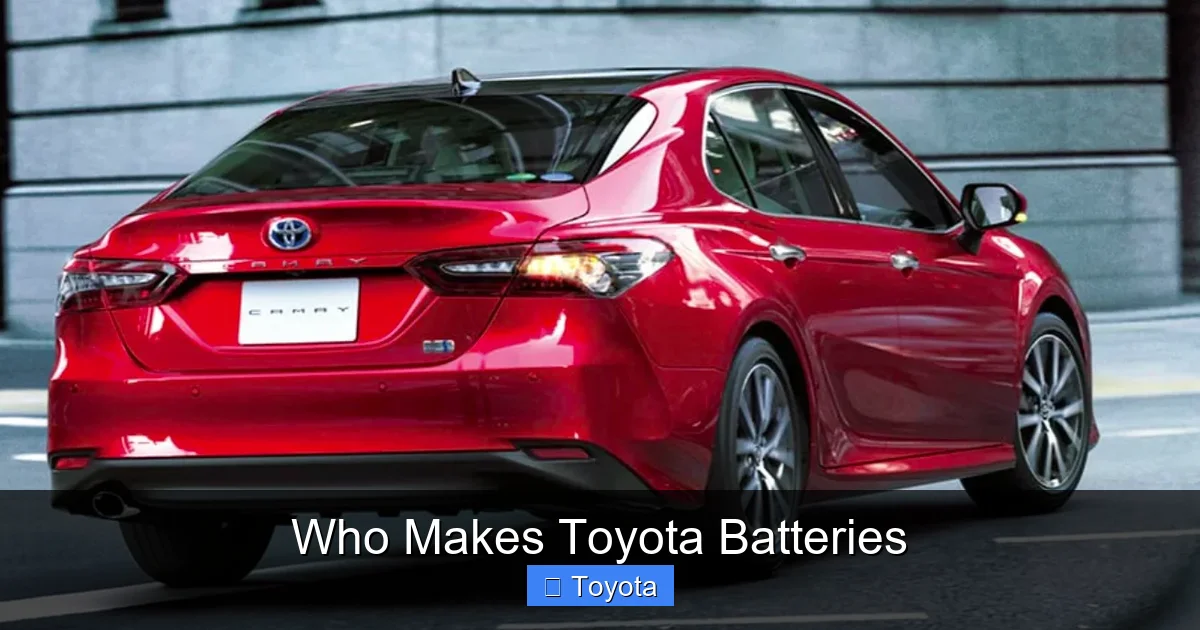
Founded in 2004 through the merger of Japan Storage Battery and Yuasa Corporation, GS Yuasa is one of the world’s largest manufacturers of lead-acid batteries. These are the standard 12-volt batteries found in most non-hybrid Toyota vehicles, such as the Camry, Corolla, RAV4, and Tundra.
What Are Lead-Acid Batteries and Why Do They Matter?
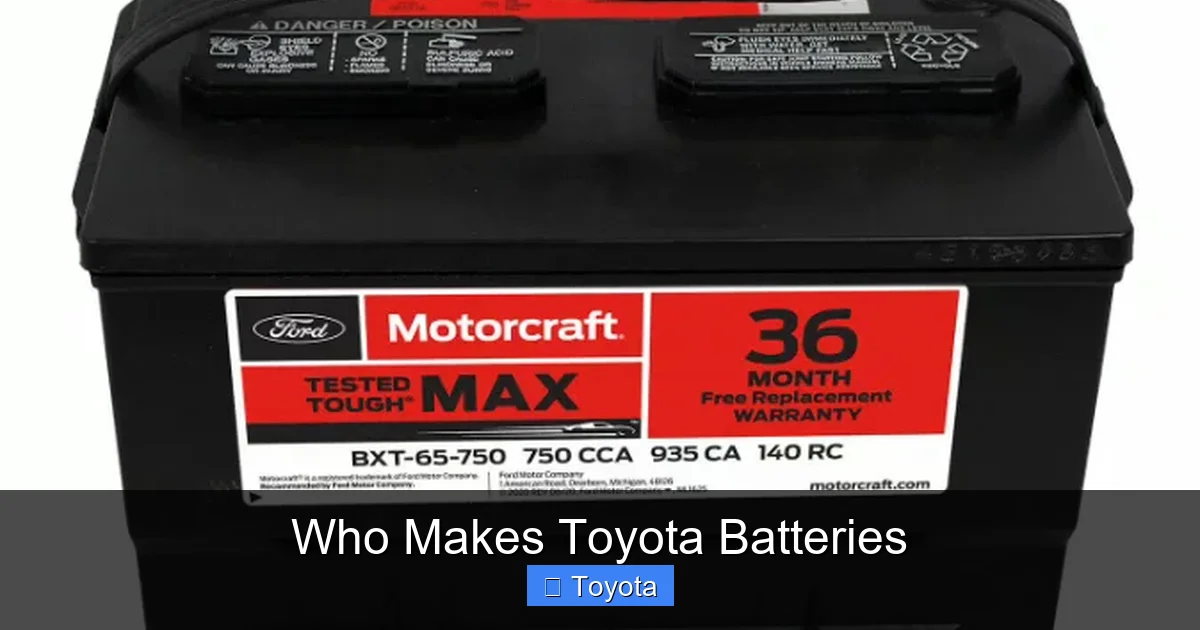
Lead-acid batteries are the workhorses of the automotive world. They provide the high burst of power needed to start the engine, and they support essential systems like lights, audio, and climate control when the engine is off. Unlike hybrid or EV batteries, which store energy for propulsion, lead-acid batteries are designed for **starting, lighting, and ignition (SLI)** functions.
GS Yuasa supplies Toyota with **maintenance-free, sealed lead-acid batteries** that are built to last. These batteries are engineered to withstand extreme temperatures, vibrations, and frequent charge cycles—common challenges in real-world driving conditions.
Advanced Features for Modern Vehicles
Modern Toyota vehicles come with more electronics than ever before—smart key systems, advanced driver assistance systems (ADAS), and infotainment centers—all of which draw power from the battery even when the engine is off. To meet these demands, GS Yuasa has developed **enhanced flooded batteries (EFB)** and **absorbent glass mat (AGM)** batteries for select Toyota models.
AGM batteries, in particular, are used in vehicles with start-stop technology, which automatically shuts off the engine at red lights to save fuel. These batteries can handle frequent restarts and deeper discharge cycles better than standard lead-acid batteries.
For example, the Toyota Highlander Hybrid uses an AGM battery to support its electrical systems, while the standard Highlander may use a conventional EFB or flooded battery from GS Yuasa.
Durability and Warranty
GS Yuasa batteries are known for their long service life—often lasting 5 to 7 years with proper maintenance. Toyota typically includes a 3-year/36,000-mile warranty on new vehicle batteries, but many GS Yuasa batteries exceed that lifespan under normal conditions.
Regular maintenance, such as checking battery terminals for corrosion and ensuring the charging system is functioning properly, can extend battery life even further.
CATL: Powering Toyota’s Electric Future in Asia
Visual guide about Who Makes Toyota Batteries
Image source: paultan.org
As Toyota expands its electric vehicle lineup, especially in China and other Asian markets, it has turned to **Contemporary Amperex Technology Co. Limited (CATL)**—the world’s largest EV battery manufacturer.
Based in Ningde, China, CATL specializes in lithium-ion batteries and has become a dominant force in the global EV market. In 2020, Toyota announced a strategic partnership with CATL to supply batteries for its electric vehicles, particularly in regions where CATL has strong manufacturing and distribution networks.
Lithium Iron Phosphate (LFP) Batteries: A Game Changer
One of CATL’s key contributions to Toyota is its **lithium iron phosphate (LFP)** battery technology. Unlike traditional lithium-ion batteries that use nickel and cobalt, LFP batteries are cobalt-free, making them more environmentally friendly and cost-effective.
LFP batteries also offer excellent thermal stability, reducing the risk of overheating and fire—a major concern in EV safety. While they have slightly lower energy density than nickel-rich batteries, they are ideal for urban EVs and shorter-range vehicles where safety and longevity are prioritized over maximum range.
Toyota has begun using CATL’s LFP batteries in select models sold in China, such as the **bZ3**, an electric sedan developed in partnership with BYD. These batteries are designed to deliver reliable performance in hot climates and support fast charging infrastructure common in Chinese cities.
Local Production and Cost Efficiency
By sourcing batteries from CATL, Toyota can reduce production costs and shorten delivery times in Asian markets. CATL operates multiple gigafactories across China, enabling rapid scaling and localized supply chains. This is especially important as Toyota aims to sell 3.5 million EVs annually by 2030.
The partnership also supports Toyota’s goal of offering affordable electric vehicles without compromising on quality. CATL’s economies of scale and efficient manufacturing processes help keep battery prices competitive.
Toyota Tsusho: The Silent Orchestrator of Battery Supply Chains
While external manufacturers produce the batteries, **Toyota Tsusho Corporation** plays a behind-the-scenes role in managing the entire battery ecosystem. As a subsidiary of the Toyota Group, Toyota Tsusho is responsible for sourcing raw materials, coordinating logistics, and ensuring sustainability across the supply chain.
From Raw Materials to Finished Batteries
Battery production requires critical minerals like lithium, cobalt, nickel, and manganese. Toyota Tsusho works with mining companies and recyclers to secure a stable supply of these materials while minimizing environmental and ethical risks.
For example, Toyota Tsusho has invested in lithium extraction projects in Argentina and cobalt recycling initiatives in Japan. These efforts support Toyota’s commitment to responsible sourcing and reduce dependence on conflict minerals.
Global Logistics and Distribution
Toyota Tsusho manages the transportation of battery components and finished products across continents. This includes coordinating shipments from Panasonic’s factories in Japan and China, GS Yuasa’s plants in Southeast Asia, and CATL’s facilities in China.
Efficient logistics ensure that batteries arrive on time for vehicle assembly, reducing downtime and production delays. Toyota Tsusho also handles customs clearance, warehousing, and distribution to dealerships for replacement batteries.
Sustainability and Circular Economy
One of Toyota Tsusho’s most important roles is promoting battery recycling and reuse. Toyota has launched several initiatives to recover valuable materials from used batteries and repurpose them in new applications.
For instance, retired hybrid batteries from Toyota Prius vehicles are being reused in stationary energy storage systems for homes and businesses. This extends the battery’s life and reduces waste.
Toyota Tsusho also supports research into second-life battery applications and partners with recycling firms to develop closed-loop systems where materials are continuously reused.
How Toyota Ensures Battery Quality and Reliability
With so many different suppliers and technologies involved, you might wonder: *How does Toyota maintain consistent quality across all its batteries?* The answer lies in strict standards, rigorous testing, and continuous innovation.
Unified Quality Standards
All batteries used in Toyota vehicles—whether from Panasonic, GS Yuasa, or CATL—must meet Toyota’s stringent quality requirements. These standards cover performance, safety, durability, and environmental impact.
For example, every battery must pass tests for:
– Cold-cranking amps (CCA) to ensure reliable starts in winter
– Reserve capacity (RC) to support electrical systems if the alternator fails
– Vibration resistance to withstand rough roads
– Thermal stability to prevent overheating
Real-World Testing and Validation
Before a battery is approved for use, it undergoes extensive real-world testing. Toyota engineers simulate extreme conditions—such as desert heat, arctic cold, and high-altitude driving—to ensure the battery performs reliably in any environment.
Hybrid and EV batteries are tested for thousands of charge and discharge cycles to verify longevity. For instance, the battery in a Toyota Prius is designed to last the lifetime of the vehicle, typically 10–15 years or 150,000–200,000 miles.
Continuous Improvement and Feedback Loops
Toyota collects data from vehicles in the field to monitor battery performance and identify potential issues. This feedback is used to improve future battery designs and manufacturing processes.
For example, if a particular battery model shows higher failure rates in hot climates, Toyota works with the supplier to enhance thermal management or adjust the chemistry.
Warranty and Customer Support
Toyota stands behind its batteries with comprehensive warranties. New vehicle batteries are typically covered for 3 years or 36,000 miles, whichever comes first. Hybrid batteries often come with longer warranties—up to 8 years or 100,000 miles in the U.S.—reflecting their durability and importance.
If a battery fails prematurely, Toyota dealerships can quickly diagnose the issue and replace it under warranty. Many dealers also offer battery health checks during routine maintenance visits.
The Future of Toyota Batteries: Innovation and Sustainability
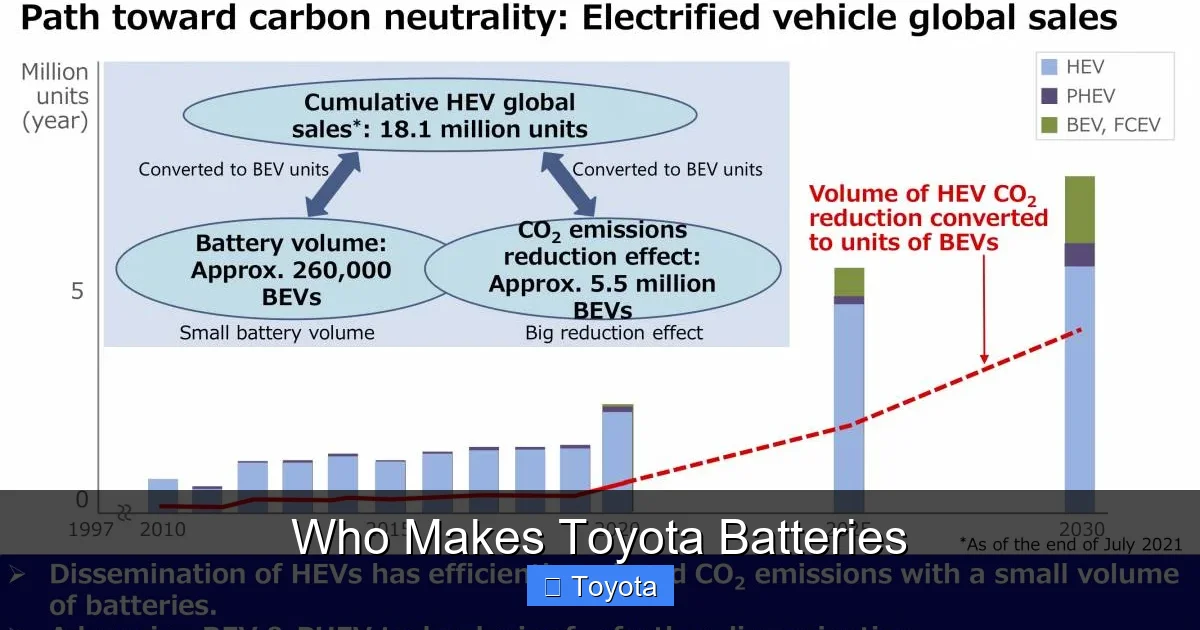
As the automotive industry shifts toward electrification, Toyota is investing heavily in next-generation battery technologies. The company has announced plans to spend over $13 billion on battery development by 2030, with a focus on solid-state batteries, improved energy density, and faster charging.
Solid-State Batteries: The Next Frontier
Solid-state batteries replace the liquid electrolyte in traditional lithium-ion batteries with a solid material, offering several advantages:
– Higher energy density (potentially doubling EV range)
– Faster charging (10–80% in 10–15 minutes)
– Improved safety (no risk of leakage or fire)
– Longer lifespan
Toyota aims to launch vehicles with solid-state batteries by 2027–2028, and Panasonic is expected to be a key partner in this effort.
Sustainability at the Core
Toyota is committed to achieving carbon neutrality by 2050. This includes reducing emissions from battery production, increasing the use of recycled materials, and promoting battery reuse.
The company is also exploring alternative battery chemistries, such as sodium-ion and lithium-sulfur, which could reduce reliance on scarce minerals and lower environmental impact.
Global Expansion and Localization
To meet growing demand, Toyota is expanding its battery production capacity worldwide. New factories are planned in the U.S., Europe, and Southeast Asia, often in partnership with local suppliers.
This localization strategy reduces shipping emissions, supports local economies, and ensures faster delivery of batteries to assembly plants.
Conclusion
So, who makes Toyota batteries? The answer is a network of trusted partners—Panasonic, GS Yuasa, CATL, and Toyota Tsusho—working together to deliver reliable, high-performance power solutions for every Toyota vehicle. From the humble lead-acid battery under the hood of a Corolla to the advanced lithium-ion pack in a bZ4X, each battery is the result of global collaboration, cutting-edge technology, and a commitment to quality.
This partnership model allows Toyota to stay agile, innovative, and sustainable in a rapidly changing industry. By leveraging the strengths of specialized manufacturers, Toyota ensures that every driver—whether in Tokyo, Texas, or Thailand—can count on their vehicle to start, run, and go the distance.
As Toyota continues to electrify its lineup and push the boundaries of battery technology, one thing remains clear: the future of mobility is powered by teamwork, trust, and a shared vision for a cleaner, smarter world.
Frequently Asked Questions
Are Toyota batteries made by Toyota?
No, Toyota does not manufacture all its batteries in-house. Instead, it partners with leading battery producers like Panasonic, GS Yuasa, and CATL to supply high-quality power solutions for its vehicles.
What type of battery does a Toyota Prius use?
The Toyota Prius uses a nickel-metal hydride (NiMH) or lithium-ion (Li-ion) battery, depending on the model year. These batteries are typically supplied by Panasonic through the Blue Energy joint venture.
Can I replace my Toyota battery with any brand?
While you can use aftermarket batteries, it’s recommended to choose Toyota-approved or OEM-equivalent batteries to ensure compatibility, performance, and warranty coverage.
How long do Toyota hybrid batteries last?
Toyota hybrid batteries are designed to last the lifetime of the vehicle, typically 10–15 years or 150,000–200,000 miles, with proper maintenance and normal driving conditions.
Are Toyota EV batteries recyclable?
Yes, Toyota promotes battery recycling and reuse through programs that recover valuable materials like lithium, nickel, and cobalt. Retired batteries are often repurposed for energy storage.
Does Toyota use CATL batteries in the U.S.?
Currently, CATL batteries are primarily used in Toyota EVs sold in China and other Asian markets. Toyota is evaluating their use in other regions as part of its global electrification strategy.