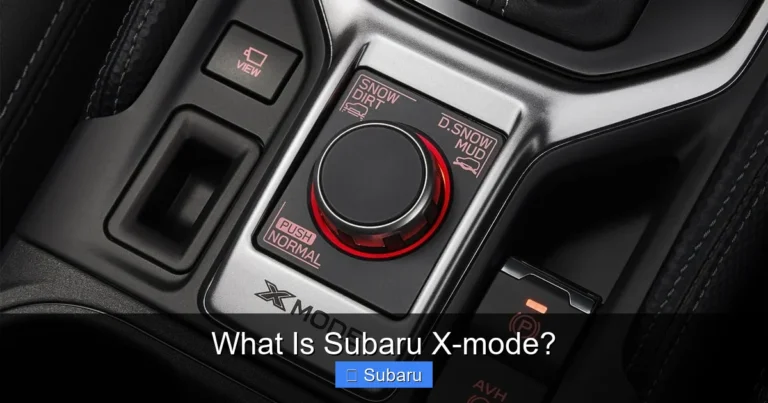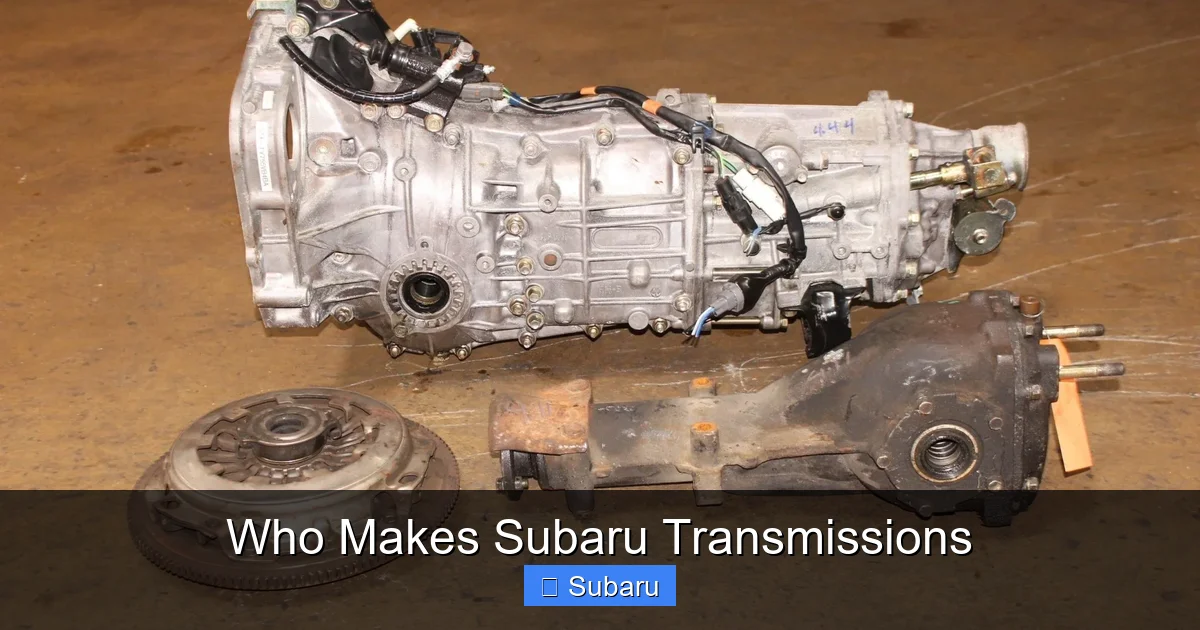
Who Makes Subaru Transmissions

Contents
- 1 Key Takeaways
- 2 Who Makes Subaru Transmissions?
- 3 Subaru’s In-House Transmission Manufacturing
- 4 The Role of JATCO in Subaru’s CVT Lineup
- 5 Evolution of Subaru Transmission Technology
- 6 Maintenance and Longevity of Subaru Transmissions
- 7 Warranty and Repair Options
- 8 Future of Subaru Transmissions
- 9 Conclusion
- 10 Frequently Asked Questions


Subaru transmissions are primarily manufactured by Subaru Corporation itself, with select models using CVTs from JATCO, a Nissan-affiliated supplier. Understanding who makes Subaru transmissions helps owners make informed decisions about maintenance, performance, and longevity.
This is a comprehensive guide about Who Makes Subaru Transmissions.
Key Takeaways
- Subaru builds most of its own transmissions: The automaker designs and manufactures many of its manual and automatic transmissions in-house at its facilities in Japan.
- JATCO supplies CVTs for many Subaru models: Starting in the late 2000s, Subaru partnered with JATCO (a Nissan subsidiary) to provide Continuously Variable Transmissions for fuel-efficient models like the Impreza and Crosstrek.
- In-house development ensures quality control: By producing transmissions internally, Subaru maintains tighter control over performance, reliability, and integration with its signature Symmetrical All-Wheel Drive system.
- CVT technology improves fuel economy: Subaru’s use of CVTs has helped boost fuel efficiency across its lineup without sacrificing the brand’s all-wheel-drive capabilities.
- Regular maintenance is crucial for longevity: Whether it’s an in-house automatic or a JATCO CVT, proper fluid changes and driving habits significantly impact transmission lifespan.
- Subaru offers transmission warranties: Most new Subarus come with a 5-year/60,000-mile powertrain warranty that includes the transmission.
- Aftermarket and remanufactured options exist: For older models, certified rebuilt or remanufactured transmissions are available through Subaru dealers and trusted third-party suppliers.
[FEATURED_IMAGE_PLACEHOLDER]
Who Makes Subaru Transmissions?
If you’ve ever wondered who’s behind the smooth shifts and reliable power delivery in your Subaru, you’re not alone. Subaru has built a reputation for ruggedness, all-weather capability, and driver-focused engineering—and much of that comes down to how the car moves power from the engine to the wheels. At the heart of that system is the transmission, a critical component that often flies under the radar until something goes wrong.
So, who makes Subaru transmissions? The short answer is: mostly Subaru itself. But the full story is a bit more nuanced. While Subaru Corporation designs and manufactures many of its own transmissions—especially its manual gearboxes and earlier automatics—the brand has also partnered with external suppliers for certain technologies, most notably Continuously Variable Transmissions (CVTs). This blend of in-house engineering and strategic partnerships allows Subaru to balance performance, efficiency, and cost across its diverse vehicle lineup.
Understanding who builds these transmissions isn’t just a trivia question—it matters for maintenance, repairs, and long-term ownership. Whether you drive a sporty WRX with a manual gearbox or a fuel-sipping Crosstrek with a CVT, knowing the origins and design philosophy behind your transmission can help you care for it better and make smarter decisions when it’s time for service or replacement.
Subaru’s In-House Transmission Manufacturing
Subaru has a long history of developing its own powertrains, and that includes transmissions. The company’s commitment to vertical integration means it controls much of the engineering and production process internally. This approach gives Subaru greater flexibility to tailor transmissions specifically for its vehicles, especially when it comes to integrating with its signature Symmetrical All-Wheel Drive (AWD) system.
Most of Subaru’s manual transmissions are built in-house at its main manufacturing plant in Ota, Gunma Prefecture, Japan. These include the 5-speed and 6-speed manuals found in models like the Impreza, WRX, and BRZ. Subaru engineers these gearboxes to handle the torque output of their boxer engines while maintaining smooth, precise shifting feel—a hallmark of the brand’s driving dynamics.
For automatic transmissions, Subaru initially relied on traditional torque-converter automatics developed internally. These were used in older models like the Legacy and Outback from the 1990s and early 2000s. These units were known for their durability and compatibility with Subaru’s AWD layout, though they weren’t as fuel-efficient as newer technologies.
One key advantage of in-house production is quality control. Subaru can monitor every stage of transmission development—from design and prototyping to assembly and testing—ensuring consistency and reliability. This also allows for faster updates and improvements based on real-world feedback from customers and technicians.
Why Subaru Builds Its Own Transmissions
There are several reasons Subaru prefers to manufacture its own transmissions rather than outsourcing entirely:
First, integration with AWD systems is critical. Subaru’s Symmetrical All-Wheel Drive is a core part of its brand identity, and the transmission must work seamlessly with the front and rear differentials. By designing both together, Subaru ensures optimal power distribution, traction, and handling—especially in snowy or off-road conditions.
Second, brand consistency matters. Subaru wants every vehicle to deliver a familiar driving experience, whether it’s a compact hatchback or a midsize SUV. In-house transmission development allows engineers to fine-tune shift points, responsiveness, and feel to match Subaru’s “active safety” philosophy—keeping drivers in control at all times.
Third, intellectual property and innovation play a role. Subaru holds numerous patents related to transmission design, especially around AWD integration and boxer engine compatibility. Keeping production internal helps protect these innovations and supports future advancements.
Finally, supply chain reliability is a factor. By controlling production, Subaru reduces dependency on external suppliers, which can be crucial during global disruptions like pandemics or semiconductor shortages.
The Role of JATCO in Subaru’s CVT Lineup
While Subaru builds many of its own transmissions, the story changes when it comes to Continuously Variable Transmissions (CVTs). Starting in the late 2000s, Subaru made a strategic shift toward CVT technology to improve fuel economy and meet tightening emissions standards—without sacrificing the all-wheel-drive capability that defines the brand.
To accelerate this transition, Subaru partnered with JATCO Ltd., a Japanese transmission manufacturer that is majority-owned by Nissan Motor Company. JATCO is one of the world’s largest producers of CVTs and has supplied units to brands like Nissan, Mitsubishi, and Renault. For Subaru, this partnership provided access to proven CVT technology while allowing the automaker to focus on integration and tuning.
The first Subaru models to feature JATCO CVTs included the 2009 Impreza and Forester. These transmissions, known internally as the Lineartronic CVT, were co-developed by Subaru and JATCO. While JATCO handled the core CVT mechanism—the pulleys, belt, and hydraulic controls—Subaru contributed heavily to the software, calibration, and integration with the boxer engine and AWD system.
Today, nearly all non-performance Subaru models—including the Crosstrek, Outback, Legacy, and Ascent—use JATCO-supplied CVTs. These units are branded as “Subaru Lineartronic” to emphasize the collaborative development and Subaru-specific tuning.
How Subaru’s CVT Differs from Standard JATCO Units
It’s important to note that Subaru’s CVTs aren’t off-the-shelf JATCO units. They are custom-built and calibrated specifically for Subaru vehicles. For example:
– Torque capacity: Subaru’s CVTs are reinforced to handle the unique characteristics of boxer engines, which produce smoother but sometimes higher-torque outputs than inline engines.
– AWD compatibility: The transmission is designed to work with Subaru’s viscous coupling or electronic AWD systems, ensuring power is sent to all four wheels efficiently.
– Driving modes: Subaru adds features like “Sport” and “Sport Sharp” modes that simulate stepped gear shifts, giving drivers a more engaging feel—something traditional CVTs often lack.
– Cold-weather performance: Subaru tunes its CVTs to operate reliably in freezing temperatures, a common concern for owners in northern climates.
This level of customization ensures that even though JATCO builds the hardware, the final product feels distinctly “Subaru.”
Evolution of Subaru Transmission Technology
Subaru’s transmission journey reflects broader trends in the automotive industry—shifting from mechanical simplicity to electronic sophistication, all while maintaining core brand values.
In the 1980s and 1990s, Subaru relied heavily on manual transmissions and basic automatics. These were durable and straightforward but lacked the efficiency and refinement of modern systems. As fuel economy became a bigger concern in the 2000s, Subaru began exploring alternatives.
The introduction of the Lineartronic CVT in 2009 marked a turning point. It allowed Subaru to offer improved fuel economy—often 20–30% better than previous automatics—while retaining full-time AWD. Early versions had some reliability issues, particularly with overheating and belt slippage, but Subaru has steadily improved the design over the years.
By the 2010s, CVTs became standard on most Subaru models, except for performance variants like the WRX and STI, which retained manual transmissions (and later, a dual-clutch automatic in the STI). Subaru also introduced EyeSight driver-assist technology, which relies on smooth, predictable transmission behavior—something CVTs excel at due to their seamless acceleration.
More recently, Subaru has focused on enhancing CVT durability and driver engagement. Updates include better thermal management, revised software for quicker response, and simulated shift points to reduce the “rubber band” effect that some drivers dislike.
Manual Transmissions: A Nod to Enthusiasts
Despite the shift to automatics and CVTs, Subaru continues to offer manual transmissions in select models—primarily the WRX, BRZ, and certain Impreza trims. These gearboxes are entirely built in-house and are praised for their crisp shifts and durability.
For driving enthusiasts, the manual remains a key selling point. Subaru’s 6-speed manual, introduced in the 2015 WRX, features shorter throws and improved synchronizers for a more engaging experience. While sales of manuals have declined industry-wide, Subaru has committed to keeping them available as long as there’s demand.
This balance between modern efficiency and driver involvement is a hallmark of Subaru’s engineering philosophy.
Maintenance and Longevity of Subaru Transmissions
Regardless of who makes them, Subaru transmissions require regular care to perform well over time. Proper maintenance can extend the life of both in-house automatics and JATCO CVTs, often beyond 150,000 miles with good habits.
One of the most critical aspects is transmission fluid. Subaru recommends changing the fluid every 30,000 to 60,000 miles, depending on driving conditions. For CVTs, using only Subaru-approved CVTF (Continuously Variable Transmission Fluid) is essential—generic fluids can cause slippage or damage.
Drivers should also avoid excessive towing or aggressive driving in hot climates, as CVTs are more sensitive to heat than traditional automatics. Subaru’s CVTs include thermal sensors and cooling systems, but prolonged stress can still lead to premature wear.
Another tip: warm up your car gently in cold weather. Subaru CVTs have a “cold protection mode” that limits engine speed until the transmission reaches operating temperature. Revving the engine during this phase can cause unnecessary strain.
For manual transmissions, regular clutch inspections and fluid changes (typically every 60,000 miles) help prevent slippage and gear grinding.
Common Transmission Issues and Fixes
While Subaru transmissions are generally reliable, some issues have been reported over the years:
– CVT overheating: Common in older models or during heavy towing. Solution: Install an aftermarket cooler or avoid towing beyond rated capacity.
– Shuddering or hesitation: Often due to old or contaminated fluid. Flushing and refilling usually resolves it.
– Delayed engagement: Can indicate low fluid or solenoid problems. Have a technician diagnose with a scan tool.
– Manual transmission noise: Grinding or whining may point to worn synchros or bearings—best addressed early.
Subaru has issued technical service bulletins (TSBs) for some of these issues, and many can be resolved under warranty if caught early.
Warranty and Repair Options
Subaru backs its transmissions with a strong warranty. New vehicles come with a 5-year/60,000-mile powertrain warranty, which covers the transmission, engine, and drivetrain. Some extended warranties or certified pre-owned programs offer even longer coverage.
If a transmission fails outside warranty, owners have several repair options:
– Dealer service: Most reliable for diagnostics and parts, but often the most expensive.
– Independent Subaru specialists: Many shops specialize in Subaru repairs and offer competitive pricing with OEM or high-quality aftermarket parts.
– Remanufactured transmissions: Subaru offers factory-rebuilt units through its parts network. These come with a warranty and are a cost-effective alternative to new transmissions.
– Used transmissions: Available from salvage yards, but carry higher risk unless thoroughly inspected.
Always use Subaru-approved fluids and filters, even in aftermarket repairs, to maintain performance and avoid voiding any remaining warranty.
Future of Subaru Transmissions
As the automotive world moves toward electrification, Subaru is adapting its transmission strategy. The brand has announced plans to introduce more hybrid and fully electric vehicles in the coming years.
For hybrids, Subaru is likely to use e-CVT systems—similar to Toyota’s Hybrid Synergy Drive—which combine electric motors with planetary gearsets for seamless power delivery. These systems don’t have traditional gears but function like CVTs electronically.
For fully electric models, like the upcoming Solterra SUV (developed with Toyota), transmissions are much simpler. Most EVs use single-speed reducers rather than multi-gear systems, reducing complexity and maintenance needs.
However, Subaru has stated it will continue to offer internal combustion engines—and thus traditional transmissions—for the foreseeable future, especially in markets where EVs aren’t yet practical.
Will Subaru Keep Using JATCO?
It’s likely that Subaru will continue its partnership with JATCO for CVTs, at least in the near term. The two companies have a strong working relationship, and JATCO continues to innovate in CVT technology, including higher torque capacities and improved efficiency.
However, as Subaru develops more hybrids and EVs, the role of traditional transmissions will shrink. The focus will shift to electric drivetrains, battery management, and software integration.
Conclusion
So, who makes Subaru transmissions? The answer is a blend of in-house engineering and strategic partnerships. Subaru Corporation designs and builds most of its manual and older automatic transmissions, ensuring tight integration with its boxer engines and Symmetrical AWD system. For modern CVTs, Subaru relies on JATCO—a trusted supplier with deep expertise in variable transmission technology—while maintaining control over tuning, software, and vehicle integration.
This hybrid approach allows Subaru to deliver vehicles that are fuel-efficient, reliable, and true to the brand’s driving ethos. Whether you’re shifting gears in a WRX or cruising silently in a Crosstrek, the transmission plays a vital role in the Subaru experience.
Understanding who builds these components empowers owners to make informed decisions about maintenance, repairs, and upgrades. With proper care, a Subaru transmission—whether made by Subaru or JATCO—can deliver hundreds of thousands of miles of dependable service.
As Subaru evolves toward electrification, its transmission strategy will change too. But one thing remains constant: a commitment to engineering vehicles that are safe, capable, and fun to drive.
Frequently Asked Questions
Are all Subaru transmissions made by Subaru?
No, not all. While Subaru builds its own manual and some automatic transmissions, many newer models use CVTs supplied by JATCO, a Nissan-affiliated company. These are co-developed and branded as Subaru Lineartronic.
Is JATCO owned by Subaru?
No, JATCO is not owned by Subaru. It is a separate company, majority-owned by Nissan, but it supplies CVTs to multiple automakers, including Subaru, under a partnership agreement.
How long do Subaru CVTs last?
With proper maintenance—especially regular fluid changes—Subaru CVTs can last 150,000 miles or more. Avoiding excessive heat and towing beyond capacity helps extend their lifespan.
Can I use any transmission fluid in my Subaru?
No. Subaru requires specific fluids: CVTF for CVTs and ATF for traditional automatics. Using the wrong type can cause damage and void your warranty.
Does Subaru still offer manual transmissions?
Yes, Subaru still offers manual transmissions in select models like the WRX, BRZ, and certain Impreza trims, appealing to driving enthusiasts.
What happens if my Subaru transmission fails?
If it’s under warranty, Subaru will repair or replace it at no cost. Outside warranty, options include dealer service, independent specialists, or remanufactured units—always use Subaru-approved parts and fluids.