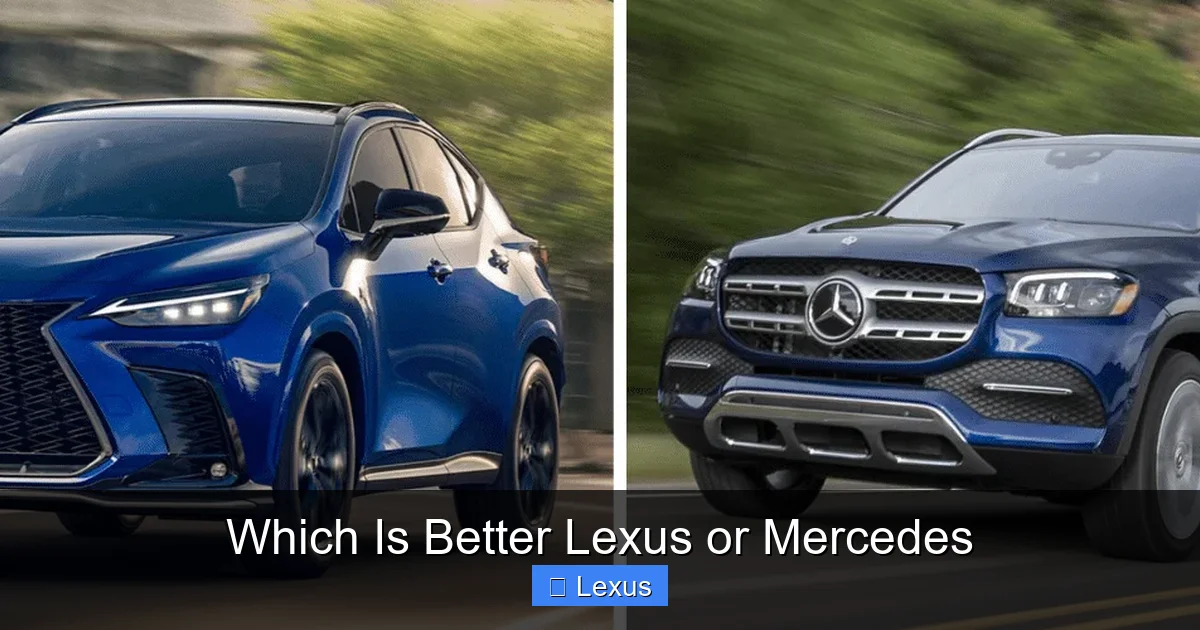
Which Is Better Lexus or Mercedes

Contents
- 1 Key Takeaways
- 2 Introduction: The Luxury Car Dilemma – Lexus vs. Mercedes
- 3 Brand Heritage and Philosophy: What Sets Them Apart
- 4 Reliability and Ownership Costs: The Long-Term View
- 5 Performance and Driving Experience: Thrill vs. Tranquility
- 6 Interior Comfort and Technology: Luxury Redefined
- 7 Fuel Efficiency and Environmental Impact
- 8 Which Is Better for You? Making the Right Choice
- 9 Conclusion: Two Paths to Luxury
- 10 Frequently Asked Questions



Choosing between Lexus and Mercedes comes down to what you value most: Lexus wins on reliability, comfort, and long-term value, while Mercedes excels in performance, cutting-edge tech, and bold styling. Both brands offer exceptional luxury, but your driving priorities will determine which is truly better for you.
This is a comprehensive guide about Which Is Better Lexus or Mercedes.
Key Takeaways
- Lexus prioritizes reliability and low maintenance costs: Known for long-lasting engines and fewer repairs, Lexus vehicles often outlast competitors with minimal issues.
- Mercedes leads in performance and driving dynamics: With powerful engines, sport-tuned suspensions, and advanced handling, Mercedes delivers a more engaging drive.
- Lexus offers superior comfort and quiet cabins: Focused on smooth rides and serene interiors, Lexus excels in daily comfort and long-distance cruising.
- Mercedes boasts more advanced technology and luxury features: From MBUX infotainment to ambient lighting and driver assists, Mercedes pushes innovation further.
- Lexus provides better value retention and lower ownership costs: Higher resale values and affordable maintenance make Lexus a smarter long-term investment.
- Mercedes appeals to those who want prestige and style: With bold designs and a strong brand image, Mercedes attracts drivers who value status and visual impact.
- Both brands offer strong safety ratings and hybrid options: Whether you choose Lexus or Mercedes, you’ll get top-tier safety and eco-friendly models.
[FEATURED_IMAGE_PLACEHOLDER]
Introduction: The Luxury Car Dilemma – Lexus vs. Mercedes
So, you’re in the market for a luxury car. You’ve narrowed it down to two of the most respected names in the game: Lexus and Mercedes-Benz. Both brands scream sophistication, offer plush interiors, and come packed with features that make driving feel like a first-class experience. But which one is truly better? That’s the million-dollar question—well, not quite a million, but close enough when you’re shopping in the premium segment.
It’s easy to get overwhelmed. One brand promises bulletproof reliability and a smooth-as-silk ride. The other delivers heart-pounding performance and a tech-forward cabin that feels like the future. One feels like a trusted companion for long road trips; the other turns heads at every red light. The truth is, there’s no one-size-fits-all answer. The better choice depends on what you value most in a car—whether it’s peace of mind, driving excitement, or cutting-edge innovation.
Brand Heritage and Philosophy: What Sets Them Apart
The Lexus Approach: Reliability Meets Refinement
Lexus, the luxury division of Toyota, launched in 1989 with a simple mission: to challenge European luxury brands by offering superior quality, comfort, and dependability. From day one, Lexus focused on engineering vehicles that would last—vehicles that wouldn’t leave you stranded or buried in repair bills. This philosophy has paid off. Lexus consistently ranks at the top of reliability surveys, including those by J.D. Power and Consumer Reports.
What makes Lexus different is its obsession with detail. Every component is tested rigorously, and the brand’s manufacturing process—known as the Toyota Production System—emphasizes precision and consistency. This isn’t just about avoiding breakdowns; it’s about creating a driving experience that feels effortless. Whether you’re cruising down the highway in an ES sedan or navigating city streets in an NX SUV, Lexus aims to deliver a calm, composed ride.
Lexus also embraces a more understated elegance. Its designs are sleek but not flashy, favoring clean lines and a quiet confidence over bold statements. This appeals to drivers who want luxury without the spotlight. It’s the kind of car you drive because it works flawlessly, not because it shouts for attention.
Mercedes-Benz: The Pioneer of Performance and Prestige
Mercedes-Benz, on the other hand, has been shaping the automotive world since 1886—yes, that’s over 135 years of innovation. As one of the oldest car manufacturers, Mercedes has a legacy of pushing boundaries. It introduced the first production car with an airbag, pioneered anti-lock brakes, and continues to lead in electric mobility with its EQ lineup.
The brand’s philosophy centers on performance, prestige, and progress. Mercedes vehicles are engineered to thrill. Whether it’s the growl of a V8 in an AMG model or the instant torque of an electric EQS, Mercedes prioritizes driving dynamics. The brand’s slogan, “The Best or Nothing,” reflects its commitment to excellence in every detail—from the stitching on the seats to the responsiveness of the steering.
Mercedes also embraces bold design. Its cars often feature aggressive grilles, sweeping curves, and dramatic lighting signatures. This visual flair is part of the brand’s identity. Driving a Mercedes isn’t just about getting from point A to B—it’s about making a statement. It’s for those who want their car to reflect ambition, success, and a taste for the extraordinary.
Reliability and Ownership Costs: The Long-Term View
Lexus: The King of Dependability
If you’re looking for a car that will start every morning without complaint and won’t drain your wallet with constant repairs, Lexus is hard to beat. According to RepairPal, Lexus has an average annual repair cost of around $550, significantly lower than the industry average. In contrast, Mercedes-Benz averages over $900 per year in maintenance and repairs.
This difference adds up over time. A Lexus RX 350, for example, is known to last well beyond 200,000 miles with routine maintenance. Many owners report hitting 300,000 miles with minimal issues. The brand’s hybrid models, like the ES Hybrid and NX Hybrid, are especially durable, thanks to Toyota’s proven hybrid technology.
Lexus also offers competitive warranty coverage. Most models come with a 4-year/50,000-mile basic warranty and a 6-year/70,000-mile powertrain warranty. While not the longest in the industry, it’s backed by a reputation for honoring claims without hassle. Plus, Lexus dealerships are known for excellent customer service, making ownership stress-free.
Mercedes: Performance Comes at a Price
Mercedes vehicles are engineering marvels, but that complexity can lead to higher maintenance costs. The brand uses advanced systems—turbocharged engines, air suspensions, and intricate electronics—that require specialized care. A simple oil change at a Mercedes dealership can cost twice as much as at a Lexus dealer.
That said, Mercedes has improved its reliability in recent years. Models like the C-Class and GLC have become more dependable, though they still lag behind Lexus in long-term surveys. The brand’s warranty is solid: 4 years/50,000 miles for both basic and powertrain coverage. However, out-of-warranty repairs can be expensive, especially for high-performance AMG variants.
One area where Mercedes shines is resale value. While Lexus holds its value well, certain Mercedes models—like the GLE and S-Class—retain a strong market presence due to their prestige. However, this advantage narrows over time, and overall, Lexus tends to have better long-term value retention across its lineup.
Performance and Driving Experience: Thrill vs. Tranquility
Lexus: Smooth, Quiet, and Comfort-First
Lexus doesn’t chase lap times—it chases comfort. The brand’s vehicles are tuned for a relaxed, composed ride. Whether you’re in the midsize IS sedan or the full-size LS flagship, the suspension absorbs bumps effortlessly, and the cabin remains whisper-quiet even at highway speeds.
Engine choices are smooth but not overly aggressive. The 3.5-liter V6 in the RX 350 delivers 295 horsepower—enough for confident merging and passing, but not designed to pin you to your seat. Lexus hybrids, like the UX 250h, prioritize efficiency and refinement over raw power, offering up to 42 mpg in city driving.
That said, Lexus isn’t completely devoid of performance. The F Sport trim adds sport-tuned suspensions, larger wheels, and more responsive steering. The RC F and IS 500 F Sport models pack V8 engines with over 400 horsepower, proving Lexus can deliver excitement when needed. But even these models emphasize balance over brute force.
Mercedes: Precision, Power, and Passion
Mercedes is all about driving engagement. From the agile A-Class to the mighty AMG GT, every model is engineered to feel alive on the road. The brand’s 9-speed automatic transmission shifts seamlessly, and turbocharged engines deliver instant throttle response.
Take the C 300, for example. With 255 horsepower and 273 lb-ft of torque, it accelerates from 0 to 60 mph in just 5.9 seconds—faster than the Lexus IS 300. The GLE 450 SUV offers 362 horsepower and air suspension, blending SUV practicality with sports car-like handling. And then there’s the AMG lineup: the C 63 S, with its 503-horsepower V8, is a track-ready beast that redefines what a luxury sedan can be.
Mercedes also excels in cornering and braking. Models like the E-Class and S-Class feature adaptive dampers and rear-wheel steering, making them surprisingly nimble for their size. The driving experience is dynamic, responsive, and deeply satisfying—especially on winding roads or open highways.
Interior Comfort and Technology: Luxury Redefined
Lexus: Serene Spaces and Intuitive Simplicity
Step inside a Lexus, and you’re greeted by a sense of calm. Materials are top-notch—soft-touch plastics, real wood trim, and premium leather—but the design is functional and uncluttered. The infotainment system, while not the flashiest, is easy to use. The touchpad controller takes some getting used to, but newer models like the RX and NX now feature touchscreens.
Lexus prioritizes comfort above all. Seats are plush and supportive, with multiple adjustments and available heating, cooling, and massage functions. Rear legroom is generous in sedans like the ES and SUVs like the GX. Noise insulation is exceptional, making long drives peaceful and relaxing.
Safety is another strength. Lexus Safety System+ 3.0 comes standard on most models, including adaptive cruise control, lane-keeping assist, and automatic emergency braking. The brand consistently earns top marks from the IIHS and NHTSA.
Mercedes: Cutting-Edge Tech and Opulent Design
Mercedes interiors feel like a futuristic lounge. The MBUX infotainment system is one of the most advanced on the market, with voice control, augmented reality navigation, and over-the-air updates. The optional Hyperscreen—a massive curved display spanning the entire dashboard—is a showstopper.
Materials are equally impressive. Nappa leather, open-pore wood, and ambient lighting with 64 colors create a truly luxurious atmosphere. The seats are deeply bolstered and offer multiple massage programs. Even base models feel rich and refined.
Mercedes also leads in driver assistance. Features like Active Distance Assist and Active Steering Assist make highway driving nearly autonomous. The brand’s Pre-Safe system can detect impending collisions and prepare the cabin by tightening seatbelts and closing windows.
Fuel Efficiency and Environmental Impact
Lexus: Hybrid Leadership
Lexus was an early adopter of hybrid technology, and it shows. Nearly every model in the lineup offers a hybrid variant. The UX 250h gets up to 42 mpg in the city, while the ES 300h achieves 44 mpg combined. These numbers are impressive for luxury vehicles.
The brand is also investing in electrification. The RZ 450e is Lexus’s first fully electric SUV, offering 225 miles of range and dual-motor all-wheel drive. While not as extensive as Mercedes’ EQ lineup, it’s a solid step toward sustainability.
Mercedes: Electrifying the Future
Mercedes is going all-in on electric. The EQ brand includes models like the EQB, EQE, and EQS—each offering over 300 miles of range and rapid charging capabilities. The EQS 450+ can go from 10% to 80% charge in just 31 minutes.
Even gas-powered models are efficient. The C 300 gets 27 mpg combined, and the GLE 350d diesel variant offers 30 mpg on the highway. Mercedes also uses recycled materials in its interiors, supporting its sustainability goals.
Which Is Better for You? Making the Right Choice
So, which is better—Lexus or Mercedes? The answer depends on your priorities.
If you value reliability, low maintenance costs, and a smooth, comfortable ride, Lexus is the clear winner. It’s ideal for daily commuters, families, and long-distance travelers who want a car that just works—year after year.
If you crave performance, cutting-edge technology, and a bold, prestigious image, Mercedes is the way to go. It’s perfect for driving enthusiasts, tech lovers, and anyone who wants their car to make a statement.
Both brands offer exceptional luxury, safety, and innovation. The best choice is the one that aligns with your lifestyle, driving habits, and personal taste. Test drive both. Feel the difference. And remember: the better car isn’t always the flashiest—it’s the one that fits you best.
Conclusion: Two Paths to Luxury
Lexus and Mercedes represent two different visions of luxury. Lexus delivers peace of mind, comfort, and long-term value with understated elegance. Mercedes offers thrilling performance, advanced tech, and bold design with a touch of drama. Neither is universally “better”—they’re just better for different people.
Whether you choose the quiet confidence of a Lexus or the dynamic flair of a Mercedes, you’re getting a world-class vehicle. The real winner? You, the driver, who gets to enjoy the journey in style.
Frequently Asked Questions
Which brand is more reliable, Lexus or Mercedes?
Lexus is generally more reliable than Mercedes. It consistently ranks higher in reliability surveys and has lower average repair costs. Mercedes vehicles are well-engineered but can be more complex and expensive to maintain over time.
Are Lexus cars more fuel-efficient than Mercedes?
Yes, especially in hybrid models. Lexus offers more hybrid options across its lineup and achieves higher fuel economy ratings. Mercedes is catching up with its EQ electric models, but Lexus still leads in traditional hybrid efficiency.
Which has a better infotainment system, Lexus or Mercedes?
Mercedes has a more advanced infotainment system with features like MBUX, voice control, and the optional Hyperscreen. Lexus systems are simpler and more intuitive but lack the high-tech flair of Mercedes.
Do Lexus or Mercedes hold their value better?
Lexus typically has better long-term value retention due to its reputation for reliability. While some Mercedes models retain prestige value, overall, Lexus vehicles depreciate more slowly.
Which brand offers more performance options?
Mercedes offers more performance-oriented models, especially through its AMG division. Lexus has F Sport and V8 options, but Mercedes provides a wider range of high-horsepower, track-focused vehicles.
Is it cheaper to maintain a Lexus or a Mercedes?
Yes, maintaining a Lexus is generally cheaper. Average annual repair costs are significantly lower for Lexus, and parts and labor at dealerships are more affordable compared to Mercedes.