Where Is the Tpms Reset Button on a 2016 Toyota Camry?

Contents
- 1 Key Takeaways
- 2 📑 Table of Contents
- 3 Introduction: That Annoying Little Light on Your Dashboard
- 4 Understanding Your Camry’s TPMS: It’s Smarter Than You Think
- 5 The Exact “Location”: Navigating the Digital Menu
- 6 Troubleshooting: Why Your Reset Might Be Failing
- 7 Maintenance and Best Practices for Your TPMS
- 8 Conclusion: Knowledge is Power (And a Working Dashboard)
- 9 Frequently Asked Questions

Brake Cleaner Spray

LED Indicator Light

Tire Shine Spray

Pressure Washer for Car
The TPMS reset button on a 2016 Toyota Camry is not a traditional “button” at all. It’s a hidden process accessed through the vehicle’s settings menu on the multi-information display using the steering wheel controls. You won’t find a physical button under the dash or in the glove box. The process requires navigating to the “TPMS” or “Tire Pressure” settings and holding the “Set” or “Enter” button on the steering wheel to initiate the reset sequence after adjusting tire pressures.
Key Takeaways
- No Physical Button: The 2016 Camry uses a software-based reset via the steering wheel controls and dashboard display, not a dedicated physical reset button.
- Prerequisite is Correct Pressure: You must inflate all tires, including the spare, to the manufacturer’s recommended PSI before attempting the reset.
- Steering Wheel Controls are Key: The “Set” or “Enter” button on the left side of the steering wheel is used to navigate menus and confirm the reset.
- Process is Menu-Driven: You need to scroll through the Multi-Information Display (MID) settings to find the TPMS registration/learning mode.
- Sensor Communication is Required: The reset tells the car’s computer to “listen” for and learn the signals from your specific tire pressure sensors.
- Driving Re-Learns Sensors: After a successful reset, you must drive for 20-30 minutes at varying speeds for the system to fully recognize all four sensors.
- Persistent Light Means a Problem: If the light returns immediately or won’t reset, a sensor may be faulty, dead, or there’s a system malfunction requiring professional diagnosis.
📑 Table of Contents
- Introduction: That Annoying Little Light on Your Dashboard
- Understanding Your Camry’s TPMS: It’s Smarter Than You Think
- The Exact “Location”: Navigating the Digital Menu
- Troubleshooting: Why Your Reset Might Be Failing
- Maintenance and Best Practices for Your TPMS
- Conclusion: Knowledge is Power (And a Working Dashboard)
Introduction: That Annoying Little Light on Your Dashboard
You’re driving your trusty 2016 Toyota Camry, and suddenly, a small yellow icon that looks like an exclamation point inside a cross-section of a tire illuminates on your dashboard. It’s the Tire Pressure Monitoring System (TPMS) warning light. Your first thought is probably, “Where is the TPMS reset button?” You start checking under the dashboard, near the fuse box, inside the glove compartment—you’ve heard stories about a hidden button. But on your 2016 Camry, you’ll come up empty-handed. That’s because for this model year and many recent Toyotas, the “reset” isn’t a physical button at all. It’s a digital procedure. This can be incredibly frustrating if you’ve just manually corrected your tire pressures and expect a simple press of a button to make the light go away. This guide will walk you through exactly where the reset function is located (it’s in the software!) and, more importantly, how to perform the reset procedure correctly and successfully on your 2016 Camry.
Understanding Your Camry’s TPMS: It’s Smarter Than You Think
Before we hunt for a non-existent button, let’s understand what we’re dealing with. The TPMS in your 2016 Camry is a direct system. This means each wheel has its own small, battery-powered sensor mounted inside the valve stem. These sensors constantly radio the tire pressure and temperature data to the car’s main computer (the ECU). When pressure drops 25% below the recommended level, the system triggers that warning light. It’s a critical safety feature.
Visual guide about Where Is the Tpms Reset Button on a 2016 Toyota Camry?
Image source: knowmyauto.b-cdn.net
The “Reset” is Actually a “Re-Learn” Process
When you adjust your tire pressures, the sensors are still broadcasting their old (low) values until the system is told to update its memory. The “reset” procedure is actually the car’s computer entering a “learn” or “registration” mode. In this mode, it listens for the unique ID signals from each of your four wheel sensors and records their current pressure as the new “normal.” Once it has successfully identified all four sensors within a set time (usually a few minutes of driving), the light should turn off. The process is initiated via the vehicle’s interface, not a button. For specific procedures on other models, you can see how the process varies in our guide for a Nissan Altima, which does have a more traditional button location.
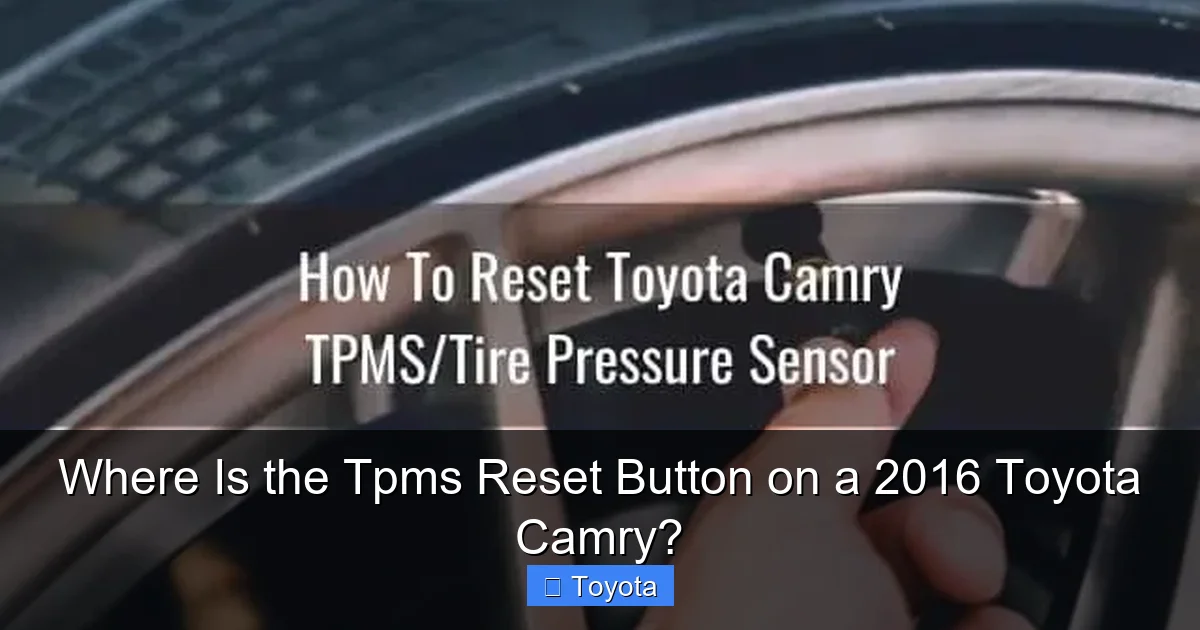
So, where is this magical reset function? It’s housed within the Multi-Information Display (MID) in your gauge cluster. You access it using the buttons on your steering wheel. Here is the precise step-by-step for a 2016 Toyota Camry:

Visual guide about Where Is the Tpms Reset Button on a 2016 Toyota Camry?
Image source: tpmsreset.com
Step 1: Prepare the Vehicle
This is the most critical step and where most people fail. Park your Camry in a safe, level area. Using a tire pressure gauge, manually check and inflate every single tire, including the full-size spare if your model is equipped with one, to the exact pressure listed on the driver’s door jamb sticker (not the number on the tire sidewall!). Common pressures are 32-35 PSI, but always use the sticker’s specification. If pressures are not correct, the reset will fail or the light will return quickly.
Step 2: Access the TPMS Menu
- Turn the ignition to the “ON” position (all dash lights on, but engine off). Do not start the engine yet.
- Using the “▲” (up) or “▼” (down) arrow buttons on the left side of your steering wheel, scroll through the display until you see a screen that says “TPMS” or “Tire Pressure”. It might also show the individual tire pressures.
- Once on that screen, press and hold the central “Set” or “Enter” button (the button with the “OK” or checkmark symbol, or just a plain button in the center of the arrow cluster) for about 3-5 seconds.
Step 3: Initiate the Reset/Learn Mode
After holding the button, the display should change. You might see a message like “TPMS Reset”, “Learnt”, or it might start blinking the tire pressure values. This indicates the system is now in registration mode and is actively listening for the sensor signals. On some models, you may need to scroll to a sub-menu like “Register ID” or “Initialize” before holding the set button. If you see a blinking icon or a message, you’ve successfully entered the mode.
Step 4: Drive to Complete the Process
Once the system is in learn mode, start the engine and drive your Camry normally. You need to drive at speeds above 25 mph (40 km/h) for at least 20-30 minutes. The drive cycle allows the car to receive signals from all four wheel sensors. The TPMS light will typically blink for a few minutes and then turn off once the system confirms all sensor IDs are learned. If the light stays solid after driving, the process was not successful.
Troubleshooting: Why Your Reset Might Be Failing
You followed the steps, but the light is still on or came back on. Don’t panic. Here are the most common culprits:
1. Incorrect Tire Pressure (The #1 Reason)
Double-check every tire, including the spare, with a reliable digital gauge. The pressure must be exact. Even being 1-2 PSI off can prevent the reset. Temperature changes affect pressure too. If it’s very cold outside, the pressure may have dropped since you last filled them.
2. A Dead or Faulty Sensor
TPMS sensors have batteries that last 7-10 years. Your 2016 Camry’s sensors are getting up there in age. If one sensor’s battery is dead, it won’t transmit, and the system can’t learn it. You’ll need a TPMS tool to diagnose which sensor is bad, or a tire shop can scan them. A sensor can also be physically damaged from curb impact or during a tire service.
3. You Have a Spare Tire That’s Not a Full-Size Matching Set
Many Camrys come with a temporary “doughnut” spare. This spare does not have a TPMS sensor. If your Camry is equipped with a temporary spare, you must have all four regular tires mounted and inflated on the car for the reset to work. The system expects four sensor signals.
4. Recent Tire Service or Rotation
If you recently had your tires rotated, the sensor positions have changed. The system needs to be reset to learn the new location of each sensor’s ID. If the shop didn’t do it, you must. The process is the same. Sometimes, after a rotation, a sensor that was low on battery might finally die, causing a new fault.
5. Interference or Proximity
When in learn mode, the car listens for signals from very close range. Make sure you’re not parked next to other vehicles with their own TPMS systems that could cause interference. Perform the reset with your Camry isolated if possible.
6. System Malfunction
Rarely, there can be an issue with the TPMS control module, antenna, or wiring. If you’ve verified correct pressure, have all four good sensors, and the reset still won’t take, you’ll need a professional with a scan tool to diagnose the deeper electronic fault.
Maintenance and Best Practices for Your TPMS
Treating your TPMS right means fewer surprises and a longer lifespan for the sensors.
Always Use a Digital Gauge
The little pencil-style gauges at gas stations are notoriously inaccurate. A good digital tire pressure gauge is a $15-$30 investment that pays for itself in proper maintenance and fuel efficiency. Check pressures monthly and before long trips.
Be Gentle with the Valve Stem
The sensor is housed in the valve stem. When adding air, don’t lean heavily on the valve stem with the air hose nozzle. It can damage the sensitive sensor. Also, when putting on valve caps, screw them on hand-tight. Overtightening can crack the sensor housing.
Understand Sensor Replacement Costs
When a sensor dies (the battery is not replaceable), you must replace the entire sensor unit. A single OEM Toyota TPMS sensor can cost $80-$150 for the part, plus labor to mount and balance it on a wheel. Aftermarket sensors are cheaper but vary in quality and lifetime. Some tire shops offer a “service pack” that includes a new sensor, valve stem, and seal for a flat rate.
Winter is a Critical Time
Colder temperatures cause air to contract, lowering pressure. You’ll see the TPMS light come on more often in fall and winter. This is usually normal. Simply add air to the correct pressure (check when tires are cold) and the light should turn off after driving. If it doesn’t, you likely have a slow leak.
Don’t Ignore a Flashing Light
A solid TPMS light means low pressure. A flashing TPMS light (on for several seconds then off, or continuously blinking) usually indicates a system fault or a sensor that has lost communication. This requires immediate diagnosis. Driving with a flashing TPMS light is not advised.
Conclusion: Knowledge is Power (And a Working Dashboard)
Finding the “TPMS reset button” on your 2016 Toyota Camry is less about physical location and more about knowing the digital path. The process is straightforward once you understand it’s a menu-driven “learn” sequence, not a button press. Remember the golden rule: correct tire pressure is the non-negotiable first step. Without that, no amount of menu navigation will make the light stay off. By following the clear steps to access the TPMS settings via your steering wheel controls and then driving to allow the system to re-learn the sensors, you can regain that clean, worry-free dashboard. If the light persists despite a correct reset, it’s your car’s way of telling you a sensor might be at the end of its life or there’s a deeper issue. In that case, a visit to a tire shop or dealer with a TPMS scan tool is the smart next move. You’ve got this—now go enjoy your Camry with properly inflated tires and a clear dashboard!
Frequently Asked Questions
Why is there no physical TPMS reset button in my 2016 Camry?
Unlike older models or some other brands, your 2016 Camry uses a software-based reset accessed through the steering wheel controls and dashboard display. This is a more modern, integrated approach that also allows the system to re-learn sensor IDs after tire rotations.
Can I reset the TPMS if my spare tire is on the car?
No, you cannot. The system expects signals from four wheel-mounted sensors. If you have a temporary “doughnut” spare that lacks a sensor, the reset will fail. You must have all four regular, sensor-equipped tires mounted and inflated on the vehicle.
My TPMS light came on after I filled my tires. Why won’t it reset?
>The most common reason is that one or more tires is not inflated to the exact pressure listed on your driver’s door jamb sticker. Use a reliable digital gauge to verify all four tires and the spare (if full-size) are precisely at that pressure before attempting the reset again.
How long do I need to drive after initiating the TPMS reset?
You should drive at speeds above 25 mph (40 km/h) for at least 20-30 minutes. This driving cycle allows the car’s computer to receive and confirm the signals from all four tire pressure sensors, completing the learn process.
What does a flashing TPMS light mean versus a solid one?
A solid TPMS light indicates low tire pressure in one or more tires. A flashing light (blinking for several seconds after startup or continuously) indicates a system fault, such as a dead sensor, lost communication, or a malfunction in the TPMS module itself. A flashing light requires immediate professional diagnosis.
How much does it cost to replace a faulty TPMS sensor on a Camry?
Replacing a single TPMS sensor on a Camry typically costs between $150 and $300 total at a tire shop or dealership. This includes the sensor part (which can be $80-$150 for an OEM unit) plus labor for mounting, balancing, and programming the new sensor to the vehicle’s system.