Where Is the Mazda 3 Made?

Contents
- 1 Key Takeaways
- 2 📑 Table of Contents
- 3 The Heart of Mazda: Japanese Manufacturing Legacy
- 4 North American Supply: The Salamanca, Mexico Plant
- 5 Serving Asia-Pacific: The Rayong, Thailand Plant
- 6 The China Factor: Nanjing Production
- 7 Decoding the VIN: How to Find Your Mazda 3’s Birthplace
- 8 Quality, Consistency, and the “Made In…” Debate
- 9 The Road Ahead: Mazda’s Manufacturing Future and the 2026 Mazda 3
- 10 Frequently Asked Questions
Power Steering Fluid

Car Glass Cleaner

LED Emergency Road Flares

Parking Sensor Kit
The Mazda 3 is produced across multiple global facilities to serve regional markets efficiently. As of 2026, primary production occurs in Japan (Hiroshima and Hofu), Mexico (Salamanca), Thailand (Rayong), and China (Nanjing). Your specific Mazda 3’s origin depends on your country of purchase. Japanese-built models are often considered the global benchmark for quality, while plants in Mexico and Thailand focus on the Americas and Asia-Pacific markets respectively. This strategic global footprint allows Mazda to balance cost, logistics, and local market demands while maintaining its core manufacturing philosophy.
So, you’re eyeing a Mazda 3. That sleek design, that engaging drive—it’s a fantastic choice. But have you ever wondered, as you run your hand along its curve, “Where was this car actually made?” The answer isn’t as simple as “Japan” anymore. In today’s global automotive world, the story of where the Mazda 3 is made is a fascinating tale of strategy, economics, and Mazda’s unwavering commitment to quality. Let’s pull back the curtain and explore the global factories that bring this beloved compact car to life, especially as we look toward the 2026 model year.
The Mazda 3, known as the Axela in some markets, has been a cornerstone of Mazda’s lineup for over two decades. Its production journey mirrors Mazda’s own evolution from a regional Japanese automaker to a sophisticated global player. Understanding its origins isn’t just trivia; it offers insight into the car’s character, its value proposition, and the intricate web of modern car manufacturing. We’ll tour the key plants, decode what the VIN tells you, and compare the subtle nuances (and myths) between models from different assembly lines.
Key Takeaways
- Multiple Global Hubs: The Mazda 3 is not made in one place; it’s built in Japan, Mexico, Thailand, and China to supply different world regions.
- Japanese Plants Are Flagships: The Hiroshima and Hofu plants in Japan are Mazda’s historic and most technologically advanced factories, often producing the highest-spec models.
- Regional Market Strategy: Where your Mazda 3 is made directly correlates to where it’s sold—North American models typically come from Mexico, while Australian/Asian models often come from Thailand.
- Uniform Quality Standards: Despite different locations, all Mazda plants adhere to the company’s “Monozukuri” (art of making) philosophy, ensuring consistent build quality and engineering.
- Future Evolution: Mazda’s manufacturing strategy, including the new MX-5 plant, signals a continued focus on flexible, efficient production for its core models like the 3.
📑 Table of Contents
- The Heart of Mazda: Japanese Manufacturing Legacy
- North American Supply: The Salamanca, Mexico Plant
- Serving Asia-Pacific: The Rayong, Thailand Plant
- The China Factor: Nanjing Production
- Decoding the VIN: How to Find Your Mazda 3’s Birthplace
- Quality, Consistency, and the “Made In…” Debate
- The Road Ahead: Mazda’s Manufacturing Future and the 2026 Mazda 3
The Heart of Mazda: Japanese Manufacturing Legacy
To understand where the Mazda 3 is made, you must start in Japan. This is where the brand’s soul resides, and for many enthusiasts, the “Made in Japan” badge carries significant weight. The primary Japanese facilities for the Mazda 3 are:
Hiroshima Plant (Ujina 1 & 2)
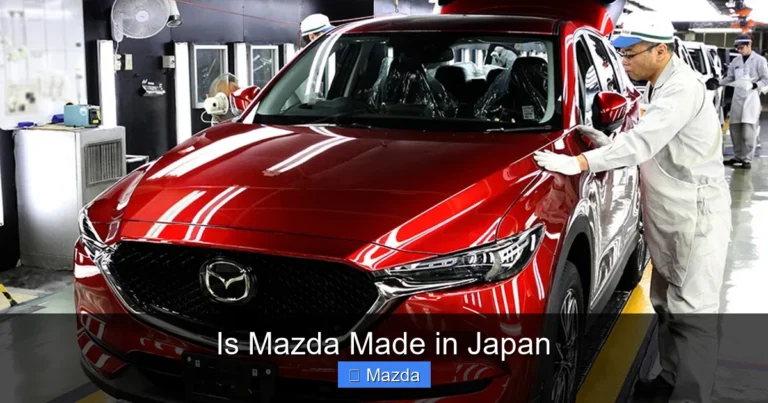
This is hallowed ground. The Hiroshima Plant is Mazda’s headquarters and its most iconic factory. It’s where the very first Mazda 3 (then the Familia/323) was built and where the current generation continues to roll off the line. The Ujina 1 plant is particularly famous for producing Mazda’s premium and high-performance models. While the MX-5 Miata is its star, the Hiroshima plant also handles a significant portion of Mazda 3 production, especially for the domestic Japanese market and for export to regions with stringent quality perceptions. The craftsmanship here is considered the global benchmark. Workers here are often the most senior and experienced, overseeing processes that have been refined for decades.
Hofu Plant (Hofu 1 & 2)
Located in Yamaguchi Prefecture, the Hofu Plant is another critical pillar. Historically, Hofu has been a major engine and transmission plant, but it also has vehicle assembly lines. For the Mazda 3, Hofu has been a key production site for generations. It shares the same rigorous quality control systems as Hiroshima. In the 2026 context, Hofu remains a vital, flexible facility that can adjust production volumes based on global demand fluctuations for the 3 and other models like the CX-5. Its integration with Mazda’s advanced powertrain development is a key strength.
Practical Tip: A Mazda 3 with a VIN starting with “JM” (for the model year range) indicates assembly in Japan. These are the cars often sought after in export markets like the Middle East, Australia, and parts of Asia for their perceived superior fit and finish.
North American Supply: The Salamanca, Mexico Plant
For customers in the United States, Canada, and Mexico itself, your new Mazda 3 most likely comes from one place: Mazda de México Vehicle Operation (MMVO) in Salamanca, Guanajuato. This plant, which opened in 2017, was a monumental move for Mazda.

Visual guide about Where Is the Mazda 3 Made?
Image source: mazda.com.au
Why Mexico?
The decision was driven by several key factors. First, the North American Free Trade Agreement (now USMCA) allowed for tariff-free movement of vehicles between the three countries, making it economically viable. Second, it placed production closer to the largest market for the Mazda 3, reducing shipping times and costs. Third, it provided access to a skilled workforce in a region with a growing automotive manufacturing ecosystem. The Salamanca plant was designed from the ground up using Mazda’s “Monozukuri” philosophy, featuring advanced robotics alongside human craftsmanship. It’s not a “low-cost” plant in the traditional sense; it’s a highly automated, quality-focused facility that mirrors the processes in Japan.
What Does This Mean for Buyers?
Mazda went to great lengths to ensure there is no perceptible quality difference between a Mexican-built Mazda 3 and a Japanese-built one for the North American market. The same stamping presses, welding robots, paint processes, and final assembly inspection protocols are used. The parts sourcing is also globally integrated. Any minor differences are within normal factory tolerances and not region-based. For the 2026 model year, Salamanca is the undisputed source for nearly all Mazda 3s sold in the Americas. This is a point of pride for Mazda, as they successfully transplanted their manufacturing DNA to a new continent.
Comparison Note: This global strategy is similar to other Japanese brands. For instance, you can read about where the Toyota 4Runner is built to see how another iconic model leverages North American production for its core market.
Serving Asia-Pacific: The Rayong, Thailand Plant
Heading east, we find another crucial hub: Mazda’s plant in Rayong, Thailand. This facility, operated by AutoAlliance Thailand (AAT), a joint venture with Ford (which has since sold its stake, but the plant continues), has been producing Mazda vehicles since the late 1990s.

Visual guide about Where Is the Mazda 3 Made?
Image source: motorbiscuit.com
Role in the Mazda 3 Lineup
The Rayong plant primarily serves the Asian, Australian, and some Middle Eastern markets. For the Mazda 3, it has been a long-standing production site. Thailand’s role is multifaceted: it’s a major automotive manufacturing hub for the entire Southeast Asian region, offering logistical advantages and a robust local supply chain. The plant is equipped to produce both front-wheel-drive and, importantly, all-wheel-drive variants of the Mazda 3, which are in high demand in markets like Australia and Canada.
Quality and Perception
Quality at Rayong is held to the same global Mazda standards. However, in some enthusiast circles, a hierarchy of perceived quality exists (Japanese > Mexican > Thai), often based on older stereotypes rather than current reality. Mazda invests heavily in training and technology at all its global plants. A 2026 Mazda 3 from Thailand will be an excellent, well-built car. The differences, if any, would be indistinguishable to 99% of drivers and are more likely related to specific market option packages than assembly plant variances.
Industry Context: Thailand’s automotive industry is fascinating. You might also be curious about where the Subaru Forester is assembled to see how different brands utilize regional manufacturing hubs in Asia.
The China Factor: Nanjing Production
No discussion of global car manufacturing today is complete without China. Mazda has a long-standing joint venture, Changan Mazda, with a major assembly plant in Nanjing.

Visual guide about Where Is the Mazda 3 Made?
Image source: images.carexpert.com.au
Serving the World’s Largest Auto Market
The Nanjing plant’s primary purpose is to supply the massive Chinese domestic market. The Mazda 3 (sold as the Mazda 3 Axela in China) is a critical model for Changan Mazda. The plant is state-of-the-art, incorporating Mazda’s latest manufacturing technologies. It also sometimes serves as an export hub for other Asian and Eastern European countries, depending on trade agreements and demand.
Unique Considerations
Cars built in China for the Chinese market are tailored to local preferences, which can include specific infotainment systems, interior materials, and even minor styling tweaks. For the global Mazda 3 platform, the engineering is identical. The supply chain for Nanjing-sourced cars is more regionally concentrated within Asia. For a buyer outside China, a Nanjing-built Mazda 3 is less common, but it’s important to know it exists as a key pillar of Mazda’s global production network.
Decoding the VIN: How to Find Your Mazda 3’s Birthplace
Curiosity got the better of you? You can absolutely find out where your specific Mazda 3 was assembled. The secret is in the Vehicle Identification Number (VIN), that 17-character code on your dashboard, door jamb, and registration.
The 11th Digit is Your Key
The 11th digit in the VIN is the “plant code.” This single character tells you the assembly plant. While codes can change slightly between model years, the general breakdown for recent Mazda 3s is:
- J: Hiroshima Plant, Japan
- M: Hofu Plant, Japan
- 3: Salamanca Plant, Mexico
- 4: Rayong Plant, Thailand
- L: Nanjing Plant, China (for Changan Mazda)
For a 2026 model, always double-check with an official Mazda source or a trusted VIN decoder for the exact current codes, but this framework holds true. Simply locate your VIN, find the 11th character, and match it to the list. It’s a neat party trick and a surefire way to satisfy your curiosity.
What the VIN *Doesn’t* Tell You
It’s crucial to remember that the plant code does not indicate the origin of every single part. Modern cars are a global mosaic of components. An engine might be built in one country, transmissions in another, and electronics sourced from a third. The VIN’s plant code certifies where the final assembly, welding, painting, and final inspection occurred. The “born-on” date is the day the car rolled off that specific line.
Quality, Consistency, and the “Made In…” Debate
This brings us to the million-dollar question: Does it matter? Is a Japanese-built Mazda 3 inherently better than a Mexican or Thai-built one?
Mazda’s Global Quality Philosophy
Mazda operates on a principle called “Monozukuri,” which translates to “the art of making.” It’s a holistic philosophy that permeates every factory. It emphasizes continuous improvement (Kaizen), meticulous attention to detail, and a deep sense of pride among craftsmen and women. Mazda invests billions in training and technology transfer to ensure this philosophy is identically applied in Salamanca, Rayong, and Nanjing as it is in Hiroshima. They use the same quality control gates, the same paint inspection standards (like their renowned “Three-Wet” process), and the same final audit procedures.
The Reality of Modern Manufacturing
In practice, the variance in build quality between two randomly selected Mazda 3s from different plants is statistically negligible and likely less than the variance between two cars from the same plant on different days. Consumer Reports and J.D. Power initial quality studies often show no significant correlation between a Mazda 3’s assembly plant and its long-term reliability scores. The engineering, the engineering tolerances, and the quality systems are universal. Any perceived differences are almost always psychological, fueled by historical brand perceptions rather than current data.
Prospective Buyer Tip: Instead of focusing on the plant code, focus on the specific vehicle’s history. A well-maintained, low-mileage Mazda 3 from any plant will be a superb car. A neglected, high-mileage example from Hiroshima will be a worse purchase than a pristine one from Salamanca. Always get a vehicle history report and have any used car inspected by a trusted mechanic.
The Road Ahead: Mazda’s Manufacturing Future and the 2026 Mazda 3
Looking toward the 2026 model year and beyond, Mazda’s manufacturing strategy is evolving. While the current Mazda 3 (launched in 2019) is in its mid-life cycle, a significant refresh or next-generation model is on the horizon. This will impact production.
Consolidation and Flexibility
Mazda is continuously optimizing its global footprint. They are investing in making plants more flexible, able to switch between models (like the Mazda 3 and CX-30, which share a platform) based on market demand. This “right-sizing” helps maintain efficiency. There is also talk of potential battery-electric vehicle production lines being integrated into existing plants as Mazda pursues its electrification goals. The plants building the Mazda 3 today are being prepared to potentially build its electrified successors.
The “Japanese-Made” Premium in a Global World
Even as production spreads, the “Made in Japan” label for Mazda’s core sports sedans and coupes (like the MX-5 and potentially a future high-performance Mazda 3 variant) will likely remain a strategic differentiator. For the mainstream, high-volume Mazda 3, the global production network is a permanent and successful reality. The 2026 Mazda 3 you buy will be a product of this intricate global system, engineered in Japan and assembled in the plant best positioned to serve your home market efficiently.
In conclusion, the answer to “Where is the Mazda 3 made?” is a lesson in 21st-century automotive manufacturing. It’s made in Japan, Mexico, Thailand, and China. Your car’s origin is a deliberate business decision, not a marker of quality. The Mazda 3’s brilliance lies in its consistent driving dynamics and design, which Mazda’s global “Monozukuri” philosophy successfully replicates around the world. So, buy with confidence, knowing that regardless of the plant code on your VIN, you’re getting a car built with the same obsessive attention to detail that defines the Mazda brand.
Frequently Asked Questions
Will the 2026 Mazda 3 be made in Mexico?
Yes, for the North American market (USA, Canada, Mexico), the 2026 Mazda 3 will continue to be manufactured at Mazda’s plant in Salamanca, Guanajuato, Mexico. This has been the primary source since the 2018 model year.
Is a Japanese-built Mazda 3 better quality than a Mexican-built one?
No. Mazda applies identical global quality standards and manufacturing processes at all its plants. Extensive testing and owner reviews show no meaningful difference in build quality, reliability, or driving experience between Mazda 3s from Japan, Mexico, or Thailand. Any differences are within normal factory tolerances.
How can I tell where my specific Mazda 3 was assembled?
You can find out by decoding the 11th digit of your Vehicle Identification Number (VIN). Common codes are “J” or “M” for Japan, “3” for Mexico, “4” for Thailand, and “L” for China. You can use an online VIN decoder or consult your owner’s manual for the specific code for your model year.
Why does Mazda build the same car in different countries?
Mazda uses a global manufacturing strategy to reduce shipping costs and tariffs, respond quickly to regional market demands, and hedge against currency fluctuations and trade disruptions. Building cars in or near their primary sales markets is a standard industry practice for efficiency.
Are parts for a Mexican-built Mazda 3 different from a Japanese-built one?
No. Mazda uses a globally standardized parts supply chain. Major components like engines, transmissions, and electronics are sourced from the same suppliers worldwide. Minor clip-on trim or market-specific accessories might differ, but the core engineering parts are identical across all assembly plants.
Will future electric Mazda 3 models be built in the same plants?
Very likely. Mazda is investing in making its existing global plants (like those in Mexico and Thailand) flexible and ready for electrified vehicle production. The same facilities that build the gasoline-powered Mazda 3 today are being prepared to potentially build battery-electric or hybrid variants in the future.