Where Is the Bmw Engine Code Located?

Contents
- 1 Key Takeaways
- 2 📑 Table of Contents
- 3 What Exactly Is a BMW Engine Code?
- 4 Why Knowing Your Engine Code Matters: It’s Not Just a Number
- 5 Where to Look: The Primary BMW Engine Code Locations (The Hunt Begins)
- 6 Model-Specific Variations: A Cheat Sheet by Series
- 7 Decoding the Code: What Do Those Letters and Numbers Actually Mean?
- 8 Tools, Techniques, and Pro Tips for a Successful Hunt
- 9 Troubleshooting: When the Standard Locations Come Up Empty
- 10 Conclusion: Empowerment Through Precise Identification
- 11 Frequently Asked Questions

Car Emergency Roadside Kit

Car Fog Light Bulb

Car Ambient Light Kit

Tire Repair Kit
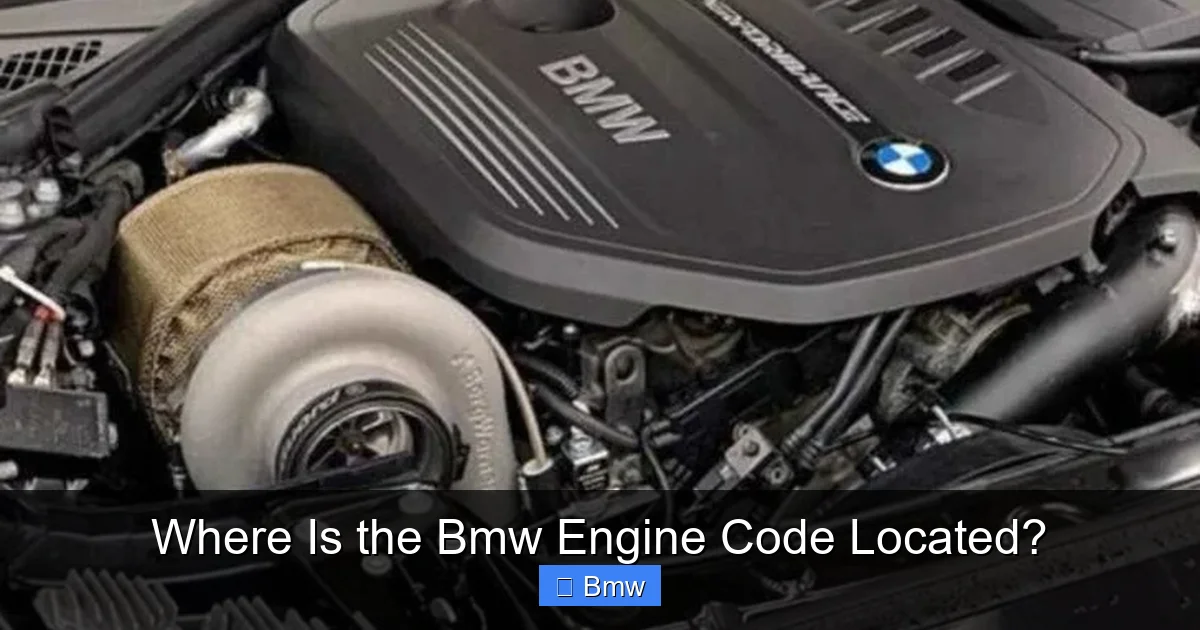
Finding your BMW’s engine code is a crucial skill for any owner, whether you’re ordering parts, diagnosing issues, or verifying your engine’s specifications. This alphanumeric stamp is physically located on the engine block itself, but its precise spot varies significantly across BMW’s model history and engine families. From the side of the block to the cylinder head, we break down every common location, model-specific quirks, and provide practical tips to locate it quickly and decode its meaning.
Key Takeaways
- The engine code is a physical stamp: It is a permanent alphanumeric code (e.g., M54B30, N55B30) machined or stamped directly onto the engine block or cylinder head, not a digital readout.
- Primary location is the engine block: For most modern BMWs (1990s-present), look on the side of the engine block, often near the starter motor or on the front/side of the block’s machined surface.
- Location varies by engine series: The legendary M50/M52, M54, N52, N55, and newer B-series engines all have different, well-documented stamping locations. Knowing your engine family is half the battle.
- It differs from the VIN: The Vehicle Identification Number (VIN) is the car’s unique fingerprint. The engine code is specific to the powerplant. While the VIN can *decoded* to reveal the original engine code, the physical stamp on the engine is the definitive source.
- Cleaning is often required: Engine bays are dirty. Use a degreaser and a brush to clean the suspected area; the code is often obscured by grime, oil, and sludge buildup over years of service.
- Use a mirror and light: A flexible inspection mirror and a bright flashlight are your best friends. The code is frequently stamped in a recessed or hard-to-see area.
- For pre-1980 models, check the block’s top: Very classic BMWs (like early 3.0 CS) often have the code on a machined pad on top of the block, behind the fuel injection system.
📑 Table of Contents
- What Exactly Is a BMW Engine Code?
- Why Knowing Your Engine Code Matters: It’s Not Just a Number
- Where to Look: The Primary BMW Engine Code Locations (The Hunt Begins)
- Model-Specific Variations: A Cheat Sheet by Series
- Decoding the Code: What Do Those Letters and Numbers Actually Mean?
- Tools, Techniques, and Pro Tips for a Successful Hunt
- Troubleshooting: When the Standard Locations Come Up Empty
- Conclusion: Empowerment Through Precise Identification
What Exactly Is a BMW Engine Code?
Before we go hunting, let’s make sure we’re looking for the right thing. Your BMW’s engine code is not the same as the vehicle’s VIN (Vehicle Identification Number). The engine code is a specific, standardized alphanumeric identifier assigned by BMW to a particular engine design, displacement, and technical specification. Think of it as the engine’s model number. For example, the code “N55B30M0” tells you it’s an N55 series engine with 3.0 liters of displacement. This code is physically stamped into the metal of the engine itself, usually by the manufacturer during assembly. It is a permanent, tamper-evident mark.
This is different from the VIN, which is a 17-digit unique serial number for the entire car. You can use a BMW VIN decoder online to find out what engine the car was originally built with, but that’s a theoretical match. The physical engine code is the absolute, irrefutable proof of what’s currently installed in the bay. This becomes critically important if an engine has been swapped, rebuilt with different internals, or if you’re dealing with a car with a complex history. Knowing how to find the BMW engine code location on the physical unit is a non-negotiable skill for serious DIYers, mechanics, and buyers.
Decoding the Format
BMW engine codes follow a logical pattern, though it has evolved. Older codes (pre-1990s) were simpler, like “M30B28” (M30 series, 2.8L). Modern codes are more complex: “B48B20A” tells you it’s a B48 family, 2.0L, with specific output and technology variants (the suffix letters). The prefix indicates the engine family (M, N, B, S, etc.), the numbers indicate displacement, and suffixes denote variants (turbocharged, different output, etc.). Understanding this format helps you interpret what you find.
Why Knowing Your Engine Code Matters: It’s Not Just a Number
You might be thinking, “Can’t I just look at my registration or VIN decoder?” In many cases, yes, for original equipment. But the physical code is king for several critical reasons that directly impact your wallet and your car’s health.

Visual guide about Where Is the Bmw Engine Code Located?
Image source: automotiveglory.com
Ordering the Correct Parts
This is the number one reason. When you need a head gasket, oil pan gasket, timing chain kit, or even specific bolts, the parts catalog will ask for your engine code. An M54B25 and an M54B30, while visually similar, have different displacements, bore/stroke, and internal components. Ordering parts for the wrong variant will lead to returns, wasted time, and a car that sits in the driveway. The engine code is the single most accurate piece of information for parts procurement from dealerships or reputable online suppliers.
Diagnostics and Repair Procedures
Technical Service Bulletins (TSBs) and factory repair manuals are often specific to an engine code. A procedure for fixing a known oil consumption issue on an N52B25 might be different from the one for an N52B30. If you’re troubleshooting a leak, a knock, or a performance issue, knowing your exact engine code allows you to search for the most relevant, proven fixes from the global BMW community and official sources.
Verifying Engine Swaps and Rebuilds
In the used market, you must verify what’s under the hood. A seller might claim it’s an “S52” from an E36 M3, but if the physical code on the block says “M54B30,” it’s not. This is also vital after a major rebuild. A rebuilder might use a different block or long engine with a different code suffix. The physical stamp tells the true story.
Insurance and Theft Recovery
In rare cases of total loss or theft, the engine code can be used as an additional identifier to verify a vehicle’s identity, especially if the VIN plate has been tampered with. It’s a forensic detail that matters to law enforcement and insurance adjusters.
Where to Look: The Primary BMW Engine Code Locations (The Hunt Begins)
Now, to the meat of the matter. The location is not random; it’s stamped on a flat, machined surface of the engine, typically on the block itself. However, BMW has used different spots over decades and across engine families. **Safety first:** Ensure the engine is cool to the touch. Disconnect the negative battery terminal as a precaution, especially if you’ll be working near the starter motor or electrical components.

Visual guide about Where Is the Bmw Engine Code Located?
Image source: shop.bimmertips.com
Location 1: The Side of the Engine Block (Most Common for 1990s-Present)
For the vast majority of BMWs from the E36 3 Series (1990) onward through the F-series chassis today, the engine code is stamped on the side of the block. But “side” is vague. Here’s the drill-down:
- M50/M52 (E36, early E46): Look on the driver’s side (left side in LHD cars) of the block, roughly midway between the cylinder head and the oil pan. It’s often on a slightly recessed, machined rectangular pad. You’ll usually see it from the top of the engine bay if you look down the side of the silver block between the valve cover and the intake manifold.
- M54 (E46, E39, E83 X3): The location is very similar to the M52—driver’s side of the block. It may be slightly lower, closer to where the block meets the oil pan. On the M54, it’s famously stamped on a pad that can be difficult to see without a mirror, often behind or below the exhaust manifold on that side.
- N52 (E90 3 Series, E60 5 Series, E70 X5): This is a common point of confusion. The N52 code is stamped on the **front of the engine block**, on the driver’s side, just behind the serpentine belt pulleys. You often have to look from the top, peering down between the power steering reservoir and the coolant expansion tank. It’s on a vertical surface. A mirror is almost essential.
- N55 (F30 3 Series, F10 5 Series, G01 X3): Very similar to the N52. The code is on the front driver’s side of the block. The exact pad is slightly different but in the same general vicinity behind the belt drive components.
- B48/B58 (Current 2.0L & 3.0L turbo engines): BMW has continued this trend. The code is on the front of the block, driver’s side. On the B48, it’s often on a more prominent, vertically oriented pad that is easier to read than some of its predecessors.
Pro Tip: When searching the side/front of the block, clean a small area with brake cleaner and a wire brush first. The stamp is usually about 1-2 inches long and comprised of raised characters. Use a bright light and a mirror at an angle.
Location 2: The Cylinder Head (Less Common, But Important)
Some BMW engines, particularly certain diesel variants and some early M models, have the engine code stamped on the cylinder head, not the block.
- M47/M57 Diesel Engines: Found in E39 525d, E60 530d, etc. The code is typically on the top of the cylinder head, near the valve cover rail on the driver’s side. It’s often a series of characters that includes the displacement and “D” for diesel.
- S54 (E46 M3): This high-revving inline-6 has its code on the **front of the cylinder head**, on the passenger’s side (right side in LHD). It’s stamped on a machined surface just behind the timing chain housing. This is a famous location for M3 enthusiasts.
- Some Early M10 and M20 Engines: Certain variants may have a secondary or primary stamp on the head. Always check both if you can’t find it on the block.
Key Insight: If you have a diesel BMW or a high-performance M model, prioritize checking the cylinder head. The code format might also include “D” or “S” prefixes to denote the family.
Location 3: The Top of the Block (Classic Era)
For BMWs from the 1970s and 1980s, the classic “shark nose” 3.0 CS, early E21 3 Series, and E28 5 Series with M20/M30 engines, the engine code is almost always on a machined pad on the **top of the engine block**.
You’ll need to remove the air filter housing and possibly some ducting to see it. The pad is usually located behind the fuel injection system (the big black air domes and throttle bodies on M30 engines, or the L-Jetronic components on M20s). It’s a flat surface, often with the code stamped vertically. This location is more accessible than the side on some later models but is hidden by intake components. This is also where you’ll find the engine’s serial number on these older units.
A Quick Note on the VIN Plate
On some very early models (pre-1977), the engine number might be stamped on a separate metal plate riveted to the block, often near the fuel pump. This is rare for models most people are working on today. Do not confuse this with the main VIN plate on the dashboard or door jamb.
Model-Specific Variations: A Cheat Sheet by Series
Knowing your car’s platform can narrow the search dramatically. Here’s a simplified guide. Always cross-reference with your specific engine family (M54, N55, etc.).

Visual guide about Where Is the Bmw Engine Code Located?
Image source: inoxpower.com
E36 (1990-1999 3 Series)
Engines: M40, M43, M50, S50, M52, S52. Primary Location: Driver’s side of the block, midway up. The M50/52 code is on a pad that is somewhat visible from above. The S50/S52 (M3) code is on the block as well, but the head has additional stamps.
E46 (1999-2006 3 Series)
Engines: M43, M54, N46, N52, S54. Primary Location: M54: Driver’s side of block, low and rearward. N46: Front of block, driver’s side. Special Case (M3): S54 code is on the front of the cylinder head, passenger side. This is a critical distinction for E46 M3 owners.
E90/E92 (2006-2013 3 Series)
Engines: N43, N52, N55, S65. Primary Location: N52/N55: Front of block, driver’s side, behind belt components. S65 (V8 M3): The code is on each bank of the V8, on the side of the block near the bellhousing.
F30 (2012-Present 3 Series) & G20 (2019-Present)
Engines: B48, B58, S55. Primary Location: Front of block, driver’s side. The B-series engines have a very consistent, relatively accessible stamping pad here. The turbocharger and intercooler plumbing can make access slightly cramped but it’s the same general area as the N55 it replaced.
X5 (E53, E70, F15, G05)
Varies by generation. E53 (first gen) with M54/M62: block side. E70/F15 with N52/N55: front of block, driver’s side. The engine bay is tight, so a mirror is highly recommended.
Practical Example: Finding the Code on a Common 2015 BMW X3 (F97) with B48 Engine
Open the hood. You’ll see the large black plastic engine cover. Remove it (4-6 Torx screws). You now see the top of the turbocharged 2.0L engine. Look to the far left (driver’s side). You’ll see the coolant reservoir and some wiring. Behind and slightly below these components, on the vertical front face of the silver engine block, is a machined rectangular pad. The code “B48B20A” will be stamped there. It will likely be covered in a light film of oil and dust. Clean it off with a rag and some brake cleaner for clarity.
Decoding the Code: What Do Those Letters and Numbers Actually Mean?
Finding the stamp is victory, but what does it say? Let’s crack the code. The format has standardized over time.
The Modern Formula (N, B, S Series)
Take “N55B30M0”:
- N: Engine family (N = naturally aspirated/turbocharged petrol, B = modular newer family, S = high-performance M division).
- 55: Concept/design number within the family.
- B30: Displacement (B = petrol, 30 = 3.0 liters).
- M0: Variant/update code. “M0” is the first version of the N55. Later versions might be “M1” or have different suffixes indicating different turbochargers, intercoolers, or software maps for different power outputs (e.g., N55B30O0 vs N55B30M0).
A B58 code like “B58B30A” follows the same pattern: B-family, 3.0L petrol, variant “A”.
The Older Formula (M, S Series)
Take “S54B32”:
- S: High-performance engine (M division).
- 54: Design series.
- B32: Petrol, 3.2 liters. Simple and clear.
- BMW VIN Decoders: Websites like bimmer.work or official BMW enthusiast sites have extensive databases. Enter your engine code to get a full breakdown of displacement, power output, torque, redline, and the models it came in.
- RealOEM.com or BMW ETK: The official parts catalogs. Enter your engine code to see exact part numbers and diagrams. This is the professional standard.
- Forums: Communities like BimmerPost and specific model forums (E46Fanatics, F30Post) are treasure troves. Search for your exact engine code. You’ll find discussions about common problems, upgrades, and compatibility.
- Bright LED Flashlight: A powerful, focused light is non-negotiable. A headlamp keeps your hands free.
- Flexible Inspection Mirror: A telescoping mirror with a 2-3 inch head. This is the single most useful tool for seeing behind components and into recessed stamping pads.
- Degreaser & Brushes: Simple Green, brake cleaner, or a dedicated engine degreaser. Use a plastic bristle brush to agitate and wipe away grime. A clean surface reveals the stamp.
- Digital Camera or Smartphone: Take a picture once you find it. Use the zoom. You can enhance the photo later to read faint stamps.
- Gloves: Protect your hands from sharp metal edges and dirt.
- Identify Your Engine Family First: This is the biggest time-saver. Look at your engine bay. Is it a straight-6 with a large plastic intake manifold (M54, N52, N55)? Is it a 4-cylinder (N46, B48)? Is it a V8 (S65, N62)? Is it a diesel (M47, M57)? A quick image search for “BMW [your model year] engine” will tell you the family in seconds.
- Target the Primary Location: Based on your engine family, go straight to the most likely spot (see the cheat sheet above). Don’t just randomly spray degreaser everywhere.
- Clean Methodically: Spray degreaser on a cloth or brush, not directly onto hot engine components (risk of fire if it hits exhaust). Scrub a small area at the suspected location.
- Illuminate and Reflect: Use your flashlight from multiple angles. Use the mirror to see behind the starter (a common hiding spot for M50/M52 codes) or around coolant pipes.
- Trace the Metal: The stamping pad is usually a smooth, flat, machined rectangle amidst the cast-iron or aluminum texture of the block. It stands out visually once you know to look for it.
- If All Else Fails, Consult the Community: Go to a forum for your specific model (e.g., “E90 N52 engine code location”). Upload a photo of your clean engine bay from the suspected angle. Experts will spot it instantly.
- Use Your VIN: The 10th digit of the VIN is the model year, but the entire VIN can be decoded by BMW or a specialist to reveal the original engine code. This is a reliable fallback for stock engines.
- Check the Cylinder Head: Sometimes the head stamp is clearer than the block stamp.
- Professional Machining Shop: In extreme cases, a machine shop might be able to use chemical etching or magnification to recover a worn stamp, but this is rare.
- Assume by Displacement: Measure the bore and stroke if you have the engine out. This is nuclear option last resort.
An “M54B25” is an M-family, 2.5L petrol engine. The “B” always denotes a petrol (gasoline) engine. For diesels, you’ll see a “D” in place of or in addition to the displacement number (e.g., M47D20).
How to Decode It for Certainty
Once you have the code, don’t guess. Use these resources:
Tools, Techniques, and Pro Tips for a Successful Hunt
Armed with knowledge of where to look, here’s how to make the search efficient and successful.
The Essential Toolkit
Step-by-Step Search Strategy
What If the Code Is Worn or Missing?
This happens, especially on high-mileage engines or those that have been steam-cleaned aggressively. If the stamp is too worn to read:
Troubleshooting: When the Standard Locations Come Up Empty
You’ve checked the side of the block, the front of the block, the top of the block, and the head. Nothing. Now what?
Consider the Uncommon Engines
Did you verify your engine family correctly? Some lesser-known engines have odd spots. The M73 V12 (E38 7 Series) has codes on each bank, on the side near the bellhousing. The S85 V10 (E60 M5) has codes on each bank, on the front of the block. If you have a rare engine, you need the specific factory manual.
Access Panels and Covers
On some models, especially the F10 5 Series with the N55, the engine code pad is located behind a small plastic cover or is partially obscured by a bracket for the charge pipe or coolant hoses. You may need to gently move aside a hose or unclip a small heat shield to get a clear view. Never force or remove components you are unsure about.
The “Dealer or Specialist” Card
If you are truly stuck and need absolute certainty for a major repair or purchase, the final arbiter is a BMW dealership’s parts department or a renowned independent BMW specialist. They can look up your VIN and tell you what the engine *should* be. They can also physically inspect it for you. For a fee, this provides peace of mind.
Related Component Checks
While you’re in the engine bay hunting for the code, it’s a great time to perform a quick visual health check. Look for oil leaks around the valve cover gasket (common on M54, N52), coolant leaks from the thermostat housing or water pump, and the condition of belts and hoses. Knowing your engine code helps you find the right gaskets for any leaks you discover. For example, if you find an oil leak on the driver’s side valve cover of an E90, knowing it’s an N52 means you need the specific N52 valve cover gasket, not an M54’s. This connection between identification and maintenance is key.
Conclusion: Empowerment Through Precise Identification
Locating your BMW engine code is more than a trivial pursuit; it’s a fundamental act of ownership and understanding. It transforms you from a driver into an informed custodian of a complex machine. That little stamped alphanumeric string—whether it’s an M54B30 on an E46, an N55B30 in an F30, or a B58B30 in a G20—is the direct link to your engine’s DNA. It unlocks the correct parts, the accurate repair procedures, and the true story of what powers your Ultimate Driving Machine.
The hunt requires patience, the right tools (a light, a mirror, and a brush), and a basic understanding of your engine’s family. Start with the most likely spot based on your model year and engine type. Clean, illuminate, and reflect. Use the vast resources of the BMW community when needed. Once you have that code, you hold a key to a world of precise information, saving you from costly mistakes and empowering you to communicate effectively with mechanics and parts suppliers. So pop that hood, take your time, and claim the knowledge that is rightfully stamped onto your engine.
Frequently Asked Questions
Is the engine code the same as the VIN?
No. The VIN is the car’s unique 17-digit serial number. The engine code is specific to the engine model. The VIN can be decoded to show the *original* engine code, but the physical stamp on the engine is the definitive source for what is currently installed.
Can I find my BMW engine code digitally through the car’s computer?
Not directly. The engine control unit (ECU) stores many parameters, but it does not typically display the physical engine stamp code on the infotainment screen or via the OBD2 port. Some diagnostic tools might show the engine family or type, but for the exact stamped code (like N55B30M0), you must find the physical stamp.
What if my engine code pad is completely covered in grime and rust?
Use a dedicated engine degreaser and a plastic or brass brush to carefully clean the area. For rust, a fine-grit sandpaper (400+ grit) used gently can reveal the stamp without damaging the metal. A mirror and bright light become even more critical after cleaning.
Can an engine code change if the engine has been rebuilt?
Yes, potentially. If the short or long engine block was replaced with a unit from a different donor car or a remanufactured core, the physical stamp on the block will reflect that donor engine’s code. The original car’s VIN would not match the new engine’s code. This is why the physical inspection is vital for used car purchases.
Where is the engine code on a very old BMW, like a 1970s 3.0 CS?
On these classic models with M30 engines, the code is on a machined pad on the **top of the engine block**. You will need to remove the large air filter housing and fuel injection components to access it. It’s stamped vertically on a flat surface.
I found a code, but it doesn’t match what my VIN decoder says. What now?
This discrepancy means the engine in the car is not the original one from the VIN. It has been swapped at some point. You must trust the physical stamp on the engine for all parts ordering and diagnostic purposes. Investigate the car’s history to understand why the swap occurred.