
What Year Is My Toyota Forklift?

Knowing the year of your Toyota forklift is essential for maintenance, parts replacement, and resale value. This guide shows you exactly how to decode the serial number to find your forklift’s manufacturing year—quickly and accurately.
Key Takeaways
- Serial numbers reveal the year: Toyota forklifts use a standardized serial number system that includes the model, year, and production sequence.
- Locate the serial number plate: It’s usually on the forklift’s frame, near the mast, or under the hood—look for a metal or plastic tag with stamped numbers.
- Decode the year code: The 8th digit in most Toyota serial numbers indicates the model year using a letter or number system (e.g., “C” = 2012, “D” = 2013).
- Use Toyota’s online tools: Toyota Material Handling offers resources and customer support to help verify your forklift’s year if decoding is unclear.
- Knowing the year helps with parts and service: Accurate year identification ensures you get the right filters, hoses, and software updates.
- Older models may need special attention: Forklifts made before 2000 may use different serial formats, so double-check with a dealer if unsure.
- Keep records updated: Document your forklift’s year and serial number in your maintenance log for future reference.
📑 Table of Contents
- What Year Is My Toyota Forklift? A Complete Guide
- Why Knowing Your Forklift’s Year Matters
- Where to Find the Serial Number on a Toyota Forklift
- How to Decode the Year from the Serial Number
- Using Toyota’s Official Resources
- Common Mistakes and How to Avoid Them
- Why Accuracy Matters for Maintenance and Safety
- Conclusion
What Year Is My Toyota Forklift? A Complete Guide
If you own or operate a Toyota forklift, you’ve probably asked yourself: “What year is my Toyota forklift?” It’s a simple question, but the answer can have big implications. Whether you’re ordering replacement parts, scheduling maintenance, or preparing to sell your equipment, knowing the exact manufacturing year is crucial. It helps you avoid compatibility issues, ensures safety compliance, and can even affect insurance and resale value.
But here’s the catch: unlike cars, forklifts don’t always have a clearly labeled “model year” sticker. Instead, Toyota embeds the year information within the serial number. That means you need to know where to look and how to decode it. Don’t worry—this isn’t rocket science. With a little know-how, you can figure it out in minutes.
In this guide, we’ll walk you through every step: from locating the serial number plate to decoding the year using Toyota’s official system. We’ll also cover common pitfalls, share real-world examples, and explain why this information matters more than you might think. By the end, you’ll be able to confidently say, “Yes, I know what year my Toyota forklift is—and here’s how I found out.”
Why Knowing Your Forklift’s Year Matters
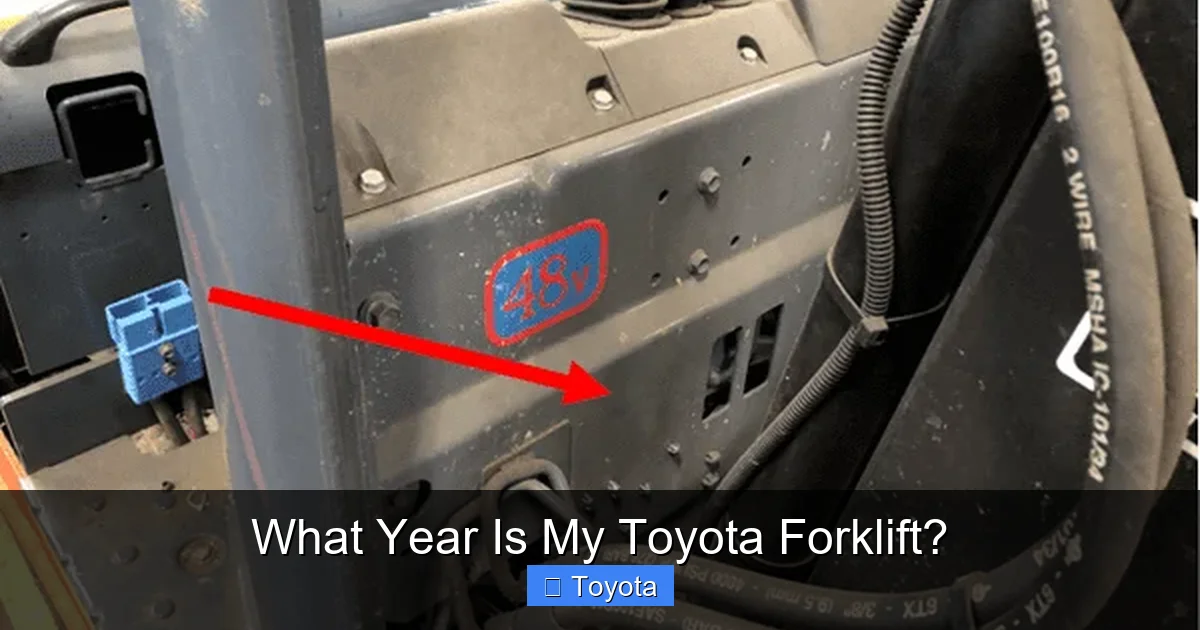
Visual guide about What Year Is My Toyota Forklift?
Image source: conger.com
You might be thinking, “It’s just a year—how important can it be?” The truth is, it’s more important than you realize. The manufacturing year of your Toyota forklift affects nearly every aspect of its lifecycle, from daily operation to long-term value.
First, let’s talk about parts. Forklifts have hundreds of components—hydraulic pumps, control modules, tires, filters, and more. Over the years, Toyota updates designs, improves efficiency, and changes specifications. A fuel filter from a 2010 model might not fit a 2018 version, even if they look similar. If you order the wrong part, you waste time, money, and risk downtime. Knowing the exact year ensures you get the right match the first time.
Second, maintenance schedules vary by model year. Newer forklifts often come with advanced diagnostics and software that require specific service procedures. Older models might need more frequent inspections or different types of lubricants. Your maintenance log should reflect the correct year so technicians know what to check and when.
Third, safety and compliance depend on accurate identification. Regulations change over time. For example, emissions standards for internal combustion engines evolved significantly between 2000 and 2020. If your forklift was made before certain regulations took effect, it may need retrofits or special permits to operate in some facilities. Knowing the year helps you stay compliant.
Finally, resale value is directly tied to age. A 2020 Toyota forklift will fetch a much higher price than a 2005 model, even if both are in good condition. Buyers want to know the year to assess wear, expected lifespan, and compatibility with their fleet. If you can’t provide that info, you might lose serious buyers.
In short, knowing what year your Toyota forklift was made isn’t just helpful—it’s essential. It saves you time, money, and headaches down the road.
Where to Find the Serial Number on a Toyota Forklift
Now that you understand why the year matters, let’s tackle the first step: finding the serial number. This is the key to unlocking your forklift’s manufacturing date.
Toyota forklifts have a serial number plate—a small metal or plastic tag—usually stamped with a series of letters and numbers. This plate is your gateway to all the information you need. But where exactly is it located?
The most common spot is on the forklift’s frame, near the base of the mast. Look along the vertical support structure where the forks extend upward. You’ll often find the plate bolted or riveted to the side, sometimes behind a protective cover. It’s usually about the size of a credit card and may be slightly recessed to prevent damage.
Another frequent location is under the hood or engine cover. If your forklift has a front-opening hood (common on IC models), lift it and check the firewall or the inner side panels. The serial number plate is often mounted there, sometimes near the battery or hydraulic reservoir.
On electric forklifts, the plate might be inside the battery compartment. Open the battery access panel and look around the frame or on the battery tray itself. Some models also place it near the operator’s seat, either on the floor plate or the side console.
If you’re having trouble finding it, don’t panic. Start by consulting your owner’s manual—Toyota often includes a diagram showing the exact location. If you don’t have the manual, you can usually find a PDF version online by searching your model number.
Here’s a quick tip: the serial number is different from the model number. The model number tells you the type of forklift (like “8FGU25”), while the serial number is a unique identifier for your specific unit. You need the serial number to decode the year.
Once you’ve located the plate, take a clear photo or write down the full serial number. It typically looks something like “8FGU25-12345A” or “7BX100-AB12345.” The format varies slightly by model and year, but it always includes a combination of letters and numbers.
Pro tip: If the plate is rusted, faded, or damaged, try cleaning it gently with a wire brush or rubbing alcohol. Sometimes the numbers are still legible underneath. If not, contact a Toyota dealer—they may be able to help identify your forklift using other markings or photos.
How to Decode the Year from the Serial Number
Now comes the fun part: decoding the year from the serial number. Toyota uses a consistent system, but it’s not always obvious at first glance. Let’s break it down step by step.
Most Toyota forklifts made from the 1980s onward use an 8-character serial number format. The key to finding the year lies in the 8th character—the last letter or number in the sequence. This character represents the model year using a coded system.
Here’s how it works:
– Letters A through Z represent years 1980 through 2005 (A = 1980, B = 1981, …, Z = 2005).
– After 2005, Toyota switched to numbers: 6 = 2006, 7 = 2007, 8 = 2008, 9 = 2009.
– Starting in 2010, they used letters again: A = 2010, B = 2011, C = 2012, D = 2013, and so on.
Let’s look at a few real-world examples:
Example 1: Serial number “8FGU25-12345C”
– The 8th character is “C.”
– According to the system, “C” = 2012.
– So this forklift was made in 2012.
Example 2: Serial number “7BX100-AB9876”
– The 8th character is “6.”
– “6” = 2006.
– This forklift was manufactured in 2006.
Example 3: Serial number “8FG20-54321D”
– The 8th character is “D.”
– “D” = 2013.
– This one was made in 2013.
It’s that simple! Just count to the 8th character and match it to the year code.
But what if your serial number is longer or shorter? Don’t worry. Some older models or specialized units may have slightly different formats. In those cases, focus on the last letter or number before any suffixes (like “A” or “B” at the end). That’s usually the year code.
Also, note that this system applies to most Toyota forklifts sold in North America and Europe. If your forklift was imported from another region, the format might vary slightly. When in doubt, contact a Toyota dealer with your serial number—they can verify the year using their database.
One common mistake is confusing the model year with the calendar year. For example, a forklift made in late 2012 might be labeled as a 2013 model. But Toyota’s serial number reflects the actual manufacturing year, not the marketing year. So if your 8th character is “C,” it’s a 2012 model—even if it was sold in early 2013.
Using Toyota’s Official Resources
If decoding the serial number feels confusing or you’re not 100% sure, Toyota offers official tools to help.
The best place to start is the Toyota Material Handling website. They have a customer support section where you can enter your serial number and model to get detailed information about your forklift, including the manufacturing year.
You can also call or email Toyota’s customer service team. Provide them with the full serial number and model, and they’ll look it up in their system. This is especially helpful for older forklifts or units with damaged plates.
Another option is to visit a local Toyota forklift dealer. They have access to proprietary databases and can often identify your forklift just by looking at it. Bring the serial number, photos, and any documentation you have.
Pro tip: Keep a record of your forklift’s year and serial number in a digital file or maintenance log. This makes it easy to reference when ordering parts or scheduling service.
Common Mistakes and How to Avoid Them
Even with this guide, people still make mistakes when trying to determine their forklift’s year. Here are the most common ones—and how to avoid them.
Mistake 1: Using the model number instead of the serial number.
– The model number tells you the type of forklift (like “8FGU25”), not the year. Always use the serial number for decoding.
Mistake 2: Counting from the wrong end.
– The year code is the 8th character from the left, not the right. Count carefully.
Mistake 3: Assuming all letters follow the same pattern.
– Remember, the system changed after 2005. Letters before 2006 represent 1980–2005, but letters after 2010 represent 2010 onward.
Mistake 4: Ignoring suffixes.
– Some serial numbers end with letters like “A” or “B.” These are usually production batch codes, not part of the year. Focus on the 8th character.
Mistake 5: Not verifying with Toyota.
– If you’re unsure, always double-check with a dealer or Toyota support. It’s better to be safe than sorry.
Why Accuracy Matters for Maintenance and Safety
Finally, let’s talk about why getting this right is so important. A small mistake in identifying your forklift’s year can lead to big problems.
Imagine ordering a hydraulic pump for a 2015 model, only to find out your forklift is actually a 2012. The connectors might not match, or the software could be incompatible. You’ve wasted time and money—and your forklift is still down.
Or worse: using the wrong oil or filter because you thought your forklift was newer than it is. This can cause engine damage, reduced performance, or even safety hazards.
Accurate year identification ensures you’re following the correct maintenance schedule, using the right parts, and keeping your forklift safe and efficient. It’s a small step that makes a huge difference.
Conclusion
So, what year is your Toyota forklift? Now you know how to find out. By locating the serial number plate, decoding the 8th character, and using Toyota’s resources when needed, you can quickly and accurately determine your forklift’s manufacturing year.
This information isn’t just a trivia fact—it’s a vital part of ownership. It helps you maintain your forklift properly, order the right parts, stay compliant with regulations, and maximize resale value.
Take a few minutes today to find your serial number and decode the year. Write it down, save it in your records, and share it with your maintenance team. Your future self—and your forklift—will thank you.
Frequently Asked Questions
How do I find the serial number on my Toyota forklift?
The serial number is usually located on a metal or plastic plate near the mast, under the hood, or inside the battery compartment. Look for a stamped tag with a combination of letters and numbers.
What does the 8th character in the serial number mean?
The 8th character represents the model year using a coded system. Letters and numbers correspond to specific years—for example, “C” = 2012 and “6” = 2006.
Can I use the model number to find the year?
No, the model number identifies the type of forklift, not the year. You must use the serial number to decode the manufacturing year.
What if my serial number is damaged or missing?
Contact a Toyota dealer or customer support with photos and details. They may be able to identify your forklift using other markings or records.
Do all Toyota forklifts use the same serial number format?
Most do, but older or imported models may vary. Always verify with Toyota if you’re unsure about the format.
Why is knowing the year important for parts replacement?
Parts are often model- and year-specific. Using the wrong part can cause compatibility issues, damage, or safety risks.
